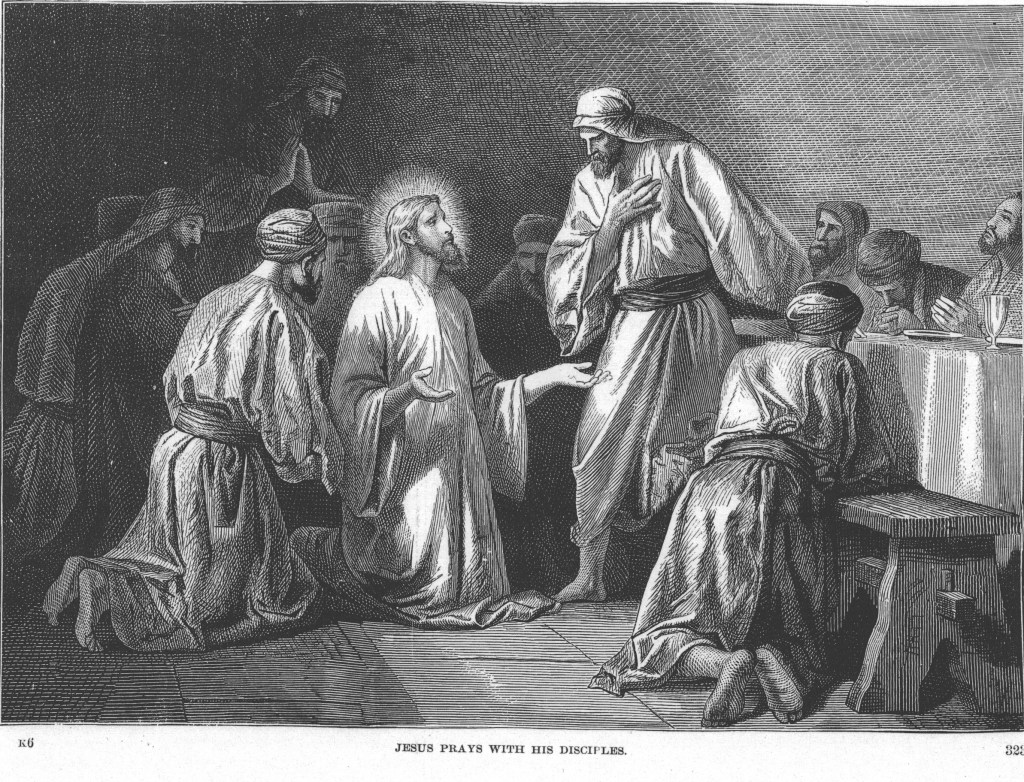
Chapter seventeen closes out the run of teaching by Jesus that John has located between the Last Supper and the walk across the Kidron Valley to the Garden of Gethsemane. In the next chapter, we will begin to move with Jesus through the events of His Passion and Resurrection.
Teaching, however, might not be the best word to describe what is happening here. Yes, Jesus is teaching. But in this instance His teaching has taken the form of a prayer. In fact, the entire chapter is one continuous prayer by Jesus to the Father entitled The High Priestly Prayer.
That gives special context to the effort to enter this scene.
Verse one begins like this: “After Jesus said this, he looked toward heaven and prayed.”
My suggestion is that you do whatever it takes to be able to picture this. Perhaps in your vision Jesus is still sitting at table. Or maybe He is sitting in a circle with eyes riveted on Him. Or maybe He is standing with arms outstretched. However you see it, make sure you see it. The picture above, by French artist Alexandre Bida, might be helpful.
Then read the chapter with this vision in your mind’s eye. Understand that Jesus is praying specifically for you as an individual. At the beginning of verse nine, when He says, “I pray for them,” understand that them is you. He is praying for you expressly as one of those given to Him out of the world by God. This is confirmed at the beginning of verse twenty when He says “My prayer is not for them alone. I pray also for those who will believe in me through their message.” That’s you. You are one of those who believe in Jesus through the message of the gospels and the balance of the New Testament.
Everything that Jesus prays for in this passage applies directly to you. Narrow your vision so that it is just you and Him. Move in as close as you dare. Tune out whatever else might be a distraction in your vision, and focus on the significance of Jesus praying directly for you to God the Father.
In verse eleven, Jesus asks the Father to protect you by the Power of His Name. Then He asks that you may be one as He and the Father are one. In verse fifteen, He asks the Father to protect you from the evil one. In verse twenty-four, He asks that you be with Him in His glory. In the last verse, verse 25, He asks that the love the Father has for Him be given to you, and that He be allowed to be in you always.
Are the immensity and intensity of what Jesus is doing here sinking in yet?
If you are like me, there are times during prayer when you just don’t know what to pray for. There is an uncertainty that only Jesus can fill. In these times, I often ask Jesus to simply pray for me. He knew that I would make this request and this chapter is His answer.
To envision Him, eyes upturned to heaven, arms spread wide, saying these words on my behalf, is the very definition of humbling. How could I ever respond adequately to this scene?
—————————-
John Chapter 17, verses 2 and 3:
“For you granted Him authority over all people that He might give eternal life to all those you have given Him. Now this is eternal life: that they may know you, the only true God, and Jesus Christ, whom you have sent.”
I would be remiss if I did not start by directly linking this verse to our overall theme of immersion in the gospel of John. Again, we go back to paragraph four of the OFS Rule:
Secular Franciscans should devote themselves especially to careful reading of the gospel, going from gospel to life and life to the gospel.
The gospel of John has 21 chapters. We have been reading and reflecting on one chapter a month. By the time we are finished, we will have spent over two years working our way through just this one gospel. Why have we done that? What makes the gospels so important, so central to the life of a Franciscan, that this expenditure of time and effort is justified?
The answer is here. Jesus declares in these two verses that He was born into our world so that each one of us might have the chance to obtain eternal life, to obtain salvation. And then He declares that the key to gaining that eternal life is knowing God and knowing Jesus Christ, whom God sent.
How do we gain that knowing?
We gain it by immersing ourselves in the gospels!
They are our primary source for obtaining the knowing that leads to eternal life!
—————————-
Here is a description by Thomas of Celano of Francis’ understanding about the link between knowledge of God and salvation. This is the entirety of Chapter 68 from The Remembrance of the Desire of a Soul.
Although this blessed man was not educated in scholarly disciplines,
still he learned from God wisdom from above and,
enlightened by the splendors of eternal light,
he understood scripture deeply.
His genius, pure and unstained, penetrated hidden mysteries.

Where the knowledge of teachers is outside,
the passion of the lover entered.
He sometimes read the Sacred Books, and whatever he once put in his mind,
he wrote indelibly in his heart.
His memory took the place of books, because, if he heard something once,
 it was not wasted, as his heart would mull it over with constant devotion.
He said this was the fruitful way to read and learn,
 rather than to wander through a thousand treatises.

He considered a true philosopher the person who never set anything ahead of the desire for eternal life.
 He affirmed that it was easy to move from self-knowledge to knowledge of God for someone who searches scripture intently with humility and not with presumption.
He often untangled the ambiguities of questions.

 Unskilled in words, he spoke splendidly with understanding and power.
In chapter seventeen, Jesus once again brings separation from the world into the conversation. The deeper we get into the gospel of John, the higher the profile of this message becomes. In verse 14, Jesus says “I have given them your word and the world has hated them, for they are not of the world any more than I am of the world.” Other verses in the chapter have similar overtones.
Francis incorporates this part of Jesus’ message into his ideas about knowledge. When Francis speaks about worldly knowledge, it is often with negative connotations. In Chapters 68 and 69 of A Mirror of Perfection, Francis addresses the subject directly. Some of the brothers, in collusion with the Cardinal of Ostia, tried to persuade Francis to adopt a Rule more favorable to scholarly pursuits. Francis responded with this:
“My brothers! My brothers! God has called me by the way of simplicity and humility, and has truly shown me this way for me and for those who want to trust and imitate me. Therefore I do not want you to mention to me any Rule…….or any other way or form of life except the one that the Lord in His mercy has shown and given to me…….God did not wish to lead us by any way other than this knowledge, but God will confound you by your knowledge and wisdom. But I trust in the Lord’s police that through them God will punish you, and you will return to your status, with your blame, like it or not.”
The cardinal was greatly shocked, and said nothing, and all the brothers were greatly afraid.
It grieved blessed Francis when brothers sought learning which inflates while neglecting virtue, especially if they did not remain in the calling in which they were first called. He said, “Those brothers of mine who are led by curiosity for knowledge will find themselves empty handed on the day of reckoning.” ……….. He did not say these things out of a dislike for the reading of Holy Scripture, but rather to draw all of them back from excessive concern for learning.
It’s a stern message. Francis believes what the brothers are asking for will corrupt his religion and jeopardize their chance for eternal life. There is something about worldly knowledge that Francis sees as particularly dangerous to the way of life he is cultivating at the behest of God.
Francis casts worldly knowledge as being in direct conflict with simplicity and humility, which would also place it in direct conflict with the core value of Franciscan Poverty. Recall that Franciscan Poverty is very much a spiritual concept. At its core, it is about removing anything that constitutes worldly distraction from our list of priorities. When we do this, we provide space for heavenly considerations (for the knowledge of God that leads to eternal life) to enter in.
Knowledge “that inflates,” which I think we can read to mean knowledge that is worldly, is just such a distraction from Francis’ point of view, and thus it is to be avoided. Knowledge “that inflates” must never be “set ahead of the desire for eternal life.”
The passage from Celano is not overt, but still the stance against worldly concern is there. Read again the line about “wandering through a thousand treatises.” There is a bit of sarcasm there. Juxtapose it against the instruction to “search scripture intently with humility and not with presumption” and decide for yourself which course you ought to take.
Think of it this way. What good would it do to perfectly understand those thousand treatises if we did not know God at all? What good if we spent all our time studying those treatises and none of it studying scripture? During our earthly sojourn, we might be widely respected for our knowledge. Our knowledge might make us wealthy. It might give us great earthly power. But when our short sojourn on earth is over, and it is time to face judgment, and we do not achieve eternal life because we do not know God, would we not trade all that knowledge, respect, wealth and power for just one chance at salvation?
This is a lesson in Franciscan Poverty. From our modern perspective, we tend to think of knowledge as a supreme good, something to be pursued incessantly for its own sake. But Francis is saying something different. The pursuit of knowledge is not itself the highest good, but instead a distraction unless it is specifically directed toward knowing God for the purpose of achieving salvation. The desire for eternal life supersedes the pursuit of worldly knowledge “that inflates.”
We need Poverty to fight against the tendency toward worldly distraction, even when that distraction comes in the seemingly benign guise of the general pursuit of knowledge.
We need Poverty to help us stay focused on the pursuit of knowing God for the purpose of gaining eternal life.
—————————-
Would you believe me if I told you Lady Poverty herself agrees with Francis?
In The Sacred Exchange between Saint Francis and Lady Poverty there is a paragraph with the title Poverty Warns False Religion. Lady Poverty is addressing “the False Poor.” These are “men who took up the habit of holy religion but did not put on the new man and only covered the old.” They claim Poverty should be set aside so that wealth can be accumulated in order to better serve the needy. But their motivations are corrupted, and the wealth they seek, even if they do use a portion of it to serve the poor, has worldly incentives and ramifications that will inevitably taint their activities.
I said to them: “I am not contradicting the good that you have said, brothers, but I beg you: look at your calling. Do not look back. Do not come down from the housetop to take something from the house. Do not turn back from the field to put on clothing. Do not become involved in the business world. Do not become entangled in the world’s initiatives and the corruption you have fled through knowledge of the Savior. For it is inevitable that those who are again entangled in these affairs will be overcome and their last state will become worse than their first, for under the appearance of piety, they withdraw from that which was given them by holy commandment.”
Francis is arguing that the pursuit of worldly knowledge will have a similar effect on his brothers.
In A Mirror of Perfection, Francis is grieved by those who “did not remain in the calling in which they were first called.” Here, Lady Poverty similarly begs the brothers to “look at their calling.” She wants them to remember first things first. Poverty is the essence of who they are. To reject it would be to reject “knowledge of the Savior” and to “withdraw from that which was given them by holy commandment.” As a result, their “last state will become worse than their first.” They potentially have given up eternal life.
If they forego Poverty, even if they do so for another seeming good, then they are no longer who they claim they wanted to be. They have forfeited their core status and as a result they have rejected knowledge of God and Jesus. That loss of knowledge places their salvation in jeopardy.
The danger lies in not understanding the hierarchy of good. In the Franciscan charism, Poverty is not something that can be traded off against another good. It is foundational. It is sacrosanct. It cannot be compromised.
Poverty gained this status because, as article eleven of the SFO rule says,
“Trusting in the Father, Christ chose for Himself and His mother a poor and humble life.”
Jesus accomplished everything He accomplished from a position of Poverty. As Franciscans, we believe we must do the same. Poverty is not an idea to be embraced or set aside based on human evaluation, but it is instead a grace that Jesus taught us by the very example of His life. Once we understand and accept this, there is no turning back from that truth. We must follow the example of Jesus and live as He lived.
Franciscans who would forsake Poverty on the premise of pursuing another good they deem as equal do not understand the true nature of Franciscan Poverty. Serving the needy and/or gaining knowledge are goods to be carried out, but they do not have equal standing with Poverty. Poverty comes first, and only from a position of Poverty can these other goods be properly pursued, at least if you are a Franciscan.
—————————-
It’s not possible to discuss chapter seventeen of John without talking about the prologue to the SFO Rule, otherwise known as The Exhortation of St. Francis to the Brothers and Sisters of Penance. In that prologue, at the end of the first chapter Francis quotes this chapter of John by paraphrasing the words of Jesus:
O holy Father, protect them with your name whom you gave me out of the world. I entrusted to them the message you entrusted to me and they received it. They have known that in truth I came from you, they have believed it was you who sent me. For these I pray, not for the world. Bless and consecrate them, and I consecrate myself for their sakes. I do not pray for them alone; I also pray for those who will believe in me through their word that they may be holy by being one as we are. And I desire, Father, to have them in my company where I am to see this glory of mine in your kingdom.
Please be aware that an extended version of this language occurs in the Early Rule that Francis wrote for his Brothers. It also occurs in the Fragments, hinting that this was also part of a Rule or Way of Life that has not survived to be passed down to us.
All have been given to Jesus that He might guide them to eternal life. A fortunate few (myself included) have also been given to Francis. Francis feels responsible for those that God has inspired to seek him out as an example and an advocate in their own search for salvation. Francis therefore prioritizes this teaching by Jesus about the path to eternal life by referencing the words of Jesus from this chapter of John in multiple prominent locations.
He wants to ensure that his followers know and understand that the only way to eternal life is “knowing the only true God, and Jesus Christ, the one whom He sent.”
In the process, he specifically references Jesus’ teaching about the distracting nature of the world. He is reinforcing for his followers that the world is an impediment to gaining the knowledge of God and Jesus required for eternal life. By this reference, he brings the entire role of Poverty in the Franciscan charism to the fore of the conversation.
I can’t help but feel that while Francis has quoted the words of Jesus here, it is Francis who is making the prayer on behalf of his followers. His desire that his “Brothers and Sisters of Penance” achieve eternal life and join him in “the company of Jesus in the Kingdom” is so strong that he is forcefully compelled to instruct them on how to do so, but he simply can’t find any words better than this prayer by Jesus. Recognizing that he cannot improve on these words, Francis chooses to repeat them.
In some sense, I feel as if both Francis and Jesus are praying directly for me as an individual. I could enter a scene and see Francis praying for me just the same way I do with Jesus. Francis knows that he is not the source of eternal life, but he so desperately wants his brothers and sisters to join him there that he cannot help but align his prayers for this outcome with those of Jesus. Francis wants to pray for us, but he cannot find any words better than these to use, so he gives them to us as his prayer as well.
—————————-
We are about to move into the final phase of the gospel of John, the Passion of Jesus.
Check this chapter one last time before you move forward. Look at the last three verses. Jesus says “I want those you have given me to be with me……..they know you have sent me. I have made you known to them……..in order that the love you have for me may be in them and that I myself may be in them.”
In John’s gospel, these are the last words Jesus will speak to the disciples before His Passion begins. It’s no accident that they are deeply profound and that they deal with eternal life. The verses from the beginning of the chapter that I have been focusing on have been restated and amplified. When I see Jesus in this scene, the most striking thing is the intensity of His prayer. His desire for my salvation is palpable. I can see Him, as He finishes His prayer and moves to the door to embrace His destiny, looking over his shoulder to make sure I was paying attention and that I got the message.
He wants me with Him for all of eternity!
Francis wants that eternal life for us just as intensely as Jesus does. This is why he quotes these words from Jesus in multiple places as his personal prayer for us as well. Look at his distillation again. He finishes with “And I desire, Father, to have them in my company …….” When I enter the scene with Jesus, it is easy to imagine that Francis enters with me. I can see him looking directly at me to make sure I got it. He also is praying vehemently for my salvation.
Francis wants me with Him for all of eternity!
This makes Francis uncompromising in showing us his way. As the passage from Celano suggests, he “untangles the ambiguities. He speaks splendidly with understanding and power.” The intensity of the desire of Francis for our salvation is demonstrated by the severity of the reaction he had when the brothers suggested a path that probably made perfect sense to them but that he knew to be compromised. He felt the need to make sure they understood his position beyond a shadow of a doubt in order that they would stay the course toward that ultimate prize of salvation.
Immersion in the gospels, combined with and as a result of staying true to the ideal of Franciscan Poverty, is the answer to my greatest hope, that I might achieve salvation when my time on this earth is done. It is a sure path to the knowledge of God that Jesus lays in front of us as the key to eternal life in the chapter.
Living Poverty is not easy. It is often tempting to turn away from it to fulfill this or that earthly desire that seems in the moment to be perfectly reasonable, even pious.
Heeding the words of our Father Francis and staying the course is the key to being a faithful Franciscan, knowing God and Jesus, and achieving the eternal life I so desperately desire.
 OFS Ongoing