Psalm 148
Praise the Lord.
Praise the Lord from the heavens; praise him in the heights above.
Praise him, all his angels; praise him, all his heavenly hosts.
Praise him, sun and moon; praise him, all you shining stars.
Praise him, you highest heavens and you waters above the skies.
Let them praise the name of the Lord, for at his command they were created, and he established them for ever and ever — he issued a decree that will never pass away.
Praise the Lord from the earth, you great sea creatures and all ocean depths,
lightning and hail, snow and clouds, stormy winds that do his bidding,
you mountains and all hills, fruit trees and all cedars,
wild animals and all cattle, small creatures and flying birds,
kings of the earth and all nations, you princes and all rulers on earth, young men and women, old men and children.
Let them praise the name of the Lord, for his name alone is exalted; his splendor is above the earth and the heavens.
And he has raised up for his people a horn, the praise of all his faithful servants, of Israel, the people close to his heart.
Praise the Lord.
In the last two reflections, we looked at the Canticle of the Creatures from the perspective of structure. First, we saw that the Canticle follows the Flow of Creation, starting with God, then proceeding to the heavens, the earth, and man, before returning to God in a circular movement. Next, we looked at the Canticle from the standpoint of the many positive Attributes that Francis assigns to God, God’s creatures, man and death as he moves through the composition.
In this reflection, we will look at the influence that scripture, tradition and prayer had on the Canticle, focusing particularly on the scriptural sources that Francis may have used for inspiration.
At the beginning of Part Four: Christian Prayer, the Catechism quotes St. John Damascene as it gives this definition of prayer: “Prayer is the raising of one’s mind and heart to God or the requesting of good things from God.” Given the exhortations to praise that dominate the Canticle, it is obvious that it meets the first half of that definition and can be understood as prayer itself.
But what is not as obvious is that Francis did not invent a new approach to praise, prayer or Creation with the Canticle. Instead, he was following traditions long established in the history of the Church and the Jewish people.
———
Francis and the entire order were deeply committed to the prayer life of the Church. The recitation of the Divine Office was written into the Rule, so this practice was fully ingrained into the everyday routine of each of the brothers. Francis himself was able to read, but many of the brothers could not, so they would have committed the prayers and readings of the Office to memory. Francis likely did the same. So as he was composing the Canticle, he had a very great wealth of material at hand for reference.
It would have been almost impossible for Francis not to have been influenced by this knowledge as he went about his composition. In a very genuine and authentic sense, his intensive prayer life can be seen as preparation for this final work that the Holy Spirit called him to. At the very least, he would have been subconsciously influenced by the daily repetition of these prayers after his conversion and the creation of the order.
But more likely is that he deliberately recalled and referenced scripture as he went about the composition.
The first piece he might have relied on was Psalm 148, which is given at the opening of this reflection. Review these words alongside the Canticle and note the repeated calls to praise, the circular flow, the mention of the sun, the moon and the stars, the references to the different kinds of weather and the abundance of the earth, and the references to man. The parallels are striking.
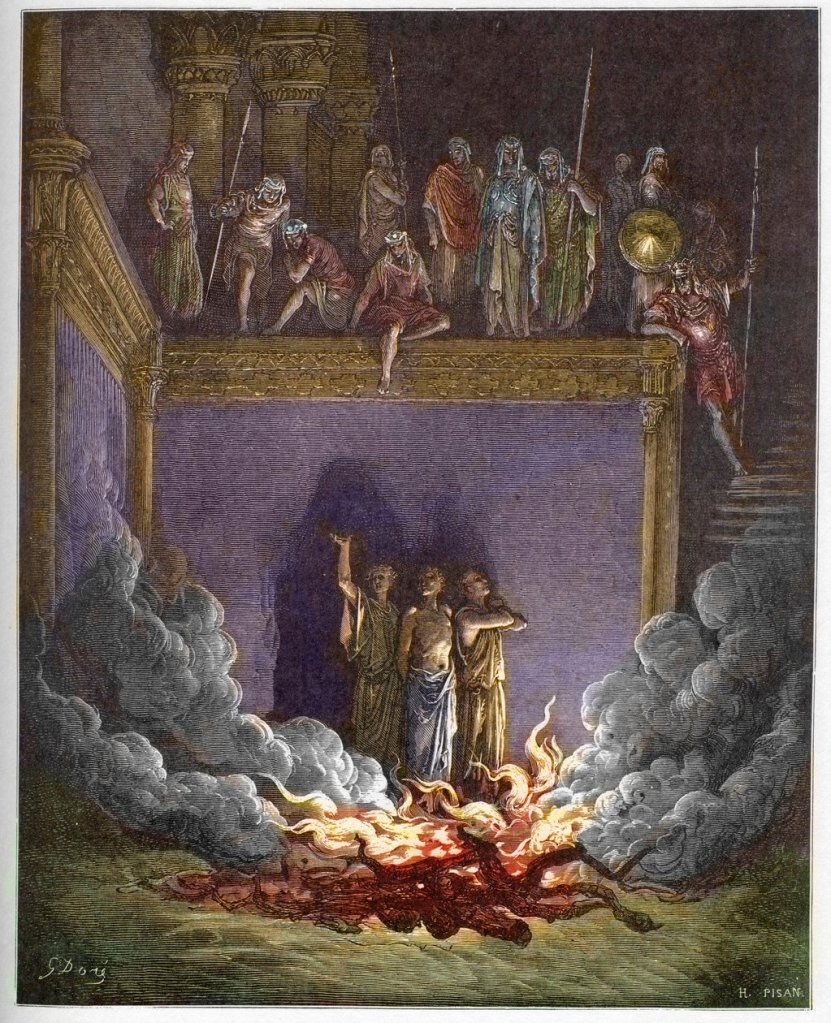
Even more astonishing are the similarities between the Canticle and the third chapter of the book of Daniel. This book relates the story of Shadrach, Meshach, and Abednego, three Jewish leaders during the time of exile in Babylon. King Nebuchadnezzar erected a golden idol and instructed his subjects to worship it. When the three Jewish leaders refused, the King had them cast into a furnace so hot that the retainers who threw them in were consumed by the intense heat themselves. But the three men were preserved by God from the fire and from the midst of the flames they sang a canticle (verses 52-90) that is a much longer, more thorough and more comprehensive version of Francis’ work. You must follow the link and experience their song to fully appreciate how it would have influenced Francis.
———
There are likely many other analogies to scripture that we could reference if we took the time to do the research. (Reference Revelation 2:10-11 for an example.) But the point is already clear that the Canticle was not composed in a void. It was clearly influenced by Francis’ lifetime immersion in scripture, liturgical prayer, and the traditions of the Church. It honors past teachings of the church about prayer, the wisdom and importance of praise, and the nature of Creation, seeking not to displace them but to further enhance and develop them.
This a realization that should strike home in the hearts of every Secular Franciscan.
- The OFS Rule calls on professed Secular Franciscans to immerse themselves in scripture, to honor the traditions of the Church, and to partake in its liturgical activities. Article Four instructs us to go from “gospel to life and life to gospel.” Article Six says we “have been united more intimately with the Church by profession.” Article Eight encourages us to “join in liturgical prayer in one of the forms proposed by the Church.” Given the obvious influence that scripture, tradition and prayer had on Francis’ composition of the Canticle, would it be wise to give greater heed to these sections of the Rule?
- At the end of his life, Francis wrote out this prayer as an exhortation to the members of the Order and the world at large so that the praise of God might take a more central place in the lives of the faithful. Consider carefully what the Holy Spirit is calling you to. Would it be beneficial to journal and write about your own experiences with scripture and prayer so that you might be better able to praise God in the future? Is this a legacy you might want to leave to your loved ones some day? Are you called to follow the example of Francis in this?
 OFS Ongoing
2 thoughts on “Canticle of the Creatures: The Influence of Scripture, Tradition and Prayer”