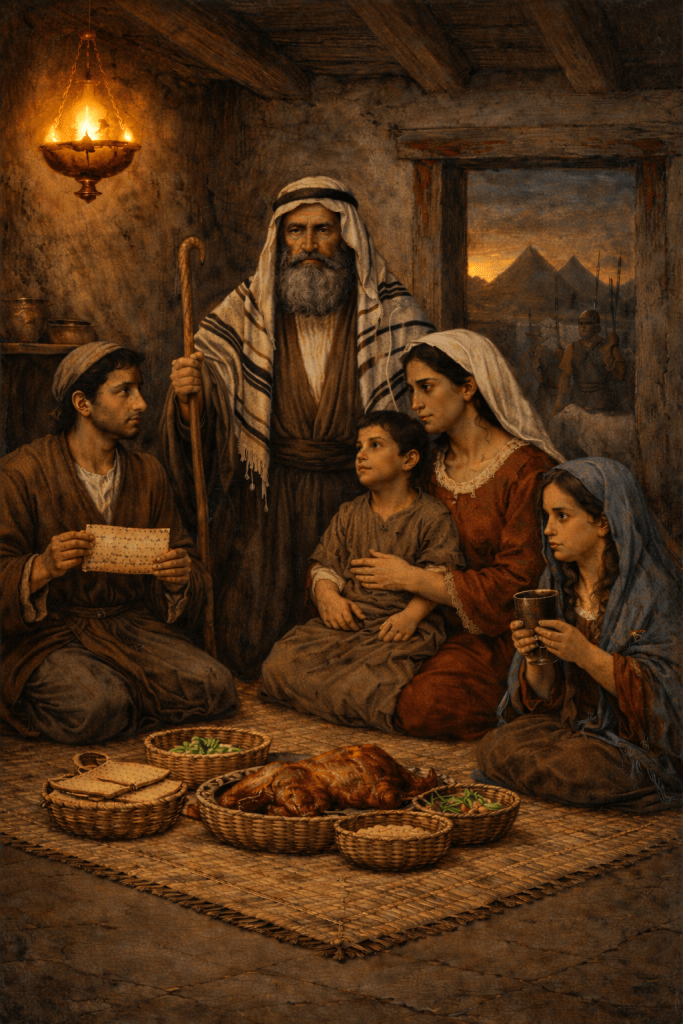
Exodus 12:1-13
The Lord said to Moses and Aaron in Egypt,
“This month is to be for you the first month, the first month of your year. Tell the whole community of Israel that on the tenth day of this month each man is to take a lamb for his family, one for each household. If any household is too small for a whole lamb, they must share one with their nearest neighbor, having taken into account the number of people there are. You are to determine the amount of lamb needed in accordance with what each person will eat.
The animals you choose must be year-old males without defect, and you may take them from the sheep or the goats. Take care of them until the fourteenth day of the month, when all the members of the community of Israel must slaughter them at twilight.
Then they are to take some of the blood and put it on the sides and tops of the doorframes of the houses where they eat the lambs. That same night they are to eat the meat roasted over the fire, along with bitter herbs, and bread made without yeast. Do not eat the meat raw or boiled in water, but roast it over a fire—with the head, legs and internal organs. Do not leave any of it till morning; if some is left till morning, you must burn it.
This is how you are to eat it: with your cloak tucked into your belt, your sandals on your feet and your staff in your hand. Eat it in haste; it is the Lord’s Passover.
On that same night I will pass through Egypt and strike down every firstborn of both people and animals, and I will bring judgment on all the gods of Egypt. I am the Lord. The blood will be a sign for you on the houses where you are, and when I see the blood, I will pass over you. No destructive plague will touch you when I strike Egypt.”
In the last reflection, I shared what the Holy Spirit gave me as I first began to contemplate Easter.
This did not happen immediately. I was struggling. I was not sure where to start. So, despite my continual insistence that separation from the world is the highest possible good, I did what anyone would do these days, and I googled the word Easter.
If you do this, you will find most of what pops up immediately is focused on the Jewish Passover. As I perused this information, I found it interesting, so I want to share. I also think these traditions supply connections that will ultimately help us better understand what is meant by the phrase, the Easter of St. Francis.
—————————
The word Easter is a biblical translation of the word Pascha in Greek. The Greek word in turns comes from the Hebrew (Pesach) and/or the Aramaic (Paskha), which designate the Jewish Festival we know as Passover. Today, most languages still use some derivation of the Greek form when referring to Easter. The English word is most likely taken from the old English name Eostre, who was a pagan goddess whose festival was celebrated in the month of April, which was also known as the Paschal month because it was during this month that Passover was celebrated.
The word Pascha is then the source for terms such as “Paschal Lamb,” “Paschal Candle” and “Paschal Feast.” “Paschal Lamb” originally referred to the lambs described in Exodus 12 (above). As Christians, we adopted “Paschal Lamb” as one of the names we give to Jesus. That appropriation originates in an idea called the “doctrine of salvation by substitution.”
In Exodus, God is seen to be executing his proper role as Judge in his decision to strike down the first born of Egypt. God, through Moses, called on the Egyptians multiple times to free His People from the bonds of slavery. Despite the escalating plagues sent to demonstrate His authority as the one and only God, Pharaoh’s heart remained hardened and he remained defiant. Pharaoh and the Egyptians were guilty of refusing the Will of God, so God is just in judging them accordingly.
In theory, the Jewish people should not be exempt from this judgment. They are sinners as well. Like Pharaoh, they are also regularly guilty of refusing God’s Will. But God, because He is Merciful, allows the Jewish people to substitute unblemished lambs for the Jewish first born that would otherwise have been sacrificed to atone for their sins as part of this judgment.
Despite God’s Mercy, the history of the Jewish people between Exodus and the time of Jesus is filled with wandering from the Will of God. They regularly stray, proving themselves incapable of living into God’s Mercy assiduously. Thus, the Jewish people periodically suffer punishment designed to call them back to the correct way of living. Think of the Babylonian exile and the Roman occupation as examples.
In Christian terms, Jesus becomes the decisive expression of this idea of substitution. The history of the Jewish people demonstrates that the sacrifice of lambs for the forgiveness of sins ultimately proves ineffectual and imperfect. In response, God sends His Son to act as the final substitution, the final sacrifice that will make all other sacrifices unnecessary. Jesus become the perfect unblemished lamb who will be sacrificed to atone for the sins of all men, past, present and future.
Thus Paul, in 1 Corinthians 5:7, is able to write “Get rid of the old yeast, so that you may be a new unleavened batch—as you really are. For Christ, our Passover Lamb, has been sacrificed.” (The reference to getting rid of old yeast is lifted directly from the requirement that all yeast be removed from a Jewish household during the celebration of Passover.)
So we see that there is a legitimate and intimate link between the Jewish Festival of Passover and the Christian celebration of Easter. The first Christians, many of them Jewish by background, did not view the advent of Jesus as cause to disestablish their Jewish heritage. Jesus himself said He came to fulfill the law, not end it, even if he also came to establish a new covenant. In that context, it makes perfect sense that existing Jewish customs be renewed and reinvigorated as part of this new covenant. The fitting of Jesus into the tradition of Passover is an example of this, made possible by the perfect Grace of God in ensuring that such a transition would make seamless sense.
There are other connections to be made as well. They need not be detailed here, but the entire Passion of Christ takes place during the Festival of Passover, the Last Supper is easily seen to be a Seder meal, and the Crucifixion takes place at the exact same time that the Jewish people would have been sacrificing their lambs for their Passover meal.
—————————
All that said, we have yet to discuss the most important parallel between the two stories.
This involves the idea of God acting to redeem his people from suffering.
Exodus opens with the conclusion of the story of Joseph. His brothers, full of jealousy, sell him into slavery. Joseph is taken to Egypt, where he prospers and rises to high station. Eventually, due to a famine, his fathers, brothers and their entire families join him. This marks the beginning of the Jewish nation’s residence in Egypt. In Exodus, the full time of this sojourn is specified as 430 years. Joseph was revered in Egypt during his lifetime, but after his death, his descendants prospered and grew quickly in numbers. This threatened the Egyptians, so, despite their reverence for Joseph, they chose to keep his descendants enslaved to secure their own place in the hierarchy of their society.
By the time of Moses, the number of Jewish people had multiplied so precipitously that the Egyptians began to fear rebellion. In response, Pharaoh ordered the death of every firstborn Hebrew child. Moses is shielded from this fate and adopted by an Egyptian noble. When he comes of age, he kills an Egyptian slaver who is mistreating a Hebrew slave and is forced to flee into the desert to avoid the wrath of Pharaoh. He is taken in by a shepherd family and begins a new life. While tending his father-in-law’s flocks, God speaks to him from a burning bush, telling him He has heard the cries of his afflicted people. God then instructs Moses to return to Egypt to deliver the Jewish nation.
The point of this brief history is to establish Passover as the story of God taking action to liberate his people from oppression. In this story, the oppression is literally slavery. When we move to the story of Easter, we must find similar themes if we are to further the parallels between Passover, the Passion, and the triumph of Easter.
In the time of Jesus, the people of Israel are suffering from the oppression of Rome, but the rescue that God has planned here has nothing to do with an oppressing foreign power. In fact, Jesus ignores all attempts to link Him to freedom from Rome and the physical establishment of an Israeli Kingdom. Instead He talks continually and powerfully about the coming of the Kingdom of God.
The message is that this time, liberation will not be bodily and worldly as it was with the Passover. Instead, deliverance will occur on the spiritual plane. The people will not seek out and occupy an earthly promised land. Instead, those who are faithful to God’s Will are destined to dwell in His ethereal Kingdom. Thus, when questioned by Pilate, Jesus responds with these words: “My kingdom is not of this world. If it were, my servants would fight to prevent my arrest by the Jewish leaders. But now my kingdom is from another place.”
Jesus does not intend to rescue the Jewish people from their Roman oppressors. Earthly deliverance has already been accomplished once, and it did not take. After being liberated from the Egyptians, and despite the Mercy associated with the substitution of lambs for sons, the majority of Jewish people remain obstinate in the face of God’s Will. If they didn’t get the message the first time, why repeat it? In reality, the Jewish leadership has taken the role of Pharaoh to themselves. Those who are faithful need to be rescued from them as much as they do from the Romans.
So God has much bigger plans than a mere second corporeal deliverance. He intends to liberate all people, everywhere, Jewish or not, past, present or future, from the slavery of the ultimate oppressor, that being sin. His act will be singular in the history of the world, not to be repeated, but available in perpetuity for anyone and everyone to live into if they so desire. Anyone who believes now, anyone who believes in the future, and anyone who believed in the past will be redeemed.
History makes it clear that there is no earthly mechanism by which the promise of Passover can be fulfilled, so this time, the action of God will not be physical, but supernatural. In order to establish redemption from suffering once and for all, the Son of God himself will be the sacrifice. He will enter the world mystically when the Virgin conceives. He will not be bound by the normal strictures of death, instead rising from the tomb on the third day. In between, his life will be marked by miracles that will identify Him as both divine and human for anyone willing to believe in the omnipotence of God as Creator.
It is a plan so outrageous that no human being could possibly conceive it. Nor can a human being comprehend it on his own. But God has provided for this as well. Once the Son accomplishes His purpose, God will send the people an Advocate, the Holy Spirit, to help them understand, believe, and remain faithful. This Advocate will always be available to guide them to the Truth if they are only willing to humble themselves enough to ask for His help.
It is an act of redemption and salvation that is above and beyond. It is perfectly constructed to endure.
It could only be conceived by a Love that is completely, exceptionally, and remarkably bountiful and abundant.
Thus Easter completely fulfills and then moves beyond the promise of Passover by not being an earthly or corporeal construction, but instead a divine and supernatural one, an idea capable of lifting God’s people beyond not just earthly suffering, but beyond the suffering of sin and death itself, opening for them the salvation that is eternal life in heaven in the company of the One who makes redemption possible.
—————————
Now, I have a confession. While I believe completely everything the Spirit has revealed to me here, I have no inkling yet how this will tie into the idea of the Easter of St. Francis. I have no idea what the plan will be for the next reflection, nor how many entries there will be in the series, nor how it will all come together.
But I think that Francis would recognize what I have asserted above as fitting and acceptable. If I am right, then the story of the end of his life will live into it. It has to. It just has to be discovered how.
I trust the Spirit. He will bring it all together.
- Were you aware of the links between Passover and Easter? Were any of them new to you? Which ones speak to you? Which do you identify with?
- Hebrews 2:14 says this:
Since the children share in blood and flesh,
Jesus likewise shared in them,
that through death he might destroy the one who has power over death, that is, the Devil,
and free those who through fear of death had been subject to slavery all their life.
Do you understand sin and fear of death to be a form of slavery? Do you believe that the Easter story is capable of delivering you from that slavery?
- Has the Spirit spoken to you about how these first two reflections about the idea of Easter might tie into the story of St. Francis? Did anything from your Franciscan background surface bubble up and speak to you as you read or reflected on this material?
 OFS Ongoing
One thought on “Links Between Easter and Passover”