In the first reflection in this series, I recounted a very intimate experience of the Passion that the Holy Spirit was kind enough to grant me. I closed the main body of that writing with the words, “He (Jesus) has made my hope for eternal salvation possible! This is the Victory of Easter!”
As I began to contemplate where to go after examining the relationship between Passover and Easter in the last post, the Spirit was once again at work. I found myself resisting the idea of proceeding directly to a discussion of the links between what has been presented so far and the notion of the Easter of St. Francis. I still feel as if the details related to the meaning of Easter are not fully flushed out yet. To do that, I need to delve deeper into the idea of Victory.
When we celebrate the Triumph of Christ on Easter Sunday morning, what exactly are we celebrating?
When I asked Chat GPT about that, I got back an answer that expands on the idea of hope I expressed above:
“The Victory of Easter is the foundational Christian belief in Jesus Christ’s Resurrection, representing the ultimate triumph of life over death, light over darkness, and hope over despair. It signifies that Jesus conquered sin, Satan, and death through his sacrifice and rising, offering humanity redemption, forgiveness and the promise of eternal life.”
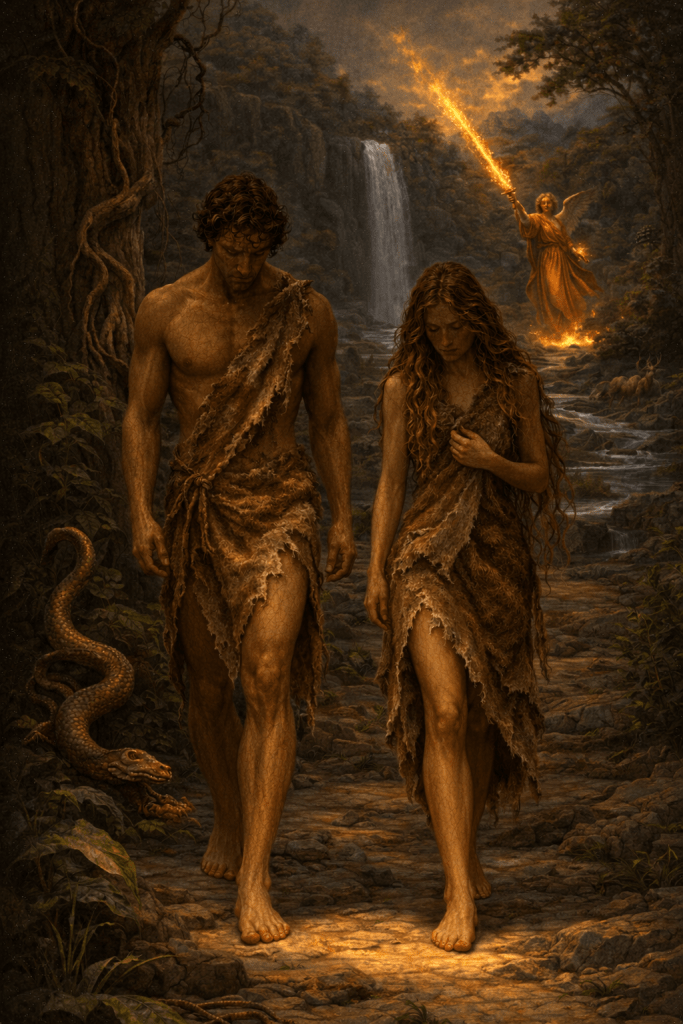
Now, I am not particularly excited about taking direction from AI, but I have to admit that these two sentences give me a clear and concise idea about what to look for next. If “the Victory of Easter is the ultimate Triumph of Life over death, Light over darkness, and Hope over despair,” and also “the conquering of sin, Satan and death,” then it seems to me that my deeper delving should be centered on the concepts of sin and death in the scriptural record. This then leads me back to the very beginning, to the Creation of man, and to the story of the Garden of Eden in the 2nd and 3rd chapters of Genesis.
(Normally my reflections start with a scripture quote. But in this instance, because the quote would require almost the full text of both of those chapters, I will instead provide a series of excerpts that relate the essence of what I am trying to convey.)
———
When I take the time to read those two chapters and reflect upon them, I find myself treated to a basic explanation of the unredeemed human condition. That definition follows these essential steps:
- The Creator (God) Loves His Creature (man) into being.
Genesis 2:7-9: Then the Lord God formed a man from the dust of the ground and breathed into his nostrils the breath of life, and the man became a living being. Now the Lord God had planted a garden in the east, in Eden; and there he put the man he had formed. The Lord God made all kinds of trees grow out of the ground—trees that were pleasing to the eye and good for food. In the middle of the garden were the tree of life and the tree of the knowledge of good and evil. - God the Creator then expresses His Will to man, His Creature.
Genesis 2:16-17: And the Lord God commanded the man, “You are free to eat from any tree in the garden; but you must not eat from the tree of the knowledge of good and evil, for when you eat from it you will certainly die.” - The expression of God’s Will implicitly bestows freedom upon man. This is because freedom enables Love. The act of Creation is an act of Love and the primary responsibility of man is to return that Love. To Love, Man must be free.
Genesis 2:19: Now the Lord God had formed out of the ground all the wild animals and all the birds in the sky. He brought them to the man to see what he would name them; and whatever the man called each living creature, that was its name. - The enemy is introduced. He seeks to subvert this exchange of Love. The primary means for doing this is to encourage the Creature to forgo humility and embrace hubris. Man is urged to seek equality with God. The enemy serves to raise the stakes. When the choice of man is to resist the enemy, the creation of Love is expedited and increased exponentially. When man succumbs to the enemy, the ramifications are severe.
Genesis 3:4-5: “You will not certainly die,” the serpent said to the woman. “For God knows that when you eat from it your eyes will be opened, and you will be like God, knowing good and evil.” - Man yields to the deception of the enemy and uses his freedom to embrace sin rather than Love. Instead of choosing Good, he chooses evil. Man becomes fallen and his essence is stained with the mark of sin. This weakens him immeasurably and with each successive sin he becomes more and more susceptible to the machinations of the enemy, ultimately becoming corrupted in such a way that he can never recover on his own.
Genesis 3:6-7: When the woman saw that the fruit of the tree was good for food and pleasing to the eye, and also desirable for gaining wisdom, she took some and ate it. She also gave some to her husband, who was with her, and he ate it. Then the eyes of both of them were opened, and they realized they were naked; so they sewed fig leaves together and made coverings for themselves. - The context of the story makes it clear that the enemy could have been resisted. Being deceived by the enemy is not a defense against the reality of sin. Despite the efforts of the enemy, the choice for Love is always available and expected. So man, completely responsible for his choices and thus his fate, is rightfully and fairly judged by God. As a result of sin, he is consigned to a life of toil and tribulation.
Genesis 3:17-19: To Adam he said, “Because you listened to your wife and ate fruit from the tree about which I commanded you, ‘You must not eat from it,’“Cursed is the ground because of you;
through painful toil you will eat food from it
all the days of your life.
It will produce thorns and thistles for you,
and you will eat the plants of the field.
By the sweat of your brow
you will eat your food
until you return to the ground,
since from it you were taken;
for dust you are
and to dust you will return.” - On top of the work and hardship, man must also suffer the ultimate consequence of his choice to sin. That consequence, clearly laid out by God at the time His Will was pronounced, is death.
Genesis 3:22-23: And the Lord God said, “The man has now become like one of us, knowing good and evil. He must not be allowed to reach out his hand and take also from the tree of life and eat, and live forever.” So the Lord God banished him from the Garden of Eden to work the ground from which he had been taken.
———
You may believe the story of man’s fall and banishment from the Garden of Eden is literal history and that it actually happened. Or you may believe it is allegory. You may believe “the enemy” is an actual entity that plots against you. Or you may believe “the enemy” is an embodiment of your own wayward tendencies. Whatever you believe, the effect is the same. The Truth about our unredeemed human condition is laid out for us in unmistakable and indisputable terms within this story.
As Catholic’s we call this first sin of Adam Original, but the Truth is I am guilty of my own original sins. Whether or not I believe the sin of Adam was passed down to me, I follow the same pattern as this story and I am subject to the same consequences. I sin, and I suffer damage. That damage weakens me, and I sin again, and I take more damage. And thus I spiral downward, away from Life toward death, away from Light toward darkness, and away from Hope toward despair.
The pattern continues until I find myself in such a state of sinfulness that the best and only word I can use to describe my degeneration is slavery. I am no longer my own master. The enemy that is sinfulness subjugates me and I follow its dictates without considering or understanding the consequences. Sin becomes a habit. It becomes established and routine and I find myself incapable of resisting it on my own.
The worst outcome is I lose control of my ability to choose. Mired in my sinful habits, I do not even bother to make choices anymore. I simply do by rote what has become customary. I am no longer a thinking and discerning being. I have become an automaton operating on autopilot, with neither compass nor conscious to guide me.
As a result, I lose the ability to Love. I am no longer able to return to my Creator the Love that is His due. Shorn of the ability to Love, my life no longer has meaning. Without the clarity and nourishment of Love to sustain me, without the ability and need to Love to animate me, I become lifeless despite the fact that my heart is still beating and my lungs are still pumping. My physical body has not yet succumbed to the rigors of this world, but my spirit has shriveled and shrunken and lies perilously close to becoming permanently lost in the abyss of death.
This is what Paul was talking about in the quote from Hebrews 2:14 that was included in the questions at the end of the last reflection: “Through fear of death I become subject to slavery all of my life.”
In my disassociated state, I suffer a nameless and numbing anxiety. I may not even recognize my condition as a state of fear, but a proper examination of my anxiety reveals it to be a fear of sinfulness and the permanence of the death that will result if I cannot shake my detachment and find my way back to a life centered in the healthiest of fears, a fear of God.
My waking mind is in a state of confusion and apathy, but my subconscious recognizes the danger. So long as I remain a slave to my sinfulness, then the only possible outcome is a death that is not just physical, but eternal. My soul fears this form of death even if my withdrawn intellect and consciousness are not immediately aware of it. My soul is in conflict with my intellect and I find myself paralyzed, compromised and rudderless.
“The worries of this life, the deceitfulness of wealth and the desires for other things come in and choke the word, making it unfruitful.” (Mark 4:19) Left unchecked, my failing will becomes so immersed in the world, and thus so distant from God my Savior, that Hope is legitimately lost, just as Jesus taught it would be in the Parable of the Sower.
———
This, sadly, is the state of many people in the culture we live in right now. Sinfulness, rooted in worldliness, has become the pre-eminent force shaping our entire cultural experience. It also then becomes the root of the rampant and unbridled division we are currently suffering.
Half of us embrace secular humanism to such an extent that the enemy can legitimately claim victory (small v) where those lives are concerned. These are people who have bought in entirely to the falsehood uttered by the serpent in the Garden. They believe themselves not to be like God, but to be God, not only capable of knowing good and evil, but of defining good and evil. Good is whatever they say is good. And, because they believe themselves to possess the omnipotence and infallibility of God, evil is whatever anyone opposed to them believes.
The other half (by definition opposed to those who think of themselves as God, and thus by definition evil in their sight) are those who seek to maintain a sense of Humility, Penance and Poverty in their lives. They understand that man is fundamentally incapable of being like God and that disaster is the only possible outcome of such an outlook. They embrace the vital role that a higher power must play in a properly ordered universe. They still seek to find the definition of Truth, Good and evil in the Revelation of God as presented by Scripture and, for Christians, the Word, the life and teachings of Jesus.
They are willing to hope in a higher good because they understand that if the arrogance of man is the highest power available to us, there is no possibility for hope at all. Man, left to his own devices, is ultimately and inevitably a source of destruction and evil, not hope and Love.
I could go on and on, but ……….
- Man’s proclivity toward sin and death makes for a dismal and disheartening story. It’s a rough stopping point, but there’s plenty here to consider. As a Franciscan, you do not fall into the group who believe themselves to be Gods. But that does not mean that you are immune from the influences of the culture they often dominate. You must battle day by day, even moment by moment, to maintain a stance of Humility, Poverty and Penance as you move through the world, “making your way to the home of the Father.”
In all Lenten honesty, where and why are you failing to resist the culture? Where and how are you succeeding?
- The good news is, it’s not the end of the story. God was not content to leave us in this dismal condition, so he sent his Son to inject unfailing Hope into our lives. In the second part of this reflection, we will go beyond sin and death and explore the Victory that Christ achieved by his Passion and Resurrection. As an antidote to the fear and hopelessness you might be feeling based on where I have left off, try and anticipate the rest of the story.
Describe your current understanding of Jesus Christ Victorious on Easter morning.
 OFS Ongoing