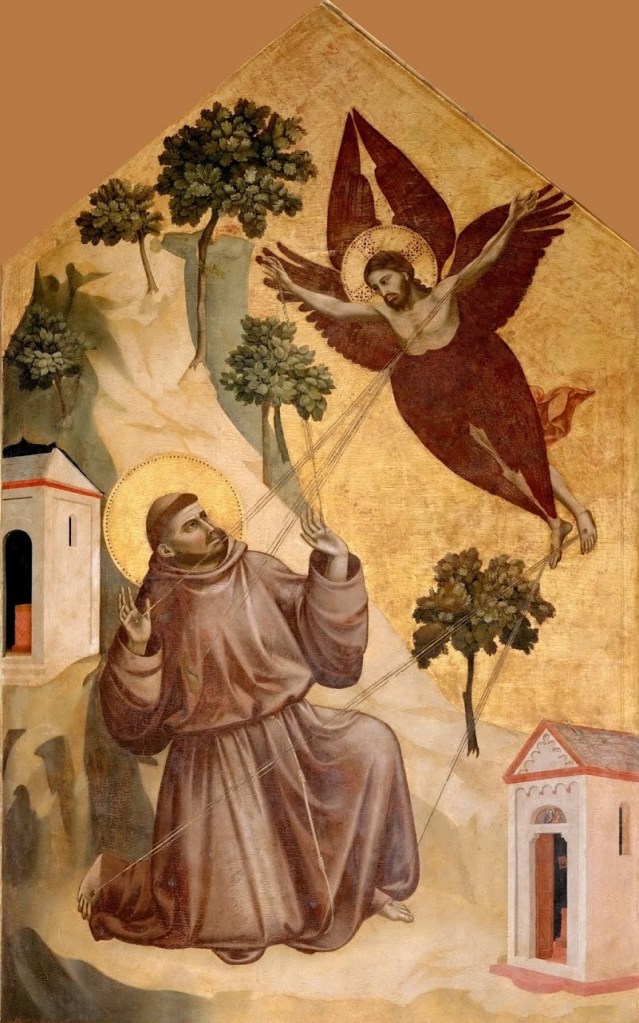
Read the chapters (pages 266 to 277) multiple times with the passage below in mind. Pay close attention to how the suffering of Francis is a theme that runs through the narrative.
“His right side was marked with an oblong scar, as if pierced with a lance, and this often-dripped blood, so that his tunic and undergarments were frequently stained with his holy blood ………. It chanced that he touched the precious scar in his right side. As soon as he had touched it, the holy one of God felt great pain and pushed Rufino’s hand away, crying for the Lord to spare him ……… During this same period his body began to be afflicted with different kinds of illnesses, and more severe than usual ………. So the precious vessel in which the heavenly treasure was hidden began to shatter all over and lose its strength ………. God multiplied his mercy on him, and he contracted a serious disease of the eyes. Day after day the disease grew worse ………. His head was cauterized in several places, his veins opened, poultices applied and drops poured into his eyes. Yet he had no improvement but kept getting steadily worse ………. Then all the rest of his body started to show signs of serious illness. His stomach had been destroyed, and his liver was failing. He was vomiting a lot of blood. So much that he seemed close to death ………. swelling began in his abdomen, his legs and his feet ………. He lost all bodily strength, and deprived of all his powers, he could not even move ………. Not one of his members remained without great pain and suffering, his bodily warmth gradually diminished, and each day he drew closer to the end. The doctors were amazed, and the brothers were astonished that the spirit could live in flesh so dead, since with his flesh all consumed only skin clung to his bones.”
The last two years of Francis’ life begins with this realization:
“This man filled with the spirit of God then understood that he would have to enter into the kingdom of God through many trials, difficulties and struggles.”
As the description of his physical state unfolds, beginning with the stigmata itself, it becomes clear that Francis’ prophetic powers did not fail him. If anything, the words of the realization seem to fall woefully short. What Francis endures in his last two years might best be described as tortuous, cruel, or brutal. But then again, that seems apt, given that what Jesus endured in His Passion might also best be described by those words.
Amid this description, Celano says that “God multiplied his mercy on him.”
Does that assertion seem out of place? Does it defy your understanding and expectations of what God’s Mercy ought to entail?
Is what Francis was asked to physically endure in these last two years the exact opposite of what you might expect the end of a supremely holy person’s life to look like?
In chapter two, Celano asserted that Francis, “having the spirit of God, was ready to endure any suffering of mind and bear any affliction of the body, if at last he would be given the choice that the will of the heavenly Father might be fulfilled mercifully in him.” (There’s that word, mercy, again.)
In chapter seven, when Francis is questioned by one of the brothers about what he would prefer to endure, this long-lasting illness or suffering a martyr’s cruel death, he answers like this: “My son, whatever is more pleasing to the Lord my God to do with me and in me has always been and still is dearer, sweeter and more agreeable to me. I desire to be found always and completely in harmony with and obedient to God’s will alone in everything. But to suffer this illness, even for three days, would be harder for me than any martyrdom. I am not speaking about its reward but only of the pain and suffering it causes.”
The context asserts that Francis’ is suffering so that God’s Will might be fulfilled. At the same time, it also asserts that God is fully endowing His Mercy on Francis. How can these two seemingly contradictory actions be reconciled to one another?
When God first called Francis, he invited him to take on the responsibility of emulating Jesus as precisely as possible. This is, in essence, what it means to live a gospel life. Francis, after a period of prayer and discernment, wholeheartedly accepts this call from God. He understands the call to be God’s Will for his individual life and he sets out to emulate Jesus as closely as possible for whatever time God grants upon this earth. One example of many that might be cited is Francis’ strict adherence to the charism of Poverty. Jesus set the example of how a life should be lived according to the ideal of Poverty, and Francis followed that example quite possibly better than anyone else who has ever lived.
During his life after his conversion, Francis’ “belief in Jesus” (see the gospel passage that heads the second reflection) never waivers and his commitment to living out the original call of God escalates. He is single minded in his pursuit of the gospel life. As his life unfolds, he begins to understand that the gospel life is about more than just living into the teachings and ministerial example of Jesus. He realizes that for a life to fully emulate Jesus, that life must go beyond Poverty, or, perhaps more exactly, he realizes that Poverty includes not just the actions of Jesus during his ministry, but also the type of death that Jesus suffered. Francis, in his desire to fulfill the Will of God by emulating Christ perfectly, reaches the conclusion that he must also suffer as Christ did.
Without the suffering, his attempt to emulate Christ can only fall short. As his life approaches its fulfillment, the need within Francis to share the suffering of Christ increases. God, in His Wisdom, sees that Francis has reached a full understanding of what the original call entailed. Therefore, in God’s Mercy, He grants Francis what he desires most. He allows Francis a full share in the suffering of Christ.
The stigmata is a glorious event in human history. It is an earthly indication and confirmation that while it might be exceedingly difficult, it is possible to live a gospel life well enough that God is satisfied in the attempt. But despite the glory, the stigmata is not without cost. Francis lived for two years with the pain of the wounds of Christ (and more) afflicting him every day.
That pain, while intense, is the source of Francis’ greatest joy. It is also, as the last three chapters will make clear, an indication of the stunning and marvelous reward that awaited Francis at the end of his trials.
- Be completely honest with yourself and where you stand in this exact moment of your Franciscan journey. If you were given the opportunity and the choice, would you willingly take on the stigmata? Are you ready to endure what Francis endured if that ensures that you are fulfilling the Will of God in your life?


3 thoughts on “4: The Life of St. Francis by Thomas of Celano, the Second Book, Chapters 4 through 7”