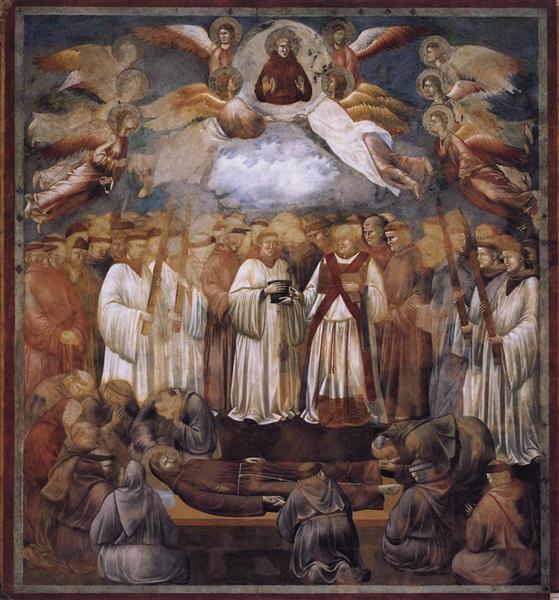
Read the chapters (pages 277 to 287) multiple times. Then focus on this passage from chapter nine:
The whole city of Assisi rushed down as a group and the entire region hurried to see the wonderful works of God which the Lord of majesty gloriously displayed in his holy servant……………People considered it a great gift to be allowed to kiss or even to see the sacred marks of Jesus Christ which Saint Francis bore in his own body.
And seeing them, who would not be moved to joy rather than tears?
And if moved to tears,
would that not be more from gladness than sadness?
Whose heart would be so iron-hard
that it would not be moved to groan?
Whose heart would be so much like stone,
 that it would not break with sorrow,
that it would not burn with divine love,
 or would not be strengthened with good will?
Who would be so dull-witted and senseless as not to realize the obvious truth.
This is a miracle worthy of everlasting remembrance and a sacrament to be remembered with unceasing and wondrous reverence.
It presents to the eyes of faith that mystery in which the blood of the spotless lamb,
flowing abundantly from the five wounds,
washed away the sins of the world.
O sublime splendor of the living cross, giving life to the dead!
Its burden presses so lightly and hurts so sweetly,
that through it, dead flesh lives and the weak spirit grows strong.
In the first reflection on the death of Lazarus, this paragraph was emphasized:
Lent is a time when the idea of suffering is front and center. We most often think of this in terms of the hardship that Jesus endured during His Passion, but here we are reminded that suffering is integral to God’s overall plan. None of us should expect to escape it. All of us should be interested in learning how to accept it, willingly participate in it, and even benefit from it.
Just like Lazarus, we may not always understand why suffering comes into our lives, but it is fair to say that the first two reflections on Celano speak directly to our need when it comes to handling the suffering God sends us. Francis not only willingly accepted suffering in his life, he clearly understood it to be necessary if he was to emulate Jesus precisely. A life of Poverty not only includes following the example and teaching of Jesus exactly, but it also includes sharing in the Poverty intrinsically contained in the tribulations of the Cross.
Nothing connects a person to Jesus more perfectly than freely embracing the suffering that God mercifully sends into our lives.
The second reflection from the gospel of John took this as its emphasis:
The baseline of my task is clearly set. Everything that I do while present on this earth must be pointed at encouraging, assuring, and securing my belief. All means necessary must be used to keep my belief thriving, growing, and increasing.
Celano makes a clear reference in the quote above to the gospel passage that was emphasized in that second lesson. Jesus told Mary, “I am the resurrection and the life. The one who believes in me will live, even though they die; and whoever lives by believing in me will never die. Do you believe this?” Jesus words here have a certain mystery about them. How is it possible that someone can never die, or live even though they die?
Celano is emphasizing this same mystery (he even uses that exact word) when he talks about the “sublime splendor of the living cross, giving life to the dead! Its burden presses so lightly and hurts so sweetly, that through it, dead flesh lives and the weak spirit grows strong.” He is recalling this passage directly, insisting that the stigmata, present in the flesh of Francis, must lead to an increase in our belief in the power of the Cross and the person of Jesus. This belief will then ensure for us the eternal life that Jesus made possible by His sacrifice.
The pattern in the story of the death of Lazarus is this: The suffering and death of Lazarus is a blessing that Jesus uses to teach belief in Himself to his disciples and the Jewish community at large. Jesus directly states this in the gospel passage from the first reflection when he says “Lazarus is dead, and for your sake I am glad I was not there, so that you may believe.” The resulting belief in the larger Jewish community that occurs after Jesus calls Lazarus out of the tomb is also stated directly in John 11:45: “Therefore many of the Jews who had come to visit Mary, and had seen what Jesus did, believed in him.”
This pattern is repeated in the life of Francis. The Will of God for the life of Francis begins with the call to emulate Jesus as precisely as possible. Francis understood this as a call to live a “gospel life” centered on the ideal of Poverty. At the end of his life, he took his understanding to its final, inevitable conclusion by discerning and embracing the need to experience the anguish of Jesus on the Cross as perfectly as possible through the mechanism of his own suffering.
The reward for Francis’ insight and devotion is the Mercy of the stigmata, which contains the suffering required for Francis to fulfill his faith. But the stigmata is more than this. After his death, it also becomes the outward sign that confirms the extreme holiness at the center of Francis’ suffering, a holiness that inspired belief in Jesus not just for those who witnessed the example and result of his life, but also in us 800 years later as we commemorate the anniversary of this “miracle worthy of everlasting remembrance” during our Centenary Celebration of the Stigmata.
Please, take a moment to reflect on the end of Francis’ life and how it parallels the story of the death of Lazarus. Make the link between the stigmata, the suffering of Francis in the last two years of his life, and the impact this has had on belief ever since, including, hopefully, your own ever-increasing belief.
————–
Francis, early in his ministry, received from Jesus, directly from the San Damiano Cross, the instruction to “rebuild His church.” This corollary to the call to a “gospel life” is, in effect, a call for Francis to teach people how to believe in Jesus again.
It would be easy, as we reflect on these last three chapters, to get caught up in the reward that Francis received at the end of his life. It is described exquisitely by one of the brothers, who tells of seeing “the soul of the most holy father rise straight to heaven over many waters. It was like a star but as big as the moon, with the brilliance of the sun, and carried upon a small white cloud.”
But we would be remiss if we did not focus on the impact Francis had on the world around him as well. The description of his transitus to heaven is striking, but just as striking is the effect that his death had on the everyday people of Assisi and the surrounding area. It is not just the brothers and sisters of Francis, the members of his order, who show up to celebrate his life. “The whole city of Assisi and the entire region” were deeply moved and effected by the life and death of Francis as a whole, and by the presence of the stigmata in his flesh in particular. “Each person burst into a song of joy at the urging of a joyful heart, and all of them had their desire fulfilled and blessed the almighty Savior.”
After reading the description of the events that followed Francis’ death, it would be difficult to dispute the notion that Francis succeeded in his quest to rebuild the church. It would be equally difficult to dispute the notion that belief in Christ increased substantially in response to his ministry. As your own vocation demonstrates, it is still increasing today, 800 years later.
A life lived according to the gospel will necessarily increase one’s belief in Jesus exponentially. Our vocation as a Franciscan, when lived successful, will inevitably encourage, assure, and secure belief in Christ as we mature. The closer one follows the example and charism of Francis the more their belief in Christ will thrive, grow, and increase.
But the life of Francis must take us further than that. As these chapters demonstrate, the Franciscan vocation is meant not just to encourage belief in Christ in the person who makes profession, but it also entails that person spreading belief in Christ by the example she or he sets as they journey through the world on their personal path to redemption.
This is what the last two years of Francis’s life, and the stigmata in particular, call us to. We must continue the pattern of increasing belief at every opportunity God places before us.
- In his description of the stigmata, Celano says that “the nails themselves were formed by his own flesh.” That manifestation would be difficult to fake. If you accept the stigmata as true history, then you accept that the wounds of Christ appeared in Francis more than twelve hundred years after Jesus died on the Cross. It seems impossible that this could be a coincidence. How does acceptance of the stigmata as truth impact your belief that Jesus is “the Messiah, the Son of God, who came into the world,” just as Martha confessed Him to be?
- In your own vocation, are you consistently aware of your responsibility to encourage belief in Jesus as you live out your own journey toward salvation? The strongest tool you have in fulfilling this responsibility is not the words you use, but the example you set. How does your daily life manifest your belief in Jesus? Do you expect to be able to sustain your example even when God sends suffering into your life, hoping that you might live into the pattern established by Lazarus and continued by Francis in your own small way?
 OFS Ongoing
2 thoughts on “5: The Life of St. Francis by Thomas of Celano, the Second Book, Chapters 8 through 10”