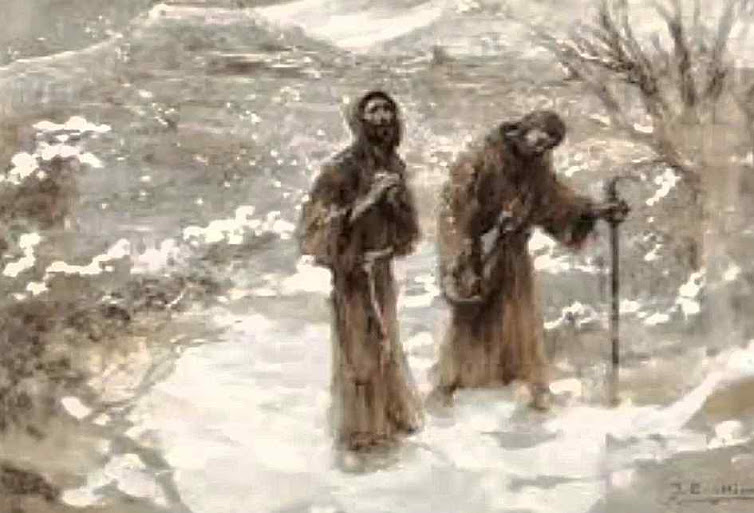
Please read the following passages multiple times:
The Writings of Francis of Assisi: The Undated Writings, True and Perfect Joy
Then focus on the following:
………. if we bear all these injuries with patience and joy, thinking of the sufferings of our Blessed Lord, which we would share out of love for him, write, O Brother Leo, that here, finally, is perfect joy. And now, brother, listen to the conclusion. Above all the graces and all the gifts of the Holy Spirit which Christ grants to his friends, is the grace of overcoming oneself, and accepting willingly, out of love for Christ, all suffering, injury, discomfort and contempt; …………….
Every time I encounter this story in either of these versions, I struggle to understand it. I have written about it in the past and thought I had it figured out, only to revisit my words and come away with the sense that I still have not quite gotten it right. I find it elusive, but it provides a natural conclusion to this short course of study, so I will try again to pin it down.
Recall again the emphasis of the first reflection. “All of us should be interested in learning how to accept, willingly participate in, and even benefit from personal suffering.” In the quote above, Francis ups the ante. He asserts that suffering is not just something to accept, but something to look forward to and embrace as the ultimate gift God can give.
The inference is this: When I reach the point where my basic response to suffering is “willing acceptance out of love for Christ,” only then have I completely discerned and surrendered to the primary essence of Spiritual Poverty, which necessarily includes Christ’s own suffering on the Cross. The unequivocal embrace of this essence is required for all barriers between Christ and I to be overcome. Only then can complete unity with Christ be achieved, and it is only in this perfect unity in suffering that true and perfect joy can be found.
This declaration is as counterintuitive and mysterious as the notion in Reflection #4 that God was “multiplying his mercy” on Francis by granting him a serious disease of the eyes.
To reconcile God’s mercy and the suffering of Francis in the writings of Celano, I had to embrace that aspect of Spiritual Poverty which calls on me to let go of all my earthly perspective and preconceptions. There is no human calculation that explains how suffering can equal Mercy. The only way to understand and reconcile these disparate concepts is to seek Revelation through Grace. To receive such Revelations, I must “overcome myself” by setting aside all I think I know and all my worldly assessments so that God can create space within me and fill that space with His Grace. That Grace then steadily works within me and reveals to me, in some small measure, God’s otherworldly and omnipotent point of view.
I find this next to impossible to do. In fact, I am sure I cannot do it on my own. This brings me back to Reflection #3 and the preparations that Francis made in prayer prior to receiving the stigmata. In the stillness and quiet of sustained prayer, Francis sought God. Or perhaps, more than actively seeking God, Francis simply did everything he could to empty himself and invite God in. Perhaps he slowly, over time, cleared himself of distraction and simply waited contentedly for God to make Himself known. When Francis achieved tranquility, God, through His Grace, made the connection between suffering and unity with Christ clear to him.
Either way, this conclusion was not reached by Francis through human cogitation. Instead, it was revealed to him through a combination of prayer and Grace. The unique thing that Francis did was accept this Revelation wholeheartedly. He did not fight against it, exercising his human perspective by trying to avoid the suffering that He now knew to be necessary for the Will of God to be fulfilled in him. Instead, he remained true to Lady Poverty and resolved to live out that devotion regardless of the personal cost.
To some extent I am guessing about how Francis proceeded, but I know myself well enough to understand that I cannot force compliance with the Will of God on my own. I am too sinful to accomplish anything by myself. I am too weak, too human, to align myself to the Will of God without assistance. I know I must learn to pray in the patient and peaceful way I have attributed to Francis here if I hope to live into Poverty as he did. I require the strength and succor of Jesus if I am to experience the unity with Him that leads to the true and perfect joy that Francis describes in these stories.
Perhaps one way to understand this teaching of Francis is to use this formula?
- In extended and peaceful prayer, I invite God to reveal Himself to me.
- God, in His Wisdom and Mercy, sends me suffering for my edification.
- God’s Grace invites me to meditate on the suffering of Christ in the Passion.
- Christ knows suffering. It is something we have in common that can unify us.
- Overcoming myself through Poverty, I hope in and rely on the strength of Jesus.
- I remember and embrace the unfathomable Love of Jesus revealed on the Cross.
- In gratitude, I return His Love as sincerely and wholeheartedly as I can.
- In the exchange of Love, I am newly united to Christ more closely than ever before.
- Unified to Christ through the gift of suffering, I experience true and perfect joy.
Francis lived out the story he told Leo on the way to St. Mary of the Angels in the last two years of his life. I think we can safely assume that he both suffered and was truly filled with joy as a result. The Stigmata is integral to both sides. It contributed to his suffering greatly, but as an indication of the approval of God, it must have also served to enhance the joy despite the hardship.
- Are you willing to pray consistently and gently in the hope of receiving God’s Grace and Revelation even if His Will includes your own version of Francis’ suffering? Does the example of Francis embolden you to the point that you might look forward to the opportunity of suffering? Might you even hope for it as Francis likely did, believing that suffering is the key to perfect emulation of, perfect unity with, and true and perfect joy in Jesus?
- Do you accept that unity with Christ can be engendered by suffering? If so, would you then welcome the full experience of the last two years of the life of Francis into your life? Do you think that true and perfect joy, inspired by love and suffering, would help you believe more firmly in Jesus as “the Messiah, the Son of God who came into the world?” If you faced suffering with joy, would that help you spread belief in Jesus to others? How would experiencing true and perfect joy as defined by Francis solidify and expand your hope for salvation?
 OFS Ongoing
One thought on “6: True and Perfect Joy”