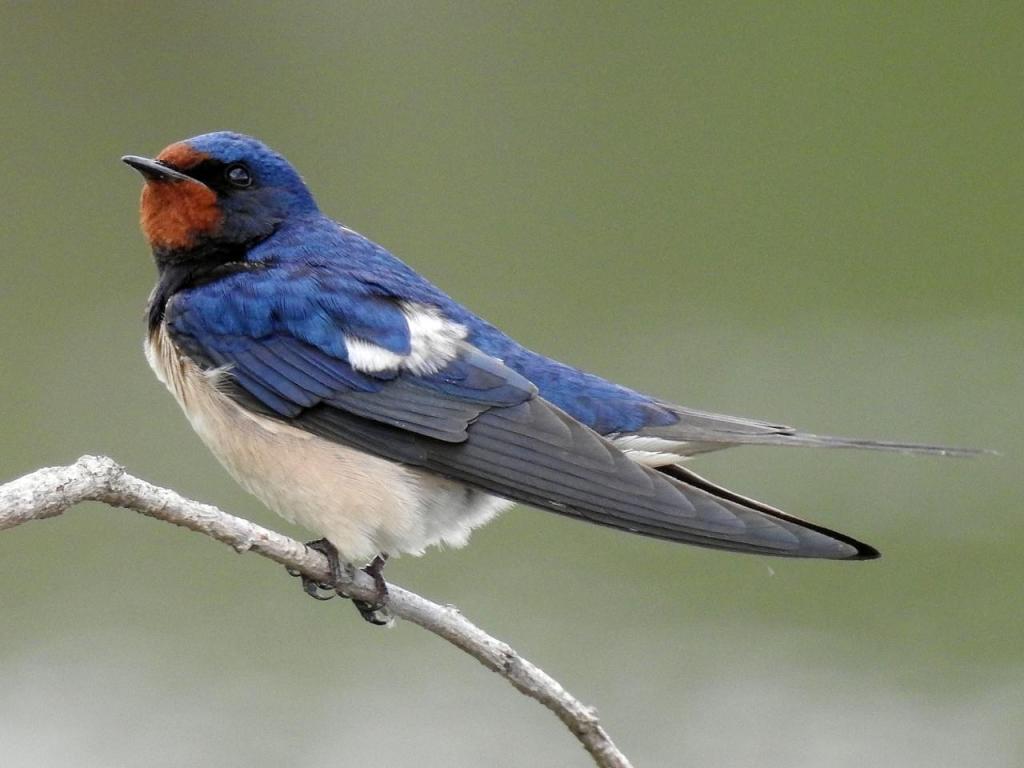
The Life of St. Francis by Thomas of Celano, the First Book, Chapter 21:
One day he came to a village called Alviano to preach the word of God. Going up to a higher place where all could see him, he called for silence. All remained silent and stood reverently. But a large number of swallows nesting there were shrieking and chirping. Since blessed Francis could not be heard by the people, he said to the noisy birds:
“My sister swallows, now is the time for me also to speak, since you have already said enough. Listen to the word of the Lord and stay quiet and calm until the word of the Lord is completed.”
Immediately those little birds fell silent — to the amazement and surprise of all present — and did not move from that place until the sermon was over. Those men who saw this sign were filled with great wonder, saying: “Truly, this man is holy, and a friend of the Most High.”
In the last reflection, we began to consider the themes that Francis wished to advance via his composition of the Canticle. We took the Attributes of God and Creation from the third reflection and extended them to show how they establish the “Goodness of God and Creation” beyond all doubt, question or ambiguity.
In this reflection, we will explore a second major theme, highlighting Francis’ belief that all the creatures of God’s Creation are intimately interrelated and interconnected. The word the OFS Rule uses to illustrate this connectedness is kinship.
As Francis moves through the various sections of the Canticle, he repeatedly uses the words “Brother” and “Sister.” This device is meant to establish and highlight this second theme of kinship. Francis wants us to understand that while all members of God’s Creation are interconnected, the connection between human beings and the balance of Creation is particularly critical. Human beings have a singular responsibility to every other creature that God Loves into being and we must honor this obligation at all times and in every action we take.
In its initial section, the Canticle lists three alternating pairs of “Brothers” and “Sisters.” Harkening back to the reflection on the Flow of Creation, the first are found in the heavens, Brother Sun and Sister Moon. Next come the four classical constituent elements of all earthly matter, Brother Wind and Sister Water, and Brother Fire and Sister Mother Earth. In strophes ten and eleven, while Francis does not use these words overtly, we can surely glean from the text and the background circumstances that he is calling the Bishop and Mayor of Assisi, and by extension all of mankind, into loving brotherhood. And then at the end, Francis adds a seventh sibling, Sister Bodily Death, as he composes strophes twelve and thirteen in response to the approach of his own earthly death.
Just as the “Goodness of God and Creation” was not a new theme to Francis in the Canticle, this theme of kinship is also not new. The words “brother” and “sister” appear regularly in the sources, meaning kinship is also a primary and foundational theme within the entire Franciscan charism.
The opening of this reflection gives an example. Here we see Francis talking to his “sister swallows” in order to gain their cooperation as he prepares to preach to the people of Alviano. In the same chapter, Celano relates a story about “brother rabbit,” who after being caught in a snare is presented to Francis. Francis attempts to set him free only to find that the rabbit prefers nestling “in his bosom” to being returned to the wild. Francis must ask one of the brothers to carry “brother rabbit” to a distant section of the forest before the rabbit will consent to leave his protection. Related next is an anecdote where a fisherman presents a tinca fish to Francis. Francis blesses the Name of the Lord, calls it “brother,” and releases it. The fish swims and plays next to the boat for some time, only leaving when Francis gives it permission to depart.
This attitude toward animals and all of Creation is ubiquitous in the Franciscan annals. Francis even refers to the wolf of Gubbio as “brother” in the process of taming it, indicating that kinship extends not just to those elements of Creation that sustain human beings, but also to those that are antagonist.
This idea should be seen to flow logically from the “Goodness” that we discussed in the last reflection. If Creation is fundamentally good, then that “Goodness” is a common trait shared by all the constituents of Creation, even those elements, natural or human, that we find troublesome or that cause us hardship. This commonality unites us. Just as the Attributes established “Goodness” beyond any doubt, question, or ambiguity, the harmony of “Goodness” establishes kinship in the same way. No amount of adversity can invalidate the elemental truth that mankind and Creation are vitally linked, and that human beings are therefore deeply dependent on Creation for their well-being.
From the perspective of God, all of Creation has an ordained role to play and that role, because it accomplishes the Will of God, is always “Good.” Often this means that the same element can be both sustaining and antagonistic. Brother Sun not only provides light, but we can also suffer sunburn if we are imprudent in how we approach Him. Brother Wind is the source of tornados and hurricanes. Sister Water manifests in floods. Brother Fire can burn out of control. And Sister Earth might present herself as a landslide or an earthquake.
The “infirmity and tribulation” that Francis instructs us to “endure in peace” in the Canticle is part of God’s perfect and providential plan for us. Our role is to accede to this truth unconditionally and to turn to Jesus, remembering His Cross and suffering, even when God asks our “brothers” and “sisters” to be mechanisms for delivering a difficulty that He deems necessary for our growth, and ultimately our redemption.
This action by God does not nullify kinship. It actually enhances it if we understand and accept that our “brothers” and “sisters,” when they are bringing us hardship according to the Will of God, are thereby encouraging us toward our final goal of salvation and eternal union with God.
In the end, all creatures share the same Father and Creator. All are meant to fulfill His Will. All are brought into being in perfect order, flawlessly designed to fulfill the purpose God has proscribed for them in His unquestionable and impeccable Wisdom.
This is a second commonality between mankind and God’s creatures, and it also establishes kinship between us and the elements of Creation.
Our source in God; Our shared “Goodness;” Our need to “praise, glorify, honor and bless Him;” the Love He rains down upon us; the sanctity He bestows on us through the Incarnation.
All of these serve to unite us and link us in the unbreakable bonds of kinship.
- Article eighteen of the OFS Rule is clearly inspired by the Canticle and the theme of kinship that is the topic of this reflection. It reads like this: “Moreover, they should respect all creatures, animate and inanimate, which ‘bear the imprint of the Most High,’ and they should strive to move from the temptation of exploiting creation to the Franciscan concept of universal kinship.”
- If you are fortunate enough to have siblings, think about them as you think about the words “brother” and “sister.” (If not, think about the person closest to you that you most associate with those words.) Think about the love you have for these special people in your life. Think also about the stresses and strains they put you through from time to time.
- How can you translate that intimate experience to a more global setting, translating the love you experience in your relationships with your “kin” to love for the entire world surrounding you? If it’s hardship you are thinking about, how can you focus on the suffering of Jesus so that you might transform that hardship to Love? How can you begin to think of everyone and everything as a “brother” or “sister” as Francis did, and how can you begin to love all of Creation, even its challenges, accordingly?
 OFS Ongoing
You covered Kinship with all of creation very well. Thank you!
MaryAnn Pajot
LikeLike