
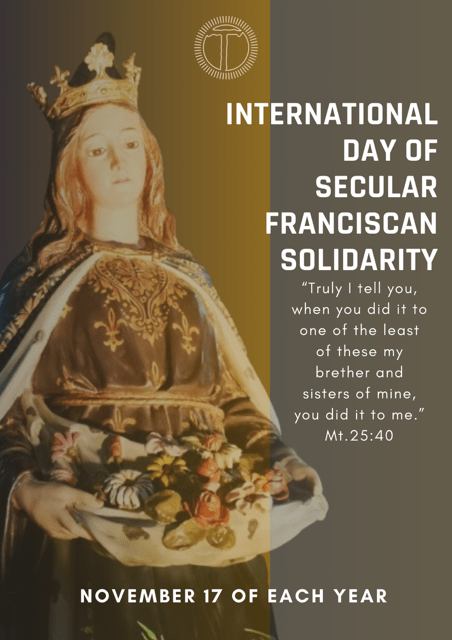
In April, the Region forwarded to our local fraternity a letter and a couple flyers (below) announcing a new proposal being put forward by the International Presidency of the Secular Franciscan Order.
This initiative establishes an International Day of Secular Franciscan Solidarity that is to be recognized and celebrated every year on November 17th. This date was chosen because it is the feast day of St. Elizabeth of Hungary, the Patroness of the entire Secular Franciscan Order.
The materials ask that we:
· Contemplate the concrete ways St Elizabeth embraced charity during her life, allowing her actions to inspire us.
· Take concrete steps to collect food or medicine, give alms, and/or visit the sick, elderly and those in need.
· Use resources to draw closer to brothers or sisters in difficulty in our own fraternity, bringing help and hope to them, again, via concrete actions.
· Create a record of our efforts to be permanently recorded in the fraternity archives and shared with all our members.
In response, the Council is asking that you consider responding specifically to the call to visit the sick, elderly and those in need. Guided by the leadership of Cyndi Pilot and Joanne Podemski, we are asking for volunteers to become part of three person teams that will visit the Professed in our Fraternity who are no longer able to come to the regular monthly meetings because of age, infirmity or some other reason. To start with, we are looking for five persons to become team leaders and another ten to volunteer to visit a brother or sister at least once a month and then to report back to the council on the results of their visit. These reports will then be recorded in our records and forwarded on to the full fraternity for their perusal.
In support of this effort, for Ongoing Formation this month the Council requests that you review these details from the life of St. Elizabeth, and then also take some time to meditate over the verses from the Gospel of Matthew that follow:
Life of St. Elizabeth of Hungary:
· Born July 7, 1207 at current day Bartislava, Slovakia, then part of the kingdom of Hungary. Her parents were King Andrew II and Gertrude of Merania. On the night of her birth, the wise man Klingor prophesied that she would become a saint who would console all of Christendom.
· At age 4, she was betrothed to Hermann of Thuringia. She moved to the great castle of the Wartburg in central Germany and was raised and educated in that court. Elizabeth was reportedly so gay and innocent that the other children declared the infant Jesus would come and play with her.
· Hermann died when Elizabeth was only nine, so she married his brother Ludwig, the second son, at age 14, the same year that he ascended to the title of Landgrave. Many of his worldly minded courtiers tried to convince their new liege to dismiss Elizabeth because she loved the poor too well, but he dismissed their concerns. By all accounts, despite the marriage being arranged, the couple was happy and in love. They had three children, one of whom became an Abbess of a convent in Germany.
· Elizabeth fasted often and would rise in the night to pray. Ever joyful, she rode through the countryside with her husband rather than being separated from him when he had business in the outlying parts of his dominion. When Elizabeth was 18, the Franciscans came to Thuringia. She helped them establish a friary in the city of Eisenach and a Franciscan friar became her confessor.
· Enamored by the Franciscan charism, she joined the fledgling 3rd order. Cardinal Ugolino, Protector of the Order, sent her a beggar’s cloak that Francis had worn, which she would don whenever she had a special petition to make to heaven. She dedicated her children to God at the altar of a local church while disguised as a peasant, and was known to venture out to help mothers in childbirth. There is a story of her helping a poor man regain his cattle after they were taken from him unjustly. On another occasion, when she was carrying bread to the poor, she was questioned by her brother-in-law, who suspected her of stealing treasures from the castle to give to the poor, and the bread miraculously transformed into roses. A third story tells of her allowing a leper to sleep in her bed. When Ludwig found out, he intended to have the bedclothes burned, but when he stripped the bed he saw a vision of the crucified Christ lying on the bed and he relented.
· While Ludwig was away in Italy on behalf of the emperor, flood, pestilence and famine struck Thuringia. Elizabeth sold her jewels and court dresses to establish a hospice that served meals to nine hundred people a day. She exhausted the revenues, stores of grain and the treasury of the Landgrave, giving it all to the poor. When her husband (who was never canonized but is regarded as a Saint locally) returned, she received his full support, protecting her against political enemies who thought she was too generous to those in need.
· Elizabeth soon found out that Ludwig had pledged himself to go to the Holy Lands on Crusade and fainted from grief at the news. Ludwig departed in the summer of 1227, but he got no further than Italy before he fell ill and died. On his deathbed he gave his signet ring to one of his trusted knights to return to Elizabeth. Upon receiving it, she knew her husband had passed.
· Ludwig’s brother Heinrich became regent for her son, then only five years old. Accused of mismanaging the funds of the Landgrave during the famine, she was soon turned out from the castle where she was living and her children were taken away from her. That night she asked the local Friars to chant a Te Deum in thanksgiving for all the suffering she had been allowed to endure.
· Her confessor helped her to obtain her lawful dowry. She promptly gave half away to the poor. She then renounced the world, choosing to live as a true child of St. Francis in complete Poverty. Devoting herself to works of mercy and charity, she used the balance of her dowry to found a hospital and gave herself completely to the care of those with the most loathsome diseases. She regularly performed miracles, healing the dumb, paralyzed and possessed.
· On November 19, 1231, at age 24, she died. The women attending her reported hearing heavenly singing as she passed. She was buried in the chapel of the hospital she founded. So many miracles followed that she was canonized by Pope Gregory IX only four years later.
Matthew 25:31-40:
“When the Son of Man comes in his glory, and all the angels with him, he will sit on his glorious throne. All the nations will be gathered before him, and he will separate the people one from another as a shepherd separates the sheep from the goats. He will put the sheep on his right and the goats on his left.
“Then the King will say to those on his right, ‘Come, you who are blessed by my Father; take your inheritance, the kingdom prepared for you since the creation of the world. For I was hungry and you gave me something to eat, I was thirsty and you gave me something to drink, I was a stranger and you invited me in, I needed clothes and you clothed me, I was sick and you looked after me, I was in prison and you came to visit me.’
“Then the righteous will answer him, ‘Lord, when did we see you hungry and feed you, or thirsty and give you something to drink? When did we see you a stranger and invite you in, or needing clothes and clothe you? When did we see you sick or in prison and go to visit you?’
“The King will reply, ‘Truly I tell you, whatever you did for one of the least of these brothers and sisters of mine, you did for me.’

 OFS Ongoing
Tim, i have read St. Elizabeth’s story and would like to volunteer to be a te
LikeLike