Mary and Zechariah: Saying “Yes” from a Position of Spiritual Poverty

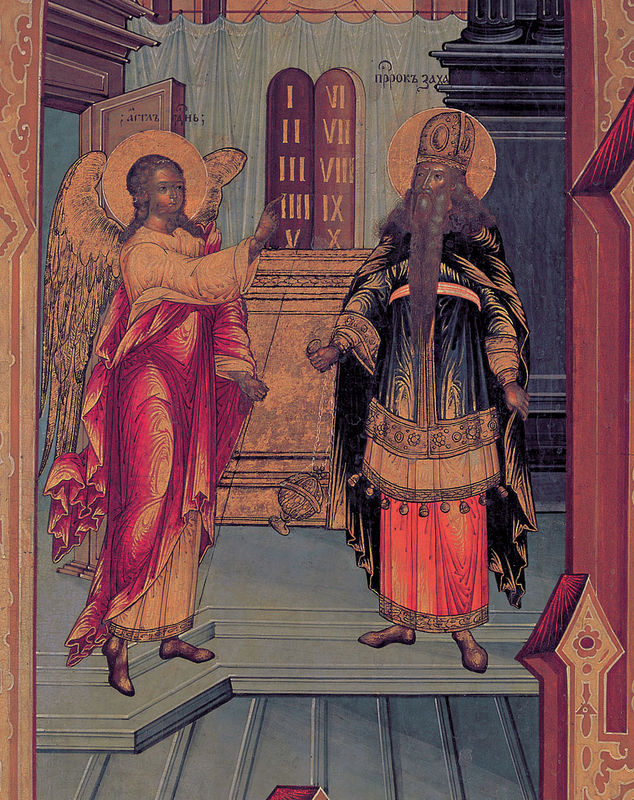
Annunciation to Zechariah (Fragment of Russian Icon, “The Execution of St. John the Baptist”)

I have recently spent considerable time in my prayer life and spiritual reading considering Mary’s “yes.”  But in order to begin writing what I expect will be multiple posts on this topic, I decided to go back to the initial source of the story, the Gospel of Luke, Chapter One.   The story of the Annunciation runs from verses 26-38.  The idea was to spend several days praying over these verses, allowing them to sink in and speak to me all over again.  As was suggested at the beginning of my reflection on the first chapter of John, I worked at entering the scene in order to enhance my prayer experience.

As I got started with this process, I read the verses of the Annunciation a couple times.  I then expanded my reading to the full chapter to provide better context for the story.  Few chapters in the gospels are as rich as this one.  It includes Gabriel’s visit to Zechariah to announce the birth of John the Baptist, the Annunciation to Mary, Mary’s visit to Elizabeth, the Magnificat, the birth of John the Baptist and the Canticle of Zechariah.

As I read the full chapter, I found that my decision to go back to basics was quickly rewarded.  I noticed an interesting parallel between Gabriel’s discussion with Zechariah and the Annunciation.  The verses that caught my attention were Luke 1:18 (Zechariah asked the angel, “How can I be sure of this? I am an old man and my wife is well along in years.) and Luke 1:34 (“How will this be,” Mary asked the angel, “since I am a virgin?”).

In both stories, Gabriel is sent to announce the birth of a child.  Zechariah’s reaction is described as “startled and gripped with fear.”  Mary’s is similar.  She is termed “greatly troubled.”  In both instances, Gabriel responds by saying “Do not be afraid” and proceeds to describe the purposes the children will fulfill in the plan of God.  Zechariah and Mary then respond with the questions quoted above.       

On their face, the responses seem to be about the same.  Both persons have been confronted unexpectedly by an angel.  Both are not sure how to react to this development.  Both are in positions in their lives where the prediction of the angel seems out of place and unlikely to come true.  Both are wondering what this means and how it will come to pass. 

Up until this point, the stories have followed a similar track.  But now they diverge.  In response to Zechariah, Gabriel says “you will be silent and not able to speak until the day this happens, because you did not believe my words.”  There is condemnation and perhaps punishment assigned to Zechariah for his response.  But in response to Mary, Gabriel is compassionate, patient, and sympathetic, providing her with this explanation: “The Holy Spirit will come on you, and the power of the Most High will overshadow you.”

The inference is that there is a difference between the two questions even though they appear parallel.  After praying over this several times, I decided that Mary’s question (How will this be….) is inquisitive and has a certain amount of faith-filled humility associated with it.  She is not doubting.  She just wants to understand how the words of Gabriel might be fulfilled.  Zechariah (How can I be sure of this…..), on the other hand, demonstrates a lack of faith and a desire to control the situation.    

(If Mary’s faith were as deficient as Zechariah’s, the conversation likely would have ended, and we never would have heard of her.  The story would have quietly disappeared into history and God would have had to wait for another opportunity to fulfill His plan to come into the world.) 

Mary’s question thus has an air of acceptance about it.  She’s just being curious even though she has already decided to say “yes” to the proposition she has been given.

————————-

This conclusion then led me to consider the differences between Mary and Zechariah.  What made Zechariah prone to faltering in his belief when this moment came?  What made Mary ready to accept, ready to say “yes”?

The easy answer is to refer to the Immaculate Conception, which appears to predestine Mary to saying “yes.”  I will address the topic of the Immaculate Conception in detail in the next post in this series.  For now, I am going to ask you to accept that Mary, like all human beings that have ever existed, was not predestined to accept and was indeed free to choose in this moment.  She could have said yes or no to Gabriel.  (Think of this in terms of Jesus in the garden of Gethsemane.  In the garden, Jesus says “not as I will, but as you will.”  Mary’s yes is similar.  Both she and Jesus had the choice, and both chose God when the pivotal moment occurred despite the appearance that their decisions were predetermined.  The dependence of love on free will within the nature of Creation makes this necessary.)     

What do we know about Zechariah?  What do we know about Mary?  What is the difference between them that led one to doubt and the other to believe?

From the text of the gospel, we know that Zechariah is old, he’s male and he’s a priest from the division of Abijah.  As a priest, he is in a position of prominence.  He is selected to burn incense in the temple, making him the focus of attention of the people assembled to worship, who wonder was has happened to him when he is delayed leaving the temple.  In verse six, he is described as “righteous in the sight of God, observing all the Lord’s decrees and commands blamelessly.”  Despite this description, a few sentences later, in verse twenty, Gabriel describes him as “not believing.”  (I suppose this should make us feel a little better about ourselves.  Even the father of John the Baptist was not immune to lapses despite being a righteous man.)

Mary is young, female and, unlike Zechariah, without prominence in her community.  While she is described as “highly favored,” this favor exists in anonymity.  She is a young girl from a small town who no one would have been aware of no matter how highly favored she was.  She was set to embark on a life that was no different than any other young Jewish girl of the time.  She was betrothed to Joseph, a working-class carpenter despite being a descendant of David, and would enter his house as a typical wife and eventually mother.  She was certainly very pious and may have been known for that in her small community, but up until the day of the Annunciation there was nothing that would have drawn attention to her in a larger context. 

We have little record of her life before the Annunciation, but we can speculate based on her selection as the Mother of God and our own experiences. 

If we reflect on our own calls to the Franciscan life, we will likely see the same pattern developing again and again.  Few if any of us would report a single great encounter with the Will of God that caused us to seek out the Franciscan life.  Instead, we would more likely relate a nagging feeling that developed and matured over an extended time.  God called us often and continually and it took us time to respond.  He pursued us unceasingly and we are grateful for that.  Even though we are professed, we know that we often falter.  We rely on His resolute call to bring us back from our lapses and to help us recommit to an ever-deepening relationship with Him.  We are thankful that He is supremely patient and that His Love for us is so encompassing that He never stops calling us into His presence.

Francis’ early experiences are similar to ours.  The event in Francis’ life that is analogous to the Annunciation is the image of Christ speaking to him in the church of San Damiano.  This event is relayed to us in Chapter Six of The Remembrance of the Desire of a Soul by Thomas Celano.  That chapter begins like this:

With his heart already completely changed – soon his body was also to be changed – he was walking one day by the church of Sam Damiano………….

Before his direct encounter with Christ, Francis’ “heart was already completely changed.”  God had been calling Francis continually, most likely from when he was a boy or a young teenager.  Francis, in the beginning, did not respond at all.  He was too focused on parties and becoming a knight.  He is captured and spends a year in the dungeons of Perugia.  During that time, he begins to hear and respond to the call.  When he is released, he tries to go back to his old life but cannot.  He spends time praying and seeking the meaning behind the compulsion he feels.  It takes an extended time for him to develop into the man that is ready to hear the voice of Christ speaking from the San Damiano Crucifix.

Next we apply our knowledge of our own calls and the calling of Francis to the life of Mary.  We can speculate with certainty that she also was called from a young age.  She likely did not suffer the same distractions as Francis, or if she did, she mastered them much sooner than he did.  (At the time of the Annunciation, she was likely younger than Francis was when he went into the battle of Perugia.)  We can assert that she was already a deeply prayerful person by the time the Annunciation occurred because she had already been faithfully answering the call of God for an extended time.  Despite her youth, she had already found her way into a certain separation from worldly concerns that made her ready to say a profound “yes” when the time came.  Like Francis, God had called her from an early age and given her time to develop into the person who was prepared to handle a visit from an Archangel without panicking.      

What I want to suggest is Mary’s long-term prayerful response to God’s call helped her learn to be minor by the time the Annunciation occurred.  She was, in fact, already the first Franciscan. 

As an unassuming young woman in an out of the way town, she had already embraced the life of minority that Francis cherished before it was possible to follow the example of Christ into that life.  The entire life of Spiritual Poverty that Francis developed and left us as his legacy is the life that Mary led even before the birth of Christ.  Thus, unlike Zechariah, who in the moment of his encounter with Gabriel fell victim to his own prominence and worldliness, Mary was able to maintain the integrity of her Spiritual Poverty and virtue. 

This is why I preceded this post with the post Mary as Holy Lady Poverty.  In that post, I suggested that Mary learned the life of Spiritual Poverty from her Son.  I want to now amend that thought by saying she was already well along the path to Spiritual Poverty before she became the Mother of Jesus.  Her long-standing prayerful answer to the call of God prepared her for the Annunciation and oriented her to a life of poverty and simplicity, thus making her the perfect candidate to become the Mother of Jesus. 

The life she experienced with her Son then perfected in her the discipline of Spiritual Poverty.  It prepared her for everything that was to come and allowed her to endure the pain of seeing her Son Crucified.  It allowed her to remain steadfast in faith and the knowledge that the plan of God would be fulfilled despite what her Son was asked to suffer.

————————-

I often think of the Passion of Christ in terms of the response I hope it engenders in me.  When I think about the Love of Christ as represented by the complete self-giving of the Passion, I know that I must attempt, no matter how many times I falter, to always reply to that Love with an unequivocal love of my own that offers every fiber of my being to the Will of God.  This is the essence of what it means to say a complete and unambiguous “yes” to my own call from God.

Now I find myself thinking of the pain of Mary during the Passion.  Do I owe that a response as well?  Her “yes” led inevitably to that pain.  How do I honor that?  How do I offer my love to her as clearly as her love was offered to me when she said, “I am the Lord’s servant, may your word to me be fulfilled.”?

Article 9 of the Rule says this:

The Virgin Mary, humble servant of the Lord, was open to his every word and call. She was embraced by Francis with indescribable love and declared the protectress and advocate of his family. The Secular Franciscans should express their ardent love for her by imitating her complete self-giving and by praying earnestly and confidently.        

I think the answer is found here.  The instruction of the Rule to “imitate her complete self-giving” is a request to honor the “yes” of Mary.  We have all heard the saying “imitation is the highest form of flattery.”  In imitating Mary’s “yes,” not just at the moment of the Annunciation, but also in all the preparation that preceded that moment, we honor what she did for humankind by agreeing to be the Mother of Jesus.  We reciprocate the love she continues to bestow on us.  We revere and perhaps to some small extent share the pain that her “yes” cost her.

She was “open to the every word and call of the Lord.”  We must be as well.  We must be willing to imitate this in her as we go through our daily lives.  We must be willing to set aside worldly concern and embrace a life of Spiritual Poverty as surely as she did with the intention of offering her the love that is her due.

————————-

Perhaps we can only hope for a momentous event in our spiritual lives when, or more precisely if, we achieve a deep enough relationship with God that we are ready for it as Mary and Francis were.  Although we might think their “yeses” happened at the time of these events, in actuality, their “yeses” developed over an extended time.  They were prepared when the momentous event presented itself and thus were able to respond with a final climatic “yes” that turned out for them to be irreversible.

This is what I am seeking for myself.  I am seeking to develop such a deep commitment to God, such a deep relationship with Him, that He might see me as fit for a wondrous encounter of my own.  I know that this is unlikely.  I know that I may never achieve such a state.  But there is no way to approach it if I do not set it as my goal. 

I long to someday make my own irreversible “yes” just as Mary and Francis did.   I know I am not there yet, but I pray for the strength to persevere.  There is no harm in dreaming such a dream. 

As I open my daily prayer, I ask specific saints to pray for me.  This always includes Francis, Clare, John the Baptist, Augustine, Peter, Paul and Andrew.  I then, just to be safe, invoke all the saints with this phrase:

“All you holy men and women pray for me that one day I might join your ranks.”

Perhaps if I persevere long and well enough in my quest to join their ranks I might also hear Christ speak to me from a Crucifix or be visited by an Archangel.

This is what I hope for. 

I invite you to hope the same as you consider how to say your own “yes” in imitation of Mary’s.

Journey thru John, Chapter 11: Living in Jesus

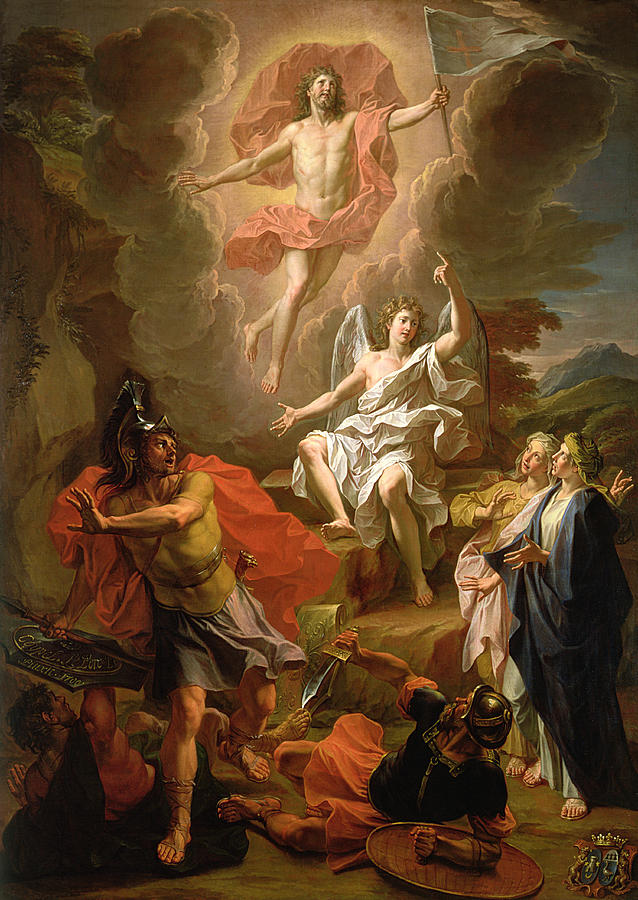
Resurrection of Christ by Noel Coypel, circa 1700

We know that the events of the gospels took place a long time ago.  For us, they are part of a distant history.  Our scene is very different than the one Jesus occupied.  We have electricity and everything that comes with it.  He had only candles for light when the sun went down.  There was no such thing as television or telephones or social media.  We can know what happens in Rome in an instant.  It would have taken weeks for the news of Rome to reach Jesus, and He would have had only word of mouth to rely on for its authenticity.  No pictures or film.

Because of these discrepancies, we often feel more like spectator than participant as we read the gospels. 

But we also know that the gospels are current.  They speak to us about our lives today despite the differences in the world from then until now. 

Entering the scene is a method for bridging this distance.  By entering the scene, we hope to participate, not just review from the far-off position of historical spectator.  We expect that our participation will reinforce the gospel’s currency and inform us how to discern the Will of God for our lives.

What was it like to be a disciple of Jesus?  Thomas says in this chapter, “Let us also go, that we may die with him.”  Can you put yourself in his place?  Can you be a companion of Jesus, struggling to understand the meaning of the events around you, and yet willing to get up and follow Him even though that following might lead to death?

Can you take the place of Martha and Mary, who both said to Jesus, “If you had been here, my brother would not have died.”  Do you have so much faith in the person of Jesus that you believe anything is possible to Him, including the curing of the seemingly incurable?

Eternal life is central to our creed as Catholics.  Even so, can you take the place of Lazarus?  Can you imagine what it would be like to wake from the dead, find yourself in a tomb wrapped in burial clothes, and then to be led out only to hear Jesus say, “Take off the grave clothes and let him go?”

We have nothing in the gospels about how Lazarus reacted.  We see his sister Mary fall at the feet of Jesus, but what about Lazarus?  Did he fall at the feet of Jesus as well?  Perhaps he was too dumbfounded to do anything but be led away?

How would you react if Jesus called you out of that tomb?

Do you understand that this is not a hypothetical question?  Someday, hopefully, it will be current for you as you are called to eternal life!  Can you imagine yourself in that scene? 

—————————-

John Chapter 11, Verses 25-26:

Jesus said to her, “I am the resurrection and the life.  He who believes in me will live, even though he dies; and whoever lives and believes in me will never die.”

When I first read verse 26, I read it like this:

               “Whoever lives” and “whoever believes in me” will never die.

Then, after I read it a few times, I began to read it like this:

               “Whoever lives in me” and “whoever believes in me” will never die.

It may be a subtle difference, but in the end, it was the difference that gave me my reflection for this chapter. 

What does it mean to “live in Jesus?” 

How does the action of “living in Jesus” relate to the word resurrection?

What does “living even though he dies” mean?  That phrasing does not seem to reference resurrection, but instead “never dying” at all, which is how the wording occurs in the restatement of the idea at the end of the sentence.  Is “never dying” the same thing as resurrection, or something else, related to resurrection and yet distinct?  If it is distinct, how can someone live and die at the same time?

The relationship between resurrection and life seems to be clear.  We know that Jesus died on the Cross, was placed in the tomb, and then rose from that tomb.  This is the Resurrection, capital “R.”  In this chapter of John, we are also given the story of Lazarus, who died and is called from his tomb by Jesus.  These are two instances of resurrection where the defining characteristic seems to be the passage of time.  Resurrection is not instantaneous, which seems contrary to the inferences of “living even though he dies” or “never dying” at all.

When Jesus calls Himself “the resurrection and the life,” is He just declaring himself capable of raising Lazarus as a prefiguration of his own Resurrection to come later?  Is He referring only to these two incidents?    Or is there an expanded meaning to the word resurrection implied here, a meaning related to “never dying” at all?

In the last chapter, we found a deeper meaning to the idea of laying down one’s life.  It started with the historical incident of the Crucifixion, but it expanded to encompass Jesus laying down His Divinity and our call to emulate this action by Jesus with the assistance and inspiration of Francis. 

Is something similar going on with the historical incident of Jesus’ Resurrection?  Is it also something we need to delve into more thoroughly before we can understand the full implications of this gospel teaching?

—————————-

In the culture that we live in, death is an entirely negative concept.  It is something to be avoided at all costs.  Few of us can think of death not as an ending, but instead as a transition.  We are too distracted from our spiritual lives to be comfortable and sure about the meaning of death. 

Thus, death becomes something that is mostly defined by fear. 

But as Franciscans, we are called to a different point of view.  Our father Francis, at the end of his life, made it clear that he was not afraid of death at all.  Francis was so comfortable with his coming bodily death that he embraced it as an opportunity for one last chance to teach.  He wrote the final verse of his most famous work, The Canticle of the Creatures, while he was literally on his death bed. 

Praised be You, my Lord, through our Sister Bodily Death, from whom no one living can escape.  Woe to those who die in mortal sin.  Blessed are those whom death will find in Your most holy will, for the second death shall do them no harm.

Note that Francis is “praising God through death.”  No one can escape death, but, nonetheless, it is an occasion not for fear or anger, but for praise.  The love that Francis carried through his life for God is not diminished at the end.  The faith that was built during his life carries him joyfully to the close, making this expression of praise not only possible, but appropriate.

Given the way he lived his life, no other approach to death by Francis would make sense. 

Also note the words “in your most holy will.”  It should be safe to assume that one of the reasons that Francis is able to praise God through death is he knows himself to have resided in God’s Will throughout his life.  As a result, he feels not afraid, but confident and even blessed.  He does not fear his death as an end or a potential condemnation, but instead sees it as an opportunity to move closer to God.  He may not know precisely what the next life will entail, but he is looking forward to the transition to that next life because he knows, whatever he finds, that he will be safe from harm because he pursued God’s Will so diligently during his stay on earth.

If Francis had instead written “blessed are those whom death will find living in You,” would the meaning be any different? 

Francis is confident about being blessed in death because he knows he has fulfilled the words of Jesus found in the above verses of John.  He has “lived in Jesus” because he has devoted himself to the gospel life and thus to following God’s most holy will.  Francis reasonably expects to “live even though he dies” and/or to “never die” just as this gospel passage promises.

Living in God, living in Jesus, can be understood to be the same thing as living according to God’s Will.  We still need to understand how to do that, but because we know that Francis accomplished this goal, we can be confident that he can show us the way.

—————————-

It is not something I would ever have expected to do, but I am also going to give you the footnote related to the above passage from Francis of Assisi: Early Documents.

Fulgentius of Rome comments on these verses in his treatise on forgiveness.  “Here on earth they are changed by the first resurrection, in which they are enlightened and converted, thus passing from death to life, sinfulness to holiness, unbelief to faith, and evil actions to holy life.  For this reason the second death has no power over them….As the first resurrection consists of the conversion of the heart, so the second death consists of unending torment.

I have chosen to do this because the footnote contains the word resurrection twice.  The verses from the Canticle themselves do not seem to reference resurrection at all, yet the footnote centers on it.

However, the context of the word resurrection is atypical.  It is not focused on the historical act of Jesus rising from the tomb as we might expect.  Instead, the context centers on conversion during the time we are living on this earth. 

“They are changed by the first resurrection.”

“The first resurrection consists of the conversion of the heart.”

This suggests to us that we should begin looking for the deeper meaning of the gospel passage. 

The implication is that the first Resurrection, the Resurrection of Jesus, is not a piece of distant history to be observed from the outside.  Instead, it is something internal to us, something that will work within us to “enlighten and convert” us on a day to day basis if we let it.  It is, to use the word from the introduction to this chapter, current in our lives.

Jesus’ Resurrection, when it is made present in our prayer lives, is a catalyst for conversion.  If you think about it, that makes perfect sense.  How could we contemplate the Passion and Resurrection of Jesus and not be changed if we take it seriously? 

The footnote describes this conversion centered resurrection as “passing from death to life.”  This then hearkens to the ideas of “living even though he dies” and/or to “never dying” from the gospel verses.  The further inference is that “passing from death to life” (resurrection) is not a one-time occurrence that happens at the end of our bodily lives but is instead something meant to happen on an ongoing basis. 

—————————-

As Franciscans, the word “ongoing” should set off bells and whistles in our heads.  It should remind us immediately of our profession and our commitment to ongoing conversion as part of that profession.

The SFO Rule, in article seven, says this regarding conversion:

…..let them conform their thoughts and deeds to those of Christ by means of that radical interior change which the gospel itself calls “conversion.”  Human frailty makes it necessary that this conversion be carried out daily. 

The gospel instructs us to “live in Jesus.”  Francis instructs us to place ourselves “in God’s most holy will.”  The rule, in relation to conversion, tells us to “conform our thoughts and deeds to those of Christ.”  All statements of the same concept.

I would just ask you to consider whether it is possible to “conform your thoughts and deeds to those of Christ” if you are not consistently immersed in the gospels?

The answer is, of course, no.  This means that the act of “living in Jesus,” the act we are called to in this chapter of John, is at the core of the Franciscan charism.  Our rule, in article 4, calls us to go from gospel to life and life to gospel so that Jesus becomes the center of our life.   This act of immersion, which leads to conformance and conversion, is what “living in Jesus” is all about and it must be “carried out daily” because of our “frail human nature.”

The daily nature of our need for immersion then fits snugly with the discussion of resurrection and conversion suggested by the footnote.  Resurrection is not a single event that happens once at the end of our life if we manage to be good girls and boys.  Our sinfulness always leaves us in some lesser or greater state of death.  Therefore, we are always in need of resurrection, in need of moving from death to life.  The Resurrection of Jesus is a beacon that inspires us to fulfill our ongoing need for continual conversion and resurrection, for a continual movement away from death toward life, away from sin towards the Will of God.

Our Franciscan efforts at continual conversion then translate into a state of ongoing resurrection.  When we work at this through gospel immersion, we are fulfilling the instruction from this chapter of John to “live in Jesus.”

It is how we can be alive and dead at the same time.  It is how we can ultimately never die at all.      

If we acknowledge our frailty as the rule suggests and embrace continual daily conversion, a cycle develops.  Our frailty causes us, at times, to swing back toward death.  But immersion and conversion take us toward an ongoing resurrection that moves us back toward life again.  There is then resurrection on both ends of this definition of conversion.  Resurrection both leads to conversion and is the result of conversion.  There is a circle at work, conversion and resurrection building on one another.

We may take two steps forward and one step back, but so long as we are always committed to immersion in the gospels, we should be able to stay on a course of conversion and ongoing resurrection that ultimately leads us to the position where, by the end, we can be confident that we have followed in Francis’ footsteps and can praise God as he did as we meet Sister Bodily Death when our individual time comes.

—————————-

The SFO Rule, in article 19, at the very end of Chapter Two, The Way of Life, speaks directly to this possibility.  It says this:

Since they are immersed in the resurrection of Christ, which gives true meaning to Sister Death, let them serenely trend toward the ultimate encounter with the Father.

I did not place the word immersed in the Rule in this location.  Nor the word resurrection.  I would like to be able to take credit for these words coming together, linking the verses of the Gospel, the Canticle of the Creatures, the footnote and the sections of the rule to each other, but I can’t.  Still, there they are, neatly summarizing the entire reflection.

When we immerse ourselves in the gospels, we are immersing ourselves in resurrection not just as we read this Chapter of John or the Passion accounts but in every chapter of every gospel.  The entirety of the gospels is an instruction on how to “live in Jesus,” and therefore on how to experience the ongoing conversion and continual resurrection that leads to living while dying and ultimately never dying at all.   

This is what Jesus means when He says that He is the Resurrection and the Life.  He is not the Resurrection only on the day of Resurrection.  His every movement, His every teaching, His entire being is a guide to an ongoing resurrection that leads to continuous conversion away from sin, from death to the continuous Life found when we choose to reside in Him, to follow His Will, and to conform ourselves to Him via the gospels.

Just as in the last chapter, where the meaning behind laying down one’s life was expanded, the same thing happens here with the idea of resurrection.  Resurrection is not a single event in history, but instead part of the ongoing process that leads us from death to life at all points in our existence. 

For conversion to be possible, we must immerse ourselves in Jesus via the gospels.  To the extent that we do so, the door to a life based on ongoing resurrection is opened to us.  We “live even though we die” in so much as we practice the cycle of resurrection and conversion rooted in the decision to “live in Jesus.”   

That then gives true meaning to Sister Death as the rule suggests, not as an end, but as a loving companion during a lifetime of transition.  It is what allowed Francis to praise God as Sister Death approached and what should allow us to do the same.  It is what allows us to understand that ongoing conversion gives us the full confidence we need to “serenely trend toward the ultimate encounter with the Father” not just at the end of our lives, but throughout them.

—————————-

Sometimes words are just inadequate.  I have read and reread my reflection many times now and I know that the words I used to describe what I experienced by immersing myself in this gospel chapter are insufficient.

I used the word “death” to describe my state of sinfulness because no other word seems to suffice.  The word resurrection describes an event in history, but I have attempted to extend its meaning here to describe something else, no doubt poorly.

I hope this does not lead to confusion.  Death and resurrection seem to be straightforward words, but they turn out to be anything but.  Somehow, because of the brilliance of Jesus, they have extended meanings which other words in our language struggle to encompass.

In Volume Three of Francis of Assisi: Early Documents, there are two versions of a work called A Mirror of Perfection.  The work is based on material from the time of Francis that was discovered in hermitages and residences of the Order in the early 1300s. 

Because my words feel so inadequate, I am going to rely on the very end of the second version of this work to summarize this reflection for me.  Hopefully, it begins to describe what you and I will experience when our bodily life comes to its end, assuming we manage to “live in Jesus” as we are called to do.

Feel free to reread and answer the questions in the section with the focus verses, but please also pray over the passage below.  This is how Sister Death carried Francis to Jesus just after he composed the last verse of the Canticle of the Creatures.  We should long to experience the same. 

After saying these things, he was carried to Saint Mary’s where, having completed the fortieth year of his life, the twentieth year of perfect penance, in the year of the Lord one thousand, two hundred and twenty-six, on the fourth day before the Nones of October, he passed to the Lord Jesus Christ Whom he loved with his whole heart, with his whole mind, with his whole soul, and with all his strength, with a most burning desire, and with the fullness of affection, following Him most perfectly, hastening swiftly after Him, and, at last, attaining Him most gloriously, Who lives and reigns with the Father and Holy Spirit forever and ever.  Amen.

Dr. Martin Luther King on Nonviolence

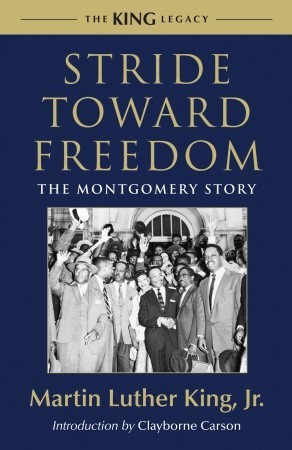
In my post on the death of Congressman John Lewis, I mentioned that I had ordered a copy of the book Stride Toward Freedom: The Montgomery Story, by Dr. Martin Luther King. When it arrived, I read it cover to cover in a couple days. I found it both fascinating and informative. Published in 1958, it is from early in the Civil Rights movement timeline and it chronicles the Montgomery Bus Boycott.

The final chapter is entitled “Where Do We Go From Here?” This chapter begins with suggestions on what several different groups might do to help maintain the momentum begun by the boycott. The book then ends with a discussion about what “the Negro himself” must do going forward. This section of the book is a detailed essay on the idea of nonviolence and how it can be employed to ensure that Negroes are ultimately successful in their quest for equality.

I am so impressed by what Dr. King wrote that I feel no choice but to include it here in its entirety. So here, in his own words, is Dr. King’s passionate plea for Negroes in particular and the nation in general to embrace the ideals of nonviolence as they seek to promote the general welfare and the pursuit of happiness for all in the days that were to come. His message is every bit as relevant today as it was sixty years ago.

____________________________

Finally, the Negro himself has a decisive role to play if integration is to become a reality.  Indeed, if first-class citizenship is to become a reality for the Negro he must assume primary responsibility for making it so.  Integration is not some lavish dish that the federal government or the white liberal will pass out on a silver platter while the Negro merely furnishes the appetite.  One of the most damaging effects of past segregation on the personality of the Negro may well be that he has been victimized with the delusion that others should be more concerned than himself about his citizenship rights.

In this period of social change, the Negro must come to see that there is much he himself can do about his plight.  He may be uneducated or poverty-stricken, but these handicaps must not prevent him from seeing that he has within his being the power to alter his fate.  The Negro can take direct action against injustice without waiting for the government to act or a majority to agree with him or a court to rule in his favor.

Oppressed people deal with their oppression in three characteristic ways.  One way is acquiescence:  the oppressed resign themselves to their doom.  They tacitly adjust themselves to oppression, and thereby become conditioned to it.  In every movement toward freedom some of the oppressed prefer to remain oppressed.  Almost 2800 years ago Moses set out to lead the children of Israel from the slavery of Egypt to the freedom of the promised land.  He soon discovered that slaves do not always welcome their deliverers.  They become accustomed to being slaves.  They would rather bear the ills they have, as Shakespeare pointed out, than flee to others they know not of.  They prefer the “fleshpots of Egypt” to the ordeals of emancipation.

There is such a thing as the freedom of exhaustion.  Some people are so worn down by the yoke of oppression that they give up.  A few years ago, in the slum areas of Atlanta, a Negro guitarist used to sing almost daily: “Ben down so long that down don’t bother me.”  This is the type of negative freedom and resignation that often engulfs the life of the oppressed. 

But this is not the way out.  To accept passively an unjust system is to cooperate with that system; thereby the oppressed become as evil as the oppressor.  Noncooperation with evil is as much a moral obligation as is cooperation with good.  The oppressed must never allow the conscience of the oppressor to slumber.  Religion reminds every man that he is his brother’s keeper.  To accept injustice or segregation passively is to say to the oppressor that his actions are morally right.  It is a way of allowing his conscience to fall asleep.  At this moment, the oppressed fails to be his brother’s keeper.  So, acquiescence – while often the easier way – is not the moral way.  It is the way of the coward.  The Negro cannot win the respect of his oppressor by acquiescing; he merely increases his oppressor’s arrogance and contempt.  Acquiescence is interpreted as proof of the Negro’s inferiority.  The Negro cannot win the respect of the white people of the South or the peoples of the world if he is willing to sell the future of his children for his personal and immediate comfort and safety.

A second way that oppressed people sometimes deal with oppression is to resort to physical violence and corroding hatred.  Violence often brings momentary results.  Nations have frequently won their independence in battle.  But in spite of temporary victories, violence never brings permanent peace.  It solves no social problem; it merely creates new and more complicated ones.

Violence as a way of achieving racial justice is both impractical and immoral.  It is impractical because it is a descending spiral ending in destruction for all.  The old law of an eye for an eye leaves everybody blind.  It is immoral because it seeks to humiliate the opponent rather than win his understanding; it seeks to annihilate rather than to convert.  Violence is immoral because it thrives on hatred rather than love.  It destroys community and makes brotherhood impossible.  It leaves society in monologue rather than dialogue.  Violence ends by defeating itself.  It creates bitterness in the survivors and brutality in the destroyers.  A voice echoes through time saying to every potential Peter, “Put up your sword.”  History is cluttered with the wreckage of nations that failed to follow this command.

If the American Negro and other victims of oppression succumb to the temptation of using violence in the struggle for freedom, future generations will be the recipients of a desolate night of bitterness, and our chief legacy to them will be an endless reign of meaningless chaos.  Violence is not the way.

The third way open to oppressed people in their quest for freedom is the way of nonviolent resistance.  Like the synthesis in Hegelian philosophy, the principle of nonviolent resistance seeks to reconcile the truths of two opposites – acquiescence and violence – while avoiding the extremes and immoralities of both.  The nonviolent resister agrees with the person who acquiesces that one should not be physically aggressive toward his opponent, but he balances the equation by agreeing with the person of violence that evil must be resisted.  He avoids the nonresistance of the former and the violent resistance of the latter.  With nonviolent resistance, no individual or group need submit to any wrong, nor need anyone resort to violence in order to right a wrong.

It seems to me that this is the method that must guide the actions of the Negro in the present crisis in race relations.  Through nonviolent resistance the Negro will be able to rise to the noble height of opposing the unjust system while loving the perpetrators of the system.  The Negro must work passionately and unrelentingly for full stature as a citizen, but he must not use inferior methods to gain it.  He must never come to terms with falsehood, malice, hate or destruction.

Nonviolent resistance makes it possible for the Negro to remain in the South and struggle for his rights.  The Negro’s problem will not be solved by running away.  He cannot listen to the glib suggestion of those who would urge him to migrate en masse to other sections of the country.  By grasping his great opportunity in the South, he can make a lasting contribution to the moral strength of the nation and set a sublime example of courage for generations yet unborn.

By nonviolent resistance, the Negro can also enlist all men of good will in his struggle for equality.  The problem is not a purely racial one, with Negros set against whites.  In the end, it is not a struggle between people at all, but a tension between justice and injustice.  Nonviolent resistance is not aimed against oppressors but against oppression.  Under its banner consciences, not racial groups, are enlisted.

If the Negro is to achieve the goal of integration, he must organize himself into a militant and nonviolent mass movement.  All three elements are indispensable.  The movement for equality and justice can only be a success if it has both a mass and militant character; the barriers to be overcome require both.  Nonviolence is an imperative in order to bring about ultimate community. 

A mass movement of a militant quality that is not at the same time committed to nonviolence tends to generate conflict, which in turn breeds anarchy.  The support of the participants and the sympathy of the uncommitted are both inhibited by the threat that bloodshed will engulf the community.  This reaction in turn encourages the opposition to threaten and resort to force.  When, however, the mass movement repudiates violence while moving resolutely toward its goal, its opponents are revealed as the instigators and practitioners of violence if it occurs.  Then public support is magnetically attracted to the advocates of nonviolence, while those who employ violence are literally disarmed by overwhelming sentiment against their stand.

Only through a nonviolent approach can fears of the white community be mitigated.  A guilt-ridden white minority lives in fear that if the Negro should ever attain power, he would act without restraint or pity to revenge the injustices and brutality of the years.  It is something like a parent who continually mistreats a son.  One day that parent raises his hand to strike the son, only to discover the son is now as tall as he is.  The parent is suddenly afraid – fearful that the son will use his new physical power to repay his parent for all the blows of the past.

The Negro, once a helpless child, has now grown up politically, culturally, and economically.  Many white men fear retaliation.  The job of the Negro is to show them that they have nothing to fear, that the Negro understands and forgives and is ready to forget the past.  He must convince the white man that all he seeks is justice, for both himself and the white man.  A mass movement exercising nonviolence is an object lesson in power under discipline, a demonstration to the white community that if such a movement attained a degree of strength, it would use its power creatively and not vengefully.

Nonviolence can touch men where law cannot reach them.  When the law regulates behavior, it plays an indirect part in molding public sentiment.  The enforcement of the law is itself a form of peaceful persuasion.  But the law needs help.  The courts can order desegregation of the public schools.  But what can be done to mitigate the fears, to disperse the hatred, violence, and irrationality gathered around school integration, to take the initiative out of the hands of racial demagogues, to release respect for the law?  In the end, for laws to be obeyed, men must believe they are right.

Here nonviolence comes in as the ultimate form of persuasion.  It is the method which seeks to implement the just law by appealing to the conscience of the great decent majority who through blindness, fear, pride, or irrationality have allowed their consciences to sleep.

The nonviolent resisters can summarize their message in the following simple terms:  We will take direct action against injustice without waiting for other agencies to act.  We will not obey unjust laws or submit to unjust practices.  We will do this peacefully, openly, cheerfully because our aim is to persuade.  We adopt the means of nonviolence because our end is a community at peace with itself.  We will try to persuade with our words, but if our words fail, we will try to persuade with our acts.  We will always be willing to talk and seek fair compromise, but we are ready to suffer when necessary and even risk our lives to become witnesses to the truth as we see it.

The way of nonviolence means a willingness to suffer and sacrifice.  It may mean going to jail.  If such is the case the resister must be willing to fill the jail houses of the South.  It may even mean physical death.  But if physical death is the price that a man must pay to free his children and his white brethren from a permanent death of the spirit, then nothing could be more redemptive.

What is the Negro’s best defense against acts of violence inflicted upon him?  As Dr. Kenneth Clark has said so eloquently, “His only defense is to meet every act of barbarity, illegality, cruelty and injustice toward an individual Negro with the fact that 100 more Negros will present themselves in his place as potential victims.”  Every time one Negro school teacher is fired for believing in integration, a thousand others should be ready to take the same stand.  If the oppressors bomb the home of one Negro for his protest, they must be made to realize that to press back the rising tide of the Negro’s courage they will have to bomb hundreds more, and even then they will fail.

Faced with this dynamic unity, this amazing self-respect, this willingness to suffer, and the refusal to hit back, the oppressor will find, as oppressors have always found, that he is glutted with his own barbarity.  Forced to stand before the world and his God splattered with the blood of his brother, he will call an end to his self-defeating massacre.

American Negroes must come to the point where they can say to their white brothers, paraphrasing the words of Gandhi: “We will match your capacity to inflict suffering with our capacity to endure suffering.  We will meet your physical force with soul force.  We will not hate you, but we cannot in all good conscience obey your unjust laws.  Do to us what you will, and we will still love you.  Bomb our homes and threaten our children; send your hooded perpetrators of violence into our communities and drag us out on some wayside road, beating us and leaving us half dead, and we will still love you.  But we will soon wear you down by our capacity to suffer.  And in winning our freedom we will so appeal to your heart and conscience that we will win you in the process.”

Realism impels me to admit that many Negroes will find it difficult to follow the path of nonviolence.  Some will consider it senseless; some will argue that they have neither the strength nor the courage to join in such a mass demonstration of nonviolent action.  As E. Franklin Frazier points out in Black Bourgeoisie, many Negroes are occupied in a middle-class struggle for status and prestige.  They are more concerned about “conspicuous consumption” than about the cause of justice and are probably not prepared for the ordeals and sacrifices involved in nonviolent action.  Furthermore, however, the success of this method is not dependent on unanimous acceptance.  A few Negroes in every community, unswervingly committed to the nonviolent way, can persuade hundreds of others at least to use nonviolence as a technique and serve as a moral force to awaken the slumbering national conscience.  Thoreau was thinking of such a creative minority when he said:  “I know this well, that if one thousand, if one hundred, if ten men whom I could name – if ten honest men only – aye, if one honest man, in the state of Massachusetts, ceasing to hold slaves, were actually to withdraw from the copartnership, and be locked up in the county jail therefore, it would be the abolition of slavery in America.  For it matters not how small the beginning may seem to be, what is once well done is done forever.”

Mahatma Gandhi never had more than one hundred persons absolutely committed to his philosophy.  But with this small group of devoted followers, he galvanized the whole of India, and through a magnificent feat of nonviolence challenged the might of the British Empire and won freedom for his people.             

This method of nonviolence will not work miracles overnight.  Men are not easily moved from their mental ruts, their prejudiced and irrational feelings.  When the underprivileged demand freedom, the privileged first react with bitterness and resistance.  Even when the demands are couched in nonviolent terms, the initial response is the same.  Nehru once remarked that the British were never so angry as when the Indians resisted them with nonviolence, that he never saw eyes so full of hate as those of the British troops to whom he turned the other cheek when they beat him with lathis.  But nonviolent resistance at least changed the minds and hearts of the Indians, however impervious the British may have appeared.  “We cast away our fear,” says Nehru.  And in the end the British not only granted freedom to India but came to have a new respect for the Indians.  Today a mutual friendship based on complete equality exists between these two peoples within the Commonwealth.

In the South, too, the initial reaction to Negro resistance has been bitter.  I do not predict that a similar happy ending will come to Montgomery in a few months, because integration is more complicated than independence.  But I know that the Negroes of Montgomery are already walking straighter because of the protest.  And I expect that this generation of Negro children throughout the United States will grow up stronger and better because of the courage, the dignity, and the suffering of the nine children of Little Rock and their counterparts in Nashville, Clinton and Sturges.  And I believe that the white people of this country are being affected too, that beneath the surface this nations’ conscience is being stirred.

The nonviolent approach does not immediately change the heart of the oppressor.  It first does something to the hearts and souls of those committed to it.  It gives them new self-respect; it calls up resources of strength and courage they did not know they had.  Finally, it reaches the opponent and so stirs his conscience that reconciliation becomes a reality.

I suggest this approach because I think it is the only way to reestablish the broken community.  Court orders and federal enforcement agencies will be of inestimable value in achieving desegregation.  But desegregation is only a partial, though necessary, step toward the ultimate goal which we seek to realize.  Desegregation will break down the legal barriers and bring men together physically.  But something must happen so to touch the hearts and souls of men that they will come together, not because the law says it, but because it is natural and right.  In other words, our ultimate goal is integration which is genuine intergroup and interpersonal living.  Only through nonviolence can this goal be attained, for the aftermath of nonviolence is reconciliation and the creation of the beloved community.

It is becoming clear that the Negro is in for a season of suffering.  As victories for civil rights mount in the federal courts, angry passions and deep prejudices are further aroused.  The mountain of state and local segregation laws still stands.  Negro leaders continue to be arrested and harassed under city ordinances, and their homes continue to be bombed.  State laws continue to be enacted to circumvent integration.  I pray that, recognizing the necessity of suffering, the Negro will make of it a virtue.  To suffer in a righteous cause is to grow to our humanity’s full stature.  If only to save himself from bitterness, the Negro needs the vision to see the ordeals of this generation as the opportunity to transfigure himself and American society.  If he has to go to jail for the cause of freedom, let him enter it in the fashion Gandhi urged his countrymen, “as the bridegroom enters the bride’s chamber” — that is, with a little trepidation but with a great expectation.

Nonviolence is a way of humility and self-restraint.  We Negroes talk a great deal about our rights, and rightly so.  We proudly proclaim that three-fourths of the people of the world are colored.  We have the privilege of watching in our generation the great drama of freedom and independence as it unfolds in Asia and Africa.  All of these things are in line with the work of providence.  We must be sure, however, that we accept them in the right spirit.  In an effort to achieve freedom in America, Asia, and Africa we must not try to leap from a position of disadvantage to one of advantage, thus subverting justice.  We must seek democracy and not the substitution of one tyranny for another.  Our aim must never be to defeat or humiliate the white man.  We must not become victimized with a philosophy of black supremacy.  God is not interested merely in the freedom of black men, and brown men, and yellow men; God is interested in t he freedom of the whole human race.

The nonviolent approach provides an answer to the long debated question of gradualism versus immediacy.  One the one hand it prevents one from falling into the sort of patience which is an excuse for do-nothingism and escapism, ending up in standstillism.  On the other hand, it saves one from the irresponsible words which estrange without reconciling and the hasty judgment which is blind to the necessities of social process.  It recognizes the need for moving toward the goal of justice with wise restraint and calm reasonableness.  But it also recognizes the immorality of slowing up in the move toward justice and capitulating to the guardians of an unjust status quo.  It recognizes that social change cannot come overnight.  But it causes one to work as if it were a possibility the next morning.

Through nonviolence we avoid the temptation of taking on the psychology of victors.  Thanks largely to the noble and invaluable work of the NAACP, we have won great victories in the federal courts.  But we must not be self-satisfied.  We must respond to every decision with an understanding of those who have opposed us, and with acceptance of the new adjustments that the court orders pose for them.  We must act in such a way that our victories will be triumphs for good will in all med, white and Negro.

Nonviolence is essentially a positive concept.  Its corollary must always be growth.  On the one hand nonviolence requires noncooperation with evil; on the other hand, it requires cooperation with the constructive forces of good.  Without this constructive aspect noncooperation ends where it begins.  Therefore, the Negro must get to work on a program with a broad range of positive goals. 

…………..  (Here I am skipping eight paragraphs related to the “broad range of positive goals” that speak to economics, voting, personal standards, etc.  and little to the idea of nonviolence.  The last paragraph is then the last paragraph of the entire book.)  ……………………………………………………………       

This is a great hour for the Negro.  The challenge is here.  To become the instruments of a great idea is a privilege that history gives only occasionally.  Arnold Toybee says in A Study of History that it may be the Negro who will give the new spiritual dynamic to Western civilization that it so desperately needs to survive.  I hope this is possible.  The spiritual power that the Negro can radiate to the world comes from love, understanding, good will and nonviolence.  It may even be possible for the Negro, through adherence to nonviolence, so to challenge the nations of the world that they will seriously seek an alternative to war and destruction.  In a day when Sputniks and Explorers dash through outer space and guided ballistic missiles are carving highways of death through the stratosphere, nobody can win a war.  Today the choice is no longer between violence and nonviolence.  It is either nonviolence or nonexistence.  The Negro may be God’s appeal to this age – an age drifting rapidly to its doom.  The eternal appeal takes the form of a warning: “All who take the sword will perish by the sword.”     

Mary as “Holy Lady Poverty”

The Nativity at Night, Guido Reni, 1640

This reflection appears today in a special edition newsletter published by the Our Lady of Indiana region. We normally get together for “Unity Day” in early August for fellowship as an entire region. Because of the pandemic, the physical gathering was cancelled this year. Instead, we asked our scheduled speaker for a reflection on his planned topic (Mary the Immaculata as seen through the eyes of Maximillian Kolbe.) Then several of us wrote reflections on Mary for the newsletter to complement his.

As I started work on my next post for the formation series “On Saying Yes” (by reflecting on the Annunciation and the rest of chapter One of the gospel of Luke), I realized that this reflection fits nicely as an introduction to where I am headed.

______________________

Whenever I wish to investigate a topic in the Franciscan charism, I start with what I believe to be the three basic pillars of Secular Franciscan formation:

Tasked with the need to write about the relationship between Mary and Francis, I started by looking through the Index to the Sources for references to Mary in the writings.  As I reviewed the occurrences of Mary’s name, I found two immediate themes I might reflect upon.  (There are surely others.)

The first has to do with Mary as Advocate.  In Chapter CL of The Remembrance of the Desire of a Soul, Thomas of Celano records Francis’ specific wish that Mary be “Advocate of the Order.”  He describes her selection for this role as “giving great joy.”  Later, Mary is also portrayed as Francis’ personal advocate.  At the beginning of Chapter Three of his Major Legend, Bonaventure tells us Francis “begged her …… to become his advocate” and that “through the merits of the Mother of Mercy, he conceived and brought to birth the spirit of Gospel truth.”

Our Rule confirms Mary in this role in Article Nine as it names her “Protectress and Advocate” and calls on us to “express our ardent love” for her.

Mary was clearly instrumental in the founding of the religion that we, 800 years later, still seek to live out.  As you will see, I do not wish to diminish her role as Advocate or as a primary focus of anyone’s prayer life.  But, at least for me, this is a theme of Mary that I am familiar with.  Instead, I am choosing to concentrate on the other theme that struck me as I went through the Sources.  This has to do with Mary as bearer of the virtue indicated by the title “Lady Holy Poverty” (to quote Francis from A Salutation of the Virtues).

Coming into this I had not drawn a distinct connection between Mary, Mother of God and the Lady Poverty that Francis sought as his bride.  (I am not implying that Francis thought of Mary as his bride.  Francis acknowledged Mary as the bride of the Holy Spirit so it does not follow that Francis would think of himself as wedding her.)  I did not generally think of Mary, at least in Franciscan terms, as an archetype of virtue as Francis did.  I thought of her in that role of Advocate.  Thus I must admit to a disconnect between Mary and the concept of Poverty in my less than fully mature conception of Franciscan thought.

As I looked through the Sources, I found that disconnect challenged.  The passage that really brought this home to me is something I do not recall hearing before.  It occurs in Chapter CLI of The Remembrance of the Desire of the Soul, the chapter right after the reference to Mary as Advocate given above: 

He (Francis) could not recall without tears the great want surrounding the little, poor Virgin on that day (Christmas).  One day when he was sitting down to dinner a brother mentioned the poverty of the blessed Virgin, and reflected on the want of Christ her Son.  No sooner had he heard this than he got up from the table, groaning with sobs of pain, and bathed in tears ate the rest of his bread on the naked ground.      

Take a moment and place yourself in that scene.  Picture yourself in the time of Francis, in a handmade lean-to lit only by daylight coming through a door open to the elements.  See a brother in his habit mention the poverty of Mary and Jesus.  Then see Francis get up, “groaning with sobs of pain,” and move to the dirt floor to finish his meal. 

Can you bring yourself to sob in response to the privation of Mary and Jesus?  Not me.  Relative to this, there is no way my commitment to Spiritual Poverty could ever be sufficient.  The scene challenges everything about the way I live.  How, as Francis’ follower, can I hope to match the empathy he had for the Poverty of Mary and Jesus? 

Article Eleven of the Rule makes the task both more difficult and more urgent.  The example of Francis is hard enough to follow, but this article tells us that “…… Christ chose for Himself and his Mother a poor and humble life.”  The Poverty of Mary and Jesus is not happenstance.  It is a deliberate choice by Jesus.  Acknowledging that choice is critical to all Franciscans as they “strive to purify their hearts ….. as pilgrims and strangers on their way to the home of the Father.”

Remember that formation rests on three pillars.  The third, the gospels, provides the foundation for this article of the Rule. The evidence of Mary and Jesus rejecting worldliness in their lives begins with the Christmas story (which is antecedent to Francis’ sobbing as recounted above) and runs unchecked through the length of the gospels to His death on the Cross: 

  • Jesus could have chosen to be born under any circumstances.  He chose a manger in Bethlehem. 
  • He could have chosen to be born anonymously, in complete safety.  He chose to send the Magi to Herod and thus an early childhood in exile. 
  • He could have chosen to grow up anywhere.  He chose the backwater of Nazareth instead of a palace in Jerusalem.
  • He could have chosen a comfortable home as an adult.  He chose an itinerant lifestyle, dependent on the charity of others, with “no place to lay his head.”
  • He could have chosen to live to an old age.  He chose the Poverty of death on the Cross.

These are examples of lifestyle (there are many more), not quotes from His teaching.  Jesus did not just teach Poverty, He personified it.  Our decisions about how we implement Poverty in our own lives are not just attempts to follow theoretical instructions.  They are attempts to follow the corporeal example of both Jesus and Francis, which makes them more urgent. 

Because of our formation experiences, it is no surprise when we are reminded how literally Francis followed the example of Christ in choosing a poor and humble life.  For me, unfortunately, it is also no surprise that when I reflect on my life, I find my emulation of the pattern of first Jesus and then Francis to be significantly wanting.

Thank goodness, then, that I have Mary as my personal Advocate and Advocate of the order.  I crave her intercession in my prayer life as I desperately seek conversion to the ideals of Poverty that I know I must pursue more diligently.  I also rely on her support for the OFS as it provides “the fraternal bonds of community that will always be my help” as I attempt to sincerely embrace a lifestyle that brings me into closer communion with the design of Jesus and Francis. 

And further thank goodness that Mary is an Advocate who can identify precisely with my shortcomings.  She lived a fruitful, human experience of Poverty under the guidance of her Son.  Who better to present my prayers in pursuit of conversion than someone with personal experience living out the ideals that I am striving for so imperfectly?

Remarkable how Jesus worked that out!

On Franciscan Peace, Podcast #3: Bill Schmitt and David Seitz, Part Two

Jesus Heals Blind Bartimaeus, Johann Heinrich Stoever, 1861

Click on the play button below to listen to the podcast: (For part one, click here.)

Possible Questions for Discussion:

Julian the Apostate said “Christians were making Romans look bad because they were offering charity not just to other Christians, but to non-Christians as well.”  This “love-in-action” was a major catalyst in lifting Christianity to its place as the dominant religion of the west.  “Love-in-action” does not seem to be a direct example of dialogue.  Do you agree, however, with David and Bill, that it can open pathways to deeper conversations and thus help Peace to thrive in our world?

Are you a person who likes to listen to the stories of others?  Or are you more likely to find someone else’s story tedious?  When I first listened to these podcasts, I had to admit to myself that I probably fell in the latter category.  It made me realize that this is something I had to work on if I were to become a successful peacemaker.  Is there anything else in these two podcasts that made you think, “I need to work on that in order to become a better listener and thus a better peacemaker?

Some of the traits of St. Francis that we most admire seem to be traits that a good listener would have.  A simple approach to the world, humility and a respect for Creation (which naturally translates into a respect for all our brothers and sisters) were mentioned.  Are these traits that you already equated with being a good listener, or did you have to consider this before you agreed, or disagreed?

Bill and Dave talk about people as a commodity.  When Dave became the minister for his region, he set himself a goal of putting “people before tasks.”  Jesus was good at this.  He often embraced interruption in order to listen to someone who might not have otherwise been on his radar.  Think perhaps of blind Bartimaeus in Mark, Chapter 10.  Do you feel the need to work at putting “people before tasks” as part of your development as a peacemaker?     

Dave described his dinner encounter with former national minister Tom Bello by saying that Tom made him feel that “he was the most important person in the world.”  He described this as a spiritual gift that Tom had cultivated.  Do you know someone with that same gift?  If you think about it, are there things you can do to cultivate this skill in yourself?  How would improving this quality in yourself make you a better peacemaker?  

Further Thought:
Dave summarizes the overall discussion by reinforcing one last time that the unceasing build up of Peace depends on dialogue.  We must be willing to listen to the human story of the other.  By the end of the dialogue, we may not find ourselves in agreement but we accept that it’s ok to have differences. The one thing we do agree on is our responsibility to respect each other as human beings created in the image of God.  That sounds easy on the surface, but if the current polarization in our culture is any indication, it surely is not.  

  • Am I, in the role of peacemaker that the gospels and the Rule calls me to, willing to respect the other even if they do not return that respect? 
  • If enough of us are willing to risk unreturned respect, could that serve as a ground zero for a resurgence of Peace and unity in our world? 
  • Is this a risk that Francis and Jesus took? Must we take it as well if we are to emulate them? 

On Franciscan Peace, Podcast #2: Bill Schmitt and David Seitz, Part One

Click on the play button below to listen to the podcast: (For part two, click here.)

Possible questions for discussion:

One of the tools the enemy often uses to further his goals is division.  We live in a very divided and polarized society, not only on political and racial fronts, but even within the Catholic Church and the Secular Franciscan Order itself.  How is peace a possible antidote for the division and strife that is ascendant in our culture right now?

David asks the question, “What was it that drew so many people to St. Francis of Assisi eight hundred years ago?”  He answers by emphasizing Francis’ authentic pursuit of the gospel.  What people saw is what they got and they found this irresistibly attractive in Francis.  How does authenticity help to convey a sense of peace to others?  

In the Beatitudes, we are all called to be peacemakers.  After His Resurrection, Jesus greets the apostles by announcing “Peace be with you.”  The word peace is used in many other locations in the gospels.  In order to live an authentic gospel life according to the example of St. Francis, we must take the idea of peace seriously.  Is peace emphasized enough in the SFO Order specifically and in our culture at large?  Does it rate a higher level of attention than it typically receives?

David mentions the Franciscan Peace Prayer and emphasizes the line that reads “…grant that I may not so much seek to be understood as to understand.”  Article 19 of the Rule states “Mindful that they are bearers of peace which must be built up unceasingly, they should seek out ways of unity and fraternal harmony through dialogue….”  How does dialogue lead to understanding of the other, to unity, to harmony and ultimately to the unceasing build up of peace?

David interprets the last chapter of John using the Greek words agape and phileo, both typically translated into English as “love,” to show Jesus meeting Peter where he was.  If we are to understand the other (as opposed to expecting to be understood by them), it would be useful to follow this example by Jesus and meet them where they are.  Is putting yourself in the position of meeting the other where they are a risk you are willing to take if an expansion of peace and love is a potential outcome?

Further Thought:
In the last podcast with Sr. Agnes Marie, the discussion centered mostly on inner peace.  This discussion is much more about outer peace, the type of peace that is manifested when two human beings are in proper relationship with each other.  Both have their place in the Franciscan charism.  How are inner and outer peace related?  If I have developed a strong sense of inner peace through a close relationship with Jesus and the gospels, does that help me to be a peacemaker when it comes to outer peace?

Journey thru John, Chapter 10: Laying Down One’s Life

When Jesus uses parables to teach, He is inviting his listeners, then and now, to enter a scene.  The opportunity such a gospel passage presents becomes double layered.  You have the ability to first enter and watch Jesus teach, and then you have the ability to enter the parable as well, to also be present in that setting. 

In this chapter, the initial scene includes a divided group of Jews, some of whom think Jesus is possessed by demons, others who argue the opposite.  Enter that scene and imagine the discussion between the Jews and use it to review the teaching of Jesus.

Can you empathize with why some would think him demon possessed, even if you don’t want to?  Is there something to be learned by being able to put yourself in those shoes, even if ultimately you disagree?  Can you also empathize with those who find wisdom in the teaching of Jesus?  Try and see both sides in order to experience the scene more fully.

After doing that, challenge yourself to enter deeper, to the second level, in order to experience the parable fully as well.

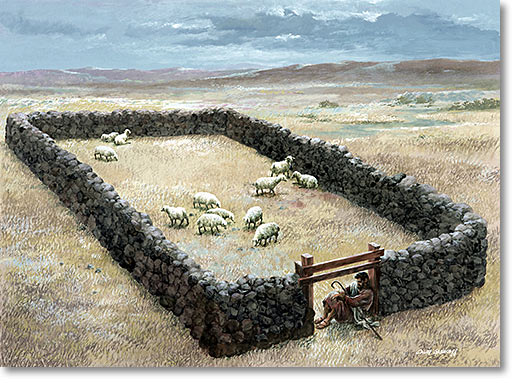
Do you know what a sheepfold from the time of Jesus looked like?  Check the picture at the top of the post. Note the typical layout of a sheepfold. The walls are built of stone and have a single opening.  Generally, the opening has neither a gate nor a door built in it.  It’s just an open passage.

Look closer.  Note the shepherd lying in the doorway, perhaps asleep.  In the time of Jesus, the pen openings were designed to be just large enough for a shepherd to lie across.  He would sleep in that space and would become the actual door.  The sheep would not be able to leave the pen without crossing over him and waking him up.  Nor would a predator be able to enter without him being aware.

Go back to the gospel and reread verse 9.  Jesus says “I am the gate, whoever enters through me will be saved.  He will come in and go out, and find pasture.”

Take the image and pray over the parable and that verse in particular.  Do they lend added meaning to what Jesus is teaching?  Do you see how he could be “the gate” in a deeper way than you might have otherwise imagined?

—————————-

John Chapter 10, Verses 14-15:

“I am the good shepherd.  I know my sheep and my sheep know me – just as the Father knows me and I know the Father – and I lay down my life for the sheep.”

In verses 11 through 18, Jesus says some version of the words “lay down my life” five times.  Five times in seven verses.  Do you think that might be important?

Do you think you already know what it means?  Does it have only one meaning, one layer?  Take time to ponder those questions for a moment while also thinking about the life of Francis. How might Francis have construed this phrase? 

The obvious interpretation centers on the Cross. 

At the beginning of the chapter, we clearly identify with being Jesus’ sheep.  We listen to His voice.  He calls us by name.  We follow Him out.  He gives us life in full.

We accept unflinchingly the assertion that He is the Good Shepherd.  When He shifts to speaking about laying down His life for the sheep, we understand that He is talking about laying down His life for us.  We understand implicitly that the sacrifice Jesus made by accepting and embracing the Cross “of His own accord” is a fulfillment of this section of the gospels.  The Good Shepherd lays down his life so that we might be saved.  The Good Shepherd calls every flock and invites them all to follow His voice.  No one is excluded from the salvific act of laying down His life.  All are eligible to be saved if they are willing to follow Him in and out of the gate that is also Him.

When, later in the chapter, Jesus says “the reason my Father loves me is that I lay down my life – only to take it up again,” we can fit that into the narrative of the Cross as well.  Taking His life back up is a clear reference to the Resurrection.  He takes His life back up and takes His seat at the right hand of the Father, and from there He continues to intercede for us in the hope that all of His sheep will be saved.

We know that one of the defining characteristics of Francis is his devotion to following the example of Jesus.  He sets out not only to follow the instructions of Jesus in the gospels, but to live his life on a day to day basis in the same earthly manner that Jesus did.  The desire to not just follow teaching, but to emulate lifestyle, is defining for Francis, and also for us as people who profess to live according to his charism.

The obvious question is this:

Did Francis “lay down his life” in some fashion in imitation of Christ? 

He didn’t suffer the Cross as Jesus did.  He did experience the stigmata.  Was that an act of laying down his life? 

Or did Francis accomplish this in some other fashion?  Did he, perhaps, make a fundamental choice that allowed him to live out this example of Jesus on a continual basis for his entire public life?

Think again.  Is there another way, an expanded way, to define “laying down one’s life” that Jesus accomplished and that Francis was able to emulate? 

—————————-

 At the end of the first volume of Francis of Assisi: Early Documents, there is a work entitled The Sacred Exchange between Saint Francis and Lady Poverty.  The author is unknown and the date of its composition is debated by scholars. 

The work is an allegory based on an imagined encounter between St. Francis and Lady Poverty.  At the end of the prologue, the beginning of the journey of Francis in search of this encounter is described like this:

At the beginning of his conversion, therefore, blessed Francis, as the Savior’s true imitator and disciple, gave himself with all eagerness, all longing, all determination to searching for, finding, and embracing holy poverty.

I just asserted that one of the defining characteristics of Francis was his devotion to following the example of Jesus.  Here that assertion is confirmed as Francis is defined as the “true imitator and disciple” of Christ.

Take a moment to look into your own heart.  Have you accepted and begun to enact this principle in your own Franciscan journey?  Decide for yourself whether or not this part of your Franciscan vocation needs to broadened. Is this an area of your profession that could benefit from some conversion?

—————————-

Francis begins his search by asking anyone he encounters if they know where he can find “her whom his soul loved.”  The problem was, no one understood what he was talking about.  “That saying was hidden from them.”  No one wanted to talk about Poverty because “they hated it with a vengeance.”

Francis decides to go and ask the wisest men he can find about Poverty.  Unfortunately, he gets an even more harsh response from them.  They also would not talk with him about Poverty, instead preferring to “enjoy delights and to abound in riches for the duration of their lives.”

Francis prayed to God that he be preserved from their counsels.  He left the city and in a nearby field encountered “two old men wasted away from great sorrow.”  When he spoke to them and asked where Lady Poverty could be found, they told him “she has now gone up to a great and high mountain where God has placed her.”  Hearing this, Francis “chose some faithful companions for himself with whom he hurried to the mountain.”

Although most who tried to ascend the mountain had failed, Francis and his group succeed with an ease that astonishes Lady Poverty, who watches their assent from the top of the mountain.  They gain the encounter they are looking for and begin to speak with Lady Poverty. 

She asks them the reason for their coming.  Francis replies by saying “we wish to become servants of the Lord of hosts.”

And then he describes Jesus in these terms:

For He, the King of kings, the Lord of lords, the Creator of heaven and earth, desired your splendor and beauty.  Even though the king was reclining at table, rich and glorious in his kingdom, he left his house and gave up his inheritance: for there were glory and riches in his house.  And so, coming from his royal throne, he sought you with the greatest courtesy.

How great must be your dignity, then, and how beyond compare your stature! He left behind all the ranks of angels and the immense powers – of which there is a great abundance in heaven – when he came to look for you in the lowest regions of the earth — ……………….

I asked you to consider whether or not there was another potential interpretation of the phrase “laying down one’s life.”  Francis could not directly imitate Jesus on the Cross, but he still needed a way to imitate this part of Christ’s sojourn on earth.

Read again the words “he left his house and gave up his inheritance” and “he left behind all the ranks of angels and the immense powers.”  They describe Jesus’ decision to come to earth, not as God, but as a man, into a situation of Poverty, not wealth. 

But they also describe Francis.  Francis left behind his own inheritance and worldly power when he walked away from his father and embraced his own life’s version of Poverty.

Before Jesus ever laid down His life on the Cross for His sheep, He had to lay down His divinity in order to come among us in the first place.  That initial laying down by Jesus is what makes the ultimate laying down of His life on the Cross possible.  When He sets aside His divinity, He holds nothing back.  He rejects all of His divine power and embraces Poverty in its place.  Jesus comes into the world not as an earthly king, but as a carpenter’s son born of a poor virgin in a stable.  As we have seen in previous chapters, He rejects all “worldly” riches and glory.  Instead, he takes Lady Poverty as His companion for the full duration of His stay on earth.

Francis did not have divinity to lay down, but he did have earthly riches and glory to lay down.  By rejecting the life his father offered him, he “laid down his life,” choosing, just as Jesus did, a life with Lady Poverty as his spouse in determined imitation of his Lord.    

In the allegory, before Francis is done praising Poverty, he reinforces this theme again:

For before he came to earth from his radiant homeland, you prepared an appropriate place for him, a throne upon which he would sit and a dwelling place in which he would rest, that is, a very poor virgin from whom his birth would shine upon the world.  At his birth you certainly greeted him with faithfulness so that in you, not in luxuries, he would find a place that would please him.  He was placed in a manger, the Evangelist said, because there was no room for him in the inn.  Thus, always inseparable from him, you accompanied him so that throughout his life, when he was seen upon the earth and conversed with human beings, while the foxes have dens and the birds of the air nests, he nevertheless had nowhere to lay his head.  Then, when he opened his own mouth to teach — he who once had opened the mouths of prophets –among the many things he uttered, he first of all praised you, he first of all exalted you: 

Blessed are the poor in spirit because theirs is the kingdom of heaven.

Jesus leaves behind His “radiant homeland” and His ability to “open the mouths of prophets” in order to dwell within “a very poor virgin,” who “places him in a manger.”  In His public life, he “had nowhere to lay his head” and His very first act is to proclaim “blessings on the poor in spirit. “

God lays down all His heavenly power in order to dwell amongst men in a state of complete Poverty.  This is the example He gives us.

In the best imitation he can achieve, Francis lays down his life, which consists of all his desire for all “worldly” wealth and power, in order to also dwell amongst men in a state of complete Poverty. 

—————————-

It is tempting to think that we should embrace Poverty so that we won’t be distracted by the things of the world and thus lose focus on what really matters, our relationship with God.

Or perhaps we think we should embrace Poverty so that we can use our resources to lift up those who, for whatever reason, can’t lift up themselves and need our help.

These are valid reasons, but they aren’t the only reasons, and maybe not even the primary reason.

Paragraph 10 of the SFO Rule says this:

               Let them also follow the poor and crucified Christ ………

As we read the Gospels, we want to pay attention to the teachings of Jesus.  We need to learn the lessons and apply them to our everyday lives.

But, as Franciscans, we also need to acknowledge the need Francis felt to imitate Christ in the way He actually lived His earthly life.  Francis chose a life of Poverty not so much because he wanted to avoid distraction or to help others, but because he looked at the Gospels and found in them the unavoidable conclusion that Jesus lived an earthly life devoted to Poverty.  Jesus told us “blessed are the poor in spirit,” but then He backed up those words completely by the way He chose to live while He abided here amongst us.  He Himself was truly “poor in spirit” just like He calls us to be.

When Jesus speaks about laying down His life for us, His sheep, it is not just about laying down His human life.  Jesus laid down everything He had, including His very divinity, in order to save us.  

Francis knew this.  He did not have divinity to lay down, but he still had the ability to imitate Jesus because he still could choose to lay down everything he had.  He chose Lady Poverty as his spouse and lived the ideal of Poverty so very strictly because that was how he interpreted what it meant to give all in imitation of Christ.

That is what constituted “laying down his life” for Francis. 

We are the sheep of Jesus, but we are also the sheep of Francis.  Francis also laid down his life so that we could be saved.  He set his own example so that we might follow it as we strive for the salvation that Jesus earned for us by laying down both His divinity and His life.

The greatest example that Francis set, the most sure thing we can do as sheep listening to his voice, is to follow him in his attempt to emulate and imitate Jesus. 

The rule does not say, “follow the poor Francis.”

It says, “follow the poor and crucified Christ.”

The reason it says that is because that is what Francis strove to do with his entire life.

On Franciscan Peace, The Death of John Lewis

Photo by Lorie Shaull

This past Saturday, I was watching the golf tournament and I fell asleep after being out in the sun all morning.  I woke up as the broadcast was ending for the day.  The local news (Chicago for me) was next on the schedule.  I can probably count on one hand the number of times I have watched mass media news in the past ten years, but a headline about the death of Congressman John Lewis caught my attention as I was about to turn the TV off.  Congressman Lewis rose to prominence as a leader of the civil rights movement in the late 1950s and early 1960s.

I watched the opening story and heard him lauded as a proponent of peaceful, non-violent protest.  Because we have this formation series on Peace open, I thought I would stay tuned.  I was intrigued enough that I listened all the way through not only the local news, but the national news that followed.  On Sunday morning, I searched out clips on Congressman Lewis from the morning talk shows.  Monday, I spent time looking for information on the Internet and ordered a book by Dr. Martin Luther King entitled Stride Toward Freedom.

The mention of the terms “non-violence” and “peaceful” made me curious at first, but my interest was captured more completely when another story came on.  This story showed video of ongoing Black Lives Matter protests somewhere in California, perhaps San Francisco?  What won my full attention was a prominent sign held up by one of the protestors that read, “No Justice, No Peace!” 

For the balance of Saturday and all day Sunday I had this juxtaposition bouncing in and out of my awareness.  I was wondering if that sign meant that the peaceful methods of Dr. King and Congressman Lewis had been largely abandoned?  This is what sent me searching the Internet on Monday.  To what extent has peace lost its ascendency as a primary component of the protests that are happening today?

———————————————

The video that accompanied the stories on Congressman Lewis was compelling.  It was immediately clear that it was the violence of those desiring to maintain the status quo that did them in.  Grainy black and white images of protestors being blasted by fire hoses or peaceful marchers being beaten on Bloody Sunday made it clear beyond doubt who was in the right and who in the wrong during that time.

Born in 1963, I am not old enough to have witnessed any of this directly.  But watching a few minutes of video educated me more about the civil rights movement (especially about its roots in the non-violent methods of Gandhi and ultimately Jesus) than anything I had experienced in the previous 56 years of my life. 

The peacefulness of the demonstrators was clearly instrumental in the victories they won.  The ultimate expression of this is of course the death of Dr. King, reminiscent of the death of Jesus himself.  In Chapter 15 of the gospel of John, Jesus says, “Greater love has no one than this: to lay down one’s life for one’s friends.”  Dr. King was not a Franciscan, but in this he followed directly in the footsteps of Francis.  He lived out this gospel passage literally and, I would argue, intentionally.  He may have hoped otherwise, but he accepted that his chosen course of public action could ultimately lead to his early death. 

Franciscans believe that conversion is an ongoing process that never reaches its completion. 

Dr King’s impact has not been as immediate or far reaching as one would hope, but it is still unfolding.  Hopefully, unlike conversion, it will reach completion, but it is likely to take a long time.  The hearts and habits of men are not easily changed in a single or even a couple generations.  The struggle requires patience and endurance. 

Are the principles of peace that Dr. King championed critical to the pace of progress?  Is the legacy of Dr. King best served by adhering to the tenets of non-violent protest that were integral to his approach and clearly instrumental in his success?  If devotion to his doctrines is allowed to wane, is the cause well served?

———————————————

According to Wikipedia, the phrase “No Justice, No Peace” first came into wide use in the mid-1980s in response to racist violence in New York City.  The same article goes on to say that the phrase has two different interpretations.

The first is conditional.  In the “if-then” scenario, Justice must proceed Peace.  If Justice is absent, then those who experience injustice will ensure that Peace is disrupted until the time that Justice has been accomplished.  According to the article, this was the context of the use of the phrase when it became prominent in the eighties.

The second is conjunctive.  In this more philosophical approach, Justice and Peace are codependent.  Neither can exist without the other.  Injustice is caused by the absence of Peace.  At the same time, Peace cannot thrive if Justice is absent.  The two are linked in such a way that each needs the other to flourish.

The two definitions might seem like splitting hairs, but they are not.  If the second is true, if peace is in any fashion a pre-requisite to justice (which codependency requires), then the if-then scenario is doomed to failure.  The disruption of Peace cannot logically lead to the implementation of Justice because the absence of Peace inherently leads to the opposite, to an absence of Justice. 

In other words, Peace and Justice must be pursued concurrently. 

Wikipedia, at the end of the article, references Dr. King using a similar phrase in 1967 in a speech against the Vietnam War.  Unfortunately, this Wikipedia reference is incomplete.  With just a little digging I found this audio on YouTube, in which Dr. King clearly states (at the 3:10 mark), “There can be no justice without peace and there can be no peace without justice.”

Dr. King embraces the conjunctive form of the phrase in this speech.  Given his passionate embrace of peaceful, non-violent protest, this is expected.  But it is nice to be able to hear him say the words in context so that his meaning cannot be misunderstood.

Dr. King clearly places himself on the side of Justice and Peace being codependent.

———————————————

There can be no doubt that the death of George Floyd and so many others in similar circumstances represent a grave injustice.  There is also no doubt that violence (in other words, a lack of peace in the broadest terms) on the part of police officers is at the root of this injustice.  The violent actions responsible for these injustices must be addressed.  Individual officers must be held accountable for the wrongs they have committed.  Police forces in general must find a way to proactively eliminate the occurrence of these events so that these offenses end.

There can be no compromise in that.  The police must adapt and maintain an attitude of peace as the predominant principle in every action they take before their perpetrations of injustice will cease.  This does not mean that they cannot use force when necessary.  But it does mean that the decision to use force is governed by an overarching devotion to peace that seems absent in the broad philosophy of policing right now.

It may mean that, like Dr. King, police officers need to accept the risk of peace in their everyday duties.  In order to become “peace officers” in the fullest sense, they may need to consider “laying down one’s life” not just for one’s friends, but also for the greater good and harmony of a fresh culture where everyone (regardless of race, etc.) must be considered not just a friend but a sister or brother.

It is a heroic request but being a police officer is often seen as a heroic calling.  How can we help police officers live into this enriched vision of themselves?

———————————————

Protest and demonstration are apropos given the situation.  But what is the role of peace in these protests?  If protestors dare to ask police officers to risk Peace, will they be willing to risk it themselves?  Will Peace be sought through Peace?  Will today’s leaders ground their actions in Peace as Dr. King and Congressman Lewis did?  

In other words, will the phrase “No Justice, No Peace” be employed in its conditional or conjunctive form? 

If the conditional interpretation is chosen, if the response to injustice is violence and a disruption of Peace, what will the outcome be? 

One already prevalent outcome is video of the response being aired right along with video of the original injustices.  It is just as likely that video of looters breaking shop windows or cars being burned will be shown as any other.  All constitute news and in the modern world of communication, all sides can emphasize whatever they wish to emphasize.  Those who ought to be stuck on defense have their own regular and social media outlets and often their own dedicated audiences.  Any instance of retaliatory violence captured on tape allows them to go on the offensive, thereby clouding and confusing the picture as well as reinforcing the viewpoint of persons already partial to the status quo.

In the original civil rights movement, videos of violence by the government against peaceful protestors were the best weapon the protestors had.  The first link above (about the use of fire houses in Birmingham) makes it clear that videos of unwarranted violence catapulted the civil rights movement to success.  As each instance of governmental violence was videotaped and added to the existing record, the accumulation of injustice provided momentum to the movement until it could not help but culminate in victories such as landmark Civil Rights legislation.

Racism may not have been completed defeated and eliminated by that legislation (legislation does not possess the power to change the hearts of individual men) or the accumulation of other victories in the 1960s, but progress was made.  How then to learn from these lessons of history so that more progress can be made?

How can Peace be used as a tool today just as it was used in the original movement?

———————————————

It is clear from the audio that Dr. King and Congressman Lewis embraced the second, conjunctive interpretation of the phrase “No Justice, No Peace.”  They believed that embracing Peace was imperative to progress against injustice.  Justice did not precede Peace but existed in close cooperation with it, each building the other up.  The more the protestors embraced Peace (in contrast to the embrace of unjust violence by the forces of the entrenched) the more successful the movement became.

The result of this embrace of Peace was that there was no competing video story to derail the story of injustice that the entrenched were writing themselves.  Only one side of the story, the side of the story grounded in Peace, was compelling enough to be captured on tape and thus to secure the attention and sympathy of the nation.

Contrast that to current circumstances.  Videos of violence done to black men at the hands of police abound.  Yet, they have not had the same effect.  Is this because the storyline is clouded by the abundance of videos on the other side?  Does a lack of peacefulness make the current effort its own worst enemy just as the entrenched were their own worst enemy sixty years ago?

What if now, like then, there was only video on one side of the story?  How would that change the dialogue?

One injustice cannot correct another.  More acts of violence cannot cure a culture that is addicted to violence in so many ways.  They only serve to enable and excuse the next round in a never-ending cycle of pain and hostility. 

Only Peace can break that cycle.  If the police will not embrace Peace, then the opposition must if it hopes to overcome them.

The protests themselves must not increase the amount of injustice in the world as they are carried out.  Acts of violence on the part of the protesters (looting, destruction of property, treating all police officers as unethical instead of as individual human beings) constitute the opposite of Peace and, because of their indiscriminate nature, are in and of themselves undertakings of injustice. 

They supply pretexts for maintaining the status quo and muddy the waters making it much more difficult to achieve progress.

They are contradictory to the goals that Dr. King and John Lewis set so many years ago.  They are harmful to the cause of ending racism and establishing equality.

———————————————

So, what does all of this have to do with Franciscan formation?

The gospel of Mark (5:9) says,

“Blessed are the peacemakers, for they will be called children of God.” 

The epistle of James (3:18) reads,

Peacemakers who sow in peace reap a harvest of righteousness.”

Article 19 of the OFS Rule says,

Mindful that they are bearers of peace which must be built up unceasingly, they should seek out ways of unity and fraternal harmony through dialogue, trusting in the presence of the divine seed in everyone and in the transforming power of love and pardon.”

Francis, in Admonition XV (Peace), quotes the verse above from Matthew and then continues,

“Those people are truly peacemakers who, regardless of what they suffer in this world, preserve peace of spirit and body out of love of our Lord Jesus Christ.”

Thomas of Celano, in The Second Book of The Life of St. Francis, chapter V, says this about Bishop Hugolino, who Francis chose as father and lord over his whole religion: 

“That lord conformed himself to the ways of the brothers…………….The Lord gave him a learned tongue.  With it he confounded the opponents of truth, refuted the enemies of the cross of Christ, led strangers back to the way, made peace between those in conflict, and bound together those in peace in a stronger bond of love.”

One of the biggest challenges I am confronted with as a Franciscan is how to live out my vocation in the real world.  Fraternity meetings are a place of great solace and comfort.  They allow me to explore my profession with like minded people in an atmosphere of security and peace.  I love that about our meetings, and I miss it tremendously in the absence of gatherings forced by the pandemic.

But to truly live out my calling, I must find ways to leave the comfort of that fraternity cloister and take Franciscanism into the world.  As I listened and investigated the stories of John Lewis and Dr. Martin Luther King, I found myself confronted by peace in action in a real-world setting.  These men were true peacemakers and I found myself wanting to follow their example.

Read the quotes above again, this time with the example of these men in mind.

Do you find them fulfilled in their lives?

Does this inspire and challenge you to seek ways to become a peacemaker in these troubled times?

On Saying Yes, the Introduction

Image by Gemma Correll

In mid-November 2019, I took a leave of absence from my regular job as a project manager for a large construction company.  This came at the end of a grueling two plus year assignment on a single project.  During those two years, I lost my 17-year-old son in a car accident and my 42-year-old sister to lung cancer.  I never had a chance to deal properly and completely with either loss in the course of the job.  No job can give you the genuine extended freedom needed to deal with such things appropriately.  The “world” is not arranged to allow such accommodations.

I was spent.  I did not quit outright because I knew I was in no state to make sound judgments. Did I either want or need to continue doing this type of work with my life?  I did not think I would go back, but it was not the opportune moment to decide.  To the credit of my employer, they allowed the leave of absence and left the door open for me to come back.

By February, I knew that I was not going back to the corporate construction world.  I had neither the desire nor the energy (at age 56) to recommit myself to the grind.  I am fortunate that my wife has a good job that provides sufficient income for us to stay even plus the health insurance benefit the “world” requires.  I offered to help in a consulting role that I thought might be useful, but the truth is I was relieved when they said no.  I did not want to go back even in that role, primarily because of the office politics I knew would be waiting.  My wife’s income afforded the flexibility to be patient and contemplate other options.  I was content to do just that.

I had been trying unsuccessfully to find time to work on building some houses for a nonprofit.  Perhaps I would now have the flexibility to follow through on this not just as a job, but as a vocation.  But as the work on the houses unfolded, I found that I was viscerally resisting this option.  I was engaged reasonably well as the design work took place, but as soon as we began investigating the money, I was filled with dread each time I needed to open my computer.  It had been some time since I had been enthusiastic about the world of construction, but I thought this was due to burn out.  Once I had a chance for an extended recovery period, I expected I would re-embrace it, especially if I were associated with a nonprofit. 

But this was not the case. 

I will stop here long enough to say that in this situation, discernment is a difficult thing.  It is hard to know if the resistance is the call of the Good Guys to something else, or the enemy distracting you from what you are supposed to be doing.  In truth, I am still not 100% sure which it is.  (I say is because the situation is still unfolding.  The house building endeavor was stopped cold by the pandemic and is just now regaining traction.  While I have reached the decision not to act as the builder, I am still involved with the nonprofit and it is unclear how that will develop.)

As the planning for the houses progressed and the pandemic started, I launched this blog.  The idea had been in hand for a long time, but there came a point in mid-March where I could not escape the sensation that the moment had come.  The pandemic seemed to offer a natural segue to an online effort at religious formation.  People were going to be separated from their fraternities for an extended period (which appears even longer now) and this format had the potential to allow them to maintain some sense of connection.  I had experimented with blogging before and found that advancements in technology made it much easier to get restarted.  Within a day or two, I was up and running in test mode.  In not much more than a week, I was able to publish for the public.

Mid-April arrived and I felt like I had my long-lost energy back.  My enthusiasm was no longer being depleted by the stress and strain of a regular job.  I was making progress on the housing front and on the blogging front and I was even getting caught up on some commonplace things I had let slide, like keeping my bank accounts balanced.  I was exercising regularly, eating better and had lost some weight.  I was in the midst of planting a full vegetable garden (39 raised beds) and the physical labor felt good.  If not yet fully healed, I was progressing beyond everything I had endured in the previous two plus years.  There were other projects not getting attention, but I felt like it was just a matter of time before I could get to everything.

However, within a month, I began to lose momentum.  Distractedness and uneasiness increased.  I caught myself back at some old, bad habits.  Too much TV at night, procrastination, rationalization, etc.  When I had a regular job, I always felt that it kept me from doing the things I was being called to by God.  The “world” just took too much out of me.  I thought without that drain I could consistently and meticulously offer a proper “yes” in response to what God wanted of me.  But that proved to be temporary.  I was not there yet.

The surge of energy I found in the liminal time waned as a new normal developed.  I fell back into the waywardness that I was used to blaming on the fatigue of my working life.  But now, I no longer had that excuse.  I would find myself sitting on the couch watching some inane show on Netflix or Amazon Prime and would think, “What are you doing?  God is watching and you are just sitting here frittering away the day?  Why don’t you get up and do something productive!”

But I would not respond.  Once I used frivolousness as an escape from the pressure, exhaustion and dissatisfaction of a day spent doing things other than what I felt called to.  Now, I could not explain away my flippancy.  I had to look at things differently.  I could review a day where I meant to get an estimate done on a house or a post written for this blog and see that I did not accomplish what I meant to.  I had good intentions at the beginning of the day, but I would find that I got sidetracked, often without realizing it.

Something was wrong and it was now out in front of me.  The excuse of a regular job no longer concealed it.  I was failing to do what I perceived as God’s Will for my life and I could not hide from it.

I would do an examination of conscience at the end of the day and see spots where even if I were doing something that seemed productive, I was not focused on the most important thing that needed doing.  This is what I mean by rationalization.  I would choose to dig a garden bed when I could have been writing a new blog post that was needed to maintain the pace of the blog.  I knew in retrospect the blog post was the priority, but I was not choosing it in the moment.  (Before June I was publishing something every four days or so.  In all of June there are only four posts, and this will be the first in July.  I could have published most of Journey thru John in June if I had just been diligent about it.)

The open discernment issue on the nonprofit is another example.  I have yet to find my way to a final answer.  This is at least in part due to not working diligently enough at the issue.  If, in the end, I am going to move away from that possibility, I still must complete what is mine to complete before I can hand things off.  But I am procrastinating instead of working consistently on it.  I could still decide to stay involved, limiting my availability in other areas and that will be fine if I believe staying involved is in fact a “yes” to a calling. But I am not sure because I am not diligently doing the work, which is the most likely way to complete the discernment.

I am allowing myself to be distracted by a sort of lesser good, a human conceived good.  Why?  If I think a blog on religious formation or working for a nonprofit is was what I might be called to, why am I continually being distracted by the garden?

Some of this is attributable to still having too much on my plate.  I have not learned to make my life simple enough yet.  (Just yesterday I was watching a show on Netflix called Amazing Interiors and found myself thinking about all the cools things I could design and implement.  Then I stopped and thought, “Am I called to that?  Probably not. ” At least I had that thought to check me, but why did I allow the show to distract me to start with?)  I am rid of the burden of a regular job, but I still have too many things to do.  The work on the houses, the blog, the garden and more mundane things (like grocery shopping and cooking, which I feel more obligated to since my wife is working and I am not) still add up to more than what can be accomplished in a day.   

Still, I cannot escape the real conclusion that I am not saying “yes” to God and Jesus in the way I need to.  If I cannot yet do exactly what is asked of me, I can at least work on the simplification that should lead to the proper “yes” I so desperately (at least in theory?) want to say! Whether it is an outside distraction from the enemy or an internal failing (or more likely a combination of both) is hard to know, but I feel as if I must develop greater discipline than I have known in a long time If I am to grow into what I long to be for God.  I have a lot of negative habits to unlearn and a lot of positive ones to subsequently relearn. 

In Franciscan terms, I have a lot of conversion in front of me!  I need to find a way to get to the point where I am feeling confident that I have said “yes” in a comprehensive way!  I want more than ever to do what I am called to do!  I am committed to this despite being disappointed in my execution the last few weeks!  I am resolved not to give up!

As a result, I have concluded that I need to investigate the idea of saying “yes” itself.  It is an idea I have already been considering.  My recent prayer life has led me to a deep reflection on the ultimate “yes” in scripture, the “yes” that Mary says in response to the angel Gabriel at the Annunciation.

I have also recently been reading a commentary on The Confessions of St. Augustine.  His “yes,” which comes at the end of a long period of “worldly” procrastination, comes out of a life experience that I have always felt closely parallels my own.  I believe it could help me greatly if I can find my way to the core of Augustine’s triumph over his own prevarication.

I am also feeling drawn to the conversion experience of St. Paul.  I cannot give details about that yet other than to say there are certain passages in his writing that I connect to in a substantive way.  

And then, finally, a review of the Franciscan sources with an eye toward identifying those pivotal moments when Francis said “yes” and thus moved toward the culmination of his seeking.  At what moments did Francis chose Jesus definitively and how do those relate to the experiences of Mary, Augustine and Paul?  And how might those moments help me to give a more perfect “yes” in imitation of these other great yeses from Christian history?

At the beginning my reflections may not be as strictly Franciscan as the Journey thru John formation series is.  I will not often be drawing on Franciscan Sources and the OFS Rule as I look at the examples of those who came before Francis.  But I do believe that those three figures will inform and give context to my investigation. In the meantime, I hope that my Franciscan nature is sufficiently developed that it will show through even when I am not specifically concentrating on Franciscan texts or overtly attempting to make Franciscan points.

In Journey thru John, I began by following a personal calling to investigate the phrase “gospel to life and life to gospel.”  I then took my local fraternity along for the ride.  (As an aside, I would recommend every formation director follow similar inclinations as they discern what materials to present to their groups.  Passion for your subject material will translate into a positive experience for those you are leading.)

I am proposing to do something similar here.  In order to take the next step in my faith development, I am feeling the need to investigate what it means for a committed Christian to say a complete and proper “yes” to whatever it is she or he might be called to by God.    

I am inviting you to join in this exploration!

And I would humbly and appreciatively welcome any observations the Holy Spirit might inspire you to share along the way!

Journey thru John, Chapter 9: On Being Blind

Jesus Opens the Eyes of a Man Born Blind (Duccio di Buoninsegna, between 1307 and 1311)

I am sure the pattern is consistent by now, but just in case, be aware for a moment how the reflection on each chapter begins with suggestions about how to immerse yourself in the scene.  Recall that this immersion is meant as an aid to your ability to pray over the material in the chapter.

Chapter Nine is, in its entirety, about blindness.  The goal of immersion is to enter closely into the scene so that you can “see” the events and take part in them.  Juxtapose that against the teaching on blindness.  Seeing is not just a physical action, but a spiritual one as well.  In the act of immersion, these two aspects of seeing are combined.  Using imagination, we attempt to actually “see” the physical action in the gospel scene.  In prayer, we are attempting to “see” the point of the teaching that Jesus is attempting to convey so that we might apply it to our everyday lives as Franciscans.

Is it important to grasp Jesus’ meaning here?  Do you need to be able to “see” with your spirit in order to fully enter the scene?  What blindness do you carry with you on a day to day basis and how does that hamper your ability to enter the scene and learn what Jesus wants to teach you?

Given the opportunity, would you go one step further with your immersion?  Is there someone you know well enough that you would ask them to spit in some dirt and rub mud in your eyes that you might “see” better?

Would you let a stranger do it?

Will you let Jesus do it?

If you’re willing, challenge yourself to enter the scene in such a deep and meaningful way that you experience Jesus rubbing mud in your eyes.

—————————-

John Chapter 9, Verses 39-41:

Jesus said, “For judgment I have come into this world, so that the blind will see and those who see will become blind.”  Some Pharisees who were with him heard him say this and asked, “What?  Are we blind too?”  Jesus said, “If you were blind, you would not be guilty of sin:  but now that you claim you can see, your guilt remains.”

It is important to read this scripture carefully.  When we think about Jesus curing the blind anywhere in the Gospels, we tend to focus on the surface, on the immediate outcome.  We want our eyes and spirits opened as well.  We want to see what Jesus wants us to see.  We want to be healed by Him.  It seems straightforward.

In these verses, however, that forthrightness is challenged.  Jesus says He has come into the world so that “those who see will become blind.”  For some of us, He is proposing the opposite of what we would seem to want.  What does that mean?  If I can already see, why would I want to be blind?  I do not need to be cured, right?  To make me blind would seem to be contrary to what Jesus came to do?

Then a moment later Jesus says, “now that you claim you can see, your guilt remains.”  Here then, is an answer to the contradiction.  He is revealing to us that our sight is often faulty.  He is asking that we embrace the possibility that while we think we can see, maybe we should think again.  He is asking us to do a careful self-examination and to be internally truthful about what we find.  Are we honestly able to see what He wants us to see, or is our assumption of sight a symptom of a more profound blindness? 

Jesus wants us to understand that spiritual blindness is a state that has to be purposefully embraced before it can be cured.  He can be the healing agent, but He cannot effect the cure without our cooperation and participation.  We must humbly and honestly seek the cure for it to take hold.  If I am not willing to admit that I am blind, if instead I follow the ongoing example of the Pharisees throughout the Gospels and assert my own vision and will as determinative, then I wind up never realizing (never seeing?) that I have left the path to salvation. 

The key to the cure is not the willingness of Jesus.  He is always willing, always waiting, always available to provide the cure.  But the cure can only take place if I am willing.  Will I cooperate by embracing humility and acknowledging my need?  I cannot cure myself.  I can only be cured if I embrace the truth that I must completely rely on Jesus for the healing to take place.  The act of humility that embraces the truth of my need is the transition point between blindness and sight.  

I think I can see but am blind.  I become humble enough to acknowledge the incorrectness of my ways and to accept that without Jesus, it is impossible to be anything but blind.  This then provides the opening for Jesus to work the healing and turn my blindness to sight.

—————————-

If you want your eyes opened to the starting point, I would invite you to begin by re-reading the Prologue to the Rule.  As a reminder, these are the actual words of Francis, written as an Exhortation to the Brothers and Sisters of Penance.  Francis thoroughly defines blindness in Chapter Two, Concerning Those Who Do Not Do Penance:

But all those men and women who are not doing penance………These are blind, because they do not see the true light, our Lord Jesus Christ:  they do not have spiritual wisdom because they do not have the Son of God who is the true wisdom of the Father………See, you who are blind, deceived by your enemies, the world, the flesh and the devil, for it is pleasant to the body to commit sin and it is bitter to make it serve God.

Take note of the word “world” again in its negative connotation.  It does not seem to want to go away.  Here we find the “world” to be a major cause of spiritual blindness.

Bonaventure, in the Sermon on the Feast of the Transferal, echoes the theme of “worldly” blindness while confirming poverty as the antidote, the pathway to spiritual sight.

………when a person is tied to temporal possessions which waste away and are dark and tainted, he cannot perceive the brilliance of divine light.  That was the kind of advice Saint Francis gave to his brothers, having in mind the words of the Psalm: “fire has fallen on them,” that is, the fire of avarice and possession.  The fire of avarice and possessiveness causes blindness, whereas the fire of poverty gives brightness and solace.

I would encourage you to read and contemplate the entire Exhortation again if you have not done so lately.  It is quite clear that Francis sees the need to obtain a cure for our blindness as paramount.  If we do not, here is what he believes to be waiting for us:

The worms eat up body and so they (those who do not do penance) have lost body and soul during this short earthly life and will go into the inferno where they will suffer torture without end.

There is a decision that has to be made and, if these are the consequences, it would be unwise to put it off.  Eternity hinges on the answers.

Do I think I can see, or not?  Am I blind, or not?  Do I need the healing of Jesus, or not?

Am I committed to penance and poverty, or not? 

Do the words of Francis and Bonaventure describe a part of me still desperately in need of conversion?  Will I do my part to enable healing from Jesus by acknowledging my attachments to the world and thus the need for conversion toward and through penance?  Can I willingly welcome the separation from the “world” that leads to healing and sight and ultimately salvation? 

It’s worth praying over.  It demands a thorough self-examination through a clear lens of self judgement.  I cannot afford to deceive myself, to believe I have sight when no sight is present.

I must ask Jesus to help me judge myself correctly.  I must ask Jesus to help me see who I really am.  I must ask Jesus to help me understand just how much I need Him, how dependent on Him I truly am.  

—————————-

So, now that I have scared myself (and you?) sufficiently about the hazards of remaining blind, perhaps it might be a good idea to inject some hope into the process.

The records of the miracles of Francis are full of instances where he healed blindness.  As I read through them, however, I found one that was particularly intriguing.  This comes from Chapter 14 of The Treatise on the Miracles of Saint Francis by Thomas of Celano:

In Zancato, a village near Anagni, a knight named Gerardo had entirely lost his sight.  It happened that two Lesser Brothers arriving from abroad sought out his home for hospitality.  The whole household received them with honor and treated them with every kindness.  The brothers gave no notice of the blindness of their host.  After their stay, the two brothers journeyed to the brothers’ place six miles away and stayed there eight days. 

One night blessed Francis appeared to one of the brothers in a dream with the command:  “Get up, hurry with your companion to the home of your host.  He honored me through you and on account of me was so graciously kind!  Show your thanks for your delightful reception and repay honor to the honorable!  For this man is sightless and blind, and that is what he deserves for the sins he has not yet confessed.  The shadows of eternal death await him, and unending torture is his lot.  He is bound to this by the misdeeds he has not let go.” 

When the father had gone, the son got up stunned and hurried with his companion to carry out the command.  Both of the brothers returned to the host together, and the one related what he had seen all in order.  The man was quite astonished as he confirmed the truth of all he heard.  He broke out in tears, freely made his confession and promised amendment.  As soon as the inner man was thus renewed, he recovered the outer light of his eyesight.  The greatness of this miracle spread everywhere and encouraged all who heard of it to extend the gift of hospitality.

The story is compelling because it addresses more than just a physical healing.  The healing is spiritual as well.  It also includes a self-examination that leads to penance.  The depth of the story, the duality of the healing, the embrace of conversion, all combine to echo the gospel and give a true life example of the power that is present in the teaching of Jesus about blindness.   

For the blind man in the gospel, Jesus provided physical healing and the man in turn worships Him as a result of revelation brought on by sight.  That worship is a sign of spiritual healing.  The healing enabled the man to see Jesus with his spirit, to recognize Him as the Son of Man. 

Likewise, this particular miracle by Francis has both components even if they are reversed in order.  Gerardo is healed spiritually and then experiences physical healing as well.

It’s also intriguing because it speaks directly to the instruction by Jesus to the Pharisees (who represent us) to acknowledge blindness so that they might see.  When the Brothers tell Gerardo their reason for returning, he looks inside himself and his blindness about his own sin is revealed.  His acceptance of that blindness leads to the cure, which then leads to him avoiding the fate that Francis warns about in the Prologue/Exhortation.  If and when we sincerely embrace penance as Gerardo did, it will lead to our eyes being opened and our blindness turning to sight.  Only then can we be saved from the dire consequences that Francis cautions about. 

And as friends of Francis, as people who honor Francis as Gerardo did, we have the hope that if we stray too far from the path Francis will attempt to intervene on our behalf just as he did for Gerardo.

—————————-

In fact, the Franciscan tradition holds a much greater vision of hope, a vision of blindness being healed on a global basis by the power of the Franciscan religion.  For those of you who have been on pilgrimage to Assisi, perhaps this is an image you can internalize in a way others can’t.  (Being in the scene is not just for the gospels!)  If you are planning on making that pilgrimage, make a special note to yourself to take a reminder of this image with you to reference on the day you visit the Portiuncula.  Maybe you will experience something akin to what happened to this fortunate follower of Francis. 

This vision can be found in the writings of both Celano and Bonaventure but the version I am giving you comes from Chapter 13 of The Legend of the Three Companions.  This is the most complete recounting and also the likely source for the other two.

A vision one of the brothers had, while in the world, contributed much to the commendation and love of this place.   Blessed Francis loved this brother with unique affection as long as he was with him, by showing him extraordinary affection.  This man, wanting to serve God – as he later did so faithfully in religion – saw in a vision that all the people of the world were blind and were kneeling in a circle around the church of St. Mary of the Portiuncula with their hands joined and their faces raised to heaven.  In a loud and sobbing voice, they were begging the Lord in his mercy to give them sight.  While they were praying, it seemed that a great light came from heaven and, resting on them, enlightened all of them with its wholesome radiance.

On awakening, the man resolved to serve God more faithfully, and, shortly thereafter, leaving the world with its seductions, he entered religion where he persevered in the service of God with humility and dedication.

The entire blind world gathered around the home of St. Francis in an act of universal penance.  Upon petitioning for the Lord’s mercy, enlightenment is granted to all. 

If the story of Gerardo the Knight was hopeful, how much more hopeful is this vision?  As Franciscans, we have always known that “our religion holds the cure for all the world’s ills.”  We often say such things tongue in cheek, but perhaps we should take them more seriously.  This vision would seem to suggest that what we believe about penance and poverty could miraculously affect the entire world. 

What would it take to get the world to listen? 

I don’t know for sure, but I do know that if I am honest with myself, if I hope to provide a cure for even one other person, I must first be sure to take the cure myself.  I must first embrace my own blindness and I must do so not once, but on a continual basis, always with my heart set on poverty, penance and ongoing conversion. 

Then, maybe, others will see in me the healing mercy of God and be moved to seek it for themselves as this vision of hope portends. 

—————————-

Francis, in an even further expression of wisdom and hope, tells us that we actually have reminders of this great light from heaven, this wholesome radiance, this cure for blindness, available to us on an everyday basis if we just pay attention to Creation around us.  In paragraph 83 of The Assisi Compilation, Francis links The Canticle of Brother Sun (The Canticle of the Creatures) to the curing of blindness:

He used to say:  “At dawn, when the sun rises, everyone should praise God, who created it, because through it the eyes are lighted by day.  And, in the evening, when it becomes night, everyone should praise God for another creature, Brother Fire, because through it the eyes are lighted at night.

He said, “For we are like blind people, and the Lord lights up our eyes through these two creatures.  Because of this, we must always praise the glorious Creator for these and for His other creatures which we use every day.”

I spend a lot of time encouraging you to enter scenes in the gospels.

It’s about time I encouraged you to be present to the actual scene you live in as well.  Be aware of the goodness of the Creation that surrounds you at every moment of every day.  Stop right now and take a few moments to acknowledge the Creation that you reside in.  Night or day, acknowledge the light around you and thank God for it.  Thank Him for imbuing Creation with His Presence and Power and learn something about light and blindness from His Creation right now, at this very moment. 

Jesus in this gospel is asking you to embrace blindness that you might see, repent and seek God’s mercy in order to be saved for all of eternity.

How amazing and unbelievable is it that Creation itself surrounds you with a reminder to do so?  The very light which we see by, be it sunlight, fire, or even the electrical light that we take for granted that Francis never knew, is a gift from God.  Even on the darkest night, when the slightest sliver of moon is hidden by a cloud covered sky, the stars always shine with enough light for us to see.  Creation itself is an antidote to the blindness that Jesus is speaking about in this gospel if we can just remain present enough to recognize it.  It’s a gift that can be used at any and every moment of our waking lives to remind us to embrace the healing sight that Jesus offers not just in these verses, but as the sum total of everything in His gospels. 

Every teaching in the gospels is a call to healing, a call to sight, a call to salvation.  On top of that, Creation itself echoes the call of the gospels, revealing the goodness and desire and love of God for you and me in its every aspect if we simply stop long enough to appreciate it.  It is all ours for the taking if we can simply humble ourselves enough to embrace the call by rejecting the world and embracing the light of Creation and the gospels.  Francis knew this.  He internalized it better than anyone else other than Jesus ever has.  It’s what allowed him to conceive The Canticle of the Creatures.  It’s why he was who he was. 

It’s why eight hundred years after his death we make a profession to follow his charism.  We want what he knew.

—————————-

It seems so easy, but it’s not.  The world does everything it can to maintain its hold on us, to distract us from emulating Francis and thereby Jesus.

Sometimes, when my prayer gets dark and difficult and unproductive, when the light seems the dimmest, when I am full of questions and I can’t find the answers and every thought is a distraction from the “world,” I find that there is only one thing to do, one way of praying, that works and brings me back to the place in my core where Jesus dwells.

Technically I suppose it falls under the heading of a prayer of petition, but I think it might be more accurately described as a prayer of pleading meant to give every need to Jesus for His action. 

It goes something like this:

Jesus I love you, Jesus I need you, Jesus enlighten me.

Jesus I love you, Jesus I need you, Jesus consume me.

Jesus I love you, Jesus I need you, Jesus guide me.

Jesus I love you, Jesus I need you, Jesus transform me.

Jesus I love you, Jesus I need you, Jesus convert me.

Jesus I love you, Jesus I need you, Jesus dwell in me.

Jesus I love you, Jesus I need you, Jesus pray for me.

Jesus I love you, Jesus I need you, Jesus strengthen me.

Jesus I love you, Jesus I need you, Jesus heal me.

I encourage you to pray long and deep over these ideas of blindness, sight and healing.  Use the method of prayer that works for you.

But if normal methods fail you, if you can’t put the distractions aside, if you are not confident that you are genuinely reaching the truth, I would encourage you to try this style of prayer.

There are hundreds of words that will fit at the end.  Once you declare your love and your need, take your time to search for the words that express your true desire, your true doubts, your true whatever and insert them at the end.  If you go sincerely in search of those words, the Spirit will provide them to you.  You will find yourself in prayer and discovery at the same time.

And when you find that point, when you find the words that truly express your need, you will have also found the true nature of your blindness, the true path to your sight.  By using those words to ask for Jesus’ help, you will be giving your blindness over to Him.

And He will, upon receiving it, provide the healing that turns sight to blindness and blindness to sight.

He will heal you just as he healed the man in this Chapter of John.

And you will then be free to worship and love Him gladly, just as that man did.