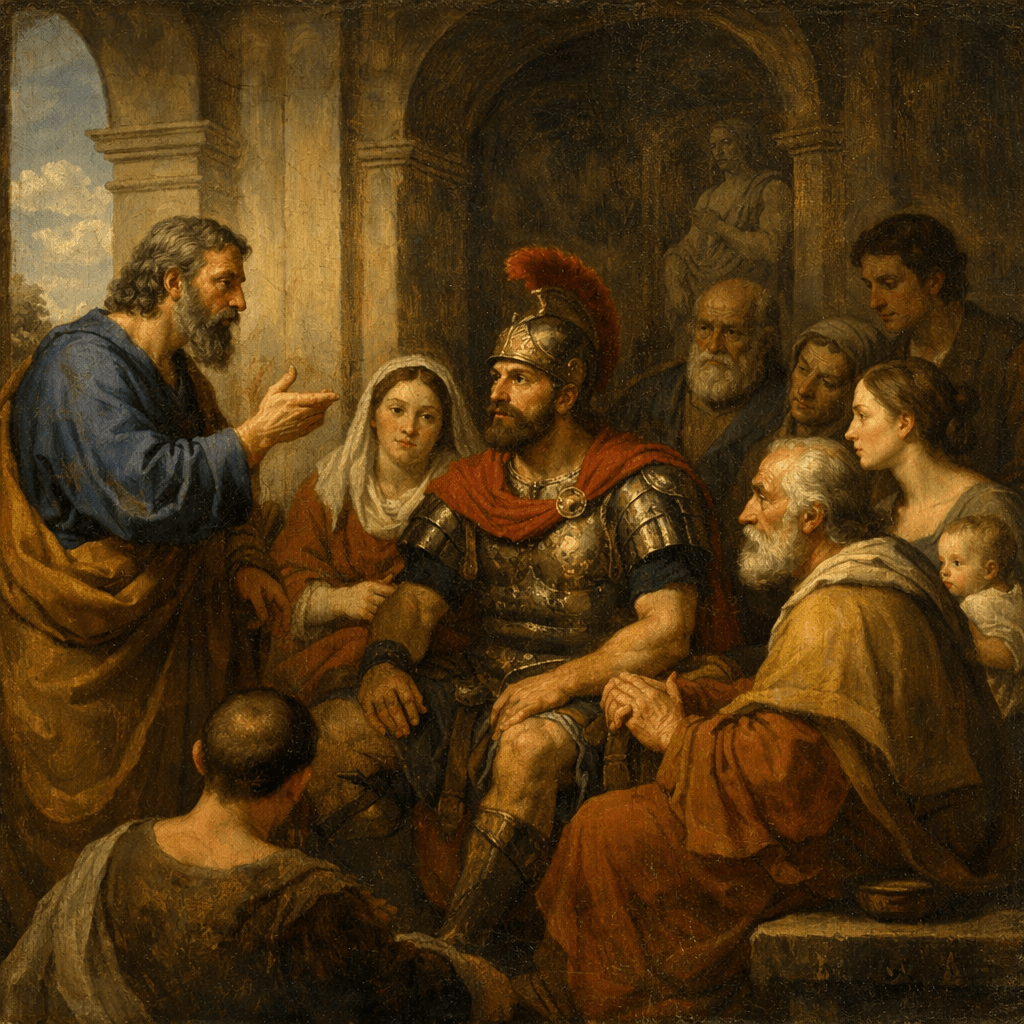
Acts 10: 34, 37-43 (The 1st reading from the Mass on Easter Day)
Then Peter began to speak:
“You know what has happened throughout the province of Judea, beginning in Galilee after the baptism that John preached—how God anointed Jesus of Nazareth with the Holy Spirit and power, and how he went around doing good and healing all who were under the power of the devil, because God was with him.
We are witnesses of everything he did in the country of the Jews and in Jerusalem. They killed him by hanging him on a cross, but God raised him from the dead on the third day and caused him to be seen. He was not seen by all the people, but by witnesses whom God had already chosen—by us who ate and drank with him after he rose from the dead.
He commanded us to preach to the people and to testify that he is the one whom God appointed as judge of the living and the dead. All the prophets testify about him that everyone who believes in him receives forgiveness of sins through his name.”
In the bullet points of Part One of this post I stated that, so far, it’s been a dismal and disheartening story. From the perspective of our humanity, the downward spiral we experience as a result of sin seems irreparable and irreversible. Despair seems appropriate. A permanent death seems inevitable. Darkness seems triumphant. What could we possibly do to rescue ourselves from our predicament?
This must have been what the enemy was thinking as he watched Adam and Eve exit the garden. He must have been feeling celebratory. God had created man with the highest of hopes about the bliss that would result from the exchange of Love between Himself and His Creation, and within a short period of time, with one simple suggestion, the enemy seemingly had derailed the entire plan. His first reaction must have been to congratulate himself.
His fall had come because he wished to be the equal of his Creator. He was not content to be second, so it was natural that he deceive Adam and Eve by suggesting to them the same. They should also not be content to be lesser. Instead, they should seek to become greater by eating the forbidden fruit. By spoiling God’s plan, he surely believed that he had proven to God his equality.
Feeling empowered and elevated by the success of his deception, he likely thought to try his own hand at creating. But he would have realized abruptly that he had no idea how to proceed. Following directly from that would be the realization that destroying is not the same as creating. Creating is something that is completely and utterly beyond him. Creating is the purview of God alone and the enemy has no idea how to wrest that power away and claim it for himself.
Grave doubt must have crept in quickly. Almost immediately, he must have begun to fear that his success came too readily. Surely, God would not allow his plans to be ruined so simply and easily?
He would have realized that God had likely planned for this contingency.
And worse than that, God would likely have planned in such a way that this obstacle would not only be overcome, but it would prove to be a catalyst to an even greater success than what would have occurred if the deception had never taken place.
Blinded by anger, he would have been unable to comprehend that God had created with the intent that Love would not only be present within His Creation, but that it would expand and increase as a result of every action that occurred within Creation. The enemy’s goal is the disruption of this process, but he deceives himself when he believes he is capable of accomplishing that purpose. Instead, his role, as is true for every role, is to serve God’s design. The more he seeks to disrupt the process, the more God will use him to expedite and increase the production of Love.
In the image from the last post, we see the snake slinking along the ground, trailing Adam and Eve from the garden. Frustrated by doubt, driven by bitterness, and unable to comprehend the inevitability of his role in the unfolding of Creation and the expansion of Love, he is not content with this single disruption. He will beleaguer man relentlessly, attempting to deceive him at every turn. Even if he is unable to create as God does, if he can foil the plan of God and deny Him success, then he believes he can still be triumphant, and still attain the equality with God that he so desperately seeks.
Never will he realize or accept that the one he is ultimately deceiving is himself. Never will he recognize or admit that he is a tool and also part of the plan.
God, in his omniscience and omnipotence, is content to allow the enemy to proceed. He will turn what seems to be evil into not just good, but a good that is greater than what is otherwise possible if the evil had never been present.
His boundless Love and certain Will ensure the result.
Life will inexorably triumph over death, Light over darkness, and Hope over despair, just as our definition of Victory requires.
———
That definition, given in the opening of Part One, contains a second element that centers on the conquering of sin and death. When I felt the Holy Spirit pushing me to fully flush out the meaning of the Victory of Easter before I moved on to how the word “Easter” applies to the life of St. Francis, it was this component that I focused on. Thus, I stated that “my deeper delving should be centered on the concepts of sin and death in the scriptural record.” This led me to the story of the Garden of Eden in Genesis, and then to the conclusion that the rejection of Love and the embrace of sin can only, if left unchecked, result in death.
When I speak above of the enemy’s desire to thwart the plans of God, it should be understood that the ultimate goal he is striving for is death. When he follows Adam and Eve out of the garden with the intent of badgering man ruthlessly and incessantly, the flourishing of sin and the permanent death of each and every one of us is what he is seeking. It is by ensuring the dominance of sin and the eternal death of God’s beloved creatures that the enemy hopes to establish his equality with God.
God, of course, is unwilling to allow this outcome. His righteous judgement includes death as a penalty for our sin. However, just as the enemy feared, this judgment is not the end of the story, but the beginning. His Love, Mercy, Power and Wisdom are intent on not just denying the efforts of the enemy, but on turning those desires to His own purposes. The story that unfolds beyond judgment will therefore serve His original intent. The result He will achieve will include an expansion of Love well beyond the enemy’s ability to foresee, comprehend or forestall.
When we recognize that the Victory of Easter must be centered on God’s (Love’s) desire to forgive sin and overcome death, we become open to possibilities that otherwise are not evident. Yes, God pronounces a judgment that includes death in response to our willful sinfulness. This is because we must be held accountable for our defiance. Creation could not be just otherwise. But He quickly moves beyond that judgment to the arena of Love and Mercy because Creation could also not be just if it was impossible for Love to ultimately emerge triumphant.
Let me say that again, for emphasis. Creation cannot be just unless a pathway for the triumph of Love is clear and apparent.
Therefore, even as God pronounced His judgment in the Garden, He was also planning the Victory of Love over sin and death that would follow.
The context of Genesis makes it clear that God often walked with Adam and Eve in the Garden. He desired to be present to them regularly, continuously and always. Even as he told Adam “dust you are and to dust you will return,” He already knew that He would become present to man again in the form of the Son. And he knew that His Loving and Merciful presence would be the mechanism by which sin and death would be overcome.
The Victory of Easter is the culmination of God’s Loving desire to maintain a physical, authentic and permanent presence among His people.
In His Passion, He accomplishes the first element required for Victory. He takes the sin of all people, past, present and future, upon himself and at the moment of His death on the Cross He achieves remission and forgiveness of that sin.
And then the second element of Victory, the defeat of death and the restoration of the possibility of eternal life, is restored through the Resurrection. By raising His Son on the third day, God proves that death is not the end. Because Jesus rose, we have hope (remember, hope is an integral part of the first element of the definition of Victory) that we can rise as well and join our God and Savior in everlasting life in heaven.
This is why the scriptural passage above is given to us on Easter Sunday. It contains both of the requirements for our second component of Victory:
“Everyone who believes in Him will receive forgiveness of sins through His name.”
“This man God raised on the third day and granted that he be visible …….”
In the Passion and Resurrection of Jesus, we find a triumph of Love that is beyond all expectation and an expansion of Love that is beyond anything that might have been feasible without the failure of Adam and Eve in the garden. The enemy was surely blindsided when God chose this path. The idea that God would become present once again amongst His people and choose to suffer the very same death that He pronounced on them as judgment is something that would be incomprehensible to a being unable to understand, know and practice Love.
The enemy did not recognize Jesus after the Incarnation. He was no doubt perplexed by this man who performed miracles as easily as most men walked across a room. He plotted for the demise of this man at the hands of the powers that be, never understanding that he was contributing to God’s plan all the while. As the Passion unfolded he thought he was about to achieve his goal, never realizing that all of his scheming was about to be permanently overturned. His own devious maneuverings would open the door for the stain of sin to be erased from anyone willing to believe in Jesus and trust in His Name. Then the Resurrection that followed would restore the possibility of eternal life to all who enthusiastically embraced that belief.
He is utterly defeated and his plan to establish equality with God is permanently thwarted. Yet still he seeks to lead us into sinfulness and death in the hope that somehow the reality of God’s Victory will be undone.
This happens because the enemy also cannot comprehend the long term implications of what occurred. He cannot accept the reality that God’s Victory did not happen once, but instead is always unfolding, and thus can never be negated. As we touched on in the last reflection, the permanent institution of the Mass and the Eucharist ensure that the Victory of Easter over sin and death is not a historical event, but an ongoing occurrence. And the triumph of Light over darkness is also constant to those who appreciate that the continuous rising of the sun, set into motion by God on the very first day of Creation, is a permanent and fitting reminder of the rising of the Son amid His Resurrection on Easter morning.
———
In the opening paragraph I asked “what can we do to rescue ourselves from our predicament?”
The truth is, there is nothing we can do on our own. But the ever-present good news is that we were created by a God that Loves us so completely that He was willing to share condemnation with us in order to provide us a way out of our dilemma. Since the inception of Creation, He has sought the expansion of Love, and the solution to our quandary is to freely choose to fully participate in His plan for the fulfillment of Love within Creation.
As the reading from Easter morning tells us, we have one responsibility to fulfill in this transaction, and that is to believe. We are to believe in the saving power of Christ and allow it to transform our lives. Our belief, properly enacted, is much more than an intellectual decision. It is a commitment to plunge ourselves into the life of Christ by prayer and by immersing ourselves in scripture, most particularly in the gospels.
As Secular Franciscans, Article Four of our Rule calls us specifically to this task when it instructs us to go from gospel to life and life to gospel.
When we enter into the gospels, we find this call to belief omnipresent. Our immersion in the life of Christ incessantly calls us to belief and our belief constantly encourages us to maintain our immersion. Each will feed the other in a cycle that reverses the decline from Genesis and restores us to an upwardly mobile state where we can fight successfully against our inclination to sin and live into the hope of the Resurrection.
John’s gospel is the apex of this call to belief, with the verb “believe” appearing 98 times in the text. Therefore, it is only fitting that on Divine Mercy Sunday (which celebrates the Mercy and Love that made the Victory of Easter possible) the gospel selection come from John. On the Sunday after Easter, we experience a resounding call to reject doubt and believe wholeheartedly in the Triumph of Christ.
John 20: 26-31
A week later his disciples were in the house again, and Thomas was with them. Though the doors were locked, Jesus came and stood among them and said, “Peace be with you!” Then he said to Thomas, “Put your finger here; see my hands. Reach out your hand and put it into my side. Stop doubting and believe.”
Thomas said to him, “My Lord and my God!”
Then Jesus told him, “Because you have seen me, you have believed; blessed are those who have not seen and yet have believed.”
Jesus performed many other signs in the presence of his disciples, which are not recorded in this book. But these are written that you may believe that Jesus is the Messiah, the Son of God, and that by believing you may have life in his name.
When we assume the role of Thomas and follow the direction from Jesus given here, when we seek for ourselves “life in His Name” through committed and devoted belief, then the final fruit of the Victory of Easter, salvation and eternal life, becomes possible.
- Does it make sense to you that Justice requires man to be judged for his sinfulness and that the judgment include death? Does it also make sense that Justice requires the possibility of the forgiveness of sins and the restoration of access to eternal life in order that Love can ultimately be triumphant? Do you see how Justice grants a second chance, a chance to recognize our sinfulness and recover from it through the mechanism of belief, a belief that requires us to fully embrace and immerse ourselves in the life and saving power of our Lord and Savior Jesus Christ?
- Do you now have a better idea of where this series is headed? What are the specific ways that the Franciscan charism encourages belief in the saving power of Christ? Specifically, how does the call to live a gospel life support the need to believe?


2 thoughts on “Victory, Part Two”