Mark 1:14-15
After John was put in prison, Jesus went into Galilee, proclaiming the good news of God. “The time has come,” he said. “The kingdom of God is near. Repent and believe the good news!”
In the last reflection, we completed our investigation into the meaning of the word “Victory” in the context of the celebration of Easter. As a reminder, here is the definition we were working with:
“The Victory of Easter is the foundational Christian belief in Jesus Christ’s Resurrection, representing the ultimate triumph of life over death, light over darkness, and hope over despair. It signifies that Jesus conquered sin, Satan, and death through his sacrifice and rising, offering humanity redemption, forgiveness and the promise of eternal life.”
That reflection focused on the second half of this definition. I acknowledged that death as a consequence of sin was rooted in a sense of justice that was completely righteous. As a counterpoint, I also emphasized that justice required a clear and apparent pathway for Love to emerge triumphant. This meant that “the Victory of Easter must be centered on God’s (Love’s) desire to forgive sin and overcome death.” I then recognized how Jesus conquered and overpowered sin via His Passion, how God established the possibility and promise of eternal life through the Resurrection, and how these two together constitute a pathway for Love to triumph over the death that the enemy ultimately hopes to inflict upon each of us. Finally, I argued that this manifestation of Love is much more resplendent than what would have been possible if Adam and Eve had never failed in the Garden.
Then, through the story of Jesus’ appearance to Thomas at the end of the gospel of John, I proposed that my main responsibility in response to the actions of Jesus must be belief. “I am to believe in the saving power of Christ and allow it to transform my life. This belief, properly enacted, is much more than an intellectual decision. It is a commitment to plunge myself into the life of Christ by prayer and by immersing myself in scripture, most particularly in the gospels.”
With these understandings in hand, I finally feel prepared (and hope you do as well) to consider what might be meant by the phrase “the Easter of St. Francis.”
———
Because the historical event of Easter occurs at the end of Jesus’ life, it might seem logical that we head to the end of Francis’ life at this stage. However, I think we need to take our initial cue from the word “transform” as it appears above. If we start with the idea of transformation, then it only makes sense that we need a firm understanding of Francis’ state of being as he began his journey of conversion. To completely and accurately understand the meaning of such words as Poverty, Penance and Conversion and how they have the potential to lead us to holiness and sanctity, we must begin not with the end of Francis’ life, but the beginning.
This takes us to the first chapter of “The Life of St. Francis” by Thomas of Celano, where we find considerable detail not just about Francis’ state as a young man, but about how he arrived at that state. (As you read these excerpts, keep in mind the discussion of the spiral of sin that took place in the reflection Victory, Part One. Celano clearly has a similar understanding of the predicament man faces as a result of his sinfulness. In particular note his use of the phrase “slaves of sin,” which echoes that reflection and speaks directly to the woefulness of our fallen state.)
In the city of Assisi, which is located in the confines of the Spoleto valley, there was a man named Francis. From the earliest years of his life his parents raised him to arrogance in accordance with the vanity of the age. And by long imitating their worthless life and character he himself was made vain and arrogant.
But even when children advance a little more in age, they always fall into more ruinous actions by their own choice. For a flawed tree grows from a flawed root; and what was badly corrupted can only with difficulty be brought back to a norm of justice.
…… flowing on the tide of every kind of debauchery, since they are permitted to fulfill everything they desire, they surrender themselves with all energy to the service of outrageous conduct. For having become slaves of sin by a voluntary servitude, all the members of their body display the weapons of iniquity, and, displaying nothing of the Christian religion in their own lives and conduct, they content themselves with just the name of Christian………
This is the wretched early training in which that man whom we today venerate as a saint – for he truly is a saint – passed his time from childhood and miserably wasted and squandered his time almost up to the twenty-fifth year of his life. Maliciously advancing beyond all of his peers in vanities, he proved himself a more excessive inciter of evil and a zealous imitator of foolishness…….Thus with his crowded procession of misfits he used to strut about impressively and in high spirits, making his way through the streets of Babylon.
If one of my sons becomes a saint, I hope his biographer will be more generous with me than Celano was with Francis’ parents! But I think the point here is more about demonstrating the power of evil operating in the world than it is to specifically condemn Pietro Bernardone and Pica. The influence of the enemy was present in the world in the time of Francis every bit as much as it is now or was in the Garden. The sinful state of Francis is the norm, not the exception. It should be comforting and a source of hope to know that Francis began his adult life as a sinner, and an accomplished one at that.
The emphasis here is that Francis’ sinfulness placed him on a path that would inevitably end in death (see the definition of Victory again) and that conversion centered on the Passion and Resurrection of Christ was the mechanism by which he would be saved.
(Truthfully, it reminds me of me at that point in my life. If I can make a fraction of the progress that Francis did once he committed himself to the process of conversion, I will consider myself fortunate and blessed.)
At the end of that first chapter, Celano then relates God’s reaction to Francis’ behavior. As we have come to expect, God’s focus is not on punishment, but on Mercy. Love for not just Francis, but for all of those who would be converted through him, clearly shines through as the planned intervention of God is detailed.
Then the Lord looked down from the heavens
and for the sake of His own name
He removed His own anger far from him (Francis),
and for His own glory He bridled Francis’ mouth
so that he would not perish completely.
The hand of the Lord was upon him,
a change of the right hand of the Most High,
that through him the Lord might give sinners confidence
in a new life of Grace;
and that of conversion to God
he might be an example.
———
As the second chapter opens, Celano tells us about what “having the hand of the Lord upon him” meant in the life of Francis. We might hope that God would simply cure us miraculously from our sinfulness in much the same way that Jesus cured the afflicted during His earthly ministry, but that is not the way God typically seeks to attract and hold our attention. His just judgement and His Love require us to pay a price in suffering for our sinful willfulness, and Francis was no exception.
Thus it is that Celano portrays God’s intervention as double edged, using both the words “vengeance” and “anointing” to describe the trial that He set before Francis at the opening of his journey to conversion. The same trial that was meant to afflict Francis was also meant to turn him away from sin and lead to spiritual healing. (If I am open and honest with myself, I can point to times where God attempted similar two sided interventions with me. Unfortunately, I have yet to respond as successfully as Francis ultimately did):
At the very time when he (Francis), not knowing how to become tame, was aroused by the venom of the ancient serpent, the divine vengeance, or rather the divine anointing, came upon him. This aimed, first of all, at recalling his erring judgment by bringing distress to his mind and affliction to his body, according to that prophecy: “Behold, I will hedge up your path with thorns, and I will stop it with a wall.” (Hosea 2:6)
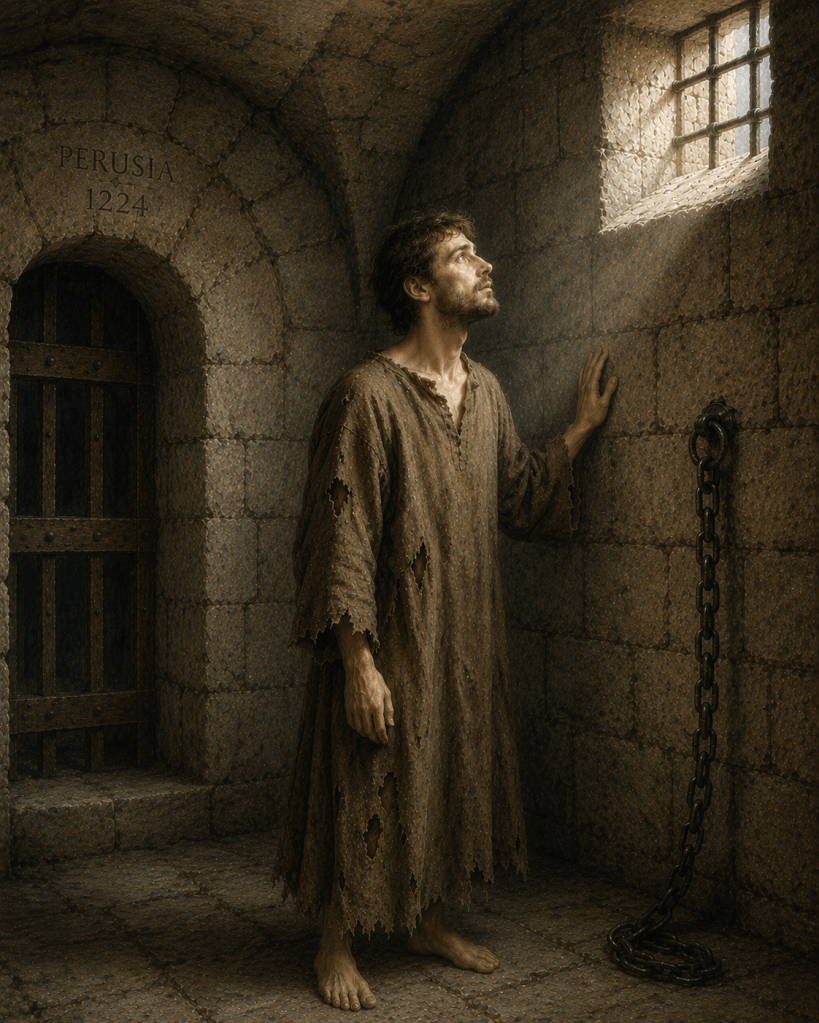
Distress and hardship for Francis came in the form of an illness (most likely malaria) that he suffered as a result of imprisonment. Accoutered as a knight and riding a splendid horse, Francis joined his fellow citizens in battle against the neighboring city of Perugia. Assisi experienced a resounding defeat and Francis, because he had the resources to afford armor and a horse, was deemed a good candidate for ransom. He spent nearly a year in harsh conditions in a subterranean prison before negotiations for his release were completed, and the resulting maladies incapacitated him for an extended period after his liberation.
Amidst his recovery, he began to experience a change of heart, the beginnings of what would become his lifelong process of conversion. Celano describes Francis walking through the countryside and finding no solace in the experience:
But the beauty of the fields, the delight of the vineyards, and whatever else was beautiful to see could offer him no delight at all. He wondered at the sudden change in himself, and considered those who loved these things quite foolish.
From that day he began to regard himself as worthless and to hold in some contempt what he had previously held as admirable and lovable, though not completely or genuinely. For he had not yet been freed from the bonds of vanities nor had he thrown off from his neck the yoke of degrading servitude.
Francis needed to relinquish the superficial before he could begin to understand the underlying Grace, splendor and magnificence that we encounter when we experience God present in His Creation. His worldly eyes had to be closed and his spiritual eyes opened before he could appreciate the goodness, loveliness and exquisiteness of this paradise that God had provided for him.
This does not happen in an instant. It takes time. Thus Celano describe the changes as “not complete or genuine.” In the next sentences he says “It is difficult to leave familiar things behind, and things once instilled in the spirit are not easily weakened. The spirit, even a long time after its early training, reverts to them; and vice, with enough custom and practice, becomes second nature.”
More echoes of the discussion on the spiral of sin.
The balance of the chapter then continues in the same vein. Celano talks about Francis “vowing, out of vainglory and vanity, to do great things.” A nobleman from Assisi begins to plan another military excursion and Francis determines to accompany him. He mistakes a dreamed vision of a house filled with soldier’s arms as a promise of great worldly success and glory to come.
Celano does not go into as much detail related to the aborted excursion to Apulia as other sources do. He also leaves out many other incidents from the early period of Francis’ conversion. This may be because he was writing first and was not aware of everything that came later, or perhaps he sought brevity and felt he had supplied enough to make the context of this period clear. Either way it is evident from just this much that Francis’ conversion did not happen instantaneously, but instead unfolded over a period of time. It’s also clear it was not a smooth or direct path, but instead consisted of fits and starts and detours and roadblocks.
It is the nature of our human condition that change is difficult and Francis was not exempt. The enemy and the world work against our reformation. Old habits die hard. Comfort and ease and familiarity call us back continuously to what we might prefer to leave behind. We take two steps forward and one step back, and we do so over and over and over again.
It is no use to deny or downplay this reality. The first step on the road to change and conversion is to accept our current truth and prepare ourselves for the long journey ahead. If we know and accept that we will falter, then it is that much easier to persevere, because when we accept the inevitability of a stumble, we open ourselves to the humility and dependence that allows us to seek the help of our Lord and Savior, Jesus Christ, who is anxious to assist us.
At the opening of chapter three, Celano tells us how Francis did just this:
Changed in mind but not in body, he now refused to go to Apulia and was anxious to direct his will to God’s. Thus he retired for a short time from the tumult and business of the world and was anxious to keep Jesus Christ in his inmost self. Like an experienced merchant, he concealed the pearl he had found from the eyes of mockers and selling all he had, he tried to buy it secretly.
Francis plunged himself into the life of Christ and this became the turning point in his conversion. He accepted the truth of his situation and began to plan for the long haul. He separated himself from the distractions that made it so hard to accomplish his purpose and placed himself firmly in the presence of God the Father and Christ the Son. Celano tells us next how Francis joined a friend in “remote places” to talk about what he was experiencing. “Inspired by a new and extraordinary spirit he would pray to his Father in secret…….He prayed with all his heart that the eternal and true God guide his way and teach him to do His will.”
His conversion took on momentum because, in a true demonstration of Penance and Poverty, he had turned his face away from the world and toward God.
The door to transformation, sanctity and holiness had been opened by God through both “vengeance” and “anointing,” and Francis had managed to step through it. He still had a long way to go, but he was well begun.
———
As Franciscans, we often talk about conversion as a lifelong, ongoing task. This is rooted in what we have been discussing above. We understand conversion to be trying and continuous because when we look at the life of Francis, we see this is how it was for him.
Article 7 of the OFS Rule understands and expresses this difficulty. It reads in part:
United by their vocation as “brothers and sisters of penance,” and motivated by the dynamic power of the gospel, let them conform their thoughts and deeds to those of Christ by means of that radical interior change which the gospel itself calls “conversion”. Human frailty makes it necessary that this conversion be carried out daily.
I now want to suggest to you that one great place to anchor our understanding of Easter within the Franciscan charism is this article of the Rule.
In the first sentence of his Testament, Francis begins by saying “when I was in sin.” Celano gave us sin as the starting point and Francis, nearing the end of his life, confirms it. This phrase defines the circumstance of being in and of the world. He is acknowledging that as his process of conversion began, he was no different from Adam. The pattern of sin and death that began for all of humanity in the Garden is the same pattern that Francis was living as he moved from youthfulness to early adulthood. Like Adam, his sinfulness left him at risk of death. If he was to have hope of eternal life, he needed to change the way he was living.
At the end of the opening paragraph of the Testament, Francis finishes by saying “I delayed a little and left the world.” He is now designating his destination. He is relating how conversion took hold and defined a new direction and outcome for his life. This phrase then describes the opposite of his initial condition, the condition of having successfully turned away from the world and toward God in a sincere attitude of Poverty and Penance. By acknowledging his delay, he is conceding the difficulty and unevenness of the conversion process. But despite those difficulties, he succeeded in moving from a life centered in sin and death into a life fixed on the promise of Easter.
Go back to the second half of the definition of Victory: “It signifies that Jesus conquered sin, Satan, and death through his sacrifice and rising, offering humanity redemption, forgiveness and the promise of eternal life.”
Is it clear that as Francis is relating his own conversion, he is detailing a movement away from sin and death and toward eternal life? Is it clear that he is describing a transformation that embodies the meaning of the Victory of Easter?
When Francis sought to remove himself from sin via conversion, he sought to live into the promise of redemption and forgiveness that Jesus offered through His Passion. When he sought to leave the world, he was striving to live into the promise of eternal life that God opened through the Resurrection. Conversion and transformation characterize the path that leads us away from the downward spiral of sin and toward a cycle of upward mobility and reunification with God.
They are the affirmation that signifies belief in the life sustaining power of the Passion of Christ and His Resurrection.
They are the fruit of immersion in the gospel of Christ and a prayer life that seeks unity with Christ in all things.
They are the mechanism by which we fulfill our responsibility to fully participate in the expansion and Triumph of Love within Creation.
Turning away from the world in an attitude of humility, Penance and Poverty is the essence of the transformation that Francis sought. A conversion rooted in reliance on and confidence in the restorative power of our Lord and Savior Jesus Christ is the core of everything that Francis believed. What we see then is that Francis’ entire religion, his entire journey of conversion, is an attempt to live into the Victory that Christ accomplished via His suffering and sacrifice on the Cross and His rising from the dead.
Accessing the Victory of Easter and the life giving power of Christ’s Passion and Resurrection is then the ultimate goal and summation of everything that Francis taught and hoped to accomplish.
- In the last reflection, I said that the one responsibility we have to fulfill in response to the Passion and Resurrection of Christ was to believe. In the gospel quote at the beginning of this reflection, we hear Jesus calling on the people to “Repent and believe the good news!” It seems a second responsibility has been added. We must believe, but we must also repent and seek conversion. How do you view the relationship between repentance and belief?
- Conversion is a hard thing to accomplish. We understand this from examining the life of St. Francis. An honest acceptance of our own “human frailty” also makes us intimately aware of this truth. We have no choice but to commit to the long and narrow road. What do you do to help sustain your commitment to conversion? What do you do when you realize that you have slipped? How do you get yourself back on track?
- Do you agree with the assertion that one of the overarching purposes of the Franciscan charism is to live into the promise of the Victory of Easter through conversion? Sin and death are to be left behind in favor of the pursuit of eternal life. How can you use this idea to build momentum in your own conversion journey?
 OFS Ongoing
2 thoughts on “The Conversion of St. Francis”