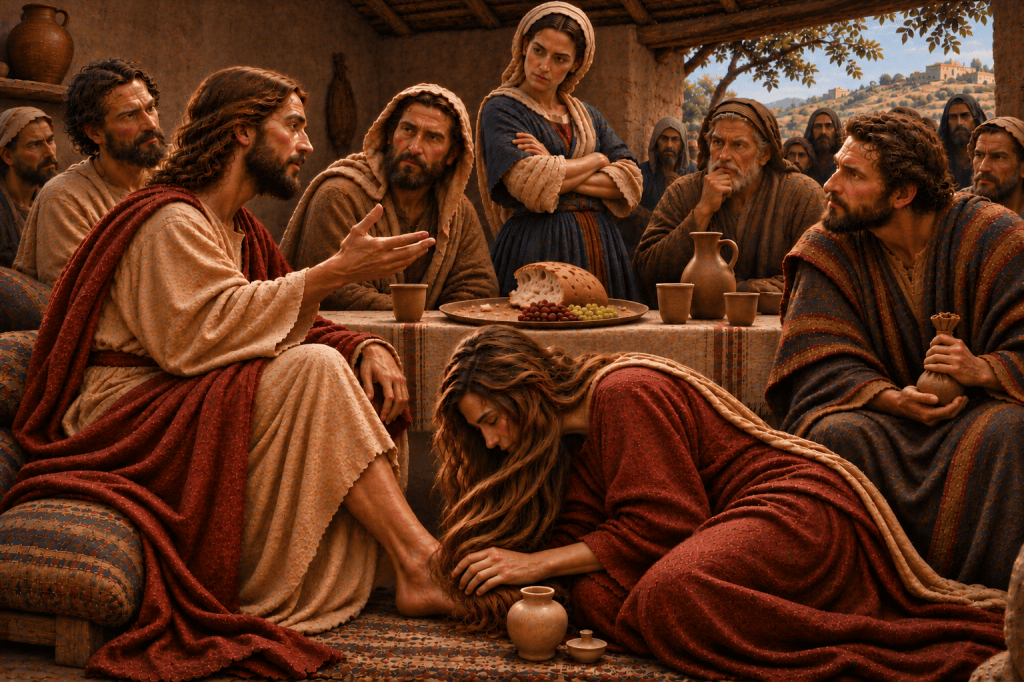
John 12:1-2, 9-11
Six days before the Passover, Jesus came to Bethany, where Lazarus lived, whom Jesus had raised from the dead. Here a dinner was given in Jesus’ honor. Martha served, while Lazarus was among those reclining at the table with him ……… Meanwhile a large crowd of Jews found out that Jesus was there and came, not only because of him but also to see Lazarus, whom he had raised from the dead. So the chief priests made plans to kill Lazarus as well, for on account of him many of the Jews were going over to Jesus and believing in him.
We have come to the concluding reflection for our series, The Easter of St. Francis. You are invited one more time to read and reflect upon chapters eight through ten of the second book of The Life of St. Francis by Thomas of Celano.
The actual passing of Francis occurs in chapter eight:
……… he called to him two brothers, his special sons, and told them to sing The Praises of the Lord with a loud voice and joyful spirit, rejoicing at his approaching death, or rather at the life that was so near ……… Then he ordered the book of the Gospels to be brought in. He asked that the Gospel according to John be read to him, starting with the passage that begins: Six days before the Passover (above), ..…… And then that most holy soul was released from the flesh, and as it was absorbed into the abyss of light, his body fell asleep in the Lord.
Note the presence of the risen Lazarus in the gospel passage. Also note the redirection of focus away from death and toward life in the quote from Celano.
Then recall our definition of the Victory of Easter:
“The Victory of Easter is the foundational Christian belief in Jesus Christ’s Resurrection, representing the ultimate triumph of life over death, light over darkness, and hope over despair. It signifies that Jesus conquered sin, Satan, and death through his sacrifice and rising, offering humanity redemption, forgiveness and the promise of eternal life.”
By now it should not be surprising to find “the ultimate triumph of life over death, light over darkness, and hope over despair” present and fully operational amidst the final scenes of the life of Francis. The choice of gospel passage, and in particular the presence of Lazarus in this passage, is not accidental. Francis is emphasizing for his followers (including you and I) the saving power of Jesus and “the promise of eternal life” that He won for us. And by calling on the brothers to “sing with a loud voice and joyful spirit,” he is asking his followers (again, including you and I) to be aware of the larger, long term picture.
His Transitus might be imminent, but this is not a reason for sadness or despair. Instead, we should be rejoicing because our spiritual father is about to experience the Victory of Easter directly. The “offer of redemption and forgiveness” generated by the Passion and Resurrection of Christ is about to be fulfilled in Francis, and he wants us to focus on this and this alone as the potential of his passing is fully realized.
Our definition of Victory, generated by AI eight hundred years after the death of Francis, melds perfectly with what Celano has to tell us about Francis’ state of mind at the end of his earthly life. This is not coincidence, although the credit for the long term continuity and immutability of God’s plan for our salvation belongs not to Francis, but to God’s ability to make his plan for humanity known and operative outside any bounds of time that might otherwise be thought or expected to restrict Him.
In fact, God’s foresight and omnipotence extends even to the discussion of belief that this definition of Victory has inspired in these reflections. Francis and his followers are able to rejoice in what is to come because of the unshakeable belief in the saving power of Christ that is at the core of the Franciscan religion. The Incarnation, Passion and Resurrection of Christ culminate in the Victory of Easter. The reference to “belief” in the gospel passage (“many of the Jews were going over to Jesus and believing in him”) is a foreshadowing of the prodigious belief that was about to develop in the wake of the first Easter, now just days away. As such, it clinches and cements the conclusions about belief that the Spirit led us to within these reflections.
None of these connections were planned by me or apparent to me when I started this series. I did not look ahead several months ago to this gospel passage, read the word belief, and then organize the train of thought in these reflections accordingly. None of this is ironic, happenstance, or accidental. At the very beginning, I sought the assistance of the Holy Spirit because I had no idea what the phrase The Easter of St. Francis meant. It is the Spirit, working over not just the past few months, but over the course of thousands of years, who is responsible for these ideas coming together so neatly in the end.
I feel like I should be surprised that it has all worked out so well. But, honestly, I’m not. I didn’t anticipate it, but it feels as if this congruence was inevitable, which I suppose it was, so long as I was able to keep myself out of the way and let the wisdom of God unfold before me.
_________
I am not feeling the need to make any more arguments about what the Victory of Easter means, or even about whether or not Francis’ life corresponds to it or somehow illustrates it. The arguments are complete. The only thing left to do is present some stories from the sources about the immediate aftermath of Francis’ passing and to allow the reality of Francis’ salvation to speak for itself.
It is now up to you to draw your own conclusions about what the “Easter of St. Francis” means from a historical and theological perspective, and then also from the perspective of how the balance of your earthly life will be effected.
In chapter eight of Celano, right after the quote above, we get this:
His disciple saw his soul ascending into heaven:
beautiful as the moon,
bright as the sun,
glowing brilliantly as it ascended upon a white cloud!
O true lamp of the world,
shining more brilliantly than the sun in the Church of Christ!
Now, you have withdrawn the rays of your light,
as you withdraw into that luminous homeland.
You have exchanged our poor company
for that of the angels and saints!
In The Remembrance of the Desire of a Soul by Thomas of Celano, Chapter CLXIV, we get this:
At that time the minister of the brothers of Terra di Lavoro was Brother Augustine. He was in his last hour, and had already for some time lost his speech when, in the hearing of those who were standing by, he suddenly cried out and said: “Wait for me, father, wait! Look, I’m coming with you!” The amazed brothers asked him to whom he was speaking, and he responded boldly: “Don’t you see our father Francis going to heaven?” And immediately his holy soul, released from the flesh, followed his most holy father.
In the next chapter, this:
At the very same hour that evening the glorious father appeared to another brother of praiseworthy life, who was at the moment absorbed in prayer. He appeared to him clothed in a purple dalmatic and followed by an innumerable crowd of people. Several separated themselves from the crowd and said to the brother: “Is this not Christ, brother?” And he replied: “It is he.” Others asked him again, saying: “Isn’t this St. Francis?” And the brother likewise replied that it was he. For it really seemed to that brother, and to the whole crowd, as if Christ and St. Francis were one person.
And this will not seem at all like a rash statement to those who rightly understand it, for whoever clings to God, becomes one spirit with Him, and that God will be all in all.
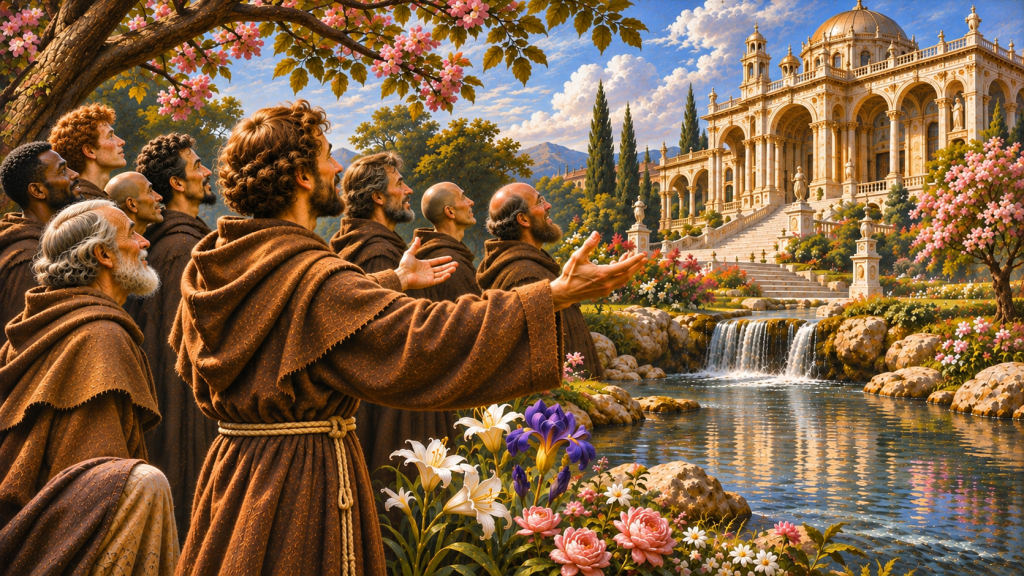
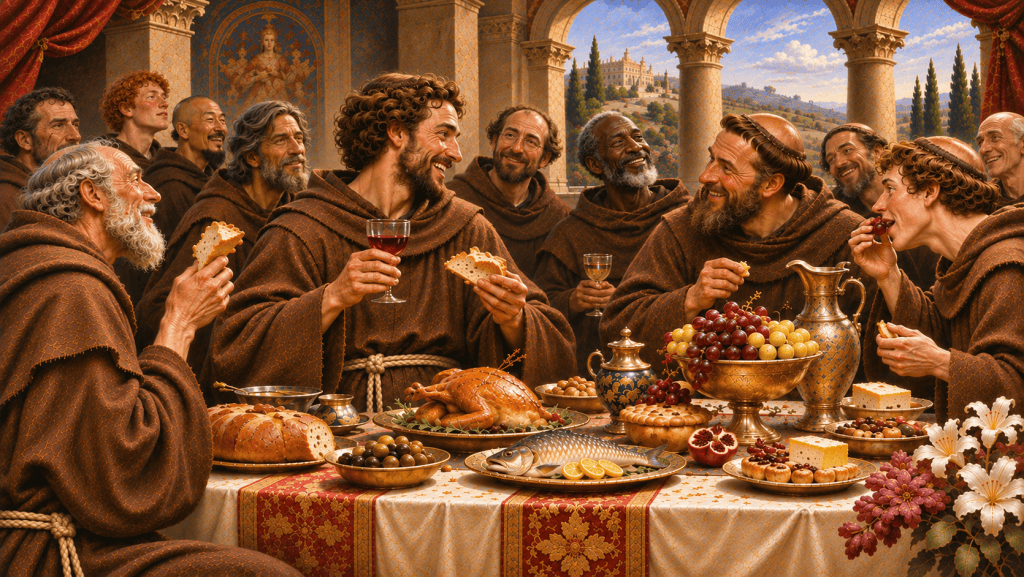
Finally the blessed father and the crowd arrived at a very beautiful place, watered with the clearest waters, flourishing with the beauty of flowers and full of every delightful sort of tree. There, too, was a palace of amazing size and singular beauty. The new inhabitant of heaven entered it eagerly. He found inside many brothers sitting at a splendidly set table loaded with various delicacies and with them he delightfully began to feast.
And in the next chapter, this:
At that time the bishop of Assisi had been at the church of Saint Michael because of a pilgrimage. He was returning from there, and was lodging at Benevento, when the blessed father Francis appeared to him in a vision on the night of his passing, and said to him: “See, my father, I am leaving the world and going to Christ!” When he rose in the morning, the bishop told his companions what he had seen, and summoning a notary, had the day and the hour of the passing noted. He was very saddened about this, and flowing with tears he regretted having lost such an outstanding father. And so he returned to his own country and told it all in order, giving unending thanks to the Lord because of his gifts.
_________
In the last couple reflections, I have been asking you to read and reflect upon chapters eight through ten of the second book of The Life of St. Francis by Thomas of Celano, but I have yet to touch upon chapter ten. That chapter deals with the transportation of Francis’ body back to the city of Assisi for burial. On the way, the procession stopped at San Damiano so that Clare and the Poor Ladies could say their goodbyes.
As you might expect, the messaging related to belief and joy remains consistent throughout Celano’s narrative. Like the brothers, they “looked upon him, groaning and weeping with great anguish of heart.” But they also experienced the miracle of the Stigmata, and thus, like the brothers, they were able to temper their mourning with the knowledge that Francis’ reward was assured.
The virgins’ modesty overcame their tears.
To grieve too much over him was unbecoming,
for at his passing
a host of angels rushed to greet him,
and the citizens of heaven
and members of God’s household rejoiced.
Thus,
torn between sorrow and joy,
they kissed his most splendid hands
that glittered with rare jewels and shining pearls…..
Celano then closes chapter ten with a prayer directed to Francis as intercessor. Francis’ bodily journey on earth may have come to an end, but Celano recognizes that he now occupies a position where he can be an advocate for the welfare of the family he has left behind:
O loving one,
bear in mind your poor sons,
for whom, without you,
their one and only consolation,
there is little comfort.
Even though you,
their primary and prized portion,
have joined the choirs of angels,
and are seated with the apostles on a throne of glory,
they still lie in a muddy swamp,
enclosed in a dark cell, tearfully crying out to you:
“O father,
place before Jesus Christ, son of the Most High Father,
His sacred stigmata;
and show Him the signs of the cross on your hands, feet, and side,
that He may mercifully bare His own wounds to the Father,
and because of this
the Father will ever show us in our anguish
His tenderness.
Amen.
So be it, so be it.
- How often do you think about your own passing in terms of Easter? Do you envision that, like Francis, you might “ascend into heaven upon a white cloud?” Do you picture yourself “eagerly entering a palace of amazing size and singular beauty” and “delightfully beginning to feast,” with friends and family “at a splendidly set table loaded with various delicacies.” Do you envision Francis among the crowd at that feast? Are you hopeful that he will be among those waiting to greet you when your time comes?
- Whatever your vision of salvation and heaven, do you regularly think of St. Francis as an intercessor and an advocate? Will you ask Francis to show his wounds to Christ, that Christ might in turn show His Wounds to the Father, all in support of your ever expanding belief in the saving power of Christ and unquenchable hope in the Victory of Easter?
- After this year long journey into the “Easter of St. Francis,” how has your outlook about “life and death, light and darkness, and hope and despair” evolved? Do you feel better equipped to understand and describe the idea of salvation to others? Have you made any changes in how you approach the most precious gift of life that God has graced you with, and are you organizing the balance of your life differently, with the specific goal of salvation more prominent in your decision making process?

