As a reminder, you are once again invited to read and reflect upon chapters eight through ten of the second book of The Life of St. Francis by Thomas of Celano. These chapters formed the basis of the last reflection, they are the primary source for this reflection, and they will also be referenced for the final reflection in this series next month.
Last time, I encouraged you to take this quote from chapter nine and use it in your personal prayer routine until you develop the ability to recall and reference it easily:
He was always with Jesus:
Jesus in his heart,
Jesus in his mouth,
Jesus in his ears,
Jesus in his eyes,
Jesus in his hands,
he bore Jesus always in his whole body.
I used these lines to define what I meant by the word “plunge” in my definition of belief. If I truly and fully immerse myself in the life of Christ via committed prayer and contemplation, then, even when I embrace rationality, my belief inevitably takes me well beyond the limits that come with an approach that is solely based in reason and logic. The ultimate conclusion is that “belief is not an intellectual decision. It is not even a way of life. It is more a mode of being and Francis is the consummate model of how this mode manifests itself.”
Francis’ tendency to remove himself from earthly concerns and constraints whenever Jesus became ascendant in his thoughts resulted in him inhabiting a liminal space somewhere between the worldly and the heavenly. He often found himself not quite here and not quite there. As he redefined what it meant to make the gospel and Poverty the center of one’s life, the nature, depth and commitment of his belief naturally evolved to a state well beyond what anyone had achieved before. One result of this progression was the Stigmata.
But he also developed a presence that was supremely attractive. This aura allows me to confidently assert that “another person could not look upon him without being entranced. His charisma was such that no one could encounter him and not be effected by his holiness.” And, “when his wake washes over you, it calls out to you, assures you of your innate worth, and invites you to believe as he believes, and thus to be transformed as he was transformed.”
If these assertions are true, then evidence of the impact that Francis had on the world around him should be readily evident in the sources that inform our understanding of his charism.
It should come as no surprise that when we look at the events at the end of his life, we find just that.
_________
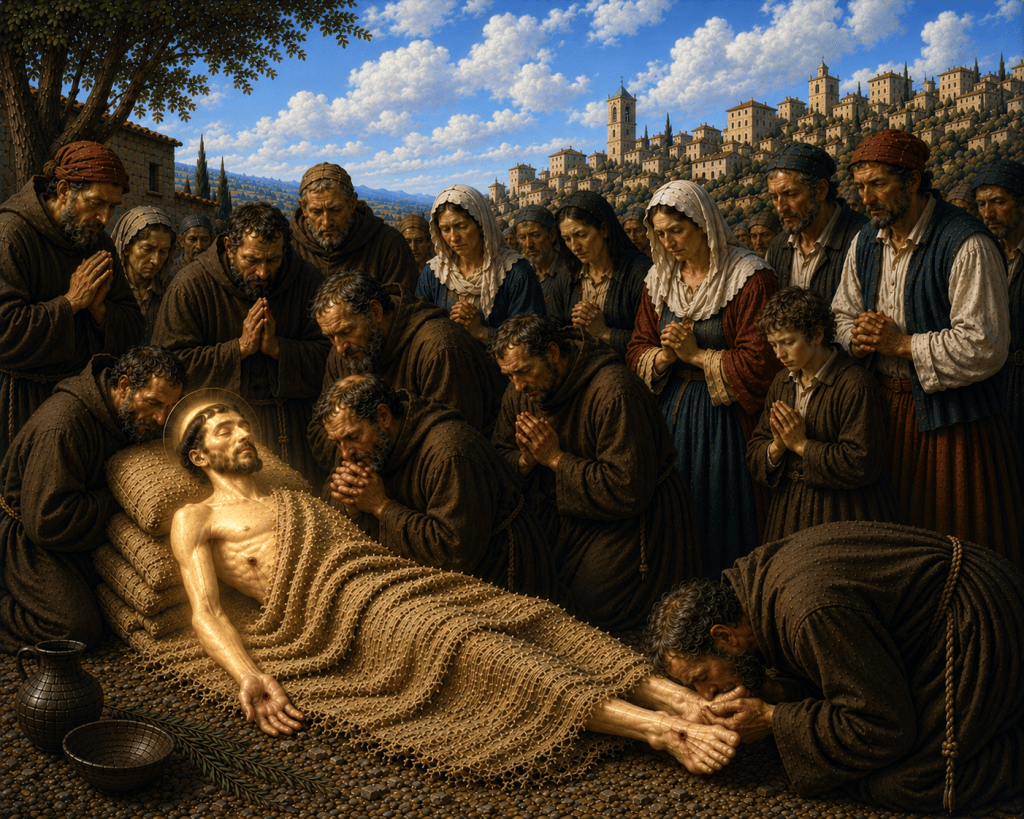
In the Celano text, chapter eight is chiefly devoted to the last few days of Francis’s life and the moment of his death. It is at the beginning of chapter nine that we see the general response to what has happened. In the first paragraph of prose we hear this:
“The whole city of Assisi rushed down as a group and the entire region hurried to see the wonderful works of God which the Lord of majesty gloriously displayed in his holy servant. Each person burst into a song of joy at the urging of a joyful heart, and all of them had their desire fulfilled and blessed the almighty Savior. Still his sons were mourning, bereft of so great a father, and showed the deep feeling of their hearts in groaning and tears.“
The sequencing here by Celano is a little confusing. We see the entire City of Assisi responding collectively. In the verse just before this they are described as “praising and blessing” God for having been “given so precious a remnant!” and their reaction is fully joyful. At the same time, the brothers remain in “mourning, showing the deep feeling of their hearts in groaning and tears.”
“The wonderful works of God …. displayed in his holy servant” and the word “remnant” are a reference to the Stigmata. The brothers would almost certainly have observed the Stigmata first, but, somehow, the citizens of Assisi seem to be aware of the Stigmata (or at least the meaning of it) before the brothers.
Maybe the grief of the brothers is so great that it has blinded them temporarily? Or, perhaps, Celano is just extending the grief of the brothers for dramatic effect, because he immediately follows the quote above with this:
Then incredible joy lightened their grief!
A new miracle
turned their minds to amazement.
Their mourning turned into song,
their weeping to jubilation.
For they had never heard or read in Scripture
about what their eyes could see:
they could not have been persuaded to believe it
if it were not demonstrated by such clear evidence.
This is a more obvious reference to the Stigmata and Celano goes on to tell us that other manifestations appeared to demonstrate the extraordinary holiness of Francis’ life. “All the people saw him glowing with remarkable beauty and his flesh became even whiter than before.” “They saw his face like the face of an angel, as if he were not dead, but alive.” “His limbs were not rigid but could easily be moved back and forth.”
The net effect of these miracles is evident in the passage above. Both the people and the brothers are “persuaded to believe.”
The context seems to suggest that they would not have believed the reality of the Stigmata without seeing the clear evidence for themselves. But I want to suggest that what they were “persuaded to believe” goes well beyond the holiness of Francis. These manifestations prove more than just the particular cause of the sainthood of Francis. They are meant to attest to the efficacy of the mode of life he lived. They recommend that the broad example of Francis’ entire manner of being is a pattern worth emulating. (That eight hundred years later we are celebrating a Centenario associated with these events suggests that this plan of God remains active and is/was highly successful.)
To quote Celano later in the chapter:
We too will certainly be able to reach these heights if ………, following blessed Francis’ example, in every good work we have a pure intention and upright conduct, and, directing these to God, we strive untiringly to please God alone in all things.
If the last reflection is creditable, this means that, in particular, we should be following the mode of belief that St. Francis exemplified for us because, after all, it was the depth and commitment of his belief that led to the Stigmata and his Sainthood in the first place.
We are meant to be “persuaded to believe,” just as Francis did, that the saving power of Christ is indomitable, unconquerable and indisputable. The end of the life of Francis (his Easter) and the revelation of the Stigmata in particular point us unmistakably to the original Easter. They instruct us to believe unconditionally in the entire story of Jesus. The Incarnation, the public life and teaching, the Passion and the Resurrection cannot help but be recollected and brought to the forefront of our consciousness when we look upon the body of Francis and the miracles revealed as a result of his death.
Transport yourself to the scene and see for yourself. Look upon the wounds of Christ inscribed on the body of Francis. Look upon his shining skin and his angelic countenance. Listen to the gasps and the expressions of blessing and rejoicing from the citizens of Assisi as the import of what has occurred dawns on them. Witness the elation of the brothers as they begin to recognize the profundity of the life of their spiritual father in a way they had not previously considered. Join them as their grief is transformed into incredible joy, amazement and jubilation.
You are looking at the body of Francis, but it is the sacrifice and Love of Christ you should see. The core meaning of Easter, the promise of salvation, and the Victory of Christ over death should be resonating within you. Your entire being should be vibrating with grace and gratitude.
If you were there, actually present in that scene, how would you have been impacted? What would seeing the stigmata in person, in the flesh, have engendered in you? How would it have effected your ability and desire to believe in the power of Christ? What lifestyle changes would you have considered? Would those changes have been permanent? Are those changes and impacts any less vital just because you are eight hundred years distant from the physical events?
All those references to the articles of the Rule in the last reflection, when taken and considered together, amount to a lifestyle that is worthy of not just profession, but of constant, unrelenting, and faithful pursuit. They represent a distillation of a mode of being developed by Francis so that his followers might embrace the saving power of Jesus and be transformed and saved by their belief. As Franciscans, we profess these principles and operate accordingly because we understand them to be the ongoing Will of God for our own lives.
This is the impact that Francis had and continues to have. It is why he remains so attractive eight hundred years after his death. The events at the end of his life provide a fitting crescendo to the impact he began to have from the very beginning of his religion. He makes us want to transform our entire mode of being and believing into one of far-reaching righteousness and rectitude.
He makes us want to be something more than we previously were.
________
As you might expect, this line of thought and its emphasis on the meaning of Easter is reinforced by what happens next in the narrative. A couple paragraphs later we get the full reaction of the brothers:
His brothers and sons hurried to him and, weeping together, kissed the hands, the feet, and the right side of their dear father who had left them. The wound in his side made them remember the One who poured out blood and water from His own side and reconciled the world to the Father.
Then, in the verse that follows, we find this:
This is a miracle worthy of everlasting remembrance
and a sacrament to be remembered
with unceasing and wondering reverence.
It presents to the eyes of faith
that mystery in which the blood of the spotless lamb,
flowing abundantly through the five wounds,
washed away the sins of the world.
O sublime splendor of the living cross,
giving life to the dead!
As has already been stated, the purpose of the Stigmata and other manifestations is not just to declare the efficacy of the life of St. Francis or his holiness. The ultimate purpose is to “remember the One who poured out blood and water from His own side and reconciled the world to the Father.” The purpose is to spur an “everlasting remembrance” of “that mystery in which the blood of the spotless lamb, flowing abundantly through the five wounds, washed away the sins of the world.”
We know that Francis’ life, as splendid as it was, was not his own. It was instead inspired and governed by the life of Christ. This is why he always sought to keep Jesus in his “heart, mouth, ears, eyes and hands.” Everything that Francis did was meant to recall, honor and renew the sacrifice of Christ.
The purpose of his life was not his own aggrandizement. Always he wished to remain humble, poor, lowly, and minor. Always he wished to place the emphasis on Christ, not himself. He would have cringed at the idea that his life could be remembered for its own sake, separate from the life of his beloved Lord and Savior, Jesus Christ.
Because magnification of the life of Jesus was his purpose, Francis would have wanted the focus to move away from him and to Christ as quickly as possible. Therefore, it is completely appropriate that the brothers and the people of Assisi be directed to the sacrifice of Christ and the Victory of Easter as a result of the happenings at his death.
In the end, Francis remains first and foremost a servant of the Will of God. God’s purpose for the life of Francis, explicitly voiced by Jesus from the San Damiano Cross, was the renewal of the church. The culmination of that renewal is the revitalization, expansion and enhancement of our belief in the saving power of the Son. In retrospect, it makes perfect sense that Francis’ final act, his Easter, would remind us of everything that the original Easter encompasses. The script was leading that way the entire time, even if we did not see it until the encore was complete.
The mechanism of the stigmata is present because the other manifestations would not have been enough by themselves. God’s plan was to ensure that Jesus was the focus of everything that Francis taught, and most especially of the events that surrounded his death. The stigmata is the final plot twist that ensures that everything that went before would become unforgettable.
Thus it is that when we transport ourselves to the scene and look upon the body of Francis, we immediately see Christ. Francis was the instrument, but the spotlight is perfectly directed toward Christ. And Francis would not have it any other way because what Francis ultimately believed in was not his own power, but the saving power of Jesus.
In turn, our task is to tenaciously hold onto the impact that Francis has had in our lives through our formation and profession and to help Francis help Jesus impact the larger world by living out our calling as resolutely as we can. Following the example of Francis, our lives must affirm and amplify the saving power of Christ at every opportunity. Our goal is, in whatever small way that might be possible, to have our own wake influence anyone we touch as we move through the world just as Francis’ did.
Our Rule, faithfully pursued and adhered to, is a guide on how we might achieve this.
- If you were there, actually present in the scene of Francis’ passing, how would you have been impacted? What would seeing the stigmata in person, in the flesh, have engendered in you? How would it have effected your ability and desire to believe in the power of Christ? What lifestyle changes would you have considered? Would those changes have been permanent? Are those changes and impacts any less vital just because you are eight hundred years distant from the physical events?

