John 3:16
For God so loved the world that he gave his one and only Son, that whoever believes in him shall not perish but have eternal life.
Romans 10:9-13
If you declare with your mouth, “Jesus is Lord,” and believe in your heart that God raised him from the dead, you will be saved. For it is with your heart that you believe and are justified, and it is with your mouth that you profess your faith and are saved. As Scripture says, “Anyone who believes in him will never be put to shame.” For there is no difference between Jew and Gentile—the same Lord is Lord of all and richly blesses all who call on him, for, “Everyone who calls on the name of the Lord will be saved.”
My attempt to unpack the meaning of the Easter of St. Francis is now seven reflections deep. It’s August. In September we have a retreat planned with a guest speaker. In December, in lieu of ongoing formation, we will visit our traditional Greccio program as we always do. There is time for two or three more reflections on this topic if we are to complete this series in this calendar year.
This means it is now time to move on to the events at the end of Francis’ life. In preparation for this, I would invite you to read chapters eight through ten of the second book of The Life of St. Francis by Thomas of Celano. This material will be the basis for the remaining reflections on this topic.
_________
In the last three reflections, one of the main threads of discussion has been the idea of belief.
In Victory, Part Two, I noted that there is really nothing we can do to save ourselves from the predicament of sin. Fortunately, “we were created by a God that Loves us so completely that He was willing to share condemnation with us in order to provide us a way out of our dilemma.”
Our responsibility in response to this tremendous offering of Love and Grace by our Creator is to believe. In that reflection I gave the following definition as to what constitutes appropriate and comprehensive belief. I then repeated it in the summary introduction of the last two reflections, using the word transform to launch the discussion on the Conversion of St. Francis:
“I am to believe in the saving power of Christ and allow it to transform my life. This belief, properly enacted, is much more than an intellectual decision. It is a commitment to plunge myself into the life of Christ by prayer and by immersing myself in scripture, most particularly in the gospels.”
In chapter nine of Celano, we find this description of Francis in the context of the Stigmata.
Our blessed father Francis fulfilled all these things completely: he had both the image and the form of the Seraph and, remaining on the cross, he merited to fly away to the highest order of spirits. He was always upon his cross, never shirking labor or pain, fulfilling to the utmost the Lord’s will in and about himself.
The brothers who lived with him know
that daily, constantly, talk of Jesus was always on his lips,
sweet and pleasant conversations about Him,
kind words full of love.
Out of the fullness of the heart his mouth spoke.
So the spring of radiant love
that filled his heart within
gushed forth.
He was always with Jesus:
Jesus in his heart,
Jesus in his mouth,
Jesus in his ears,
Jesus in his eyes,
Jesus in his hands,
he bore Jesus always in his whole body.
Often he sat down to dinner
but on hearing or saying or even thinking “Jesus”
he forgot bodily food,
as we read about another saint:
“Seeing, he did not see; hearing, he did not hear.”
Often as he walked along a road,
thinking and singing of Jesus,
he would forget his destination
and start inviting all the elements
to praise Jesus.
With amazing love he bore
in his heart and always held onto
Christ Jesus and Him crucified.
For this reason,
he, above others, was stamped with Christ’s brilliant seal
as, in rapture of spirit,
he contemplated in unspeakable and incomprehensible glory
the One sitting “at the right hand of the Father,”
the Most High Son of the Most High,
Who, with the Father, “in the unity of the Holy Spirit,
lives and reigns,” conquers and commands,
God eternally glorified throughout all the ages.
Amen.
When I used the word “plunge” in my definition, this is what I had in mind.
The second grouping in these verses is particularly poetic, striking and compelling. I would invite you to spend your next several prayer sessions with those seven lines. Repeat them to yourself over and over again, slowly and gently and continuously, until they begin to speak to you in the depths of your heart. Contemplate them enough times over enough sessions that they become embedded in your psyche. Inculcate and implant them so firmly in your consciousness that you can recall them from your memory in an instant.
Then, going forward, whenever you find yourself with a free minute, use these words to drop yourself seamlessly into a few moments of prayer in the midst of the chaotic world that surrounds you. Let them help you live into the mandate that “prayer and contemplation be the soul of all you are and do.” (OFS Rule Article Eight) Acknowledge and accept that the world is doing everything it can to distract you from the goal of salvation. Then let these words inspire a determined and resolute resistance in your heart to those efforts and effects. They will help you “purify your heart from every tendency and yearning for power and possession.” (OFS Rule Article Eleven)
Allow the example of St. Francis as captured by these lines to be a mechanism for conversion in your life. Use them to pursue a plan that will help you overcome any diversion or interference that removes you from the goal of salvation. These words describe the extent to which Francis “made Christ the inspiration and center of his life.” (OFS Rule Article Four) Use them to seek the same level of commitment that Francis accomplished, remembering always that conversion is a lifelong journey that is never complete.
These words cannot help but evoke Jesus in your consciousness. If you embrace them, they will make Him present to you. His presence will then provide embers of peace in your life. The more time you spend in His company, the more brightly those embers will glow and the more fiercely they will catch, and the more peace you will experience. Be determined to hold and embrace that peace until it begins to emanate from you in turn, touching first the people closest to you, those you love. Eventually it will be felt by anyone you encounter as you become empowered to “go forth as a witness and instrument of the Church, proclaiming Christ by your life and words.” (OFS Rule Article Six)
Finally, allow these words to remind you of your determined and steadfast belief in the Victory of Easter and the saving power of Christ. You have been made “a living member of the Church by being buried and raised with Christ in baptism.” (OFS Rule Article Six) The second scripture passage above says, “if you believe in your heart that God raised Jesus from the dead, you will be saved.” Use these words to help you live into these promises and you will become ever more aware of the call to salvation that can often lay dormant in a distracted heart.
God wants to spend eternity with you!
Embrace that opportunity wholeheartedly just as Francis did!
Take every action to make the goal of salvation a reality!
_________
If you wish to escalate the effectiveness of these words and the belief they engender, the next step is to supplement and enhance them with Poverty.
The above quote from Celano talks about how Francis would sit down to dinner, think of Jesus, and forget to eat. Here is a similar quote from chapter five of The Legend of the Three Companions:
When he ate with his brothers, he often sprinkled ashes on the food he was eating, telling a brother, as a cover for his abstinence, that “Brother Ash” was chaste.
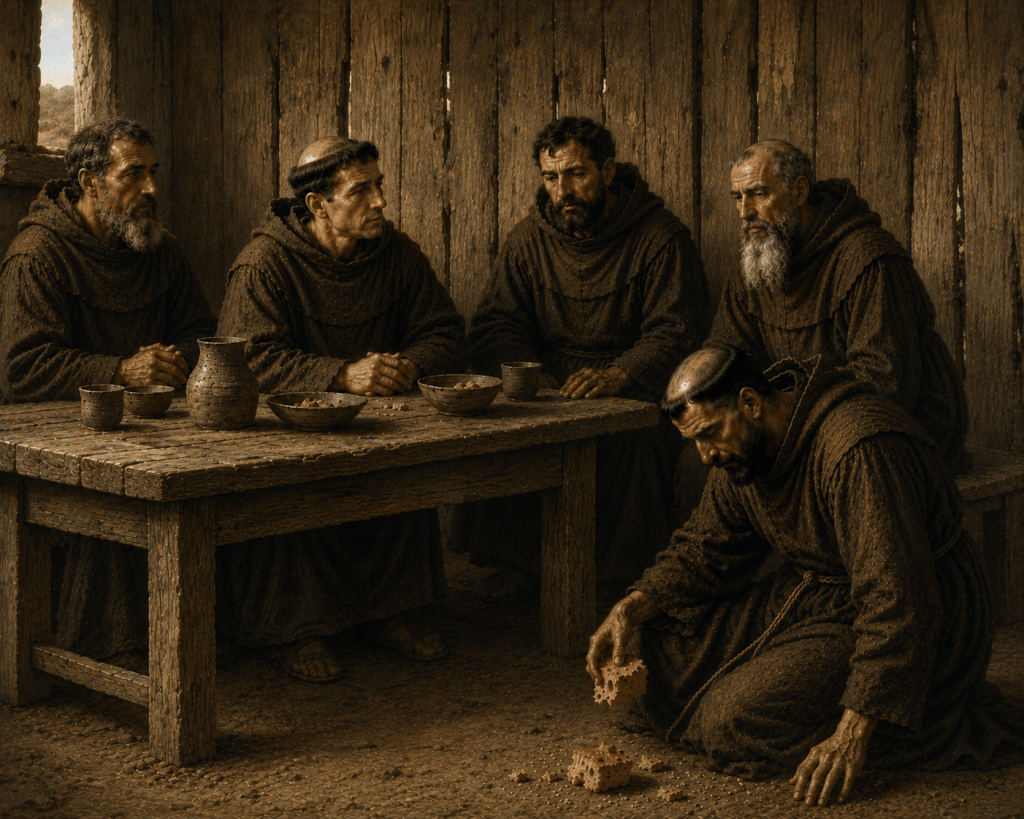
Once, when he sat down to eat, a brother remarked that the Blessed Virgin was so poor that when it came time to eat, she had nothing to give her son. When he heard this, the man of God sighed deeply with great sorrow and, after he left the table, he ate bread off the bare ground.
Many times, in fact, having sat down at table, he had barely begun to eat when he would stop eating and drinking, absorbed in meditation on heavenly things. Then he did not want to be disturbed by any conversation. Sighing loudly from the depths of his heart, he would tell the brothers that, whenever they heard him sighing this way, they should always praise God and pray for him faithfully.
It was impossible for Francis to think of Jesus without thinking of Poverty, and here we find the link between Poverty, “immersion in the Resurrection of Christ” (OFS Rule Article Nineteen), and belief. A Brother makes an offhanded remark about the Poverty of Jesus and Mary and Francis is transported into ecstasy.
Francis possessed a “proper detachment from temporal goods” gained “by simplifying his own material needs.” (OFS Rule Article Eleven) As a result, he could set aside everything except that which was most crucial. (Sometimes, as the quotes suggest, even arguably crucial things like nutrition also fell by the wayside.) As a result, he was able to utterly immerse himself in the Incarnation, Passion and Resurrection by going “from gospel to life and life to the gospel.” (OFS Rule Article Four) This immersion meant he “sought to encounter the living and active person of Christ in his brothers and sisters, Sacred Scripture, and the Church.” (OFS Rule Article Five) Prayer and contemplation and relentless seeking led him to an ever deepening consideration of Christ, and the closer his examination, the more innate, insightful and mysterious his belief became.
His depth of belief was fostered and enhanced by his understanding of Poverty. The singlemindedness of his belief nurtured and heightened his understanding of Poverty.
Each enriched and accelerated the other. The result is that his “leaving the world” (to harken back once again to the words from the opening of his Testament) took on a dimension that was more than just hyperbole.
“Seeing, he did not see; hearing, he did not hear.”
Francis was present in this world, but not entirely. His attention was so completely focused on Jesus that he often found himself in an indefinable elsewhere. The first quote from Celano talks about him walking down the road and forgetting his destination as he called on all of creation to praise the Creator. While he was alive, he may not have been able to leave his earthly body behind in order to transport himself fully to the presence of his beloved Jesus, but he was absent from the physical world to such an extent that it no longer had any hold on him.
Often, he found himself in a liminal space that was not quite here, not quite there. He “accepted all people as a gift of the Lord and an image of Christ” (OFS Rule Article Thirteen), but he could also be in a room with his brothers and not see them. They could be conversing with each other, but he would not hear them. When he was transported in spirit to the presence of his Savior, he was truly present only to Christ even though he could not yet attend him “physically” or eternally.
When I use the word “plunge” in my definition of belief, I am aspiring to just this degree of separation from the world and just this sense of proximity to Christ. I want to “acquire purity of heart” and “set myself free to love God and my brothers and sisters” (OFS Rule Article Twelve) with the same skill and perspicacity that Francis did. I want to “place my will into the Father’s hands” and “follow the poor and crucified Christ” (OFS Rule Article Fourteen) in perfect accord with the perfect pattern of Francis.
To do so, I have to recognize that, just as my definition claims, belief is not an intellectual decision. It is not even a way of life. It is more a mode of being and Francis is the consummate model of how this mode manifests itself.
He became so centered in Christ that he went well beyond a rational embrace of belief. Instead we can say that he became belief. Belief was not an action that he performed, it was a state that he personified. The line between Francis and belief blurred and coalesced until it was impossible to separate one from the other.
As a result, every action that he took became an expression and an embodiment of his belief. Another person could not look upon him without being entranced. His charisma was such that no one could encounter him and not be effected by his holiness. It emanated from him in much the same way I am suggesting that peace can emanate from you if your prayer life advances sufficiently.
Francis “followed Christ, the perfect man, and became more of a man himself.” (OFS Rule Article Fourteen) Ultimately, the degree of belief he attained drew him so close that Christ’s wounds appeared in his flesh in the form of the stigmata. His belief was so potent that it allowed him to “conform his thoughts and deeds to Christ” (OFS Rule Article Seven) to such an extent that the line between Francis and Christ also blurred and coalesced until Francis’ imitation of Christ expressed itself physically, an occurrence never before heard of in the history of man.
Think of a pebble dropped in the water, or a boat gliding over the surface, but place yourself in the water where the ripples or the wake will pass you by or wash over you. The disturbance in the water is Francis moving through the world. Even if his focus is elsewhere, his presence is still palpable and captivating. If you are paying attention at all, you cannot ignore him.
And when his wake washes over you, it calls out to you, assures you of your innate worth, and invites you to believe as he believes, and thus to be transformed as he was transformed.
_________
The Franciscan sources have many profound stories and occurrences in them. In the past two years we delved deeply into a couple. The Stigmata and the Canticle of the Creatures are well known examples of the profound spiritual heritage that is inherent in the Franciscan charism. There are many others. I am sure you have favorites that you reference often because of how deeply they speak to your soul or your particular circumstance.
But I would wager that the image of Francis sitting in the dirt to eat his meals is not high on your list. It’s a poignant example of his Poverty, but it is not flashy. There is nothing supernatural or miraculous about it. It’s not the equivalent of Jesus speaking to Francis from the San Damiano Cross, or Francis stripping himself naked in front of the entire town of Assisi, or even Francis speaking of Lady Poverty as his bride.
But I want to suggest to you that this modest and plain story contains the essence of the Franciscan charism.
I’ll admit that I went out of my way to insert quotes from the Rule in this reflection, and I hope they do not appear forced. But the truth is, I did not have to try very hard to find places where they fit. I think this is indicative that the concept of belief lies at the heart of our charism.
The Rule expresses a comprehensive and wide-ranging set of principles that we reference as we order our lives to honor, develop and live into our profession. And yet, many of the most cherished and indispensable principles of our Way of Life can be referenced in a discussion on the nature of belief that is just a few paragraphs long. This has to say something about the central position that belief occupies within Francis’ religion.
Of course, in a certain sense, it is completely appropriate that the heart of the charism be something simple. After all, minimalism and minority were principles that Francis cherished most. The idea that the essence of Francis’ life and teaching could be captured by an image of him sitting on the floor eating a piece of bread would be attractive to him.
It’s easy to suppose that Francis would be pleased to think it is not a miracle that defines him best. Instead, it is a humble image of unquestionable belief in the saving power and Love of Jesus that captures the beliefs that underpin everything most important to him.
- In the scriptural quote from Romans, belief is said to reside in the heart as opposed to the mouth. In the first quote, Celano speaks about radiant love “gushing” from the heart of Francis when he spoke. Celano was a scripture scholar and likely made this connection deliberately. What do these passages say about the connection between belief and love in the hearts of men?
- Prior to reading this reflection, how did you understand the word “belief” as it applied to your Franciscan vocation? Was it prominent in your thoughts? After considering this reflection, has your understanding of belief evolved? Will you put more emphasis on developing the depth and passion of your belief going forward?
- There are fourteen quotes from ten different articles of the Rule in the Reflection. Go back and review them in context. Do any appear forced or out of place? Do they all contribute effectively to a discussion on belief? Pick one and think critically about how it is connected to the development of your own belief.

