Encounter

Introduction:
The Father, the Son, and the Holy Spirit.
– Amen.

God, come to my assistance:
-Lord, make haste to help me.

Glory be to the Father and to the Son and to the Holy Spirit:
-As it was in the beginning, is now, and ever shall be, world without end.  Amen.

Hymn:  Shepherd Me, O God

Shepherd me, O God, beyond my wants,
beyond my fears, from death into life.

God is my shepherd, so nothing shall I want,
I rest in the meadows of faithfulness and love,
I walk by the quiet waters of peace.
Shepherd me, O God, beyond my wants,
beyond my fears, from death into life.

Gently you raise me and heal my weary soul,
you lead me by pathways of righteousness and truth,
my spirit shall sing the music of your Name.
Shepherd me, O God, beyond my wants,
beyond my fears, from death into life.

Though I should wander the valley of death,
I fear no evil, for you are at my side,
your rod and your staff, my comfort and my hope.
You have set me a banquet of love in the face of hatred;
crowning me with love beyond my power to hold.
Shepherd me, O God, beyond my wants,
beyond my fears, from death into life.

Surely your kindness and mercy follow me all the days of my life;
I will dwell in the house of my God, forevermore.
Shepherd me, O God, beyond my wants,
beyond my fears, from death into life.

On Suffering and Hope:
Antiphon 1:  “Let them purify their hearts from every tendency and yearning for possession and power.”

I am beset. The enemy pursues my soul; he has crushed me.
He makes me dwell in darkness.
My spirit fails; my heart is numb with fear.

He is relentless, ever vigilant, never resting.
His legions surround me, closing upon me from every direction.
They use my weakness against me, forging bonds from my faults, feeding on my feebleness.

Unwitting, pathetic, and blind, I am my own antagonist.
I am the source of the raw material they use to fashion the chains that bind me.
I am his amusement.  He laughs at me, continuously.  His cackling haunts me.

Against him, I am powerless. 
My strength is insufficient to overcome him.
He brushes my best efforts aside, effortlessly. 
I possess no weapon that can wound him. 
I am overmatched.

You, Lord, are my only hope. 
I place my confidence in You.
You possess the power I lack.
You are my rescuer, my redeemer and my liberator.

You are faithful.  You are just.
Hear my appeal.  Safeguard me.
Do not call your servant to judgment.  Have mercy on me!

To you I stretch out my hand.
Like a parched land my soul thirsts for you.
I long for your peace.  Favor me with your grace and blessing. 

For your name’s sake, Lord, deliver and sanctify me.
Liberate my soul from the distress that engulfs me.
Do not let the enemy triumph over me.

Glory be to the Father and to the Son and to the Holy Spirit:
-As it was in the beginning, is now, and ever shall be, world without end.  Amen.

Psalm Prayer:  (Prologue to the Rule, John 17)
“O holy Father, protect them with your name whom you gave me out of the world.  I entrusted to them the message you entrusted to me and they received it.  They have known that in truth I came from you, they have believed that it was you who sent me.  For these I pray, not for the world.  Bless and consecrate them, and I consecrate myself for their sakes.  I do not pray for them alone; I pray also for those who will believe in me through their word that they may be holy by being one as we are one.  And I desire, Father, to have them in my company where I am to see this glory of mine in your kingdom.”

Antiphon 1:  “Let them purify their hearts from every tendency and yearning for possession and power.”

On Poverty, Freedom and Love:
Antiphon 2:  “Trust in the presence of the divine seed in everyone and in the transforming power of love and pardon.”

Lord Jesus Christ, Son of God, have Mercy on me, a sinner.
Please, teach me to dwell and pray unceasingly in Your Steadfast Love. 
Focus my penitential gaze on your Incarnation, your Passion, your Resurrection, and your ongoing Presence.

Increase my discipline.
Erase my complacency.
Liberate my tears.
Bolster my gratitude.
Encourage in me a deep desire to encounter you in scripture, prayer, and contemplation.

Forgive my sins. Cleanse me and heal me.
Permeate, preserve, and protect me. 
Perfect my prayers, my petitions, my perception, my patience, my persistence, my perseverance, and my resolve.

Enlist me and reinforce me as your willing and trusting, joyful and loving,
loyal and humble servant. 
Increase my faith and the quantity and quality of my prayer. 
Break the chains that bind my will, unifying mine with yours in the Holy Spirit.

Diminish and deconstruct me.
Convert and conform me.
Abide within me and grant me Your Peace.

Guide me through Poverty to the Yes that sets me free to love you, God, and all my brothers and sisters,
completely, unconditionally, without reservation or distraction,
in accord with your Most Holy Will and Perfect Gospel Example.

Glory be to the Father and to the Son and to the Holy Spirit:
-As it was in the beginning, is now, and ever shall be, world without end.  Amen.

Antiphon 2:  “Trust in the presence of the divine seed in everyone and in the transforming power of love and pardon.”

On Gratitude:
Antiphon 3:  “Let prayer and contemplation be the soul of all they are and do.”

Thank you, Lord, for being present in your Word,
your Eucharist,
your Creation,
in this wondrous day,
and within me at all times.

Help me to accept that every occurrence that happens in my life, happens in accord with your True, Excellent and Holy Will.  I place all my trust in you, Lord.

Reveal to me my sins that I might become more completely repentant this day.
Turn my face toward you.
Align my conversion with your divine, inspired, and impeccable plan for my redemption.

Remind me often that your Love for me is unshakable.
Every event in my life is always entirely consistent with that Love.
I will inevitably move one step closer to salvation if I gratefully and peacefully accept every experience you send me.

Pray with me Holy Spirit.  Perfect my prayer. 
Help me to desire only that which you know I should rightly desire. 
Sustain me as I seek to return God’s Love properly and perfectly,
for I cannot do so on my own. 
Only with your assistance can I love as fully and truly as I need and wish to love.

Lord, thank you for my life,
which you affirm moment by moment through the graces you bestow on me. 
Please, allow your Word to prepare me for whatever you send my way each day.

Glory be to the Father and to the Son and to the Holy Spirit:
-As it was in the beginning, is now, and ever shall be, world without end.  Amen.

Psalm Prayer:
Almighty God, protect me by your power, hour by hour, moment by moment.
Do not let me turn to sin.
Let my every thought, word and deed be pleasing in your sight.
Grant this through our Lord Jesus Christ, your Son, Who lives and reigns with you in the unity of the Holy Spirit, God, forever and ever, Amen.

Bless me, Lord, and keep me from all evil, and bring me to everlasting life.

Antiphon 3:  “Let prayer and contemplation be the soul of all they are and do.”

Reading:  (True and Perfect Joy)
One day at St. Mary’s, blessed Francis called Brother Leo and said: “Brother Leo, write.”  He responded: “Look, I am ready.”  “Write,” he said, “what true joy is.”

“A messenger arrives and says that all the Masters of Paris have entered the Order.  Write: this is not true joy!  Or, that all the prelates, archbishops and bishops beyond the mountains, as well as the King of France and the King of England have entered the Order.  Write: this is not true joy!  Again, that my brothers have gone to the non-believers and converted all of them to the faith:  again, that I have so much grace from God that I heal the sick and perform many miracles.  I tell you true joy does not consist in any of these things.”

“Then what is true joy?”

“I return from Perugia and arrive here in the dead of night.  It is winter time, muddy, and so cold that icicles have formed on the edge of my habit and keep striking my legs and blood flows from such wounds.  Freezing, covered with mud and ice, I come to the gate and, after I have knocked and called for some time, a brother comes and asks: ‘Who are you?’  ‘Brother Francis,’ I answer.  ‘Go away!’ he says. ‘This is not a decent hour to be wandering about!  You may not come in!’  When I insist, he replies: ‘Go away! You are simple and stupid! Do not come back to us again!  There are many of us here like you – we do not need you!’  I stand at the door again and say: ‘For the love of God, take me in tonight!’  And he replies: ‘I will not!  Go to the Crosiers’ place and ask there!’”

“I tell you this:  If I had patience and did not become upset, true joy, as well as true virtue and the salvation of my soul, would consist in this.”   

Responsorial:
In you, Lord, I have hoped, let me not be put to shame!  In your justice, free me and rescue me!
-God, be my protector and stronghold!  Look upon me with Mercy!

You are my patience, Lord, my hope from youth!  Incline your ear to me!  My song will always be to you! 
-Look upon me with Mercy!

May my mouth be filled with praise!  I will sing all day long of your glory and greatness!
-God, be my protector and stronghold!  Look upon me with Mercy!

Blessed be the Lord my God!  He has become my refuge on the day of my distress!
-Alleluia, Alleluia, Alleluia!!! 

The Word Became Flesh: (John 1:1-14) 
Antiphon:   The Word became flesh and made his dwelling among us.

In the beginning was the Word, and the Word was with God, and the Word was God. He was with God in the beginning. Through him all things were made; without him nothing was made that has been made. In him was life, and that life was the light of all mankind. The light shines in the darkness, and the darkness has not overcome it.

There was a man sent from God whose name was John. He came as a witness to testify concerning that light, so that through him all might believe. He himself was not the light; he came only as a witness to the light.

The true light that gives light to everyone was coming into the world. He was in the world, and though the world was made through him, the world did not recognize him. He came to that which was his own, but his own did not receive him. Yet to all who did receive him, to those who believed in his name, he gave the right to become children of God — children born not of natural descent, nor of human decision or a husband’s will, but born of God.

The Word became flesh and made his dwelling among us. We have seen his glory, the glory of the one and only Son, who came from the Father, full of grace and truth.

Glory be to the Father and to the Son and to the Holy Spirit:
-As it was in the beginning, is now, and ever shall be, world without end.  Amen.

Antiphon:   The Word became flesh and made his dwelling among us.

Intercession:
Let all of us, sisters and brothers, consider the Good Shepherd who bore the suffering of the Cross to save his sheep. 
-Follow the poor and crucified Christ, and witness to Him even in difficulties and persecutions.

The Lord’s sheep followed Him in tribulation and persecution, in shame and hunger, in weakness and temptation; for these things they received eternal life from the Lord.
-Follow the poor and crucified Christ, and witness to Him even in difficulties and persecutions.

Let us boast only in our weakness and in carrying each day the Holy Cross of our Lord Jesus Christ.
-Follow the poor and crucified Christ, and witness to Him even in difficulties and persecutions.

Each day He humbles Himself as when He came from the royal throne into the Virgin’s womb; each day He comes down from the bosom of the Father onto the altar in the hands of a priest.
-Follow the poor and crucified Christ, and witness to Him even in difficulties and persecutions.

Contemplate His most Holy Body and Blood, living and true, with your spiritual eyes and believe that He is God.  In this way the Lord is always with his faithful, even until the end of the age.
-Follow the poor and crucified Christ, and witness to Him even in difficulties and persecutions.

Our Father:
Our Father, who art in Heaven, hallowed be Thy Name.
Thy Kingdom come, Thy Will be done, on earth, as it is in Heaven.
Give us this day our daily bread, and forgive us our trespasses,
as we forgive those who trespass against us,
and lead us not into temptation, but deliver us from evil.
Amen.

Concluding Prayer:
Holy Virgin Mary, among women born into the world, there is no one like you.
Daughter and servant of the most high and supreme King,
Mother of our most holy Lord Jesus Christ,
Spouse of the Holy Spirit;
Pray for us, with St. Michael the Archangel,
all the powers of heaven,
and all the saints at the side of your most holy and beloved Son,
our Lord and Teacher. 
Amen.

Dismissal:
May the all-powerful Lord grant us a restful night.
-Amen.

May He accompany us as we move through the world as pilgrims and strangers making our way home.
-Amen.

May the love and compassion of Sister Death attend us as we serenely tend toward the ultimate encounter with the Father.
-Amen.

The Father, the Son, and the Holy Spirit.
-Amen.

Streaming Prayer

Introduction:
The Father, the Son, and the Holy Spirit.
-Amen.

God, come to my assistance:
-Lord, make haste to help me.

Glory be to the Father and to the Son and to the Holy Spirit:
-As it was in the beginning, is now, and ever shall be, world without end.  Amen.

Hymn:  Lord Let Me Walk

Lord, let me walk that lonely road with you,
Under the weight of the wood.
Lord, let me walk that last mile in your shoes,
Under the weight of the wood.
Freedom can be found, laden down,
Under the weight of the wood.

They gave you gall and sour wine for food,
Under the weight of the wood.
Father forgive them; they don’t know what they do,
Under the weight of the wood. 
Freedom can be found, laden down,
Under the weight of the wood.

Lord, must this journey always end this way,
Under the weight of the wood.
How many times have we nailed you up today,
Under the weight of the wood? 
Freedom can be found, laden down,
Under the weight of the wood.

Freedom can be found, laden down,
Under the weight of the wood.

On Confession:
Antiphon 1:  “Whoever wants to be my disciple must deny himself, take up his cross, and follow me.”

Lord, have mercy on me,
Christ, have mercy on me,
Lord, have mercy on me.

Jesus, I am fallen,
Jesus, I am weak,
Jesus, I am frail.

Jesus, I am feeble,
Jesus, I am hopeless,
Jesus, I am broken.

Jesus, I am oh so human,
Jesus, I am ruined,
Jesus, I am a sinner.

Jesus, I need you,
Jesus, I love you,
Jesus, fortify me.

You dwell within me,
Help me to dwell within you.
You are ever mindful of me,
Make me ever mindful of you.

I am fallen, weak, and frail,
feeble, hopeless, and broken,
oh so human, ruined and a sinner!

Jesus, I need you!
Jesus, I love you! 
Jesus, strengthen me!

Lord, have mercy on me,
Christ, have mercy on me,
Lord, have mercy on me.

Glory be to the Father and to the Son and to the Holy Spirit:
-As it was in the beginning, is now, and ever shall be, world without end.  Amen.

Psalm Prayer: (Matthew 16:24-27)
Then Jesus said to his disciples, “Whoever wants to be my disciple must deny themselves and take up their cross and follow me. For whoever wants to save their life will lose it, but whoever loses their life for me will find it. What good will it be for someone to gain the whole world, yet forfeit their soul? Or what can anyone give in exchange for their soul? For the Son of Man is going to come in his Father’s glory with his angels, and then he will reward each person according to what they have done.”

Antiphon 1:  “Whoever wants to be my disciple must deny himself, take up his cross, and follow me.”

On Healing:
Antiphon 2:  Read the gospels carefully, going from gospel to life, and life to gospel.

Lord, have mercy on me,
Christ, have mercy on me,
Lord, have mercy on me.

Jesus, arise within me,
Jesus, consume me,
Jesus, purify me.

Jesus, hold me,
Jesus, heal me,
Jesus, sustain me.

Jesus, aid me,
Jesus, restore me,
Jesus, pray for me.

Jesus, I need you,
Jesus, I love you,
Jesus, fortify me.

You dwell within me,
Help me to dwell within you.
You are ever mindful of me,
Make me ever mindful of you.

Arise within me, consume me, and purify me,
hold me, heal me, and sustain me,
aid me, restore me and pray for me!

Jesus, I need you!
Jesus, I love you! 
Jesus, strengthen me!

Lord, have mercy on me,
Christ, have mercy on me,
Lord, have mercy on me.

Glory be to the Father and to the Son and to the Holy Spirit:
-As it was in the beginning, is now, and ever shall be, world without end.  Amen.

Antiphon 2:  Read the gospels carefully, going from gospel to life, and life to gospel.

On Conversion:
Antiphon 3:  Jesus answered, “I am the way and the truth and the life.”

Lord, have mercy on me,
Christ, have mercy on me,
Lord, have mercy on me.

Jesus, form me,
Jesus, mold me,
Jesus, fashion me.

Jesus, confirm me,
Jesus, bolster me,
Jesus, secure me.

Jesus, convert me,
Jesus, transform me,
Jesus, recreate me.

Jesus, I need you,
Jesus, I love you,
Jesus, fortify me.

You dwell within me,
Help me to dwell within you.
You are ever mindful of me,
Make me ever mindful of you.

Form me, mold me and fashion me,
confirm me, bolster me, and secure me,
convert me, transform me, and recreate me!

Jesus, I need you!
Jesus, I love you! 
Jesus, strengthen me!

Lord, have mercy on me,
Christ, have mercy on me,
Lord, have mercy on me.

Glory be to the Father and to the Son and to the Holy Spirit:
-As it was in the beginning, is now, and ever shall be, world without end.  Amen.

Psalm Prayer: (John 14:6-14) 
Jesus answered, “I am the way and the truth and the life. No one comes to the Father except through me. If you really know me, you will know my Father as well. From now on, you do know Him and have seen Him……..The words I say to you I do not speak on my own authority. Rather, it is the Father, living in me, who is doing His work……….Very truly I tell you, whoever believes in me will do the works I have been doing, and they will do even greater things than these, because I am going to the Father. And I will do whatever you ask in my name, so that the Father may be glorified in the Son. You may ask me for anything in my name, and I will do it.”

Antiphon 3:  Jesus answered, “I am the way and the truth and the life.”

Reading:  (Matthew 19: 16-26)
Just then a man came up to Jesus and asked, “Teacher, what good thing must I do to get eternal life?”

“Why do you ask me about what is good?” Jesus replied. “There is only One who is good. If you want to enter life, keep the commandments.”

“Which ones?” he inquired.

Jesus replied, “‘you shall not murder, you shall not commit adultery, you shall not steal, you shall not give false testimony, honor your father and mother,’ and ‘love your neighbor as yourself.’”

“All these I have kept,” the young man said. “What do I still lack?”

Jesus answered, “If you want to be perfect, go, sell your possessions and give to the poor, and you will have treasure in heaven. Then come, follow me.”

When the young man heard this, he went away sad, because he had great wealth. Then Jesus said to his disciples, “Truly I tell you, it is hard for someone who is rich to enter the kingdom of heaven. Again I tell you, it is easier for a camel to go through the eye of a needle than for someone who is rich to enter the kingdom of God.” When the disciples heard this, they were greatly astonished and asked, “Who then can be saved?”

Jesus looked at them and said, “With man this is impossible, but with God all things are possible.”

Responsorial:
All you nations, clap your hands!  Shout to God with a voice of gladness.  For the Lord, the Most High, the Awesome, is the Great King over all the earth!
-Have mercy on me, O God.  In You I place my trust! 

The Most Holy Father of Heaven sent his Beloved Son from on high and has brought salvation to his people! 
-Have mercy on me, O God!

Take up the burden, carry His Holy Cross, and follow His Holy Commands! 
-Have mercy on me, O God.  In You I place my trust!

He ascended into Heaven and is seated at the right hand of His most Holy Father!  Let the whole earth tremble before Him!
-Alleluia, Alleluia, Alleluia!!! 

The Beatitudes: (Matthew 5:1-12) 
Antiphon:   Blessed are the poor in spirit, for theirs is the kingdom of heaven.

When Jesus saw the crowds, he went up on a mountainside and sat down. His disciples came to him, and he began to teach them.

“Blessed are the poor in spirit,
    for theirs is the kingdom of heaven.
Blessed are those who mourn,
    for they will be comforted.
Blessed are the meek,
    for they will inherit the earth.
Blessed are those who hunger and thirst for righteousness,
    for they will be filled.
Blessed are the merciful,
    for they will be shown mercy.
Blessed are the pure in heart,
    for they will see God.
Blessed are the peacemakers,
    for they will be called children of God.
Blessed are those who are persecuted because of righteousness,
    for theirs is the kingdom of heaven.

Blessed are you when people insult you, persecute you and falsely say all kinds of evil against you because of me. Rejoice and be glad, because great is your reward in heaven, for in the same way they persecuted the prophets who were before you.

Glory be to the Father and to the Son and to the Holy Spirit:
-As it was in the beginning, is now, and ever shall be, world without end.  Amen.

Antiphon:   Blessed are the poor in spirit, for theirs is the kingdom of heaven.

Intercessions:
Blessed is the one who has no pleasure and delight except in the Words and Deeds of the Lord and who, through these, leads people to the Love of God with gladness and joy.
-Blessed is the servant who avoids idle and empty chatter.

Blessed is the one who stores up in heaven the good things which the Lord has done for him and does not wish to reveal them to people under the guise of a reward. 
-Blessed is the servant who safeguards the secrets of the Lord in his heart.

Blessed is the one who no more exalts himself over the good the Lord says or does through him than over what He says or does through another.  A person sins who wishes to receive more from his neighbor than he is willing to give of himself to God.
-Blessed are the poor in spirit, for theirs is the Kingdom of Heaven.

Blessed is the one who looks down upon earthly things, seeks those of heaven, and, with a clean heart and spirit never ceases adoring and seeking the Lord God living and true.
-Blessed are the pure in heart, for they will see God.

Blessed is the one who, regardless of what they suffer in this world, preserves peace of spirit and body out of love of our Lord Jesus Christ.
-Blessed are the peacemakers, for they will be called children of God.

Our Father:
Our Father, who art in Heaven, hallowed be Thy Name.
Thy Kingdom come, Thy Will be done, on earth, as it is in Heaven.
Give us this day our daily bread, and forgive us our trespasses,
as we forgive those who trespass against us,
and lead us not into temptation but deliver us from evil.
Amen.

Concluding Prayer:
Behold, I am the handmaid of the Lord.
May the Holy Spirit come upon me.
May the power of the Most High overshadow me.
May it be done to me and through me according to Your Will and Word.

Dismissal:
Let us praise the Lord and give Him thanks.
-Amen.

The Father, the Son, and the Holy Spirit.
-Amen.

The Canticle of the Creatures: Creation as Revelation of God

The Major Legend of Saint Francis by St. Bonaventure, Chapter Nine:

Aroused by everything to divine love,
he rejoiced in all the works of the Lord’s hands
and through their delightful display
he rose into their life-giving reason and cause.
In beautiful things he contuited Beauty itself
and through the footprints impressed in things
he followed his Beloved everywhere,
out of them making for himself a ladder
through which he could climb up to lay hold of him
Who is utterly desirable.
With an intensity of unheard devotion
he savored
in each and every creature
--- as in so many rivulets ---
that fontal Goodness
and discerned
an almost celestial choir
in the chords of power and activity
given to them by God,
and, like the prophet David,
he sweetly encouraged them to the praise of the Lord.

In the last two reflections we looked at the themes of “Goodness” and “Kinship” present in the Canticle.  We saw these were not isolated but intimately connected.  The shared commonality of the “Goodness” inherent in all elements of Creation generates a unity between God’s creatures best described by the idea of kinship.  We also found that mankind is deeply dependent on the rest of Creation for its well-being while acknowledging that, in return, human beings have a singular responsibility to the balance of Creation.  Kinship bestows on us the duty of providing an enlightened and loving stewardship to all our “brothers” and “sisters,” animate and inanimate, that they may thrive and function in the exact way that God providentially designed them to.

The same holds true as we move on to our third theme.  We will find these themes once again building on one another and we will see them culminate in a final theme that will bring our series examining the Canticle to a close.  This final theme explores Creation’s ability to reveal God to us and to continually bring our attention back to Him.

At the end of the last reflection, we concentrated on article eighteen of the OFS Rule as we considered a couple questions to help us complete our understanding of the idea of kinship.  That article states that all of God’s creatures “bear the imprint of the Most High.”  This quote then provides the jumping off point for our final reflection.

If we look closely at the opening quote from Bonaventure, we find the source for the word “imprint” in the Rule.  When Bonaventure talks about “the footprints impressed in things,” he is talking about the “imprint” God has left on each and every element of His Creation.

In today’s crazy and hectic world, it is easy to take for granted the Love that God imbues into every aspect of this paradise that He has placed us in.  We often go through the motions of our daily life, never stopping to notice God’s Loving action and presence in each and every detail that surrounds us. 

  • Did you thank Him for “Brother Sun” and the blue sky that greeted you today when you awoke?
  • Or for your “sister” birds that serenaded you?
  • Or, if it was cloudy or raining, did you thank Him for the live giving gifts of “Sister Water?”
  • Or if it was a chilly winter morning, did you thank Him for the gift of “Brother Fire” and the heat he generates to protect you from the cold?
  • Did you thank Him at each meal and snack for the sustenance that “Sister Mother Earth” provides?
  • Or for the loveliness of the flowers that she furnishes to bring Beauty into your day?
  • Or for the trees at the side of the road that work with “Brother Wind” to provide the oxygen you breathe?

We are meant to see Him, recognize Him, and discern His Loving Nature and Goodness in every moment of every day.  Everything surrounding us calls us to Him and we are expected to be open and present to His call at all times.  In every instant, He does everything He can to make Himself known.  First by constantly sustaining this paradise that is our home, and then second by sending His son into our paradise via the Eucharistic, which He causes to be celebrated non-stop so that our opportunity at redemption is continuous and never ending.     

If we properly embrace Poverty and Penance in our life, then we will always be turning away from worldliness and toward Him.  Creation, in accord with His perfect and precise design, calls us to this conversion incessantly, most especially in times of distress and difficulty.  If we are intent on righteousness and virtue, then we will not allow ourselves to be diverted by the enemy and the chaos he intentionally introduces into our earthly existence.  Instead, we will focus on the exquisiteness of Creation and allow it to call us back to Him and we will center our lives on the Most Beautiful Savior that God continually sends to bring us back into full and complete communion with Himself.

When Creation convinces us to turn our countenance away from worldliness and toward God, we then have a chance to live into the ecstasy of Francis which is the basis of the quote from Bonaventure.

We can be “aroused by everything to divine love.”

We can “rejoice in all the works of the Lord’s hands” and “through their delightful display, rise into their life-giving reason and cause,” which is God Himself.

We can intuit “Beauty itself,” and “make for ourselves a ladder” which will allow us to “climb up and lay hold of Him who is utterly desirable,” Who is Jesus Himself.

We can “savor the fontal Goodness” of God and hear the musical “chords of power of the celestial choir” of Creation.  This in turn should cause us to sing our own canticle of praise as we are inspired by the Holy Spirit to follow the examples of David, Daniel and Francis.  Or, if we are not confident in our ability to craft our own song, we can use one of theirs (Franciscans, or course, would opt first for the Canticle) and we can be assured that God will accept it as our own.

Just as with the first two themes, this final theme is also universal and foundational within the Franciscan charism.  The words “Poverty” and “Penance” may not be overtly present, but in the Franciscan context, these words call on us to continually turn away from worldliness and to focus all our energies and all our being on God.  As Francis calls the creatures of Creation to praise, he is also purposefully and inevitably calling on their ability to reveal God to us as we focus on them.  When we pray and/or sing the Canticle, we are, without a doubt, practicing Poverty and Penance.  The Canticle and the praise it engenders compels us to turn away from the world and focus on God as we perform it. 

This confirms the unavoidable link between the first two themes and this one.  The goodness of Creation and the kinship it generates endow on it the ability to reveal God to mankind.  When we make ourselves attentive to the wonders of Creation, the “imprint of the Most High” speaks to us whether we realize it or not.  It works on our subconscious even when we are not purposefully thinking of God.  We are awestruck by Sister Moon and the stars when we consider the night sky because it is the nature (and purpose) of Creation to speak to us about God when presented with even the slightest opening.

This aspect of Creation is what then creates in us a happy dependence.  We rely on Creation to call us back to God continually and inexorably.  At the same time, we are tasked with the responsibility to properly steward Creation because our own salvation depends on it.  We must preserve the wellness of Creation because we are hardwired to trust it to keep us focused on the Love of God that brought us and it into being in the first place.

  • As we come to the close, we now see the Canticle revealed as a powerful expression of several of the foundational ideas of the Franciscan charism.  The complimentary themes of Goodness, Kinship, and Revelation make the charism (and the Canticle) a potent force for good in a world that can easily go astray.  They have allowed the Franciscan movement to endure to its eight hundredth Centenaro, flourishing brightly for most of that time.  Do you agree that now seems to be a time when the message of St. Francis is needed in the world as much as ever?
  • Mull the three major themes of the Canticle over for a few moments.  Remind yourself of the role Penance and Poverty play in encouraging Franciscans to turn away from the distractions of the world so that they might focus fully and continually on God, Jesus and the gospels. Do you recognize that Penance and Poverty must be underlying themes in the Canticle?
  • Do you see the Canticle in a new light as our reflections come to their conclusion?  Will you reference it more often in your prayer life?  Would you consider praying it every day as part of your prayer routine?  Why is it a fitting vehicle for praying for the well-being of the world in general?  Will you now look for openings to introduce it to others?

Return to Previous Reflection

The Canticle of Creation: Kinship

“Sister Swallow”

The Life of St. Francis by Thomas of Celano, the First Book, Chapter 21:

One day he came to a village called Alviano to preach the word of God.  Going up to a higher place where all could see him, he called for silence.  All remained silent and stood reverently.  But a large number of swallows nesting there were shrieking and chirping.  Since blessed Francis could not be heard by the people, he said to the noisy birds:

“My sister swallows, now is the time for me also to speak, since you have already said enough.  Listen to the word of the Lord and stay quiet and calm until the word of the Lord is completed.”

Immediately those little birds fell silent — to the amazement and surprise of all present — and did not move from that place until the sermon was over.  Those men who saw this sign were filled with great wonder, saying:  “Truly, this man is holy, and a friend of the Most High.”

In the last reflection, we began to consider the themes that Francis wished to advance via his composition of the Canticle.  We took the Attributes of God and Creation from the third reflection and extended them to show how they establish the “Goodness of God and Creation” beyond all doubt, question or ambiguity.  

In this reflection, we will explore a second major theme, highlighting Francis’ belief that all the creatures of God’s Creation are intimately interrelated and interconnected.  The word the OFS Rule uses to illustrate this connectedness is kinship. 

As Francis moves through the various sections of the Canticle, he repeatedly uses the words “Brother” and “Sister.”  This device is meant to establish and highlight this second theme of kinship.  Francis wants us to understand that while all members of God’s Creation are interconnected, the connection between human beings and the balance of Creation is particularly critical.  Human beings have a singular responsibility to every other creature that God Loves into being and we must honor this obligation at all times and in every action we take. 

In its initial section, the Canticle lists three alternating pairs of “Brothers” and “Sisters.”  Harkening back to the reflection on the Flow of Creation, the first are found in the heavens, Brother Sun and Sister Moon.  Next come the four classical constituent elements of all earthly matter, Brother Wind and Sister Water, and Brother Fire and Sister Mother Earth.  In strophes ten and eleven, while Francis does not use these words overtly, we can surely glean from the text and the background circumstances that he is calling the Bishop and Mayor of Assisi, and by extension all of mankind, into loving brotherhood.  And then at the end, Francis adds a seventh sibling, Sister Bodily Death, as he composes strophes twelve and thirteen in response to the approach of his own earthly death.

Just as the “Goodness of God and Creation” was not a new theme to Francis in the Canticle, this theme of kinship is also not new.  The words “brother” and “sister” appear regularly in the sources, meaning kinship is also a primary and foundational theme within the entire Franciscan charism.

The opening of this reflection gives an example.  Here we see Francis talking to his “sister swallows” in order to gain their cooperation as he prepares to preach to the people of Alviano.  In the same chapter, Celano relates a story about “brother rabbit,” who after being caught in a snare is presented to Francis.  Francis attempts to set him free only to find that the rabbit prefers nestling “in his bosom” to being returned to the wild. Francis must ask one of the brothers to carry “brother rabbit” to a distant section of the forest before the rabbit will consent to leave his protection.  Related next is an anecdote where a fisherman presents a tinca fish to Francis.  Francis blesses the Name of the Lord, calls it “brother,” and releases it.  The fish swims and plays next to the boat for some time, only leaving when Francis gives it permission to depart.

This attitude toward animals and all of Creation is ubiquitous in the Franciscan annals.  Francis even refers to the wolf of Gubbio as “brother” in the process of taming it, indicating that kinship extends not just to those elements of Creation that sustain human beings, but also to those that are antagonist.

This idea should be seen to flow logically from the “Goodness” that we discussed in the last reflection.  If Creation is fundamentally good, then that “Goodness” is a common trait shared by all the constituents of Creation, even those elements, natural or human, that we find troublesome or that cause us hardship.  This commonality unites us. Just as the Attributes established “Goodness” beyond any doubt, question, or ambiguity, the harmony of “Goodness” establishes kinship in the same way.  No amount of adversity can invalidate the elemental truth that mankind and Creation are vitally linked, and that human beings are therefore deeply dependent on Creation for their well-being.

From the perspective of God, all of Creation has an ordained role to play and that role, because it accomplishes the Will of God, is always “Good.”  Often this means that the same element can be both sustaining and antagonistic.  Brother Sun not only provides light, but we can also suffer sunburn if we are imprudent in how we approach Him.  Brother Wind is the source of tornados and hurricanes.  Sister Water manifests in floods.  Brother Fire can burn out of control.  And Sister Earth might present herself as a landslide or an earthquake.

The “infirmity and tribulation” that Francis instructs us to “endure in peace” in the Canticle is part of God’s perfect and providential plan for us.  Our role is to accede to this truth unconditionally and to turn to Jesus, remembering His Cross and suffering, even when God asks our “brothers” and “sisters” to be mechanisms for delivering a difficulty that He deems necessary for our growth, and ultimately our redemption. 

This action by God does not nullify kinship.  It actually enhances it if we understand and accept that our “brothers” and “sisters,” when they are bringing us hardship according to the Will of God, are thereby encouraging us toward our final goal of salvation and eternal union with God.    

In the end, all creatures share the same Father and Creator.  All are meant to fulfill His Will.  All are brought into being in perfect order, flawlessly designed to fulfill the purpose God has proscribed for them in His unquestionable and impeccable Wisdom. 

This is a second commonality between mankind and God’s creatures, and it also establishes kinship between us and the elements of Creation. 

Our source in God; Our shared “Goodness;” Our need to “praise, glorify, honor and bless Him;” the Love He rains down upon us; the sanctity He bestows on us through the Incarnation. 

All of these serve to unite us and link us in the unbreakable bonds of kinship.    

  • Article eighteen of the OFS Rule is clearly inspired by the Canticle and the theme of kinship that is the topic of this reflection.  It reads like this:  “Moreover, they should respect all creatures, animate and inanimate, which ‘bear the imprint of the Most High,’ and they should strive to move from the temptation of exploiting creation to the Franciscan concept of universal kinship.”
  • If you are fortunate enough to have siblings, think about them as you think about the words “brother” and “sister.”  (If not, think about the person closest to you that you most associate with those words.)  Think about the love you have for these special people in your life.  Think also about the stresses and strains they put you through from time to time. 
  • How can you translate that intimate experience to a more global setting, translating the love you experience in your relationships with your “kin” to love for the entire world surrounding you?  If it’s hardship you are thinking about, how can you focus on the suffering of Jesus so that you might transform that hardship to Love?  How can you begin to think of everyone and everything as a “brother” or “sister” as Francis did, and how can you begin to love all of Creation, even its challenges, accordingly?    

Return to the Last Reflection

Proceed to Next Reflection

Canticle of the Creatures: The Goodness of God and Creation

The Life of St. Francis by Thomas of Celano, The First Book, Chapter 29:

Even for worms he had a warm love, since he had read this text about the Savior:  “I am a worm and not a man.”  That is why he used to pick them up from the road and put them in a safe place so that they would not be crushed by the footsteps of passersby.

What shall I say about the other lesser creatures?  In the winter he had honey or the best wine put out for the bees so that they would not perish from the cold.  He used to extol the artistry of their work and their remarkable ingenuity, giving glory to the Lord.  With such an outpouring, he often used up an entire day or more in praise of them and other creatures.  Once the three young men in the furnace of burning fire invited all the elements to praise and glorify the Creator of all things, so this man, full of the Spirit of God, never stopped glorifying, praising and blessing the Creator and Ruler of all things in all the elements and creatures.

How great do you think was the delight the beauty of flowers brought to his soul whenever he saw their lovely form and noticed their sweet fragrance?  He would immediately turn his gaze to the beauty of that flower, brilliant in springtime, sprouting from the root of Jesse.  By its fragrance it raised up countless thousands of the dead.  Whenever he found an abundance of flowers, he used to preach to them and invite them to praise the Lord, just as if they were endowed with reason.

In the last reflection, we looked at the influence that scripture, tradition and prayer most likely had on Francis as he composed the Canticle of the Creatures.  As we move forward, we will now turn to some of the themes that run through the work. These threads will provide the material for the last three entries in the series.

The first theme we will consider is the “Goodness of God and Creation.”

In both Psalm 148 and the third chapter of the book of Daniel, we saw precursors to the Canticle.  If you return to these two texts, you will find that they are essentially lists of creatures that are being called to the praise of God.  Both entries make reference to the exaltation of God.  Both extol His Greatness.  But neither David nor Daniel provide any reference to the characteristics of God or His creatures within their compositions.

As we discussed in the third reflection, Francis goes well beyond a simple listing.  The vivid description of the Attributes that Francis assigns to God and His Creation separate his work from these previous pieces of scripture.  His work is greater, more memorable and more impactful because of the poetic details he provides in his depictions.  These details then provide the enhancement and further development of church tradition and teaching that I claimed he was after at the end of the last reflection.

As Francis opens the Canticle, he establishes God’s superiority by referring to him as “most high, all powerful and good,” and he asserts His otherness by stating that all “praises, glory, honor and blessings” belong to Him alone.  These affirmations are meant to demonstrate the Goodness of God beyond any possibility of doubt or question.  This declaration of Goodness is not new to Francis but is instead a reiteration of a constant teaching that runs throughout all of his writings.  This theme is primary and foundational within the entire Franciscan charism and when it is translated to Creation, it results in the inevitability of Francis being chosen as the Patron Saint of both animals and ecology.

It is impossible to think or believe that the Creation of a Good and Loving God could be contrary to these Attributes in its fundamental nature.  Salvation history reinforces this conclusion by teaching us that the Goodness of God is specifically extended to Creation when God blesses it with the presence of His Son via the Incarnation. 

Jesus’ sanctifying presence is enough by itself to establish the Goodness of Creation beyond all ambiguity.  But for Francis, this is only the beginning of the argument he wishes to make.  As he assigns Attributes to the creatures themselves, he is strengthening and extending his proof.  When he emphasizes the “beauty, clarity, radiance, splendor, preciousness, serenity, playfulness, strength, humility and chastity” of the elements, he is by definition proclaiming their Goodness.  When he underscores life giving qualities like light, sustenance and governance, he is accentuating the Love that underpinned God’s motive for acting.

Even when the Holy Spirit prompts Francis to extend the Canticle to include men, the theme of Goodness is central.  Positive qualities like the ability to pardon, to bear infirmity and tribulation, to endure in peace, and to obey God’s Most Holy Will are indicative of the virtue and ability to Love that God endows on all men, even those who sinfully choose to suppress these capabilities.

And when he attributes the title of Sister to Death, making death not something to be feared, but something to be embraced, he is describing the inherent Goodness present in the circular nature of the Flow of Creation.  Returning to God at the end of our lives is a profound blessing, meaning death is not a misfortune, but a gift that includes the promise of eternal peace and rest in the bosom of the One whose Love formed us and continues to define us in every moment of every day.

There is not a moment in the Canticle when Francis is not stressing the Goodness of the Creator and therefore the intrinsic Goodness of Creation itself. 

How could all creatures, including you and me, respond responsibly with anything but genuine and heartfelt praise when presented with the enormity of all that God has provided for us?  Francis proclaims and extols the Goodness of Creation in the Canticle precisely so we will have no choice but to burst out in praise in response to the Goodness of the God who Loved us and everything around us into being.

  • Article Eleven of the OFS Rule asserts that Jesus “valued created things attentively and lovingly.”  Franciscans are called to emulate Jesus in everything they do.  Consider the words “value, attentively, and lovingly.”  Does your approach to Creation honor these words from the Rule and the example of Jesus?  What are some concrete examples from your life that demonstrate this?
  • Article Eleven also calls on Secular Franciscans to be “mindful that according to the gospel they are stewards of the goods received for the benefit of God’s children.”  In Genesis, God gave human beings the responsibility to “rule over” Creation.  Too often, the power of “ruling” causes us to be irresponsible.  We are more apt to choose exploitation rather than stewardship.  How can Franciscans use the Canticle to combat this tendency so that the “Goodness of Creation” is preserved for generations to come?  How can we encourage others to see the link between the “Goodness of Creation” and the need to praise God unconditionally?       

Return to Previous Reflection

Proceed to the Next Reflection

Canticle of the Creatures: The Influence of Scripture, Tradition and Prayer

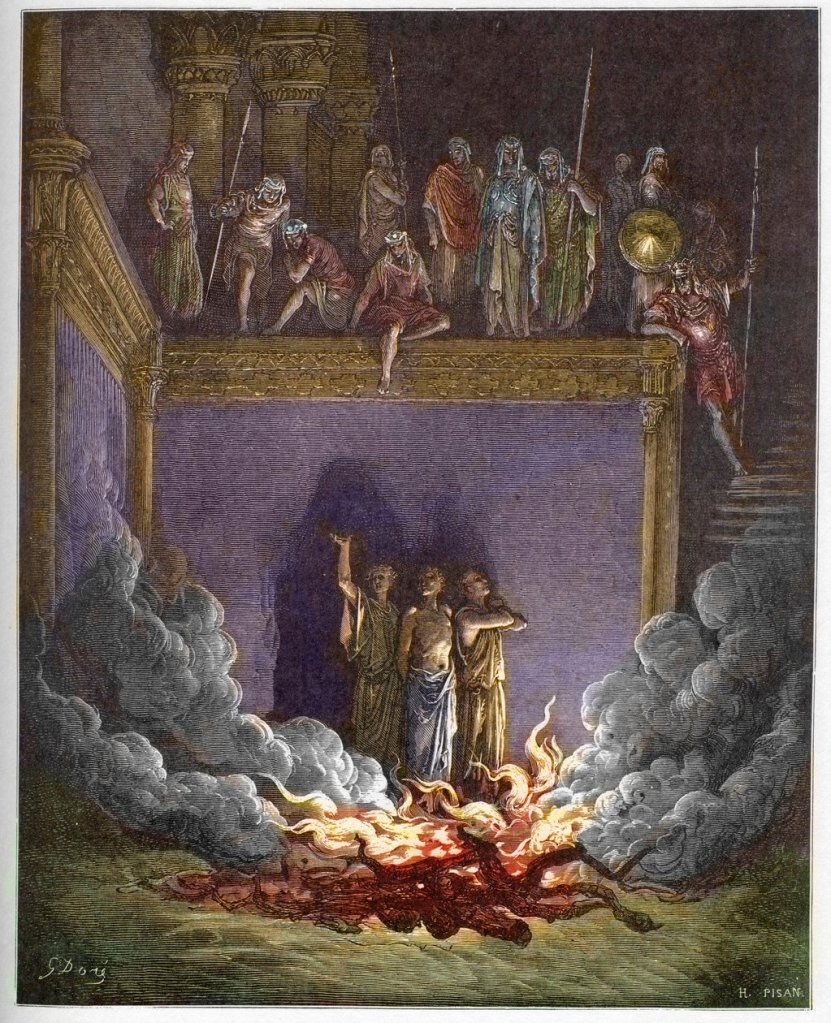
Gustavo Dore, Into the Fiery Furnace, 1866

Psalm 148

Praise the Lord. 
Praise the Lord from the heavens; praise him in the heights above. 
Praise him, all his angels; praise him, all his heavenly hosts. 
Praise him, sun and moon; praise him, all you shining stars.
Praise him, you highest heavens and you waters above the skies.
Let them praise the name of the Lord, for at his command they were created, and he established them for ever and ever — he issued a decree that will never pass away.  
Praise the Lord from the earth, you great sea creatures and all ocean depths, 
lightning and hail, snow and clouds, stormy winds that do his bidding, 
you mountains and all hills, fruit trees and all cedars,
wild animals and all cattle, small creatures and flying birds, 
kings of the earth and all nations, you princes and all rulers on earth, young men and women, old men and children. 
Let them praise the name of the Lord, for his name alone is exalted; his splendor is above the earth and the heavens.  
And he has raised up for his people a horn, the praise of all his faithful servants, of Israel, the people close to his heart.
Praise the Lord.

In the last two reflections, we looked at the Canticle of the Creatures from the perspective of structure.  First, we saw that the Canticle follows the Flow of Creation, starting with God, then proceeding to the heavens, the earth, and man, before returning to God in a circular movement.  Next, we looked at the Canticle from the standpoint of the many positive Attributes that Francis assigns to God, God’s creatures, man and death as he moves through the composition.

In this reflection, we will look at the influence that scripture, tradition and prayer had on the Canticle, focusing particularly on the scriptural sources that Francis may have used for inspiration. 

At the beginning of Part Four: Christian Prayer, the Catechism quotes St. John Damascene as it gives this definition of prayer: “Prayer is the raising of one’s mind and heart to God or the requesting of good things from God.”  Given the exhortations to praise that dominate the Canticle, it is obvious that it meets the first half of that definition and can be understood as prayer itself.

But what is not as obvious is that Francis did not invent a new approach to praise, prayer or Creation with the Canticle.  Instead, he was following traditions long established in the history of the Church and the Jewish people.

———

Francis and the entire order were deeply committed to the prayer life of the Church.  The recitation of the Divine Office was written into the Rule, so this practice was fully ingrained into the everyday routine of each of the brothers.  Francis himself was able to read, but many of the brothers could not, so they would have committed the prayers and readings of the Office to memory.  Francis likely did the same.  So as he was composing the Canticle, he had a very great wealth of material at hand for reference. 

It would have been almost impossible for Francis not to have been influenced by this knowledge as he went about his composition.  In a very genuine and authentic sense, his intensive prayer life can be seen as preparation for this final work that the Holy Spirit called him to.  At the very least, he would have been subconsciously influenced by the daily repetition of these prayers after his conversion and the creation of the order. 

But more likely is that he deliberately recalled and referenced scripture as he went about the composition. 

The first piece he might have relied on was Psalm 148, which is given at the opening of this reflection.  Review these words alongside the Canticle and note the repeated calls to praise, the circular flow, the mention of the sun, the moon and the stars, the references to the different kinds of weather and the abundance of the earth, and the references to man.  The parallels are striking.

Even more astonishing are the similarities between the Canticle and the third chapter of the book of Daniel.  This book relates the story of Shadrach, Meshach, and Abednego, three Jewish leaders during the time of exile in Babylon.  King Nebuchadnezzar erected a golden idol and instructed his subjects to worship it.  When the three Jewish leaders refused, the King had them cast into a furnace so hot that the retainers who threw them in were consumed by the intense heat themselves.  But the three men were preserved by God from the fire and from the midst of the flames they sang a canticle (verses 52-90) that is a much longer, more thorough and more comprehensive version of Francis’ work.  You must follow the link and experience their song to fully appreciate how it would have influenced Francis.

———

There are likely many other analogies to scripture that we could reference if we took the time to do the research.  (Reference Revelation 2:10-11 for an example.) But the point is already clear that the Canticle was not composed in a void.  It was clearly influenced by Francis’ lifetime immersion in scripture, liturgical prayer, and the traditions of the Church.  It honors past teachings of the church about prayer, the wisdom and importance of praise, and the nature of Creation, seeking not to displace them but to further enhance and develop them.

This a realization that should strike home in the hearts of every Secular Franciscan.

  • The OFS Rule calls on professed Secular Franciscans to immerse themselves in scripture, to honor the traditions of the Church, and to partake in its liturgical activities. Article Four instructs us to go from “gospel to life and life to gospel.” Article Six says we “have been united more intimately with the Church by profession.” Article Eight encourages us to “join in liturgical prayer in one of the forms proposed by the Church.”  Given the obvious influence that scripture, tradition and prayer had on Francis’ composition of the Canticle, would it be wise to give greater heed to these sections of the Rule?
  • At the end of his life, Francis wrote out this prayer as an exhortation to the members of the Order and the world at large so that the praise of God might take a more central place in the lives of the faithful.  Consider carefully what the Holy Spirit is calling you to.  Would it be beneficial to journal and write about your own experiences with scripture and prayer so that you might be better able to praise God in the future?  Is this a legacy you might want to leave to your loved ones some day?  Are you called to follow the example of Francis in this? 

Return to Last Reflection

Proceed to Next Reflection

Canticle of the Creatures: The Attributes

Genesis 1:29

Then God said. “I give you every seedbearing plant on the face of the whole earth and every tree that has fruit with seed in it. They will be yours for food.”

In the last reflection, we looked at the structure of the Canticle of the Creatures in terms of the flow of Creation.  The Canticle starts with God the Creator, moves through the heavens to earth, and lastly focuses on man as the final act in God’s initial burst of creative energy.  We then noted that the flow of Creation is fundamentally circular.  It must return to God, so the end of the Canticle reinforces the praise of God that took place in the introduction.

In this reflection, we will look at an alternate interpretation.  This analysis is similar to the last, with only minor changes in the arrangement.  But instead of focusing on the flow of the Canticle, it is directed to the attributes that Francis assigns to God and His creatures as he moves through the composition.  It looks like this: 

  • Strophes 1-2: Opening, Concerning the Attributes of God
  • Strophes 3-9: Concerning the Attributes of the Creatures
  • Strophes 10-11: Concerning the Attributes of Man
  • Strophes 12-13:  Assigning an Attribute to Death
  • Strophe 14: Refrain, Returning to the Attributes of God

In the opening, we see Francis referring to God as “most high, all powerful and good.”  “Praises, glory, honor and blessings” belong to Him alone.  “No human is worthy to mention His name.”  Francis is attributing to God superiority and otherness in relation to man.  His distinctiveness is such that He is essentially incomprehensible except when He chooses to reveal Himself.  Fortunately for us, He has chosen to make Himself known through both Creation and the Incarnation.  That revelation makes it undeniably clear that He is the definition of Love.  His Goodness is pure, indisputable and absolute.  Our only worthwhile option is to accept Him as such and praise Him in response.

In strophes 3-9, we see the Goodness and Love of God confirmed by the characteristics He infuses into Creation.  As might be expected from One who is completely virtuous, the qualities He introduces are all positive and, even more importantly, are all designed to provide for the welfare of man.  His creatures are “beautiful, radiant, splendorous, precious, serene, humble and chaste.”  They also provide us with light and sustenance.  They are useful, capable of governing us, and they feed us with fruit and herbs.

Francis is essentially describing a paradise where a Loving Creator has anticipated and fulfilled our needs before we knew them.  Because of the Holiness of the Creator, this paradise is sacred.  His Image is inscribed in the signs and vestiges that populate His handiwork.  When we failed to recognize Him via His Creation, rather than abandoning us, He choose to enter Creation personally as the Living Word, further revealing His Goodness and Love.  We should thrive, but often we do not, because we fail to respond to Him with Humility and Poverty.  Instead, we prefer sin to Him, and we struggle when we should prosper.  

Francis was reminded of our failings by the behavior of the mayor and bishop of Assisi.  Reverence for God was wholly absent not only in the way they were treating each other, but more critically in the example they were setting for their followers.  In response, He recognized that the Canticle was incomplete without reference to the attributes that man must embrace to return to paradise and the state of praise that God rightly expects from him.  The list he offers is necessarily incomplete because of the vastness of words it would take to address all of man’s shortcomings.  But in response to the specific issue facing him, he offers pardon based in God’s Love as a starting point, for what greater praise of God is there than to love an adversary just as Jesus commanded? 

He then moves to the universal condition of man.  Recognizing in the dispute between the mayor and bishop a version of the “infirmity and tribulation” that all men suffer, he reveals an all-encompassing reward for praising God within hardship.  We might be suffering physically as Francis was, or we might be suffering spiritually as the mayor and the bishop were.  Either way, if we embrace Poverty and persevere in praise, God will grant us Peace, empowering us to surmount every trial He asks us to undergo while steadily refining us along the way.  Better, not only will He assist us to “endure in Peace,” He will also finally reward consistent steadfastness with a crown.

This crown then represents the assurance Francis received from God when he turned to prayer in his suffering.  Francis is affirming that the promise of the Kingdom he received is available to anyone who embraces the constant praise he calls us to via the Canticle.

It was the Holy Spirit that moved Francis to expand the Canticle when the dispute between the mayor and bishop arose.  At the end of his life, the Spirit inspired Francis a second time, again to address a collective experience we all must face.  In this extension, Francis exhorts us to continue our praise even through death, the experience “no one living can escape.” 

To make this easier, Francis personifies death.  It would be strange to praise God through the unembodied, mysterious and frightening form of the grim reaper.  But by attributing to death the title “Sister,” Francis establishes kinship between us and death.  Instead of a brooding specter, we now have a loving and trustworthy “Sister” to carefully guide us through the transition from this world to the next.        

Strophe 13 feels like it might have been more at home with strophes 10 and 11.  Conforming myself to God’s “Most Holy Will” feels like an attribute that will help me toward salvation.  Why did the Holy Spirit hold this off until the end?  We must remember that just as our creation was the Will of God, so is our death.  This truth makes us uncomfortable.  We resist it, potentially making us more susceptible to fighting against God’s Will when it comes to our death that we are at any other time.  So perhaps this strophe is not just about seeking absolution for our sins at the end or our life?  It is meant to emphasize the importance of serenely accepting God’s Will when facing our own mortality? 

We ended the last reflection by affirming the circular nature of the flow of Creation.  The final movement had to be back to God.  The same holds true here.  All these attributes are sourced in God, so it is only appropriate that the refrain take us back to Him through praise, blessing and thanks.  At the same time, it is also proper that it emphasizes service to God with humility.  This is another attribute men must embrace to properly praise their Creator, whose Name they are otherwise unworthy to mention.

  • We can infer from the attributes of Creation emphasized by Francis that the earth was meant to be a paradise.  Why does it seem so often to be anything but?  How does the OFS Rule and the Franciscan charism ask you to respond to the state of the world?  What personal attributes do you need to bring to bear?  How should praise fit into your response?
  • If God created a paradise for us during our earthly life, what are the attributes of whatever is waiting for us in eternal life?  Does pondering those attributes help you to “praise the Lord through your Sister Bodily Death”?  Do you equate “serenely tending toward the ultimate encounter with the Father” (Article 19 of the Rule) with “being found by death in God’s Most Holy Will?”       

Return to Previous Reflection

Proceed to Next Reflection

Leisure as Opposition to the World

Jesus and Nicodemus, Julius Schnorr von Carolsfeld (1794-1872)

The relationship between Poverty, Penance, and the “world” is a common theme in most of the reflections I write.  Whenever I need to define either Poverty or Penance, I invariably do so in reference to the word “world.”  I like to suggest that in the Franciscan charism the core practice of both Poverty and Penance consists in the act of “turning away from the world and toward God.”

Please understand that in this context, the word “world” has an entirely different connotation than it does when it is used in relation to God’s Creation. 

Like Jesus, Franciscans attempt to “value created things attentively and lovingly” (Article 11 of the Rule).  We believe that Creation was sanctified by His Incarnation, and we also believe there are visible vestiges of His Father present in all of God’s creatures.  We remember enthusiastically that in the Canticle of the Creatures (and elsewhere) Francis taught us to refer to those creatures as “brothers and sisters,” and we understand Creation to be one of the primary means God uses to reveal Himself to us.  When we employ leisure to approach Creation peacefully and serenely, we find that glimpses into the nature and mystery of God are available to us. 

Article Eighteen of the Rule expresses our reverence for Creation like this:

Moreover they should respect all creatures, animate and inanimate, which “bear the imprint of the Most High”, and they should strive to move from the temptation of exploiting creation to the Franciscan concept of universal kinship.

When I suggest that Franciscans need to “turn away from the world,” I am referring to a characterization that places worldliness in opposition to heavenliness.  In this context, the word “world” encapsulates all of the negativity that accumulates when man dismisses his dependency on his Creator and becomes obsessed with himself.  This is modern life at its worst, where it seems that distractedness, busyness and cultural expectations are so overwhelming that there is no hope that one can ever be properly connected to God again.

In this “world,” achievement and the accumulation of wealth and goods is paramount.  We think that our significance is determined by the size of our house, the car we drive, and the fineness of our clothes.  This is the “world” of red carpets and advertising campaigns, where materialistic achievement and accumulation equate to power, status and adulation. 

In this “world,” the poor are not seen as “an image of Christ,” but instead as untouchable.  Those who have achieved material success naturally regard themselves as better than those who have not.  Worthiness is measure by the size of bank accounts and investments, not by character or moral attentiveness.  Cheating is acceptable, as long as the gain is big enough, and you do not get caught.

The “world” is a place where God is an afterthought, if not completely absent.  It is the place where the enemy dominates and is even sometimes worshipped.

Article Eleven of the Rule describes it nicely even though the word “world” is not present. 

Trusting in the Father, Christ chose for himself and his mother a poor and humble life, even though he valued created things attentively and lovingly. Let the Secular Franciscans seek a proper spirit of detachment from temporal goods by simplifying their own material needs. Let them be mindful that according to the gospel they are stewards of the goods received for the benefit of God’s children.

Thus, in the spirit of “the Beatitudes”, and as pilgrims and strangers on their way to the home of the Father, they should strive to purify their hearts from every tendency and yearning for possession and power.

The “world” is the place where people are attached to temporal goods and their material needs are ever spiraling.  People are consumers of goods to excess rather than stewards.  Instead of purifying themselves from every tendency and yearning for possession and power, they actively embrace these propensities, making them the center of their lives.

In this context, humanistic domination of the “world,” and humans being dominated by the “world,” become the enemy of a Franciscan.  The “world” is something to be resisted and something that seeks to drag us down.  It is a place where sin is not opposed, but openly embraced and enjoyed.  It is the opposite of a place that a Franciscan would choose to be, which is why the Rule suggests that we think of ourselves as “pilgrims and strangers on our way to the home of the Father.”  Ultimately, as we will see below, we are not meant to be “of this world.”

_________

In the gospel of John, the word “world” appears fifty-seven times.  This is more than double the appearances it makes in the other three gospels combined.  Not every instance of the word has connotations like those above, but the “world” as opposition is a theme that runs throughout.  Jesus emphasizes it consistently, enough that the theme is often present even when the word “world” is not.

In order to reinforce our understanding of this theme, I am going to present some passages from this gospel for your perusal.  I think the trend will be self-explanatory, so I am not going to present any commentary.  I will let you absorb them and draw your own conclusion.

(John 1:9-11 The true light that gives light to everyone was coming into the world. He was in the world, and though the world was made through him, the world did not recognize him. He came to that which was his own, but his own did not receive him.   

(John 2:23-25) Now while he was in Jerusalem at the Passover Festival, many people saw the signs he was performing and believed in his name.But Jesus would not entrust himself to them, for he knew all people. He did not need any testimony about mankind, for he knew what was in each person.

(John 3:19)  This is the verdict: Light has come into the world, but people loved darkness instead of light because their deeds were evil.

(John 3:31-32, 36) “The one who comes from above is above all; the one who is from the earth belongs to the earth, and speaks as one from the earth. The one who comes from heaven is above all. He testifies to what he has seen and heard, but no one accepts his testimony…….  Whoever believes in the Son has eternal life, but whoever rejects the Son will not see life, for God’s wrath remains on them.”  (John the Baptist is speaking here.)

(John 5:41-44) “I do not accept glory from human beings, but I know you (the Jewish leaders). I know that you do not have the love of God in your hearts. I have come in my Father’s name, and you do not accept me; …….”        

(John 7:6-7) Therefore Jesus told them, “My time is not yet here; for you (Jesus’ brothers) any time will do. The world cannot hate you, but it hates me because I testify that its works are evil.” 

(John 8:23) But he continued, “You (the Pharisees) are from below; I am from above. You are of this world; I am not of this world.”

(John 9:39-41)  Jesus said, “For judgment I have come into this world, so that the blind will see and those who see will become blind.”  Some Pharisees who were with him heard him say this and asked, “What? Are we blind too?”  Jesus said, “If you were blind, you would not be guilty of sin; but now that you claim you can see, your guilt remains.”

(John 12:25) “Anyone who loves their life will lose it, while anyone who hates their life in this world will keep it for eternal life.”

(John 12:42-43) Yet at the same time many even among the leaders believed in him. But because of the Pharisees they would not openly acknowledge their faith for fear they would be put out of the synagogue; for they loved human praise more than praise from God.

(John 14:27) “Peace I leave with you; my peace I give you. I do not give to you as the world gives. Do not let your hearts be troubled and do not be afraid.”

(John 15:18-25) “If the world hates you, keep in mind that it hated me first. If you belonged to the world, it would love you as its own. As it is, you do not belong to the world, but I have chosen you out of the world. That is why the world hates you.  Remember what I told you: ‘A servant is not greater than his master.’ If they persecuted me, they will persecute you also. If they obeyed my teaching, they will obey yours also. They will treat you this way because of my name, for they do not know the one who sent me. If I had not come and spoken to them, they would not be guilty of sin; but now they have no excuse for their sin. Whoever hates me hates my Father as well. If I had not done among them the works no one else did, they would not be guilty of sin. As it is, they have seen, and yet they have hated both me and my Father. But this is to fulfill what is written in their Law: ‘They hated me without reason.’”

(John 16:8-11) “When he (the Advocate) comes, he will prove the world to be in the wrong about sin and righteousness and judgment: about sin, because people do not believe in me; about righteousness, because I am going to the Father, where you can see me no longer; and about judgment, because the prince of this world now stands condemned.”

(John 16:20) “Very truly I tell you, you will weep and mourn while the world rejoices.”

(John 16:33) “I have told you these things, so that in me you may have peace. In this world you will have trouble. But take heart! I have overcome the world.”

(John 17:13-19) “I am coming to you (the Father) now, but I say these things while I am still in the world, so that they may have the full measure of my joy within them. I have given them your word and the world has hated them, for they are not of the world any more than I am of the world. My prayer is not that you take them out of the world but that you protect them from the evil one. They are not of the world, even as I am not of it. Sanctify them by the truth; your word is truth. As you sent me into the world, I have sent them into the world.For them I sanctify myself, that they too may be truly sanctified.”

(John 17: 25-26) “Righteous Father, though the world does not know you, I know you, and they know that you have sent me. I have made you known to them, and will continue to make you known in order that the love you have for me may be in them and that I myself may be in them.”                   

(John 18:36) Jesus said, “My kingdom is not of this world. If it were, my servants would fight to prevent my arrest by the Jewish leaders. But now my kingdom is from another place.”

I have given eighteen scriptural passages above, which I think is plenty to establish the theme I have put forth.  I whittled this number down from the thirty-eight that jumped out at me on just one reading of the gospel.  I am sure if I took my time and studied the text, I could come up with more.  An entire book could probably be written (maybe it has been?) on just this theme as it appears in the gospel of John. 

In many ways, the entirety of John’s gospel is a running commentary on the enmity between Jesus and the Pharisees.  I would invite you to read this gospel from beginning to end in one session.  It’s not that long.  It might take about two hours.  It could easily be done in one day if you put in the effort. 

If you do so, you get a much different picture than you do reading a couple verses at a time, or even a chapter at a time.  The persistent conflict between Jesus and the Pharisees jumps off the pages.  And you will see that the most prominent subtext of that conflict is the theme we are discussing here.  Jesus’ instruction to be wary of the “world” is evident in every chapter of the book, and it is rooted in Jesus’ assessment of the motives and behavior of the Pharisees.

_________

How then, does this relate to our conversation about leisure?

Or, I might better ask, how does leisure help one experience one of the passages above and come to an understanding of the teaching that Jesus is offering?

Let’s just take one of the shortest passages.  

(John 12:25) “Anyone who loves their life will lose it, while anyone who hates their life in this world will keep it for eternal life.”

This is one sentence, but it has volumes to teach us.  It contains contradictions and mysteries.  It mentions love and hate.  It speaks of the “world” and eternity.  When I read it, there’s a good chance I will find a different emphasis than you do when you read it.  At different readings, the same person will hear different messages depending on the circumstances of their life at that given moment.  An entire reflection and more could be written about it and the full meaning might not be discerned or explained.

In just this one sentence, we find, to quote from the first reflection, a “locus where the spiritual and divine meet the ordinary and earthly.”  These are the places that I need to seek out as a Franciscan.  I want to place myself in this scene with Jesus and listen to Him speak.  When I do this wholeheartedly, I can understand and believe that Jesus exists out of time.  He is not speaking in the past.  He is truly speaking to me in the present.  He is truly present to me as He is speaking.

When I enter these scenes, I must accept that action is verboten.  These are times for stillness.  These are times for practicing leisure according to my new understanding and its ancient definition.  They are times when listening and receiving according to my intellectus is mandatory. 

When I use prayer and contemplation to enter a scene with Jesus, I must do so with the proper mindset.  The only thing that matters is what Jesus wishes to teach me.  I need to set aside my perspectives and desires and simply revel in being in the presence of the Master.  Anything I might wish or feel is irrelevant unless He brings it into the conversation.  He knows my needs better than I do, and I must trust that He will guide me to whatever I require in the moment.

To quote the first reflection again, the goal is “to partake in the non-discursive power of vision enjoyed by the angels, to whom it has been granted to “take-in” the immaterial as easily as our eyes take in light or our ears hear sound.”

The ratio can only get in the way in this moment.  It can only distract me away from Him.  The moment I begin to actively work at possessing the message is the moment the message becomes unattainable.  Exercising the ratio in this moment will displace me from the scene and plant me firmly back in the “world.”  Any hope I have of glimpsing the mysteries of the heavenly and eternal is then lost.

This is not to say that the ratio has no place in my life.  It simply has no place in these moments.  As a human being, I am incapable of staying in this scene with Jesus indefinitely.  I am not made to dwell in the spiritual ad infinitum.  (At least not yet. Hopefully, I will be translated to that state when I encounter Sister Death.)  I will return to the ratio soon enough without needing to be conscious of it, and it is the ratio that will help me recall and process what was revealed. 

When I am back to the ratio, I am also back in the “world.”  But I still recall that I am a “pilgrim and stranger on the way to the home of the Father” who is not meant to be “of the world.”  To the extent I can be both of these things at the same time, I can then use my ratio to carry and spread the message of Jesus throughout the “world.”  This then becomes the active work of the ratio.  Indeed, these reflections are the work of the ratio, and any ability I have been graced with to organize themes into a compelling flow that will attract others to Jesus is a most fitting work for my ratio.  

But I can only be the messenger of Jesus to the extent that I listen to and receive His message via the art and discipline of leisure exercised in the way that the ancients and Francis understood it.                  

_________

I want to close by going back to the OFS Rule, specifically Article Four.

The rule and life of the Secular Franciscans is this: to observe the gospel of our Lord Jesus Christ by following the example of Saint Francis of Assisi, who made Christ the inspiration and the center of his life with God and people.

Christ, the gift of the Father’s love, is the way to him, the truth into which the Holy Spirit leads us, and the life which he has come to give abundantly.

Secular Franciscans should devote themselves especially to careful reading of the gospel, going from gospel to life and life to the gospel.

First, I want you to note the word inspiration and recall that I used this word in the first reflection to help define leisure and the intellectus.  “It is the intellectus and the intellectus alone that experiences the inspiration, grace and revelation that are at the core and foundation of human knowing.”  Here is another happy accident where the sources of our Franciscan life help to substantiate a point I have made.  Again we see Francis embracing leisure and its inspiration as indispensable to his spiritual life.

Next, I want to point out that I completely neglected the Holy Spirit in all three of these reflections, and that this was foolish of me.  As the Rule states, the Holy Spirit is instrumental in leading us on the Way to the Truth and Life that can only be found in Jesus.  In the last section, when I was speaking of listening and receiving from Jesus, I was remiss in not bringing the Holy Spirit into the conversation.  The intellectus is dependent on the Holy Spirit, and He should have been invoked in a conversation about the ancient understanding of leisure well before now.

And finally, I want to emphasize the word “observe,” and the phrase “gospel to life and life to gospel.”  I want to especially suggest to you that the authors of the Rule got it right when they put “gospel” first.  The phrase would have a completely different meaning if it were rendered as “life to gospel and gospel to life.”

Perhaps this entire set of reflections can made clear by substituting the words “leisure” and “work” into this sentence of the Rule. 

Secular Franciscans should devote themselves especially to careful reading of the gospel, going from leisure to work and from work to leisure.

As Pieper would have had it, leisure is preeminent.  It comes first.  It inspires the shape that work will take, ensuring its value, excellence, significance and import.  And work, at its conclusion, returns to leisure to seek another round of inspiration.  The pattern continues indefinitely but leisure always has the lead.  Leisure always points work in the right direction.

The same pattern applies to the gospel and life.  Observation and reading of the gospel are preeminent and these tasks cannot be completed without engaging in leisure.  Our longing to know Jesus and to imitate His life has to begin by immersing ourselves in the gospels.  The gospels then shape the direction our lives will take, ensuring that all my decisions and pursuits have value, excellence, significance and import.  Whenever the activity of my life pauses, I take that as an opportunity to return to the gospels in leisure to find further depth in my relationship with Jesus and to take additional direction from Him on what activity I will pursue next.  Jesus is always in the lead.  Jesus always points me in the right direction. 

The tension in my life between leisure and work informs the tension in my life between the earthly and the spiritual and the heavenly and the “worldly.”  This is essentially a tension between what Jesus teaches in the gospels and what “worldly” culture seeks to emphasize.  As Jesus underscored throughout the gospel of John, it is the Father that I should seek first, and it is the Will of the Father that guides me as I move through the “world.”

This then defines the balance I am seeking in my life between the ratio and the intellectus.  The intellectus must lead, but the ratio has a role to play, a role that can even be holy when it is guided by the listening and receiving that characterizes a proper definition of leisure, and by the inspiration, revelation and grace that proceed from repeated true and faithful encounters with Jesus.

All of this requires honesty.  I have to regularly examine my conscious to ensure that I am attaining balance according to this formula.  And I have to be unafraid in presenting my needs to Jesus when I falter, seeking His assistance at all times.       

If I could establish such a pattern in my life, then my hope that one day I might learn to “be still and know that He is God” has a chance to be fulfilled.

And if that were to happen, I would no doubt be moved to “exalt God among the nations, and exalt God in the earth,” just as the Psalm suggests, and just as Francis did so perfectly at the end of his life through the composition of the Canticle of the Creatures.

Back to the Last Reflection in the “On Leisure” Series

The Tension Between Work and Leisure

Scenes from the Life of St. Francis (Scene 7), Benozzo Gozzoli (1421-1497)

In the first reflection, I asserted that the ancients and the Greeks had a different definition of the word “leisure” than the one we use today.  I also asserted that the definition advanced by the Greeks would have been identical to the one understood by Francis.

It sometimes shocks me how the Franciscan sources never fail to contain just the passage I need to substantiate a point I am making.  The following is from The Major Legend of St. Francis by St. Bonaventure, chapter nine (slightly rearranged):

Jesus Christ crucified,
into Whom
he longed to be totally transformed
through an enkindling of ecstatic love,
always rested like a bundle of myrrh in the bosom of Francis’ soul.
As a sign of his special devotion to him,
Francis found leisure*
from the feast of the Epiphany through forty successive days
-- that period when Christ was hidden in the desert --
resting in a place of solitude,
shut up in a cell,
with as little food and drink as possible
fasting, praying, and praising God without interruption.

* Footnote: The Latin is vacabat [he found leisure], a word difficult to translate but one rich in the contemplative tradition, where it has the sense of vacationing or taking a holiday in God.

In this passage, we can see that our rediscovered definition of leisure clearly had a place in the life Francis, which means it has a place in the life of every Franciscan. 

The sources are full of instances where Francis isolated himself and spent time in contemplative seclusion.  Before now, I would have not associated the word leisure with the “fasting, praying and praising of God” that Francis engaged in at these times, but now I have an understanding that allows me to make that connection.  Leisure as I now appreciate it gives me a much deeper and richer admiration of what Francis was about when he retreated to the solitude that was instrumental in his development as a saint.

When Francis visited one of the many hermitages maintained by the order, he was separating himself from the everyday world in an attempt to know God more intimately.  The goal would have been to make space for his intellectus to work unimpeded.  Much of his prayer would have been geared toward listening, and he would have been doing everything in his power to make himself more receptive to whatever it was that God wished to reveal to him.

In the words of Psalm 46, he would have been endeavoring to be still so that he could know God as God.  No amount of vigorous work by the ratio could help achieve this.  Such striving could only get in the way and obstruct or forestall his ability to obtain what he was seeking.   It was only in opening himself unconditionally in peace and tranquility that he could hope to gain a glimpse into the mystery that is God.

And then, when Francis heard God and comprehended whatever it was He was offering, he would have responded by exalting and praising God in thankfulness for the revelations and grace received.  This pattern would finally achieve its climax at the end of Francis’ life, when, in the midst of his suffering, the stillness of his prayer led to an assurance from God that he had gained the Kingdom.  Francis’ response of praise then reached its apex in the form of the Canticle of the Creatures.   

_________

In the first reflection, the tension between work and leisure is evident throughout.  That tension is exacerbated in the modern world by the redefinition of leisure as the opposite of work, but it is evident even in the ancient and medieval outlook.  It would be very easy to look at our rediscovered definition of leisure and the excerpt above and come to the conclusion that leisure is the only thing we should be concerned about, to the exclusion of everyday work. 

We must remember that Francis did not spend all his time as a hermit.  Early in his conversion, the tension between prayerful leisure and the work of preaching troubled him deeply.  In chapter twelve of The Major Legend of St. Francis by St. Bonaventure, we hear how Francis sent brothers to Clare and Sylvester to ask them to pray for him and help him with his dilemma:  “Should he spend his time in prayer, or should he travel about preaching?”  They both responded with the same answer, that God wished Francis to do both.  Francis then “rose at once, girded himself, and without the slightest delay took to the roads.”

(This story also appears in The Deeds of Blessed Francis and His Companions, Chapter Sixteen. In this text, Francis is pictured contemplating a third order for the first time.)

Beyond this, Francis spent considerable time working with his own hands and he expected his brothers to do the same.  In chapter one-hundred-twenty from The Remembrance of the Desire of a Soul, we hear from Celano how Francis could be less than charitable with those brothers who were unwilling to work.

How, Working Himself, He Despised the Idle

He used to say that the lukewarm, who do not apply themselves constantly to some work, would be quickly vomited out of the Lord’s mouth.  No idler could appear in his presence without feeling the sharp bite of his criticism.  This exemplar of every perfection always worked, and worked with his hands, not allowing the great gift of time to go to waste.  And so he would often say: “I want all my brothers to work and keep busy, and those who have no skills to learn some.”  And he gave this reason: “That we may be less of a burden to people, and that in idleness the heart and tongue may not stray into what is forbidden.”

This tension between work and leisure is a given in human life.  We even see it in the life of Christ, who, in the Gospel of Mark (6:3), is confirmed to have worked as a carpenter before he began His public life:

Isn’t this the carpenter? Isn’t this Mary’s son and the brother of James, Joseph, Judas and Simon? Aren’t his sisters here with us?” And they took offense at him.

When Jesus transitioned to His ministry, the work continued, just in a different form.  The scriptures tell us of the weariness He experienced from traveling. (John 4:6, “Jacob’s well was there, and Jesus, tired as he was from the journey, sat down by the well.”)  And a long day performing the work of healing must have left Him exhausted, because healing required the expenditure of power. (Luke 8:46, But Jesus said, “Someone touched me; I know that power has gone out from me.”)

However, we also see Christ as the epitome of prayer.  When Francis sought solitude, he did so because he was following the example of Jesus.  (Matthew 14:23, “After he had dismissed them, he went up on a mountainside by himself to pray.”) And it was after an extended period of contemplation that Jesus authored the prayer we rely on most heavily today:

Luke 11:1-4

One day Jesus was praying in a certain place. When he finished, one of his disciples said to him, “Lord, teach us to pray, just as John taught his disciples.”  

He said to them, “When you pray, say:

Father, hallowed be your name, your kingdom come.
Give us each day our daily bread.
Forgive us our sins, for we also forgive everyone who sins against us.
And lead us not into temptation.”

So clearly, when He was present here on earth as a man, even Jesus had to sort out the tension between contemplative leisure and everyday work and strike a balance that allowed Him to productively engage in both.

_________

If this tension between work and leisure is present in the life of Jesus and the life of Francis, it should not be surprising that it is also present in the Rule of the Secular Franciscan Order.

Article Eight of the Rule says this:

As Jesus was the true worshipper of the Father, so let prayer and contemplation be the soul of all they are and do. 

But Article Sixteen says this:

Let them esteem work both as a gift and as a sharing in the creation, redemption, and service of the human community.

The first is a call to leisure as I now understand it.  The second clearly places significant value on the activity of everyday work.

My first reaction is to wonder, which is it?  If “prayer and contemplation are the soul of all I am and all I do,” that does not seem to leave much room for anything else.  The invocation of my soul in this formula seems to be asking for a complete and uncompromising commitment.  I wonder how I would be capable of making something the “soul of everything I do” if I do not spend every minute of every day seeking to achieve that goal. 

And yet, I am to esteem work.  And yet, Francis did both, and Jesus did both.

How am I to proceed? If I go back to the first reflection, maybe I can find something of help.

Recall Pieper’s insistence that leisure comes first.  If leisure is the basis of culture, then it is the fundamental act.  It has to be present to inform and guide the direction and the development of any culture and any work within that culture.  But it does not constitute the culture in and of itself.  Perfectly pursued, leisure might be able to provide a perfect philosophy of existence.  But without work, that philosophy will never be anything more than theory.  All the work that had to be done to rebuild the German culture still had to be done.  People still needed to eat.  They still needed electricity and fuel to power their lives. 

This means that one of the primary roles of leisure is to define the best possible application of work. 

The Rule has multiple examples of how this might work.  Certain assertions in the Rule require the exercise of leisure before they can be appreciated, absorbed and fully ingrained in my approach to life.  I cannot “seek to encounter the living and active person of Christ in my brothers and sisters ….” (Article 5), or “conform my thoughts and deeds to those of Christ” (Article 7), or “unite myself to the redemptive obedience of Christ” (Article 10), or “accept all people as a gift of the Lord and an image of Christ” (Article 13) if I am not intimately involved with Christ in the first place.  The only way to achieve that intimacy is through leisure.  (Which is why prayer and contemplation must be the soul of everything I do.  In many ways, the rest of the Rule assumes success on this front.)

But my intimacy with Christ has no value if it does not translate to work.  The Love engendered in me by these avowals in the Rule has no value if it does not culminate in some action.  The Rule calls on me to “create conditions of life worthy of a people redeemed by Christ” (Article 13), and to “build a more fraternal and evangelical world” (Article 14), and to “promote justice by the testimony of my human life and my courageous initiatives” (Article 15). 

These constitute practical and concrete manifestations of the Love I received, acknowledged, and learned through the contemplative leisure of the previous paragraph.  They are the action I take and the response I make to the grace and revelation that Jesus bestows on me in my time of leisure.  “Accepting people as a gift of the Lord and an image of Christ” is what leads to “creating worthy conditions of life” (Article 13).  If I do not believe that every person is precious, if I do not love every person just as God Loves every person, then I will not be motivated to perform the work it takes to “promote justice” in the world.      

In other words, leisure and work are both necessary and complementary.  The better I know God through prayerful leisure, the more effective my work will be in “bringing about the Kingdom of God” here on earth (Article 14).

But none of this is possible if leisure is not preeminent.  If I lose myself in the work and forget that prayerful leisure must come first, then I will lose my way completely and fail at both things.

_________

In the past, I have often struggled with this tension.  I struggle with it now.  That’s part of my motivation for writing this series.  I was wondering how leisure might relate to my vocation as a Franciscan so I googled the word.  I do not remember what phrase I used, but it generated a link to some comments on Pieper’s book at the top of the first results page.  I read a little and immediately ordered the book.  Now I am trying to sort out what Pieper has to offer and I am dragging you along in the process. 

I tend toward wanting to wallow in the intellectus.  I have a romanticized version of my life where I spend all my time, every day, doing nothing but engaging in prayer and spiritual reading.  Jesus often feels like a stranger to me, and I am sure that if I could just spend more time seeking Him or more time abiding in His presence, then I would start to feel closer to Him.

This means I tend to see anything other than prayer, even simple things like grocery shopping, doing my laundry, making the bed, fixing dinner, or mowing the lawn, as an intrusion on my ideal life.  These tasks are the everyday work of a normal human life.  They are not evil in any sense of the word.  To requote Article Sixteen of the Rule, I should “esteem them as a gift and a sharing in the creation, redemption, and service of the human community.”  This is especially true because these things are in service to my family, which is the subject of the next article of the Rule.

Instead, I tend to see this work as “of the world” in an entirely negative way.  I see it as an imposition.  I blame it for distracting me from my true purpose and desire.  “If only I was not bogged down in these mundane tasks, then I could achieve the level of prayer and contemplation I desire!  If I could set these tasks aside, then I could spend the time with Jesus I need to be firmly connected to Him!  I could finally know Him as I wish to know Him!”     

But the truth is, I am retired, and I have plenty of time every day for prayerful leisure.  The harder truth to admit is that I rarely engage in this leisure anywhere close to the extent that my idealized version of my life suggests I should.  I procrastinate.  I watch TV and play video games on my phone or computer for hours at a time.  I do everything but this thing I tell myself I cherish above everything else.  Or, worse yet, I simply do nothing.

When I read the quote on work by Francis above, I know he is talking about me.  I shudder to think about how much I allow the great gift of time to go to waste” every day.  How often does my “heart stray into what is forbidden” because of my own idleness?  How harshly would Francis, or the Lord, criticize me if I met them face to face? 

I might spend more time in contemplative leisure than most, but I hardly spend as much time as I could.  I probably spend less time in work than most, but that does not make me particularly productive on either front.  And I often neglect or postpone the basic work I know I need to responsibly complete.

In some way I cannot complete express, I am blaming “the world” for keeping me from engaging in leisure to the extent I want to, while at the same time neglecting the must-do work that I know I am responsible for.  And, despite the neglecting, my prayer life is not as complete and fruitful as I know it should or could be.  Somewhere in there is a sin that I find myself incapable of naming, let alone acknowledging or confessing.  I think I need some help.  Like Francis, I need my brothers and sisters to pray for me and let me know the outcome of their prayer.  

_________

There is no denying that the modern world is set against me when it comes to leisure. It would gladly load me down with more work than I could ever complete.  The trend toward work as everything that Pieper was arguing against in 1947 post-war Germany has not abated.  It has only accelerated and become amplified.  Unfortunately, his point of view did not triumph.

I can look at my life and see how it would be possible to get lost in work even though I am retired.  The list of tasks above is a must-do list.  If I tried, I could easily expand that list so that it would take up all my time and then some.  I could also add some “want to” things.  I might even have a hard time telling the difference in many instances. 

I do need to be aware of not succumbing to the pressures and promptings of the everyday world.  But I also need to be more aware of identifying the work that is truly must-do and taking care of it promptly and competently. 

I ended the first reflection with some comments about the importance of balance.  I think I am back to that idea.

But I have to acknowledge that balance is impossible with honesty.  If I am not being completely honest with myself about how I view work and how I approach leisure, then balance is something I will never attain.  I may not be able to name the sin I identified above, but I know it has something to do with not being honest with myself.  In that dishonesty, I seem to open a third possibility that exists as a no man’s land between leisure and work, where nothing gets done, and true idleness and excruciating sin hold sway.

That true idleness is defined by Pieper like this: 

Idleness means that the human being has given up on the very responsibility that comes with his dignity: that he does not want to be what God wants him to be…….  It is the “despair of weakness” that consists in someone not wanting “to be oneself.”……..  It is the “sadness of the world” spoken of in the Bible.  (2 Corinthians 7:10, “Godly sorrow brings repentance that leads to salvation and leaves no regret, but worldly sorrow brings death.”) 

If, by my actions and inactions, I place myself in a gulf of idleness and sorrow where I refuse “to be myself,” is it likely that I would lie to myself about what I was doing?  Seems like not wanting to be myself and lying to myself would go hand in hand, so that answer must be yes.

Which means my balance is even more out of whack than I might have originally thought.  And the only way to correct this is to start being honest with myself.

Complete self-honesty, then, would seem to be a prerequisite for being able to live a life properly balanced between leisure and work.

If I cannot achieve that, then I cannot follow the instruction of the psalm, and I may never understand how to consistently “be still and know that He is God.

Back to First Reflection in the “On Leisure” Series

Forward to Next Reflection in the “On Leisure” Series

Rediscovering the Meaning of Leisure

Psalm 46:10

The Lord says, “Be still, and know that I am God;
    I will be exalted among the nations,
    I will be exalted in the earth.”

_____________________

If I were to ask someone for a contemporary definition of the word “leisure,” they would probably respond with something like this: “Leisure is free time meant to be used for personal enjoyment.”

If I pressed them to expound on that definition further, after pondering for a moment, they might suggest that the best way to define leisure is to say what it is not.  They might then express some version of the notion, “leisure is the opposite of work.” 

If I then instructed them to please succinctly define leisure using just a single word, a majority might be expected to come up with a word like “idleness.”

There is nothing revolutionary in these definitions.  They are commonplace and well understood in the modern age.

The problem I have is this:  I want to convince you that leisure should have a prominent place in the life of a Secular Franciscan.

Based on the above, that would be a hard argument to make.  In these definitions, leisure has a distinctly worldly focus grounded in the freedom of an individual to do as she or he pleases, with little reference to restraint or responsibility.  There is no mention of and no direct relationship to God.  Worse than that, “idleness” is a synonym for sloth or acedia, one of the seven deadly sins.

Article Eleven of the OFS Rule instructs the professed to “seek a proper spirit of detachment from the temporal.”  Indulging in leisure as defined above would seem to be in direct opposition to that.  Article Sixteen states that we should “esteem work.”  Again, leisure seems opposed.

But we need to understand that these definitions of the word “leisure” would have been unfamiliar to Francis and his brothers.  Leisure had an entirely different connotation and tone in Italy in the early 1200s.  If I am to persuade you that you need to embrace leisure as part of your Franciscan vocation, then I need to rediscover a meaning for the word that has been lost to today’s world, but that Francis would have known and understood intuitively. 

The quote from the Psalm should give a hint as to the direction we are headed.

_____________________

The book that suggested this set of reflections to me is entitled Leisure, the Basis of Culture.  The author is Josef Pieper, a German Catholic philosopher (born 1904, died 1997).  Pieper originally presented this material as a series of two essays/lectures in 1947 post-war Germany. 

At that time, Germany was emerging from their defeat in World War II.  The entire society was engaged in a rebuilding effort.  This renewal effort was not just physical.  It was also spiritual, philosophical and metaphysical.  Yes, the country needed to figure out how to meet day to day material needs on a permanent and ongoing basis, but it also needed to redefine its essence.  The people had to be united in a mutual vision of what the future would look like.  To best meet ordinary, everyday needs, the country needed to develop a common, shared understanding of the fundamental nature of reality, existence, truth and knowledge. 

In the second paragraph of the work, Pieper puts it like this: 

to build our house (i.e., to rebuild the country), we must put in order again our entire moral and intellectual history.”  

He then states emphatically,

“before any detailed plan along these lines can succeed, our new beginning, our re-foundation, calls for ….. a defense of leisure.”

Take a moment to decide whether that second statement makes sense to you?  Is leisure fundamental to developing a cohesive and meaningful philosophy of existence?  If the definitions of leisure given above are the reference, it would seem not.  Or, if it does have a role, it might be along the lines of, “One needs a certain amount of downtime, a certain amount of leisure, to recharge their batteries.  Leisure is needed if I am ultimately to be as productive as possible.”  Leisure is at best an ancillary support to work. 

To the contrary, Pieper places leisure first.  The second quote indicates it as the starting place for the efforts at hand.  The title of the book, Leisure, the Basis of Culture, confirms this assertion.  Leisure is not meant to be an afterthought, subservient to work.  The logic of that title suggests that leisure is pre-eminent, and that work can only have proper meaning in relation to a proper understanding and exercise of leisure.  

Clearly, Pieper has an entirely different definition of “leisure” in mind.  What definition is he working from?  Could that definition be one that is sympathetic to and supportive of the Franciscan charism?  If I understand what Pieper is hinting at, will that help me live out my profession more successfully?  

To begin to understand where Pieper is coming from, we must delve a little deeper into the circumstances of post-war Germany.  With the country in a process of complete renewal, there is a great expectation that everyone must do their part for success to be achieved. The amount of work that needs to be done is enormous and extraordinary.  In that context, it is easy to understand how work would be seen as the primary concern.  Anyone engaged primarily in leisure at this time would immediately be accused of not pulling their weight. 

To engage in leisure in the modern sense, given the effort required for a successful rebuild, would be seen by most as an immoral act.

This leads to every activity in post-war Germany being redefined in terms of work.  Prior to the war, the study of Philosophy would have been seen as a leisure activity.  To lift a quote from Heraclitus from the text, Philosophy and the other Liberal Arts were seen as “listening-in to the being of things.”  Being a philosopher was not an endeavor filled with activity.  It did not involve “hammering out” ideas.  Those who taught in a university or wrote books about the Liberal Arts would not have been labeled as “workers.”  They would have been seen as part of an elite class who had the privilege of making a living “at their leisure.” 

Pre-war, the Liberal Arts were more about being quiet and still and attending to Creation rather than using mental acumen to actively discern or in some way conquer the nature of Creation.  Inspiration, revelation and grace would have been more relevant to the definition of a philosopher than discovery accomplished by the vigorous or even assaulting will of a man.     

Philosophy had to be an important and necessary part of the rebuilding effort.  A coherent and standardized metaphysical philosophy would serve as a great unifier for the people.  But it could only be countenanced if its authors were translated from the world of leisure to the world of work. 

So, to be made acceptable in the context of the work of rebuilding, the Liberal Arts were redefined as “intellectual work.”  Given the framework of already established philosophical movements present both before and after the war, this redefinition became more than just a matter of semantics.  It was put into actual practice.  Philosophers began to rely more on their own intellectual acuity and less on inspiration as they practiced their craft. 

The redefinition of the Liberal Arts away from listening and to active work then led to a redefinition of knowledge.  Inspiration, grace and revelation lost eminence as sources of knowledge.  The more man actively used his will and reason to search for knowledge and truth, the more convinced he became that nothing can be known or true unless it can be proven so by human logic and intelligence.  The idea that one can “listen-in to the nature of creation” became passé, and, in many quarters, tawdry and unacceptable.  Only that which could be proven by the human mind could be accepted as knowledge.

The book puts it like this:

To Kant, the human act of knowing is exclusively “discursive,” which means not “merely looking.”  “The understanding cannot look upon anything.” ……  In Kant’s view, human knowing consists essentially in the act of investigating, articulating, joining, comparing, distinguishing, abstracting, deducing, proving – all of which are so many types of active mental effort.  According to Kant, intellectual knowing by the human being is activity, and nothing but activity.      

In other words, human knowing is possible only through work.  And the philosopher therefore is a worker just like everyone else.

Given this, we can see how the present definition of leisure developed.  If work is conclusive and listening obsolete, then a definition of leisure based in listening is also outmoded.  Instead of leisure and work complementing each other, they become opposed, and the definition of leisure evolved to become the opposite of work. 

We can even see how leisure, in the modern context, developed a certain undesirable connotation.  In the added introduction to my copy of the book, written in 1998, that negative inference is expressed like this:   

“For the puritan, leisure is a source of vice; for the egalitarian, a sign of privilege.  A Marxist regards leisure as the unjust surplus, enjoyed by the few at the expense of the many.  Nobody in a democracy is at ease with leisure, and almost every person will say that he works hard for a living.” 

_____________________

Now that we have some sense of the modern definition of leisure and the circumstances that brought it into being, we can refocus our efforts on our primary task.  What is the definition of leisure that Pieper is advocating, and will that definition help us better understand and live out our profession to the Franciscan charism?

Let’s start our search by noting that the Greek word for leisure is “Scholé.”  In Latin, the word is “Scola.”  In English, the translation becomes “School.”  In the ancient world, leisure and learning were not just complementary but intimately linked.  Leisure had nothing to do with being idle.  Instead, it was directed toward the pursuit of knowledge.

If the ancient root definition of the word leisure has to do with knowing, then the next step is to investigate how the ancients understood the act of learning.

Ancient philosophers like Aristotle and Plato did not dismiss discursive learning.  However, they did not constrain access to the scope of human knowledge the way Kant does above.  In ancient times, and in the medieval times that Francis lived in as well, a broad definition of the sources of knowledge was embraced.  Attainment of knowledge through the type of discursive work that Kant champions had its place.  But there was also much more room for intuition, grace and revelation than contemporary times and definitions allow.

Pieper presents this distinction like this:

Medieval thinkers distinguished between the intellect as ratio and the intellect as intellectusRatio is the power of discursive thought, of searching and re-searching, abstracting, refining, and concluding, whereas intellectus refers to the ability of simply looking, to which the truth presents itself as a landscape presents itself to the eye.  The spiritual knowing power of the human mind, as the ancients understood it, is really two things in one:  ratio and intellectus:  all knowing involves both.  The path of discursive reasoning is accompanied and penetrated by the intellectus’ untiring vision, which is not active but passive, or better, receptive – a receptively operating power of the intellect.      

Without going any deeper into the presentation and arguments, we can begin to see how the ancient and medieval thinkers would then have identified the word “leisure.”  Leisure becomes the conscious and deliberate act of learning by listening and being receptive to what our senses and our consciousness perceive separate from any deliberate, active work toward knowing that the mind might engage in.

Think about what it is like to look upon a rose.  Without any effort at all, you can appreciate the beauty of its varied colors and form.  If you lean in, you experience a delightful smell.  If you gently touch the petals, the texture of the bloom becomes apparent.  You might even experience a sensation of chalkiness if the pollen has blown onto the petals.  If you are outside, a zephyr might cause the slightest movement, and you then become aware of the breeze on your cheek.  A bee might enter the frame, and you can identify the buzz of its movement over the whisper of the wind.

You receive all these things through your senses, and your consciousness allows you to translate them into knowledge of the rose without engaging in any work at all.  The inspiration contained in this experience constitutes knowing through the intellectus. 

If you were a botanist, you could pick the bloom and identify the pistil and the stamen.  With a little assist from inspiration, you can deduce the relationship between the breeze, the bee and the pollen.  But to do this, you have now entered the world of work.  The parts of the flower and the mechanism by which it reproduces are discovered and advanced through the investigative and deductive capabilities of the ratio.     

Both human faculties are necessary if we are to fully know what a rose is.  But it is downright depressing to think about only knowing the rose as collection of petals, pollen, pistil and stamen revealed by the ratio.  What would we lose if we could not recognize the beauty of the infinite variety of colors and forms that flowers come in?  How would the experience of walking through a field and encountering a patch of wildflowers be diminished if we could not feel the breeze on our cheek, hear the buzz of the bees working the patch, or smell the perfume of a flower we pick and share with a companion?  

Pieper describes the act of knowing through the ratio as “decisively human” and the act of knowing through the intellectus as “surpassing human limits,” or “super-human.”  He further says of intellectus that it allows us:

“to partake in the non-discursive power of vision enjoyed by the angels, to whom it has been granted to “take-in” the immaterial as easily as our eyes take in light or our ears hear sound.”

In other words, the intellectus gives us a window into the divine.  It is the intellectus and the intellectus alone that experiences the inspiration, grace and revelation that are at the core and foundation of human knowing.  It is even arguable that everything the ratio discovers is ultimately dependent on the intellectus.  The ability to identify a pistil or stamen and discern its function within the overall concept of a flower originates initially in an inspiration that can only be sourced in the divine.

In the modern world, the activity of ratio has reached the point where it has become counterproductive.  It has moved from being the partner of intellectus to fully suppressing it.  Instead of helping us learn, it now impedes us.  It obscures our imagination and therefore limits our ability to discover and know, especially about God and the mysteries He embodies.  In an act of great irony, we have learned to follow Kant religiously.  As a result, our knowing has become one-dimensional and stunted. 

The ancient Greeks had no word that corresponds to our concept of everyday work.  Instead, they described work as “not being at leisure.”  This tells you everything you need to know about their priorities. 

This set of priorities also existed at the time of Francis.  The onset of the merchant class (Pietro Bernardone was certainly a worker) was one of the markers signaling the beginning of a slow transition to modernity.  But Francis would still have embraced the pre-eminence of the intellectus.  That inclination is what made him a willful troubadour in his youth, and the saint he became as he matured.

_____________________

We need to rediscover the importance of intellectus to our human condition.  We need to learn once again how to be “not active.”  We need to reacquire and then reassert the skills of receptivity and “listening to the being of things.”

The ability that Pieper has labeled intellectus is transcendent.  At the same time, it is both not human and the highest fulfillment of what it means to be human. 

That mystery itself can only be grasped by the intellectus, which is the locus where the spiritual and divine meet the ordinary and earthly.  It is the place where a human touches the divine, however briefly and fleetingly, and learns Truths that the discursive work and reason of ratio cannot fully observe, comprehend or define.

And it is only possible to reach this place if we redefine leisure as the ancients understood it, and as Francis understood it.

  • How often in your everyday life do you “stop to smell the roses?”  How often are you too distracted, too busy and too caught up in everyday tasks and responsibilities to stop and appreciate the paradise that God has blessed you with?
  • How much of your life is spent in the work of ratio?  How much in the listening and the receptivity of intellectus?
  • Is there proper balance in your life between the “decisively human” and the transcendently “super-human”?

If you are like me, the answer is, “I am out of balance.  Way out of balance!”

I rely too much on ratio.  I neglect intellectus almost entirely. I intentionally stop and metaphorically “smell the roses” only rarely, and when I do, I am almost always pulled back into busyness before I have learned anything.

The only way for me to correct this imbalance is to spend more time in leisure.  But not leisure as understood by modern definitions.  I need to spend time in leisure as it was understood by the ancients.  I need to spend time in leisure as it was understood by Francis.

I need to learn to listen attentively. I need to be undistracted and available.  I need to be more receptive to whatever it is that God wishes to teach me through all the faculties he has blessed me with.  This includes work and reason, but it also includes the senses, my intuition and my imagination. 

Most of all, I need to learn to see with not just my human eyes, but with my mind’s eye, the power of vision enjoyed by the angels.

In other words, as the Psalm intones, I need to “be still and know that He is God.

Forward to the Next Reflection in the “On Leisure” Series