Canticle of the Creatures: The Flow of Creation

Genesis 1:14-19

And God said, “Let there be lights in the vault of the sky to separate the day from the night and let them serve as signs to mark sacred times, and days and years, and let them be lights in the vault of the sky to give light on the earth.” And it was so. God made two great lights—the greater light to govern the day and the lesser light to govern the night.  He also made the stars. God set them in the vault of the sky to give light on the earth,to govern the day and the night, and to separate light from darkness. And God saw that it was good. And there was evening, and there was morning—the fourth day.

Last month, we looked at the context Francis was living in prior to his composition of the Canticle of the Creatures and we witnessed Francis experiencing a very human moment of despondency related to the suffering he was enduring.  To counteract his despair, he turned to God in prayer.  God responded by promising Francis the Kingdom and Francis then committed himself unconditionally to the praise of God from that moment forward.  The Canticle is the culmination of Francis’ desire to teach all of Creation to properly praise God, as is His due.

Francis likely composed his masterpiece in three pieces at three separate times.  Strophes one through nine and fourteen came first.  One and two are introductory and praise God directly.  Fourteen, also a direct statement of praise, is most likely a refrain that would have been repeated after each of the others.  Three through nine are exhortations directed to the Sun, Moon, Stars, Wind, Water, Fire and Earth.  Each begins with the words “praised be you, my Lord,” ensuring that the theme of praise is preeminent throughout the whole of the composition.

Strophes ten and eleven, with their message concerning pardon and peace, came next in response to a dispute between the Mayor and Bishop of Assisi.  Finally, the last two strophes, focused on Sister Death, come at the very end of Francis’ life as he is facing his own mortality.

The most typical way to view the structure of the Canticle is to see it in three parts corresponding to the three distinct time frames in which it was composed.  But over the years, commentators have discovered other ways to interpret how the work is organized.  In this reflection and the next, we will look at two of those alternatives in the hope of gaining a more profound insight into the depth and quality of Francis’ work.

_________

In his book Francis: Master of Prayer, Leonhard Lehmann, OFM Cap, suggests that the Canticle can be organized into five sections as follows:

  • Strophes 1-2: Opening
  • Strophes 3-5: Concerning Heaven
  • Strophes 6-9: Concerning the Four Constituent Elements of Creation
  • Strophes 10-13:  Concerning Man
  • Strophe 14: Closing

When the Canticle is looked at from this perspective, we find that it is organized according to the flow of Creation.  The first section is directed to the source of Creation, God. God existed before Creation, and it is His Love that causes Creation to come into being.  The very first verse of Genesis confirms this:

               “In the beginning God created the heavens and the earth.”

After acknowledging and praising the Creator, Francis then moves to the first aspect of God’s Creation, His own personal domain, the heavens.  These are represented in the composition by Brother Sun, Sister Moon, and the stars.  Brother Sun comes first and is given special accord because he “bears a likeness to You, Most High One.”  As the source of light, he is “beautiful and radiant with great splendor,” and he alone merits the honorific “Sir.”  His proximity to God the Creator is indisputable. 

From there the flow moves to the earth.  To fully appreciate what Francis is doing here, we must recall that before the advent of modern science, the ancients defined the four classical constituent elements of matter as Air (or Wind), Water, Fire and Earth.  These classifications held in medieval times as well.  Francis predates modern chemistry and physics, and he would not have been aware of atoms or the more than one hundred chemical elements we now use to define matter. 

When he refers to Brother Wind, Sister Water, Brother Fire and Sister Mother Earth, he is referring to what he believed to be the building blocks of all matter.  It seems strange to us to identify them as creatures, but to Francis, they are in fact the initial creations that God then used to create everything else.  By labeling the fundamental elements creatures and insisting that they praise their Creator, Francis is effectively calling on all matter within Creation to praise God in a concrete and tangible way.

From here, the flow then moves to man.  If you review the entire first chapter of Genesis, you find that everything else is created before man.  The heavens, the sea, the dry land, plants, the creatures of the sea, the birds of the air, and the animals on the land all precede man in Creation.  Only at the end of the sixth day does God fashion man in His image to rule over all that He has already brought into existence.

Man appears to be at the end of the flow of Creation, but the flow is ultimately not linear, but circular.  For the flow to be complete, the final movement must be back to God.  Creation does not become whole until it is referenced back to the Being who initiated the process and who perpetually sustains it via His Love.  Thus, the final strophe returns to praise for the Creator.

_________

  • Were you aware that Air, Water, Fire and Earth were thought to be the constituent elements of all matter in Francis’ time?  How does understanding that illuminate Francis’ desire to exhort all of Creation to the praise of God through the Canticle?  Article 8 of the Rule says that “prayer and contemplation” should be “the soul of all they are and do.”  How does praise fit into your prayer life?  Will praise receive a greater share of your prayer time after seeing the Canticle from this perspective? 
  • This structure suggests a circular pattern to the flow of Creation, including your creation.  God is the alpha and the omega, the initiator of Creation and its destination.  God deliberately loved you into being and He desperately wants you to return to Him.  Sister Bodily Death plays a key role in this pattern.  Does looking at the Canticle as a circle help you understand what it means to “serenely tend toward the ultimate encounter with the Father” as you are called to by Article 19 of the Rule?     

Return to Last Reflection

Proceed to Next Reflection

The Canticle of the Creatures: Context

As we start a new year, we are also starting a new series for Ongoing Formation.  January 2025 marks the start of the third of four consecutive Centenary years that are being observed across the entire Franciscan family.  The first year focused on the Later Rule and the Christmas celebration at Greccio.  The second on the Stigmata.  This year the emphasis is the Canticle of the Creatures.  The four-year-long commemoration will then culminate in 2026 by remembering and honoring the 800th anniversary of the Easter of St. Francis in 1226.

This month we will start our examination of the Canticle of the Creatures by returning to the scene of the last two years of Francis’s life.  We spent considerable time there last year as we immersed ourselves in the suffering that was integral to the Stigmata and the other illnesses that Francis endured at the end of his earthly life.  The idea now is to make sure we have a firm understanding of the background and situation that led Francis to compose his great masterpiece.

For each entry in the series, the formation materials will include the Canticle itself, which can be found here:

-Canticle of the Creatures

For this month we will also read and consider these two excerpts from the Franciscan source materials:

-The Remembrance of the Desire of a Soul [Chapter 161] (pages 384-385 in the link.)

-The Assisi Compilation [Number 83] (pages 184-187 in the link.)

 After reading the full material several times, please expend some effort concentrating on this passage:   

In His mercy He has given me, His unworthy little servant still living in the flesh, the promise of His Kingdom.  Therefore for His praise, for our consolation and for the edification of our neighbor, I want to write a new “Praise of the Lord” for his creatures, which we will use every day, and without which we cannot live.

———————————-

It is no accident that the Centenary for the Canticle of the Creatures follows the one that focused on the Stigmata.  As the readings demonstrate, the suffering that Francis endured during the last two years of his life was the catalyst that led him to the Canticle.  Without the Stigmata and the associated suffering, it is highly unlikely the Canticle could have come into being.

In this month’s readings, we see that Francis’ anguish culminated in a very human moment:

One night, when he was more worn out than usual because of various serious discomforts from his illnesses, he began to feel sorry for himself in the depths of his heart.

I think we can all identify with this scenario.  There have definitely been points in my life where I have experienced enough sorrow and distress that I reached the point where I began to feel sorry for myself.  I did not understand why my life had taken such a negative turn and I just wanted everything hard to go away.  My energy dropped and I faced the very real possibility that I could become stuck in my distress for an extended stay, perhaps even permanently.  Confronted with a bottom such as this, it can be very hard to find the way back to health, joy and positivity.

In the very next sentence, Celano reminds us that Francis possesses the outlook of a saint.  Therefore, he demonstrates a strength and determination that might be hard for the rest of us to muster:  

……. lest his willing spirit should give in to the flesh in a fleshly way even for a moment, unmoving he held the shield of patience by praying to Christ. 

Because of his holiness, Francis does not get bogged down in his despondency.  He identifies the truth.  Feeling sorry for himself is an indication that his being is oriented strictly toward the world.  He steels (shields) himself against the danger by reaching toward God via the mechanism of prayer.  If you doubt what I am suggesting, note that the word flesh appears three times in these three short quotes. Francis is obviously setting himself against the earthly concerns of his body.

The power of his prayer transports Francis firmly to the spiritual realm, where he encounters God directly.  This moment is the culmination of a lifelong pursuit of closeness to God.  The idiom says “Practice makes perfect.”  Francis practiced prayer hour after hour, day after day, year after year. The accumulation of this effort made his prayer perfect.  That perfection then allowed him to encounter God personally when he needed the support of God the most.       

During this encounter, God makes a promise to Francis.  The reward, not just for enduring anguish, but also for patiently pursuing proximity thru purposeful prayer, will be nothing less than an eternity spent in the presence of God in His Kingdom.

“Rejoice, then,” the Lord said to him, “for your illness is the pledge of my Kingdom; by merit of your patience you can be firm and secure in expecting the inheritance of this Kingdom.”

Next, Celano says this:

Can you imagine the joy felt by one blessed with such a happy promise?

There were many turning points in the life of Francis, but this is perhaps the final and most dramatic.  In one last act of Penance, Francis turns incontrovertibly away from worldly focus and anchors himself in the spiritual realm.  From this point forward, he has only one concern.  The balance of his time on earth will be spent in joyous praise of God for the great promise of the Kingdom He made to Francis in the midst of his suffering.

All the hardship is thus forgotten and washed away as Francis focuses on the surety of the future joy he will experience in the Kingdom.

As the first quote indicates, the need to praise that will dominate Francis’ outlook going forward will find its final and fullest expression in the Canticle of the Creatures.  At its core, the Canticle is a joyous hymn of praise to God.  In response to the promise of salvation given by God, Francis determines that he will teach the entirety of Creation to praise God as it is rightfully obligated to do.  

  • Is it comforting to know Francis faced the same kind of low points that we do and that he was able to translate his hardship into something as spectacular as the “Canticle of the Creatures?” 
  • Do you agree that Francis’ personal encounter with God in the midst of his suffering was the culmination of a lifetime spent in continuous, prayerful pursuit of a close relationship with Jesus?  If you rely on Him, will Jesus help you muster a prayer practice worthy of Francis? 
  • Do you hope that someday you will have the same kind of direct experience of God that Francis achieved at the end of his life?  What does that mean for how you organize your life going forward?  How can you embrace Penance and set aside bodily and worldly concern? Can you focus on the spiritual now so that you might have an experience like Francis later, when you are most in need of it?

Proceed to Next Reflection

Petition and Supplication

Introduction:
The Father, the Son, and the Holy Spirit.
– Amen.

God, come to my assistance:
– Lord, make haste to help me.

Glory be to the Father and to the Son and to the Holy Spirit:
-As it was in the beginning, is now, and ever shall be, world without end.  Amen.

Hymn: Just a Closer Walk With Thee

I am weak but Thou art strong. Jesus, keep me from all wrong.
I’ll be satisfied as long, as I walk dear Lord, close to Thee.

Just a closer walk with Thee. Grant it Jesus, is my plea.
Daily walking close to Thee. Let it be, dear Lord, let it be.

Through this world of toils and snares. If I falter Lord, who cares?
Who with me my burden shares? None but Thee, dear Lord, none but Thee.

Just a closer walk with Thee. Grant it Jesus, is my plea.
Daily walking close to Thee. Let it be, dear Lord, let it be.

When my feeble life is o’er, and time for me will be no more.
Guide me gently, safely o’er to Thy kingdom, dear Lord, to Thy shore.

Just a closer walk with Thee. Grant it Jesus, is my plea.
Daily walking close to Thee. Let it be, dear Lord, let it be.

On Presence:
Antiphon 1:  Lord, help me, as I live and pray, to be present to you as you are always present to me.

Good and Gracious God, you knew me in the void, at the time before time,
in the place where there was only you and chaos.
You stood apart from the chaos, considered it, brought the power of your Love to bear upon it, and ordered it into Creation.

The sun rises and sets, the moon goes through its phases,
winds blow, clouds gather, rains fall to nourish the land,
all at your direction.

Earth and sky, mountain and valley, forest and meadow,
lake, stream, river, and ocean,
animal, bird, and insect.
All these are the Creation of your Love.

So too is it with me.  I am also the Creation of your Love,
brought into being for the express purpose of expanding and returning that Love,
given free will to enable my ability to love.

Your Creation is your gift to men.
Anything in Creation that helps me to love you, I am to embrace.
Anything that hinders me, I am to reject.

In your wisdom, you neither expect nor force me to discern the difference.
Instead, you are present to me always, always available to teach me to love as you Love,
if only I will let you.

You know my thoughts before I think them,
My words before I speak them,
My steps before I take them.

There is no place so deep and dark I can retreat to where you are not present,
for darkness is as light to you.

Good and glorious God, help me, as I live and pray,
to be present to you as you are always present to me.  Amen.

Glory be to the Father and to the Son and to the Holy Spirit:
-As it was in the beginning, is now, and ever shall be, world without end.  Amen.

Psalm Prayer: 
Into your hands, O Lord, I commend my spirit. Hear me; Come quickly to my rescue.
You are my rock, a strong fortress to save me. Be my aid and my refuge.
Lead me, guide me. Reveal your Will to me. Conform me to your Love.
Into your hands, O Lord, I commend my spirit. Deliver me, my faithful God.

Antiphon 1:  Lord, help me, as I live and pray, to be present to you as you are always present to me.

On Discernment:
Antiphon 2:  Lord, make known to me your Will, that I might conform myself to it.

Father,
You sent your Son Jesus to be our inspiration,
and Jesus taught us if we ask, we shall receive.

In His Name I ask the gift of your Grace.
Please, make known to me your Will for my individual life.
Please, make known to me my role in your Kingdom.

Lord Jesus.
You are the Grace I seek embodied.
You are the Truth that walked upright upon the land.
You are the Word of God, spoken in flesh.
You are the Way, the path that leads to love and salvation.
You are the Light, the beacon that lights the path in times of trouble.

Lord Jesus.
Increase in me my desire to know you.
Strengthen in me my need to love you.
Embolden in me the courage to follow you, completely.

Send me your Spirit with the gift of patience.
Patience as I pray, that I might sit still, quietly, and know the revelation of God.
Patience as I live, that I might embrace God as my continual Creator.

Send me your Spirit with the gift of awareness.
Awareness as I pray, that I might experience the revelation of God.
Awareness as I live, that I might see the Hand of God at work in every moment of every day.

Send me your Spirit with the gift of humility.
Humility as I pray, that I might come before God without preconceptions.
Humility as I live, that I might acknowledge my overwhelming dependency on my Creator.

Father, Son and Spirit, make known to me your Will, that I might conform myself to it.
For I know that in the act of conforming, I will find peace,
the peace of an active life, well lived, with the affirmation of your Glory at its core.

Glory be to the Father and to the Son and to the Holy Spirit:
-As it was in the beginning, is now, and ever shall be, world without end.  Amen.

Antiphon 2:  Lord, make known to me your Will, that I might conform myself to it.

On Discipline:
Antiphon 3:   Lord, lend me your Strength! Drench me in your Mercy and Grace!

All my life, Lord, I have avoided the discipline necessary to properly and completely return the Love you shower upon me despite my inadequacy and unworthiness.  I preferred to live for myself, neglecting my obligations to you without a second thought.

On the rare occasion I attempted to achieve that discipline, I relied solely on my own strength and found it completely inadequate to the task.  I failed immediately, inevitably falling back into the ease of old habits and patterns.

Help me to accept and embrace this truth:
I do not possess the power or the wisdom needed to achieve the discipline I require. 
The wherewithal I lack lies only in you.

Therefore, my discipline depends entirely on my proximity to you. 
Only in your presence and only with your assistance can I hope to master my will and return to you the selfless love I undoubtedly owe you.

Please, Lord, hear my pleas!

Turn my face toward you!
Lead me to the mountain!
Envelop me, draw me close!

Convince me to dwell always with you!
Hold me near and never let me stray!
Make me resolute in pursuit of your aid!

Lend me your Strength!
Drench me in your Mercy and Grace!
Free me from the bonds of sin that I might abide joyfully and permanently in you!

Send your Spirit to increase and deepen my poverty and humility,
enabling me to embrace and treasure my dependence on you,
allowing me to finally live a discipline that glorifies you impeccably!

Grant this through our Lord Jesus Christ, your Son, Who lives and reigns with you in the unity of the Holy Spirit, God forever and ever, Amen!

Glory be to the Father and to the Son and to the Holy Spirit:
-As it was in the beginning, is now, and ever shall be, world without end.  Amen.

Psalm Prayer: 
Here I am, Lord.
Heart, soul, and mind completely for you, Lord.
What would you have me do?
Possess me.  Uphold me as I struggle and strive to embrace your example in the garden.
Not my will, Lord, but yours be done!

Antiphon 3:   Lord, lend me your Strength! Drench me in your Mercy and Grace!

Reading:  (Phillipians 4: 4-9)
Rejoice in the Lord always. I will say it again: Rejoice! Let your gentleness be evident to all. The Lord is near. Do not be anxious about anything, but in every situation, by prayer and petition, with thanksgiving, present your requests to God. And the peace of God, which transcends all understanding, will guard your hearts and your minds in Christ Jesus.

Finally, brothers and sisters, whatever is true, whatever is noble, whatever is right, whatever is pure, whatever is lovely, whatever is admirable—if anything is excellent or praiseworthy—think about such things. Whatever you have learned or received or heard from me, or seen in me—put it into practice. And the God of peace will be with you.

Responsorial:
Cry out with joy to the Lord, all the earth!  Chant a psalm in His Name, give glory to His praise!
-Blessed be the Lord, the God of Israel, Who alone does great wonders! 

Come, listen and I will tell you, all you who fear God, how much He has done for my soul! 
-Blessed be the Lord, the God of Israel!

From His holy temple, He heard my voice!  My cry reached His ears! 
-This is the day the Lord has made, let us rejoice and be glad! 

Blessed forever be the name of His Majesty!
-Alleluia, Alleluia, Alleluia!!! 

Canticle of Mary: (The Magnificat, Luke 1:46-55) 
Antiphon:   My soul glorifies the Lord, and my spirit rejoices in God my Savior!

“My soul glorifies the Lord
    and my spirit rejoices in God my Savior,
 for he has been mindful
    of the humble estate of his servant.
 From now on all generations will call me blessed,
    for the Mighty One has done great things for me—
    holy is his name.
 His mercy extends to those who fear him,
    from generation to generation.
 He has performed mighty deeds with his arm;
    he has scattered those who are proud in their inmost thoughts.
 He has brought down rulers from their thrones
    but has lifted up the humble.
 He has filled the hungry with good things
    but has sent the rich away empty.
 He has helped his servant Israel,
    remembering to be merciful
 to Abraham and his descendants forever,
    just as he promised our ancestors.”

Glory be to the Father and to the Son and to the Holy Spirit:
-As it was in the beginning, is now, and ever shall be, world without end.  Amen.

Antiphon:   My soul glorifies the Lord, and my spirit rejoices in God my Savior!

Intercessions:
Where there is charity and wisdom, there is neither fear nor ignorance.
-Lord, guide me to charity and wisdom.

Where there is patience and humility, there is neither anger nor disturbance.
-Lord, fill me with patience and humility.

Where there is poverty with joy, there is neither greed nor avarice.
-Lord, grant me poverty with joy.

Where there is rest and meditation and mindfulness, there is neither anxiety nor restlessness.
-Lord, teach me to rest, meditate and be mindful.

Where there is fear of the Lord to guard an entrance, there the enemy cannot enter.
-Lord, help me to fear you, fearlessly.

Our Father:
Our Father, who art in Heaven, hallowed be Thy Name.
Thy Kingdom come, Thy Will be done, on earth, as it is in Heaven.
Give us this day our daily bread, and forgive us our trespasses,
as we forgive those who trespass against us,
and lead us not into temptation, but deliver us from evil.
Amen.

Concluding Prayer:
Almighty, eternal, just and merciful God,
give us miserable ones the grace to do for you alone what we know you want us to do.
May we always desire what pleases you.
Inwardly cleansed, interiorly enlightened and inflamed by the Holy Spirit,
may we follow in the footprints of your beloved Son, our Lord Jesus Christ.
By your Grace alone may we make our way to you, Most High,
Who live and rule in perfect Trinity and simple Unity,
and are glorified God almighty, forever and ever.
Amen.

Dismissal:
May the Lord bless me, protect me from all evil, and bring me to everlasting life.
-Amen.

The Father, the Son, and the Holy Spirit.
-Amen.

Thanksgiving and Praise

Invitatory:
The Father, the Son, and the Holy Spirit
-Amen.

Lord, open my lips.
-And my mouth shall praise your name.

Antiphon: He is my God and my Shepherd, and I will follow His Way.

In the morning, Lord, I will pray to you.
I will place myself before you and hope in your Mercy.
Please, Lord, hear my pleas.
-He is my God and my Shepherd, and I will follow His Way.

By day the Lord sends His kindness upon me.
At night His song resounds within me.
Be not sad, my soul; Put your trust in the Lord.
-He is my God and my Shepherd, and I will follow His Way.

My soul thirsts for God, the Living God.
Deep calls to deep.
His rushing waters overflow me.
-He is my God and my Shepherd, and I will follow His Way.

I will rejoice in the Lord and acclaim Him my Salvation.
I will come before the Lord proclaiming my thanks,
praising Him with songs.
-He is my God and my Shepherd, and I will follow His Way.

For the Lord is a great God, a King above all Gods.
He holds the depths of the earth in His hands, and the peaks of the mountains are His.
The sea is His: He made it.  And His hands formed the dry land.
-He is my God and my Shepherd, and I will follow His Way.

I will worship and bow down, bending my knee before the Lord who made me.
For He is my God and my Shepherd,
and I will follow His way.
-He is my God and my Shepherd, and I will follow His Way.

Glory be to the Father, and to the Son, and to the Holy Spirit:
— As it was in the beginning, is now, and ever shall be, world without end. Amen.

Antiphon: He is my God and my Shepherd, and I will follow His Way.

Hymn: Lead me, Guide me

Lead me, oh Lord, won’t you lead me.

I am tired and I need thy strength and power,
to guide me over my darkest hour.
Lord, just open my eyes that I may see.
Lead me, oh Lord, won’t you lead me.

I am lost if you take your hand from me.
I am blind without thy light to see.
Lord, just always let me, thy servant be.
Lead me, oh Lord, won’t you lead me.

Lead me, guide me, along the way.
For, if you lead me, I cannot stray.
Lord, just open my eyes that I may see.
Lead me, oh Lord, won’t you lead me.

Lead me, oh Lord, won’t you lead me.

The Praises to be Said at All Hours
Antiphon 1:  Let us praise and glorify Him forever.

Holy, holy, holy Lord God Almighty,
Who is, and Who was, and Who is to come:
Let us praise and glorify Him forever.

O Lord our God, You are worthy to receive praise, glory, honor and all blessings.
The Lamb who was slain is worthy to receive power and divinity, wisdom and strength,
honor and glory and blessing.

Let us bless the Father and the Son with the Holy Spirit:
Bless the Lord, all you works of the Lord.
Sing praise to our God, all you His servants.
Praise Him, you who fear God, the small and the great.

Let Heaven and earth praise Him who is glorious.
Every creature in Heaven, on earth, and in the sea,
praise and glorify Him forever.

Glory be to the Father, and to the Son, and to the Holy Spirit:
— As it was in the beginning, is now, and ever shall be, world without end. Amen.

Psalm Prayer:  All powerful, most holy, most high, supreme God:  all good, supreme good, totally good, You Who alone are good, may we give you all praise, all glory, all thanks, all honor, all blessing, and all good.  So be it!  So be it!  Amen.

Antiphon 1:  Let us praise and glorify Him forever.

The Praises of God
Antiphon 2:  You are the Holy Lord God Who does wonderful things.

You are strong. You are great.
You are the most High. You are the Almighty King.
You are the Holy Father, King of Heaven and earth.

You are Three and One, the Lord God of gods;
You are the Good, all Good, the highest Good,
Lord God Living and True.

You are Love and Charity; You are Wisdom, You are Humility.
You are Patience, You are Beauty, You are Meekness,
You are Security, You are Rest, You are Gladness and Joy,
You are Hope, You are Justice, You are Moderation,
You are all our Riches to sufficiency.

You are the Protector, the Custodian and the Defender,
You are Strength, You are Refreshment, You are our Hope,
You are our Faith, You are our Charity, You are our Sweetness,
You are our Eternal Life.

You are the Great and Wonderful Lord, Almighty God, Merciful Savior.

Glory be to the Father, and to the Son, and to the Holy Spirit:
— As it was in the beginning, is now, and ever shall be, world without end. Amen.

Antiphon 2:  You are the Holy Lord God Who does wonderful things.

Excerpt from the Earlier Rule, Chapter XXIII, Prayer and Thanksgiving:
Antiphon 3:  Let us Love the Lord our God with our whole heart, our whole soul, and our whole mind!

All Powerful, most Holy, Almighty and Supreme God,
Holy and just Father, Lord King of Heaven and earth,
we thank You for Yourself,

for through Your Holy Will and through Your Only Son with the Holy Spirit,
You have created everything spiritual and corporal and,
after making us in Your image and likeness,
You placed us in paradise.

All of us, lesser brothers and useless servants,
humbly ask and beg those who wish to serve the Lord God,
to persevere in true Faith and Penance.

With our whole heart, our whole soul, our whole mind,
with our whole strength and fortitude, with our whole understanding,
with all our powers, with every effort, every affection,
every feeling, every desire and wish,
let us Love the Lord our God!

Let us desire nothing else, let us want nothing else,
let nothing hinder us, nothing separate us, nothing come between us,
let nothing else please us and cause us delight,
except our Creator, Redeemer and Savior!

Wherever we are,
in every place, at every hour, at every time of every day and continually,
let us truly and humbly believe, hold in our heart,
love, honor, adore, and serve,
praise, bless, magnify, glorify, exalt, and give thanks
to the Most High and Supreme Eternal God,
Trinity and Unity,
Father, Son and Holy Spirit,
Creator of all, Savior of all.

Glory be to the Father, and to the Son, and to the Holy Spirit:
— As it was in the beginning, is now, and ever shall be, world without end. Amen.

Psalm Prayer:  Believe and hope in Him, and Love Him, Who, without beginning and end, is unchangeable, invisible, indescribable, ineffable, incomprehensible, unfathomable, blessed, praiseworthy, glorious, exalted, sublime, most high, gentle, lovable, delightful, and totally desirable above all else, forever.  Amen.

Antiphon 3:  Let us Love the Lord our God with our whole heart, our whole soul, and our whole mind!

Reading: Readings for Today’s Mass

Responsory (from the Exhortation to the Praise of God):
Fear the Lord and give Him honor.
-Worthy is the Lamb who was slain to receive praise, glory and honor!

All you who fear the Lord, praise Him. Heaven and earth, praise him! 
-Worthy is the Lamb!

All you children of God, praise the Lord.  Let every spirit praise the Lord!
-Worthy is the Lamb who was slain to receive praise, glory and honor!

The Canticle of Zechariah (Luke 1:68-79)
Antiphon: Show us your mercy, Lord; remember your holy covenant.

Blessed be the Lord, the God of Israel;
he has come to his people and set them free.
He has raised up for us a mighty savior,
born of the house of his servant David.

Through his holy prophets he promised of old
that he would save us from our enemies,
from the hands of all who hate us.
He promised to show mercy to our fathers
and to remember his holy covenant.

This was the oath he swore to our father Abraham:
to set us free from the hands of our enemies,
free to worship him without fear,
holy and righteous in his sight all the days of our life.

You, my child, shall be called the prophet of the Most High;
for you will go before the Lord to prepare his way,
to give his people knowledge of salvation
by the forgiveness of their sins.

In the tender compassion of our God
the dawn from on high shall break upon us,
to shine on those who dwell in darkness and the shadow of death,
and to guide our feet into the way of peace.

Glory be to the Father, and to the Son, and to the Holy Spirit:
— As it was in the beginning, is now, and ever shall be, world without end. Amen.

Antiphon: Show us your mercy, Lord; remember your holy covenant.

Intercessions:
Come Holy Spirit! 
Fill these faith seeking souls! 
Kindle in us the fire of your Divine Love!
-Blessed are you, O Lord our God.  Please, hasten to our aid.

Immaculate Mary, full of Grace, the Spirit is with thee. 
Blessed art thou in all of Creation,
and blessed is the Fruit of thy most Holy, Complete and Perfect Yes,
Jesus. 
Holy Mary, Mother of God, pray for us sinners now, as we seek to emulate your Yes!
-Blessed are you, O Lord our God.  Please, hasten to our aid.

St Michael the Archangel, pray for us. 
Defend us in battle. 
Protect us from the snares and wickedness of the enemy!
-Blessed are you, O Lord our God.  Please, hasten to our aid.

Lord Jesus, we believe that you are the Messiah,
the Son of God, who came into the world. 
Have Mercy on us!  Forgive us our Sins!
-Blessed are you, O Lord our God.  Please, hasten to our aid.

Into your hands, O Lord, we commend our spirits. 
Bless us, O Lord, and keep us from all evil. 
Bring us to everlasting life! 
-Blessed are you, O Lord our God.  Please, hasten to our aid.

Our Father:
Our Father, who art in Heaven, hallowed be Thy Name.
Thy Kingdom come, Thy Will be done, on earth, as it is in Heaven.
Give us this day our daily bread, and forgive us our trespasses,
as we forgive those who trespass against us,
and lead us not into temptation, but deliver us from evil.
Amen.

Concluding Prayer, (The Prayer Before the Crucifix):
Most High, Glorious God, enlighten the darkness of our hearts.
Give us true Faith, certain Hope, and perfect Charity, Sense and Knowledge,
that we may carry out your holy and true commands.

Dismissal (A Blessing for Brother Leo):
May the Lord bless us and keep us.
-Amen.

May He show His face to us and be merciful to us.
-Amen.

May he turn his countenance upon us and give us peace.
-Amen.

May the Lord bless us,
The Father, the Son, and the Holy Spirit.
-Amen.

The Good News of the Incarnation

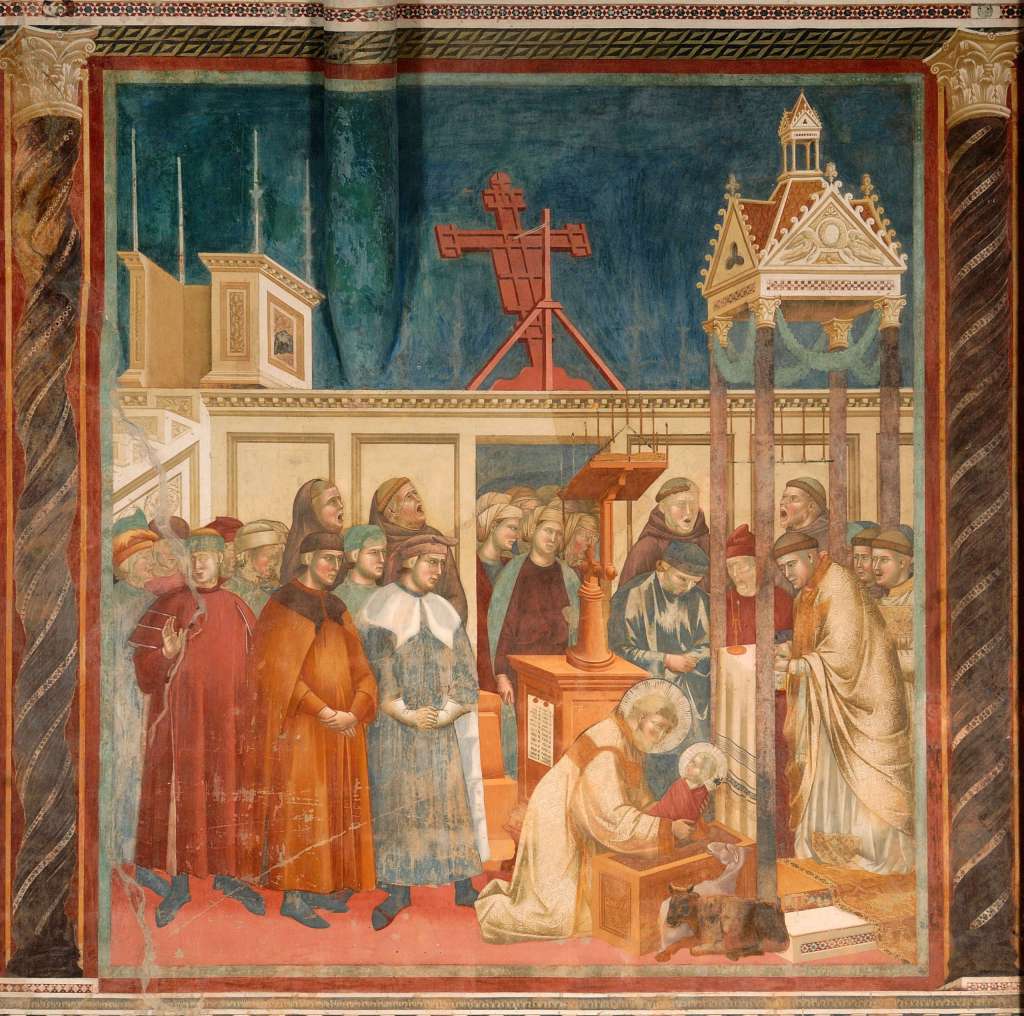
The Greccio Nativity Scene, Giotto, the Basilica of St. Francis, Assisi, Italy

The Story of Greccio from The Life of St. Francis by Thomas of Celano, Chapter XXX

(A program for use in Fraternity Meetings or other similar settings.)

Opening Hymn: O Come, O Come, Emmanuel

O Come, O Come, Emmanuel, and ransom captive Israel;
That mourns in lonely exile here, until the Son of God appear.

   Refrain: Rejoice, Rejoice, Emmanuel, shall come to thee O Israel.

O come, Thou Key of David, come, And open wide our heavenly home;
Make safe the way that leads to Thee, and close the path to misery.

O come Thou Wisdom from on high, Who orders all things mightily;
To us the path of knowledge show, and teach us in your way to go.

Opening Prayer: (Christmas Dawn Prayer #2)
Let us Pray:

Almighty God and Father of Light;
a Child is born for us and a Son is given to us.

Your Eternal Word leapt down from Heaven in the silent watches of the night, and now your Church is filled with wonder at the nearness of her God.

Open our hearts to receive His Light and increase our vision with the rising Dawn, that our lives may be filled with His Glory and His Peace, Who lives and reigns forever and ever.  Amen.

Scripture Reading #1:  The Birth of Jesus Foretold (Luke 1:26-38)
In the sixth month of Elizabeth’s pregnancy, God sent the angel Gabriel to Nazareth, a town in Galilee, to a virgin pledged to be married to a man named Joseph, a descendant of David. The virgin’s name was Mary. The angel went to her and said, “Greetings, you who are highly favored! The Lord is with you.”

Mary was greatly troubled at his words and wondered what kind of greeting this might be. But the angel said to her, “Do not be afraid, Mary; you have found favor with God. You will conceive and give birth to a son, and you are to call him Jesus. He will be great and will be called the Son of the Most High. The Lord God will give him the throne of his father David, and he will reign over Jacob’s descendants forever; his kingdom will never end.”

“How will this be,” Mary asked the angel, “since I am a virgin?”

The angel answered, “The Holy Spirit will come on you, and the power of the Most High will overshadow you. So the holy one to be born will be called the Son of God. Even Elizabeth, your relative, is going to have a child in her old age, and she who was said to be unable to conceive is in her sixth month. For no word from God will ever fail.”

“I am the Lord’s servant,” Mary answered. “May your word to me be fulfilled.” Then the angel left her.

Response: (The Magnificat, Luke 1:46-55)  (all, together)

“My soul glorifies the Lord and my spirit rejoices in God my Savior,
      for he has been mindful of the humble state of his servant.
  From now on all generations will call me blessed,
      for the Mighty One has done great things for me— holy is his name.
  His mercy extends to those who fear him,
      from generation to generation.
  He has performed mighty deeds with his arm;
     he has scattered those who are proud in their inmost thoughts.
  He has brought down rulers from their thrones
     but has lifted up the humble.
  He has filled the hungry with good things
     but has sent the rich away empty.
  He has helped his servant Israel, remembering to be merciful
      to Abraham and his descendants forever, just as he promised our ancestors.”

Scripture Reading #2: The Birth of Jesus, Part 1 (Luke 2:1-7)
In those days Caesar Augustus issued a decree that a census should be taken of the entire Roman world. (This was the first census that took place while Quirinius was governor of Syria.)  And everyone went to their own town to register.

So Joseph also went up from the town of Nazareth in Galilee to Judea, to Bethlehem the town of David, because he belonged to the house and line of David. He went there to register with Mary, who was pledged to be married to him and was expecting a child. While they were there, the time came for the baby to be born, and she gave birth to her firstborn, a son. She wrapped him in cloths and placed him in a manger, because there was no guest room available for them.

Hymn: Away in a Manger

Away in a manger, no crib for a bed,
the little Lord Jesus lay down His sweet head.
The stars in the sky looked down where he lay,
the little Lord Jesus, asleep on the hay.
The cattle are lowing, the baby awakes,
but little Lord Jesus, no crying He makes.
I love thee, Lord Jesus, look down from the sky,
and stay by my cradle ‘til morning is nigh.
Be near me, Lord Jesus, I ask thee to stay,
close by me forever, and love me, I pray.
Bless all the dear children in thy tender care,
and take us to heaven to live with thee there.

Scripture Reading #3: The Birth of Jesus, Part 2 (Luke 2:8-21)
And there were shepherds living out in the fields nearby, keeping watch over their flocks at night. An angel of the Lord appeared to them, and the glory of the Lord shone around them, and they were terrified. But the angel said to them, “Do not be afraid. I bring you good news that will cause great joy for all the people. Today in the town of David a Savior has been born to you; he is the Messiah, the Lord. This will be a sign to you: You will find a baby wrapped in cloths and lying in a manger.”

Suddenly a great company of the heavenly host appeared with the angel, praising God and saying,

“Glory to God in the highest heaven,
    and on earth peace to those on whom his favor rests.”

When the angels had left them and gone into heaven, the shepherds said to one another, “Let’s go to Bethlehem and see this thing that has happened, which the Lord has told us about.”

So they hurried off and found Mary and Joseph, and the baby, who was lying in the manger. When they had seen him, they spread the word concerning what had been told to them about this child, and all who heard it were amazed at what the shepherds said to them. But Mary treasured up all these things and pondered them in her heart. The shepherds returned, glorifying and praising God for all the things they had heard and seen, which were just as they had been told.

On the eighth day, when it was time to circumcise the child, he was named Jesus, the name the angel had given him before he was conceived.

Hymn: Silent Night

Silent night, Holy night.  All is calm, all is bright.
Round yon Virgin, Mother and Child, Holy Infant, so tender and mild.
Sleep in heavenly peace.  Sleep in heavenly peace.
Silent night, Holy night.  Shepherds quake, at the sight.
Glories stream from heaven above, heavenly hosts sing alleluia.
Christ the Savior is born. Christ the savior is born.
Silent night, Holy night.  Son of God, Love’s pure light.
Radiant beams from thy Holy face, with the dawn of redeeming grace.
Jesus, Lord at thy birth.  Jesus, Lord at thy birth.

Reading One: The Humility of the Incarnation

Francis’ chief intention, his principal desire and supreme purpose was in and through all things to observe the Holy Gospel, and with all watchfulness, all zeal, all the longing of his mind and all the fervor of his heart to perfectly follow the teaching of our Lord Jesus Christ and tread in His footsteps.  He would recall the words of Jesus assiduously and meditate on His deeds with fervent consideration. The humility of the Incarnation and the charity of the Passion so occupied his memory that he would scarce ponder anything else. Therefore, what he did at Greccio to reverently remember the birthday of our Lord Jesus Christ is to be devoutly celebrated and eagerly commemorated each year.

Response: (The Remembrance of the Desire of a Soul, Chapter 151)  (all, together)

Francis used to observe the Nativity of the Child Jesus with inexpressible eagerness.  Above all other solemnities, he affirmed it as the Feast of Feasts, when God became a little child, hung on human breasts.  He would kiss images of the “Babe of Bethlehem” and the melting compassion of his heart made him stammer sweet words as babies do.  The name “Baby Jesus” was to him like honey and honeycomb in his mouth.

Reading Two: The Celebration is Prepared

In Greccio there was a man named John, of good repute, but of better life, whom blessed Francis loved with special affection.  Although noble and greatly honored in that town, he sought nobility of spirit over that of the flesh. About fifteen days before the Nativity of the Lord, Blessed Francis sent for this man and said to him, “If you desire to celebrate the Birth of our Lord at Greccio, then make haste and diligently prepare what I tell you. For I wish to re-create the scene in Bethlehem, so that we will behold with our own eyes how He did not have even the barest necessities, and how He lay in a manger on the hay, with the ox and the ass standing by.” When the good and faithful man heard Francis’ plea, he made haste and prepared everything according to Francis’ instructions.

Hymn: Angels We Have Heard On High

Angels we have heard on high, sweetly singing o'er the plains
and the mountains in reply, echoing their joyous strain.
  Refrain: Gloria, in excelsis Deo! Gloria, in excelsis Deo!
Shepherds why this jubilee?  Why your joyous strains prolong?
What the gladsome tidings be, which inspire your heavenly song?
Come to Bethlehem and see, Him whose birth the angels sing.
Come adore on bended knee, Christ the Lord the newborn King.

Reading Three: Francis Rejoices

The day of gladness drew nigh, the time of triumph arrived. The brothers were summoned from many places; with exulting hearts the men and women of that town prepared tapers and torches to brighten the night whose shining Star has illuminated every day of every year since. The manger was made ready, the hay carried in, and the ox and ass were led to the spot. At length the Saint of God came, and finding all things prepared, beheld them and rejoiced.

Hymn: O Come, All Ye Faithful

O come, all ye faithful, joyful and triumphant!
O come ye, O come ye, to Bethlehem!
Come and behold Him, born the King of angels!
  Refrain: O come, let us adore Him!  O come let us adore Him!
           O come let us adore Him!  Christ the Lord!
O sing, choirs of Angels, sing in exultation!
Sing all ye citizens of heaven above!
Glory to God, glory in the highest!
Yea, Lord we greet thee, born this happy morning!
Jesus to thee be all glory given!
Word of the Father, now in flesh appearing!

Reading Four: Mass is Celebrated

The Simplicity of the Gospel was resplendent.  Poverty was exalted and Humility commended.  Greccio was made as it were a new Bethlehem. The night was bright as the day and made delightful to men and beasts alike. The people came and rejoiced at the Mystery made new. The woodland rang with voices and the boulders echoed the gleeful throng. The brethren sang due praises to the Lord and all the night resounded with jubilation. The Saint of God stood ecstatically before the manger, full of sighs, overcome with tenderness, his spirit trembling with compassion, ineffable Love and wondrous Joy. The solemnities of Mass were celebrated over the manger, and the priest enjoyed a consolation he had never tasted before.

Response: (Letter to the Faithful, 2nd Version)  (all, together)

Behold the Word of the Father, so worthy, so Holy, so Glorious, who’s coming in the womb of the Holy and glorious Mary was announced by the Father through His angel Gabriel!  From the Virgin Mary’s womb He received our flesh and our frailty.  Though He was rich, above all things He wished, together with the most Blessed Virgin, to choose Poverty as His lot in this world.

Reading Five: Francis Preaches

The Saint of God was clothed with Levitical vestments and with an earnest, sweet, clear and sonorous voice he chanted the holy Gospel–ravishing everyone there with heavenly desires, calling each to the highest rewards. Then he preached to the people, uttering melodious words concerning the birth of the poor King and the little town of Bethlehem. When he would name Christ Jesus, with exceeding love he would call Him the “Babe of Bethlehem,” uttering the word “Bethlehem” in the manner of a sheep bleating.  He filled his mouth with the sound, but even more his whole self with sweet affection. When naming Jesus he would lick his lips, relishing the fragrance of the Word.

Responsorial: (The Office of the Passion: Vespers of the Lord’s Birth)

Leader: The Most Holy Father of Heaven, our King before all ages, 
        sent His Beloved Son from on high, and He was born of the   
        Blessed Virgin Holy Mary.                                 
            -Exult in God our help!
Leader: On that day the Lord sent His Mercy, and at night, His song.
            -This is the day the Lord has made! Let us rejoice and 
             be glad!
Leader: For the Most Holy Child has been given to us.  He was placed 
        in a manger because there was no room at the inn.
            -Shout to the Lord God, living and True, with cries 
             of gladness!
Leader: Let the heavens rejoice and the earth exult, let the sea and 
        its fullness resound, let the fields and all that is in them 
        be joyful.
            -Sing a new song to the Lord!  Sing to the Lord all 
             the earth!
Leader: The Lord is great and worthy of praise.  He is awesome
        beyond all gods.
            -Glory to God in the highest and peace on earth to those 
             of good will!

Reading Six: “The Babe of Bethlehem” Awakens

There the gifts of the Almighty were multiplied, and a vision of wondrous worth was seen by a virtuous man. In the manger he saw the little Child lying lifeless.  Then Francis, the Saint of God, drew near and roused the Child from the lethargy of sleep. This vision was fitting, for the memory of the Child Jesus had been forgotten in the hearts of many. But by the working of Grace and the efforts of the holy man of God, it was brought to Life again and imprinted deeply on every diligent memory. And when the solemn vigil ended, each present returned to his home with unspeakable joy in his heart.

Hymn: What Child is This?

What Child is this, who laid to rest, on Mary’s lap is sleeping?
Whom angels greet, with anthems sweet, while shepherds watch are keeping.
  Refrain:  This, this, is Christ the King, whom shepherds guard and 
            angels sing. Haste, haste, to bring Him laud, the babe, 
            the Son of Mary.
So bring Him incense, gold and myrrh, come peasant, king, to own Him.
The King of kings, Salvation brings, let loving hearts enthrone him.
Raise, raise, a song on high, the Virgin sings a lullaby.
Joy, joy, for Christ is born, the Babe, the Son of Mary.

Reading Seven: Miracles Flow from the Celebration

The hay that had been placed in the manger was kept so that the Lord might save many beasts of burden and other animals through it.  And verily it came to pass, for many animals in the region were freed of diverse diseases and sicknesses by eating of that hay. Moreover, women in long and difficult labor delivered safely when some of the hay was placed upon them, and many persons of both sexes suffering from various ailments gained long-wished-for health in the same way.

Hymn: Hark the Herald Angels Sing!

Hark! The herald angels sing, "Glory to the newborn King!"
Peace on earth and mercy mild, God and sinners reconciled.
Joyful all ye nations rise, Join the triumph of the skies.
With angelic hosts proclaim, "Christ is born in Bethlehem!"
Hark! The herald angels sing, "Glory to the newborn King!"

Christ by highest heaven adored, Christ the everlasting Lord!
Late in time, behold him come. Offspring of the favored One.
Veiled in flesh the Godhead see. Hail the incarnate Deity.
Pleased as man with man to dwell, Jesus our Emmanuel.
Hark! The herald angels sing, "Glory to the newborn King!"

Mild He lays His glory by, born that man no more may die.
Born to raise the sons of earth, born to give them second birth.
Risen with healing in His wings, light and life to all He brings.
Hail the Son of righteousness! Hail the heaven born Prince of Peace!
Hark! The herald angels sing, "Glory to the newborn King!"

Reading Eight: Francis’ Requests for Christmas Day (The Mirror of Perfection, #114)

“If I ever speak to the emperor, I will beg and persuade him, for the love of God and of me, to enact a special law forbidding anyone to catch or kill our sister larks or do them any harm.  Likewise, all mayors of cities and lords of castles and villages should be bound on the day of the Nativity to scatter wheat and other grain along the roads so that our sister larks and other birds may have something to eat on such a solemn feast.  Also, out of reverence for the Son of God, whom on that night was laid in a manger between ox and ass by the most Blessed Virgin Mary, I would add that whoever has an ox or an ass be bound to provide them a generous portion of the best fodder.  Likewise, on that day, all the poor should be fed good food by the rich.”

For blessed Francis held the Nativity of the Lord in greater reverence than any other of the Lord’s solemnities, saying: “After the Lord was born to us, it was certain that we would be saved.”  On that day, he wanted every Christian to rejoice in the Lord.  For love of Jesus, Who gave Himself for us, he wished everyone to provide generously not only for the poor, but for the animals and birds as well.

Response: (The Earlier Rule, Chapter 23)  (all, together)

We thank You, Lord,
For through Your Son You created us.
 And through your Hallowed Love,
With the Glorious, ever-Virgin, most Blessed, Holy Mary,
You brought about His birth as true God and true man.
You Willed to redeem us, captive to sin,
By His Holy Cross, Blood and Death.

Reading Nine: A Church is Dedicated

Today, the place where the manger stood is revered as a temple of the Lord, and in honor of the most blessed father Francis, over the manger an altar was reared and a church dedicated. This was done so that where beasts had once eaten fodder of hay, men might hereafter, for the healing of soul and body, eat the flesh of the spotless and undefiled Lamb, our Lord Jesus Christ, Who in highest and unspeakable charity gave Himself for us. 

He Who lives and reigns with the Father and the Holy Spirit, God eternally glorious, world without end. Amen. Amen. Alleluia. Alleluia.

Hymn: Joy to the World

Joy to the world, the Lord is come, let earth receive her King!
Let every heart prepare Him room,
and heaven and nature sing, and heaven and nature sing,
and heaven, and heaven, and nature sing!
Joy to the world, the Savior reigns, let all their songs employ!
While fields and floods, rocks, hills, and plains,
repeat the sounding joy, repeat the sounding joy,
repeat, repeat, the sounding joy!
He rules the world, with Truth and Grace, and makes the nations prove,
the glories of His righteousness,
and wonders of His Love, and wonders of His Love,
and wonders, wonders, of His Love!
Joy to the world, the Lord is come, let earth receive her King!
Let every heart prepare Him room,
and heaven and nature sing, and heaven and nature sing,
and heaven, and heaven, and nature sing!

Pace e bene:  Peace and all good things!

What if Unity is Impossible?

When I first published something under the heading “The Things I Wish They’d Say,” I was experimenting. I had written a short story, or the beginning of a longer story, and I wasn’t sure if it belonged as part of this website. As part of the experiment, I posted it not as a blog entry, but as a series of pages.

That made it harder to co-locate it with the two new blog posts about the Vice-Presidential Debate, which also fit under that broad heading.

This post simply consolidates that story into a single post and allows me to group everything under the same category.

If you have not seen it before, I hope you enjoy it, or at least find it intriguing or thought provoking.

The Vice Presidential Debate, Part II

As it happens, the next topic of the debate was “America’s gun violence epidemic.”  In the clip, you will hear Norah O’Donnell introduce the topic, then ask JD Vance a specific question about whether or not parents should be held liable for a child who engages in a school shooting.

Senator Vance does a nice job of answering the question, using it as an opportunity to talk about his own young family and humanizing himself neatly in the process.  A little later he begins to talk about the need for increased security in our schools.  He says flat out that he does not like the idea, but that he thinks it’s necessary.

I have no issue with the portion of his reply that is in the clip, but I think there is a specific reason why he doesn’t like his answer when he starts talking about security, even if he can’t put his finger on that reason.  The problem is, increased security does not address the core problem.  In fact, none of the proferred solutions, including the gun control that is favored by the Democrats, addresses the core problem.  There does not seem to be a politician in the entire country who is willing to publicly delve into the depths of the issue.  Perhaps they think the American people are not sophisticated enough to understand the arguments?

If any of them have ideas similar to what I am about to suggest, they certainly are not speaking them out loud. Instead of giving an answer based on increased security, I wish JD Vance would have had the courage to say something like this:  (Note that the answer I suggested in the first post about the VP debates lays the ground work and opens the door perfectly for this one.  That is not my doing.  CBS picked the order of the topics for the debate, not me.)

“Norah, in your introduction, you stated that the leading cause of death of children and teens in America is fire arms.  Tonight, I would like to suggest that America consider having a frank discussion about whether or not this is true.  I wonder, perhaps, if we ought to open up ourselves to the possibility that the leading cause of death in America for children and teens is actually abortion.

In the last segment, I suggested that our country is suffering from a fifty-year long “abortion epidemic” and that we have been deeply injured as a people as a result.  I also suggested that we need to start talking about this in order to heal the entrenched divisions that are currently plaguing our politics.  So I want to thank you for asking this question about gun violence at this juncture, because it allows me to further expand on that idea.

We have to understand that our children are watching what we do as adults.  They are paying attention and they are learning from the examples that we set.  They may not process the consequences of the last fifty years as precisely as I am about to, but they internalize the implications deeply nonetheless. 

As I noted earlier, our country has openly sanctioned the death of 64 million innocent unborn children in the past fifty years.  A significant portion of our population and one of our two major political parties has not only enthusiastically consented to these deaths, they have overtly campaigned in favor of disallowing any reasonable attempts to limit the availability of abortion. 

Governor Walz sidestepped this issue in the last segment, but the truth is the Minnesota law has no restrictions in it whatsoever.  It grants a right to abortions without a single caveat or clarification.  The reason the Governor is charged with signing a law that does not protect the life of a baby born during an attempted abortion is because his law does not require the doctor to treat the baby if he or she is alive when removed from the womb.  It is completely silent on the issue. 

We are asking, if the intent of the procedure is to end the life of the fetus, what are the obligations of the doctor if the fetus survives the procedure?  This is the question both the law and the Governor do not answer.

But putting that aside, we have to understand that there are teenagers watching this debate.  Some of those teenagers may be deeply troubled.  Some of them may be considering the very violence that was at the heart of the question that has been asked.

When those teenagers consider the 64 million lives that have been aborted, when they consider the reality that Minnesota has passed a law that does not expressly protect the life of a fetus that survives an abortion, when they see that thousands of convicted murderers and sex offenders have crossed the border uninhibited, what conclusions will they draw about the value of life in American culture?

The answer is obvious, isn’t it?  America simply does not see life as precious.  It does not value life the way it ought to.

When I suggest that we, as a country, need to start discussing the fallout of the “abortion epidemic,” I am suggesting that we need to begin to address the possible root causes of what Norah named the “American gun violence epidemic.”  Are these two things related? 

Is the “abortion epidemic” and the callousness toward the preciousness of life that is unavoidably inferred from it a contributing factor to the gun violence that plagues our schools and streets today?

Should we have anticipated that a decreased respect for the value of life is the lesson our children would learn from making unfettered access to abortion the law of the land?     

 And there is another aspect of this, Norah, that also needs to be brought into the open.

When the Supreme Court promulgated Roe V Wade, it essentially transferred responsibility for final decisions on morality from the hands of God to the hands of men.  When we decided as a country that we could negate the Creative Will of God via a simple medical procedure, we took the responsibility of Creation from God and placed it on ourselves.  God might be present at the moment of conception, but the decision on whether or not a fetus should be brought to fruition was no longer His.  We usurped that power from Him and in the process made ourselves our own gods.

Have our children also absorbed and internalized this lesson in ways we never would have expected? 

If we are all equal, and we have assumed the power of God, then we are all gods.  Our equality and our godhood gives each of us the right to determine our own moral code.  There may be cultural norms, but they are under constant assault.  Words like marriage and gender are being redefined and those former cultural norms are passing away.  When there is no Truth with a capital T to define the difference between good and evil, then any cultural norm, including norms that prohibit violence against others, can be altered to suit our own individual sense of justice because each of us now possesses the power of God and the final right of decision.

The cultural revolution of the past fifty years has done everything it can to eliminate God not just from our schools, but from our public life entirely.  God is no longer sovereign.  Man is, which means every individual man is.  No eternal Truth means the elimination of cultural norms entirely.  Justice becomes completely individualized and therefore, quite literally, anything goes.

We have taught our children to internalize the notion that they have not only the ability, but the human right, to define justice on their own terms. 

And they are acting on it.  Why are we surprised that when they feel abused by a classmate, or a teacher, or the system as a whole, that the take matters into their own hands?  The last fifty years has done everything it can to teach them to do just that.  They are taking the deepest lessons preached by our evolved culture and applying them.  We should have expected these things to happen.

But we didn’t foresee it, because we are unwilling to talk about such things in public. To do so opens us to the possibility that we might have to admit that we made some grave errors in our recent political history and that is the last thing any politician wants to do.

We need to bring these things into the open.  These verboten topics cause the divisions that currently grip our nation.  There are millions of Americans who understand intuitively exactly what I am saying, but they have no voice and no one speaks on their behalf.

I know that as soon as this debates ends, I will be attacked vociferously for suggesting that there is even such a thing as an “abortion epidemic.”  You, Norah, and you, Margaret, and your entire network will help lead those attacks.  You will shout me down and drag me through the mud from every angle you can muster in an attempt to discredit the arguments I have just made.

As journalists, your responsibility is to foster the discussion.  But you are not really journalists, are you?  You are advocates for the Harris campaign and you will therefore be unable to do what the American people so desperately need and want you to do, which is simply to report fairly on both sides without surrendering to your overwhelming need to editorialize instead of just presenting the opposing arguments and leaving the decisions and conclusions to the American voter.  

You need to be aware that your efforts to quash this discussion will fail.  Now that it is opened, President Trump and I will continue to speak directly to the American people about the things they most wish to hear about.  No matter the outcome of the election, this discussion will move forward.  We, and Americans in general, are tired of being told what to think. The efforts to sensor our campaign and our point of view will escalate but we will remain undaunted.  We will use whatever means necessary to make sure our voices are heard.

We will do this because the lives of our children, my children, are at stake.  The question you asked, Norah, is valid.  There is a “gun violence epidemic” in America.  Discussions on security and gun control are fine, but they are at best temporary solutions.

This discussion I have suggested is about root causes, and we can never resolve the problem completely until we identify those root causes and begin to address them honestly and openly from both sides of the aisle.     

It will take all of us to tackle the issue, but we have to start, now, today, to talk about the real causes behind the problems that are plaguing us.

We have to figure out as soon as possible how to make respect for life a precious tenet of American culture once again.

Return to Part I of the Vice Presidential Debate

The Vice Presidential Debate, Part I

In the first post of the series entitled “The Things I Wish They’d Say,” I said this:

“I have been disappointed by all politics for a long time now. In their absolute quest for earthly power and dominance, both parties are wildly inconsistent. Neither captures the true tenor of how I view the world.” 

Nothing has happened since to change my mind.  I am just as disappointed in my choice for President this year as I was when President Biden was elected.  For the most part, I pay very little attention to politics, finding it such a downer that I cannot stand to listen to any politician or journalist speak for more than about thirty seconds.

That said, I acknowledge the need to be informed ahead of the upcoming election.  I forced myself to watch the debate between Donald Trump and Kamala Harris and found it disconcerting on more levels than I can describe.   

I also watched the Vice-Presidential debate.  I had seen a little of JD Vance and was curious to know more.  I had never seen Tim Walz and wanted to learn about him as well.  I found this debate much more palatable.  It was much more congenial, which I found refreshing.

In the midst of that debate, when the topic of abortion came up, I found myself liking what Senator Vance had to say.  But I also could not help but feel that he missed the chance to say something that would have truly resonated with me and with the country at large. 

The video above captures the beginning of the moment I am talking about.  

———

A little after this exchange, in response to an argument made by Governor Walls, Senator Vance said this:  “Governor, I agree with you, Amber Thurmond should still be alive …….. I certainly wish that she was.” 

Here’s the thing I wish he would have said after that sentence.

“The first thing the American voter should understand is this.  The vast majority of Republicans, myself and President Trump included, are in favor of exceptions to restrictions on abortion that provide care when the life of the mother is in danger, or when the pregnancy results from rape or incest.  This is not just true now, but it was true on the day President Biden and Vice President Harris took office.  At that point in time, the Democrats controlled not just the White House, but both houses of Congress as well.    

If a narrow piece of legislation that addressed just those two items would have been introduced then, those exceptions would be the law of the land now, and Democrats would have been able to take credit for that law getting passed.  This also means that Amber Thurmond would likely be alive today, because the state of Georgia would not have been able to deny her care given her condition. 

It’s another example of your campaign promising to take action after the election, when action could be taken right now.  In fact, if the Democrats in the Senate wish to bring forth a narrow bill tomorrow ensuring these two exceptions become the law of the land, I will be happy to co-sponsor it.

Democrats accuse Republicans of grandstanding on this issue, but the truth is, both sides are guilty.  Instead of acting on the things we can agree on, we load bills such as these down with attempts to further our agenda on matters that are in dispute.  Democrats refuse to bring forth such a narrow bill without tacking on provisions that would restore Roe V Wade.  Republicans refuse to bring forth the same bill without insisting that national restrictions on abortion are attached to it.  Both sides would rather see nothing done and use the issue to energize their political bases than compromise and do the right thing.

The politics on both sides of the aisle are what cost Amber her life, and every politician in America should be ashamed.  We need to set aside our differences where we can and do what the American people expect us to do, which is to enact common sense initiatives that are important to the welfare of the country regardless of the politics.  Donald Trump and I, when elected, will do just that.

I want to tell you, Governor, that I deeply admire your passion when it comes to the tragedy of Amber’s death.  I believe it is sincere.  I believe that you are personally aggrieved at the loss of her life.

That passion makes me wonder if you are as deeply aggrieved at the loss of the lives of Rachel Morin, Laken Riley and Jocelyn Nungary, who were murdered by illegal immigrants who never would have been in the country if not for the failures of the current administration at the border.  Are President Biden and Vice President Harris as aggrieved at their loss as you are at the loss of Amber?  If so, what are they doing about it?  Has the administration taken every step possible to ensure that no one who crosses the border is released into the general population without being properly vetted?  Are they doing everything they can to round up and deport the hundreds of thousands of convicted criminals who have entered the country during their administration?

I wonder, Governor, if your passions have not blinded you.  I wonder if you realize yet that you have chosen to defend abortion by making a passionate plea in defense of a life that was needlessly lost.  The very passion that you show when it comes to Amber is in and of itself a dramatic argument in favor of restricting abortion.  I have to ask, if Amber’s life was so precious, why are the over sixty-four million lives that have been lost to abortion since 1973 not just as precious?

The problem with your position is that it is deeply inconsistent.  You can’t treasure the life of Amber, and not also treasure the lives of Rachel and Laken and Jocelyn equally.  You can’t treasure the life of Amber without treasuring the lives of every aborted child since the initial ruling of Roe V Wade just as much.  Living that inconsistency will tear you up inside personally whether you realize it or not, and when you ask the country to do it, it tears it apart as well.

The biggest problem with the abortion debate is that we never ask the question that matters most.

When abortion was legalized, why did so many women choose to go through with the procedure?  The current population of the United States is approximately 333 million.  Since 1973, 64 million abortions have been performed.  One in every six Americans that could be alive today is not. 

That is not due to threats to the health of the mother, or incest, or rape.  It is due to a drastic change in American culture that began with the Roe V Wade decision.  Pregnancy used to be viewed as a divine miracle.  The American dream used to be centered on raising a family.  That is no longer the case.  Now, all too often, pregnancy is viewed as an inconvenience that gets in the way of worldly ambition or a definition of freedom that emphasizes avoidance of responsibility for our actions.  Pregnancy is seen as a problem to be solved, not a blessing to be embraced and cherished. 

A few years ago, there was an argument being made that abortion should be legal, but rare.  Last year, despite recent declines in overall numbers, there were still over one million abortions performed in the US.  That is not rare.  The question of whether or not abortion will remain legal is answered.  It will in many states.  The next question is, what can we do to help women make a different choice?  What can we do to encourage women to once again see a child as a beautiful gift, a supreme blessing, and an inexplicable miracle? What can we do to help America remember how to embrace life as precious at every moment and in every instance?

As I said before, the loss of Amber was tragic and I am ready to work with you, across the aisle, to try and ensure that the next Amber gets the medical treatment she needs promptly, wherever she is located.  We do not need to restore Roe V Wade to make this happen.  It could happen almost overnight if the two parties decided to make it happen.

But we must accept and acknowledge that no matter how much we lament the loss of Amber, the loss of 64 million children before they ever had the chance to see the light of day dwarfs her case.  In all honesty, this is a tragedy whose effects on the country are not understood because we never talk about them.  You would have us believe that abortion is a private decision that does not affect the culture, but I would disagree.  I believe the ramifications of unfettered abortion are widespread and deeply destructive. 

A couple years ago, the Covid pandemic stopped the country in its tracks.  Almost every day we hear arguments about global warming and the destructive effect it is having on the environment, and rightly so.    

But we never hear the idea of an “abortion epidemic” discussed at all.    

I think this is a mistake.  I think we have experienced just that, an “abortion epidemic,” over the course of the last fifty years, and I think the country was deeply injured by it.  I think the discussion on abortion needs to be completely recast.  I think we need to start talking about the long-term effects that abortion has had on the well-being of the country.      

Otherwise, we are surely ignoring one of the main causes of the division and distrust that is plaguing our country and our politics at this very contentious moment in our history.

Proceed to The Vice Presidential Debates, Part II

6: True and Perfect Joy

Please read the following passages multiple times:

The Little Flowers of St. Francis, Chapter VIII, How St. Francis Set Forth to Friar Leo Where Perfect Joy Was to be Found

The Writings of Francis of Assisi:  The Undated Writings, True and Perfect Joy

Then focus on the following:

………. if we bear all these injuries with patience and joy, thinking of the sufferings of our Blessed Lord, which we would share out of love for him, write, O Brother Leo, that here, finally, is perfect joy.  And now, brother, listen to the conclusion. Above all the graces and all the gifts of the Holy Spirit which Christ grants to his friends, is the grace of overcoming oneself, and accepting willingly, out of love for Christ, all suffering, injury, discomfort and contempt; …………….

Every time I encounter this story in either of these versions, I struggle to understand it.  I have written about it in the past and thought I had it figured out, only to revisit my words and come away with the sense that I still have not quite gotten it right.  I find it elusive, but it provides a natural conclusion to this short course of study, so I will try again to pin it down. 

Recall again the emphasis of the first reflection. “All of us should be interested in learning how to accept, willingly participate in, and even benefit from personal suffering.” In the quote above, Francis ups the ante. He asserts that suffering is not just something to accept, but something to look forward to and embrace as the ultimate gift God can give. 

The inference is this: When I reach the point where my basic response to suffering is “willing acceptance out of love for Christ,” only then have I completely discerned and surrendered to the primary essence of Spiritual Poverty, which necessarily includes Christ’s own suffering on the Cross.  The unequivocal embrace of this essence is required for all barriers between Christ and I to be overcome.  Only then can complete unity with Christ be achieved, and it is only in this perfect unity in suffering that true and perfect joy can be found. 

This declaration is as counterintuitive and mysterious as the notion in Reflection #4 that God was “multiplying his mercy” on Francis by granting him a serious disease of the eyes. 

To reconcile God’s mercy and the suffering of Francis in the writings of Celano, I had to embrace that aspect of Spiritual Poverty which calls on me to let go of all my earthly perspective and preconceptions.  There is no human calculation that explains how suffering can equal Mercy.  The only way to understand and reconcile these disparate concepts is to seek Revelation through Grace. To receive such Revelations, I must “overcome myself” by setting aside all I think I know and all my worldly assessments so that God can create space within me and fill that space with His Grace.  That Grace then steadily works within me and reveals to me, in some small measure, God’s otherworldly and omnipotent point of view.

I find this next to impossible to do.  In fact, I am sure I cannot do it on my own.  This brings me back to Reflection #3 and the preparations that Francis made in prayer prior to receiving the stigmata.  In the stillness and quiet of sustained prayer, Francis sought God.  Or perhaps, more than actively seeking God, Francis simply did everything he could to empty himself and invite God in.  Perhaps he slowly, over time, cleared himself of distraction and simply waited contentedly for God to make Himself known.  When Francis achieved tranquility, God, through His Grace, made the connection between suffering and unity with Christ clear to him. 

Either way, this conclusion was not reached by Francis through human cogitation.  Instead, it was revealed to him through a combination of prayer and Grace.  The unique thing that Francis did was accept this Revelation wholeheartedly.  He did not fight against it, exercising his human perspective by trying to avoid the suffering that He now knew to be necessary for the Will of God to be fulfilled in him.  Instead, he remained true to Lady Poverty and resolved to live out that devotion regardless of the personal cost.  

To some extent I am guessing about how Francis proceeded, but I know myself well enough to understand that I cannot force compliance with the Will of God on my own.  I am too sinful to accomplish anything by myself.  I am too weak, too human, to align myself to the Will of God without assistance.  I know I must learn to pray in the patient and peaceful way I have attributed to Francis here if I hope to live into Poverty as he did.  I require the strength and succor of Jesus if I am to experience the unity with Him that leads to the true and perfect joy that Francis describes in these stories.

Perhaps one way to understand this teaching of Francis is to use this formula?

  1. In extended and peaceful prayer, I invite God to reveal Himself to me.
  2. God, in His Wisdom and Mercy, sends me suffering for my edification.
  3. God’s Grace invites me to meditate on the suffering of Christ in the Passion.
  4. Christ knows suffering.  It is something we have in common that can unify us.
  5. Overcoming myself through Poverty, I hope in and rely on the strength of Jesus.
  6. I remember and embrace the unfathomable Love of Jesus revealed on the Cross.
  7. In gratitude, I return His Love as sincerely and wholeheartedly as I can.
  8. In the exchange of Love, I am newly united to Christ more closely than ever before.
  9. Unified to Christ through the gift of suffering, I experience true and perfect joy.

Francis lived out the story he told Leo on the way to St. Mary of the Angels in the last two years of his life. I think we can safely assume that he both suffered and was truly filled with joy as a result. The Stigmata is integral to both sides.  It contributed to his suffering greatly, but as an indication of the approval of God, it must have also served to enhance the joy despite the hardship.

  • Are you willing to pray consistently and gently in the hope of receiving God’s Grace and Revelation even if His Will includes your own version of Francis’ suffering? Does the example of Francis embolden you to the point that you might look forward to the opportunity of suffering?  Might you even hope for it as Francis likely did, believing that suffering is the key to perfect emulation of, perfect unity with, and true and perfect joy in Jesus?
  • Do you accept that unity with Christ can be engendered by suffering? If so, would you then welcome the full experience of the last two years of the life of Francis into your life? Do you think that true and perfect joy, inspired by love and suffering, would help you believe more firmly in Jesus as “the Messiah, the Son of God who came into the world?”  If you faced suffering with joy, would that help you spread belief in Jesus to others? How would experiencing true and perfect joy as defined by Francis solidify and expand your hope for salvation? 

Back to Reflection 5: The Life of St. Francis by Thomas of Celano, the Second Book, Chapters 8 through 10

5:  The Life of St. Francis by Thomas of Celano, the Second Book, Chapters 8 through 10

The Death of St. Francis, Giotto, 1300

Read the chapters (pages 277 to 287) multiple times.  Then focus on this passage from chapter nine:

The whole city of Assisi rushed down as a group and the entire region hurried to see the wonderful works of God which the Lord of majesty gloriously displayed in his holy servant……………People considered it a great gift to be allowed to kiss or even to see the sacred marks of Jesus Christ which Saint Francis bore in his own body.

And seeing them, who would not be moved to joy rather than tears?
And if moved to tears, 
would that not be more from gladness than sadness? 
Whose heart would be so iron-hard 
that it would not be moved to groan?
Whose heart would be so much like stone,
 that it would not break with sorrow,
that it would not burn with divine love,
 or would not be strengthened with good will?
Who would be so dull-witted and senseless as not to realize the obvious truth.
This is a miracle worthy of everlasting remembrance and a sacrament to be remembered with unceasing and wondrous reverence.
It presents to the eyes of faith that mystery in which the blood of the spotless lamb,
flowing abundantly from the five wounds,
washed away the sins of the world.
O sublime splendor of the living cross, giving life to the dead!
Its burden presses so lightly and hurts so sweetly,
that through it, dead flesh lives and the weak spirit grows strong.

In the first reflection on the death of Lazarus, this paragraph was emphasized:

Lent is a time when the idea of suffering is front and center.  We most often think of this in terms of the hardship that Jesus endured during His Passion, but here we are reminded that suffering is integral to God’s overall plan.  None of us should expect to escape it.  All of us should be interested in learning how to accept it, willingly participate in it, and even benefit from it.   

Just like Lazarus, we may not always understand why suffering comes into our lives, but it is fair to say that the first two reflections on Celano speak directly to our need when it comes to handling the suffering God sends us.  Francis not only willingly accepted suffering in his life, he clearly understood it to be necessary if he was to emulate Jesus precisely.  A life of Poverty not only includes following the example and teaching of Jesus exactly, but it also includes sharing in the Poverty intrinsically contained in the tribulations of the Cross. 

Nothing connects a person to Jesus more perfectly than freely embracing the suffering that God mercifully sends into our lives. 

The second reflection from the gospel of John took this as its emphasis:

The baseline of my task is clearly set.  Everything that I do while present on this earth must be pointed at encouraging, assuring, and securing my belief.  All means necessary must be used to keep my belief thriving, growing, and increasing.

Celano makes a clear reference in the quote above to the gospel passage that was emphasized in that second lesson.  Jesus told Mary, “I am the resurrection and the life. The one who believes in me will live, even though they die; and whoever lives by believing in me will never die. Do you believe this?”  Jesus words here have a certain mystery about them.  How is it possible that someone can never die, or live even though they die?    

Celano is emphasizing this same mystery (he even uses that exact word) when he talks about the “sublime splendor of the living cross, giving life to the dead!  Its burden presses so lightly and hurts so sweetly, that through it, dead flesh lives and the weak spirit grows strong.”  He is recalling this passage directly, insisting that the stigmata, present in the flesh of Francis, must lead to an increase in our belief in the power of the Cross and the person of Jesus.  This belief will then ensure for us the eternal life that Jesus made possible by His sacrifice.  

The pattern in the story of the death of Lazarus is this:  The suffering and death of Lazarus is a blessing that Jesus uses to teach belief in Himself to his disciples and the Jewish community at large.  Jesus directly states this in the gospel passage from the first reflection when he says “Lazarus is dead, and for your sake I am glad I was not there, so that you may believe.”  The resulting belief in the larger Jewish community that occurs after Jesus calls Lazarus out of the tomb is also stated directly in John 11:45:  “Therefore many of the Jews who had come to visit Mary, and had seen what Jesus did, believed in him.”

This pattern is repeated in the life of Francis.  The Will of God for the life of Francis begins with the call to emulate Jesus as precisely as possible.  Francis understood this as a call to live a “gospel life” centered on the ideal of Poverty.  At the end of his life, he took his understanding to its final, inevitable conclusion by discerning and embracing the need to experience the anguish of Jesus on the Cross as perfectly as possible through the mechanism of his own suffering.

The reward for Francis’ insight and devotion is the Mercy of the stigmata, which contains the suffering required for Francis to fulfill his faith.  But the stigmata is more than this.  After his death, it also becomes the outward sign that confirms the extreme holiness at the center of Francis’ suffering, a holiness that inspired belief in Jesus not just for those who witnessed the example and result of his life, but also in us 800 years later as we commemorate the anniversary of this “miracle worthy of everlasting remembrance” during our Centenary Celebration of the Stigmata.

Please, take a moment to reflect on the end of Francis’ life and how it parallels the story of the death of Lazarus.  Make the link between the stigmata, the suffering of Francis in the last two years of his life, and the impact this has had on belief ever since, including, hopefully, your own ever-increasing belief.

————–

Francis, early in his ministry, received from Jesus, directly from the San Damiano Cross, the instruction to “rebuild His church.”  This corollary to the call to a “gospel life” is, in effect, a call for Francis to teach people how to believe in Jesus again.

It would be easy, as we reflect on these last three chapters, to get caught up in the reward that Francis received at the end of his life.  It is described exquisitely by one of the brothers, who tells of seeing “the soul of the most holy father rise straight to heaven over many waters.  It was like a star but as big as the moon, with the brilliance of the sun, and carried upon a small white cloud.” 

But we would be remiss if we did not focus on the impact Francis had on the world around him as well. The description of his transitus to heaven is striking, but just as striking is the effect that his death had on the everyday people of Assisi and the surrounding area. It is not just the brothers and sisters of Francis, the members of his order, who show up to celebrate his life.  “The whole city of Assisi and the entire region” were deeply moved and effected by the life and death of Francis as a whole, and by the presence of the stigmata in his flesh in particular.  “Each person burst into a song of joy at the urging of a joyful heart, and all of them had their desire fulfilled and blessed the almighty Savior.”

After reading the description of the events that followed Francis’ death, it would be difficult to dispute the notion that Francis succeeded in his quest to rebuild the church.  It would be equally difficult to dispute the notion that belief in Christ increased substantially in response to his ministry.  As your own vocation demonstrates, it is still increasing today, 800 years later.

A life lived according to the gospel will necessarily increase one’s belief in Jesus exponentially.  Our vocation as a Franciscan, when lived successful, will inevitably encourage, assure, and secure belief in Christ as we mature.  The closer one follows the example and charism of Francis the more their belief in Christ will thrive, grow, and increase.  

But the life of Francis must take us further than that.  As these chapters demonstrate, the Franciscan vocation is meant not just to encourage belief in Christ in the person who makes profession, but it also entails that person spreading belief in Christ by the example she or he sets as they journey through the world on their personal path to redemption.

This is what the last two years of Francis’s life, and the stigmata in particular, call us to.  We must continue the pattern of increasing belief at every opportunity God places before us.

  • In his description of the stigmata, Celano says that “the nails themselves were formed by his own flesh.”  That manifestation would be difficult to fake.  If you accept the stigmata as true history, then you accept that the wounds of Christ appeared in Francis more than twelve hundred years after Jesus died on the Cross.  It seems impossible that this could be a coincidence.   How does acceptance of the stigmata as truth impact your belief that Jesus is “the Messiah, the Son of God, who came into the world,” just as Martha confessed Him to be?
  • In your own vocation, are you consistently aware of your responsibility to encourage belief in Jesus as you live out your own journey toward salvation?  The strongest tool you have in fulfilling this responsibility is not the words you use, but the example you set.  How does your daily life manifest your belief in Jesus?  Do you expect to be able to sustain your example even when God sends suffering into your life, hoping that you might live into the pattern established by Lazarus and continued by Francis in your own small way?

Back to Reflection 4: The Life of St. Francis by Thomas of Celano, the Second Book, Chapters 4 through 7

Proceed to Reflection 6: True and Perfect Joy