Featured

Pope Francis: When Distanced, Draw Near

From the Vatican News coverage of the Pope’s homily during Mass on March 18.

By Bill Schmitt, OFS (from OnWord.net | March 19)

Pope Francis has spoken out about our need to draw near to one another. He has done so from Rome, in the heart of a nation well-known for its current reliance on “social distancing”–the medically necessary phenomenon that tames contagions but challenges us in body, mind, and soul.

In his March 18 Mass at the Casa Santa Marta, Francis made valuable pastoral contributions to the growing conversation about how we all can use the mandate for social distancing to derive spiritual growth and wisdom for the future. The sadness of distancing and related COVID-19 containment strategies, which have grown in scope to include the heart-breaking cancellation of gatherings for Mass, is like a huge resolution to give up something for Lent; it demands to be accompanied by hope, trust, and the desire that a greater good will result from this sacrifice.

One splendid outcome would be greater awareness, among Catholics and all people of good will, that the “distanced” life we’re experiencing is the embodiment of an ongoing social trend we must resist. That trend is social polarization, the phenomenon that Pope Francis and many secular observers of public affairs are condemning as a dead-end for constructive communication, inclusive civic cooperation, the “dignitarian” principles of Catholic Social Teaching, and relationships with the Lord through missionary discipleship.

This most remarkable Lent must become a teachable moment when we wake up to the fact that we should not step closer toward the precipice. We retreat from the Kingdom of God by drifting into isolation, defamation, closed-minded outrage, relativism, and escapism through artificial realities. These and other contagions have been growing in the breeding grounds of politics, information media, the digital culture, and secular post-modernism.

Living through today’s experiences of interrupted togetherness, we need to find, and nurture, renewed preferences for the solidarity found in common pursuits, agreements about truth, and the joyful wholeness of a healthy human ecology. “Love always communicates,” the pope wrote in his 2019 message for World Communications Day.  Social distancing is an oddly unfortunate but welcome instrument of survival that combines practical wisdom with the impulse for charity–the humbled recognition that we’re all in this together.  It’s a taste of sacrificial love that should leave us wanting more and realizing that love deserves a brighter future.

If we’re willing to learn its lessons, this realization can strike us in new ways while we’re enduring the vulnerable suffering of man-made separation. Pope Francis captured this message of a fruitful attitude adjustment in his homily for the Mass he celebrated on March 18. Our uplifting pastor at the Vatican reaffirmed that we can learn lessons and skills now that will help pull us away from the precipice of polarization. The lessons come from a God who loves to be near to us even when we seem to have chosen isolation.

Here are a few points he made about the wonderful instinct to draw near to others, as reported at the Vatican News website:

  •   “The Lord gives His people the law by drawing near to them.” The laws he gave to Moses “weren’t prescriptions given by a far-off governor who then distances himself.” We should be drawn to seek a deeper relationship with this God amid our loneliness–the kind of loneliness that arises from social distancing, as well as from social polarization.
  • When God draws near, we too often pull away. “Sin leads us to hide ourselves, to not want nearness. So many times, we adopt a theology thinking that He’s a judge….” People want to be in control of relationships because they don’t want to be vulnerable. God knows this, so he makes himself weak in approaching us–with a weakness which was seen on a grand scale when Jesus came to earth in a manger and sacrificed himself through the shame of the cross.
  • “In this moment of crisis, because of the pandemic we are experiencing, this nearness asks to be manifested more…. Perhaps we cannot draw near physically to others because of the fear of contagion, but we can reawaken in ourselves a habit of drawing near to others through prayer, through help. There are many ways of drawing near.”

That’s the poignant challenge of this most remarkable Lent. How can we spend our moment of intense earthly separation–a separation that even extends to the cancellation of Masses–by bringing the heavenly Kingdom to ourselves and others? Not through physical nearness, but communication through our spirit and human senses–a smile we share, a song we sing, a thoughtful word, a period of listening, a tear we shed over someone’s pain. The March 13 post in this OnWord blog suggested some ways to refresh our talent for such nearness.

Thank God, we’ll see and hear many people offering an array of guidance for this act of repentance, a turnaround from isolation to fellowship, community, and communion. In addition to prayer and general acts of compassion to the elderly, sick, and otherwise troubled, we can resist the temptation to hoard material goods in a survivalist-style stockpile. Make a list of good alternatives. We can embrace our family and relearn its lessons of patient love. We can become more mindful of the meaning of everyday tasks that we might have performed carelessly, even hurtfully, during busier, distracted times. We can become more aware of, and thankful for, all the people who bless our lives–or other people’s lives–and then develop timeless ways to show that gratitude.

Since this is a teachable moment to remember later when social polarization is percolating, here’s one thing we might give up for this remarkable Lent: our habit of taking things for granted. It blinds us to lessons the Lord wants to teach us as He draws near. We can ask, What’s the Lord trying to teach me right now? During these days of social distancing, it’s perfectly understandable if we talk to ourselves.

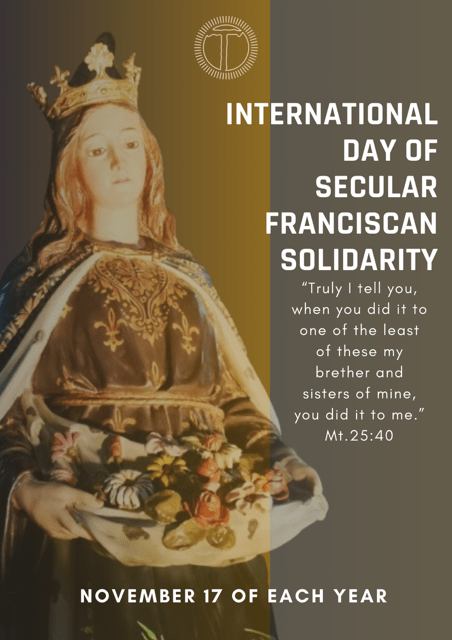
St. Elizabeth of Hungary

The Miracle of the Roses

In April, the Region forwarded to our local fraternity a letter and a couple flyers (below) announcing a new proposal being put forward by the International Presidency of the Secular Franciscan Order.

This initiative establishes an International Day of Secular Franciscan Solidarity that is to be recognized and celebrated every year on November 17th.  This date was chosen because it is the feast day of St. Elizabeth of Hungary, the Patroness of the entire Secular Franciscan Order.

The materials ask that we:

· Contemplate the concrete ways St Elizabeth embraced charity during her life, allowing her actions to inspire us.

· Take concrete steps to collect food or medicine, give alms, and/or visit the sick, elderly and those in need. 

· Use resources to draw closer to brothers or sisters in difficulty in our own fraternity, bringing help and hope to them, again, via concrete actions.

· Create a record of our efforts to be permanently recorded in the fraternity archives and shared with all our members.

In response, the Council is asking that you consider responding specifically to the call to visit the sick, elderly and those in need.  Guided by the leadership of Cyndi Pilot and Joanne Podemski, we are asking for volunteers to become part of three person teams that will visit the Professed in our Fraternity who are no longer able to come to the regular monthly meetings because of age, infirmity or some other reason.  To start with, we are looking for five persons to become team leaders and another ten to volunteer to visit a brother or sister at least once a month and then to report back to the council on the results of their visit.  These reports will then be recorded in our records and forwarded on to the full fraternity for their perusal.

In support of this effort, for Ongoing Formation this month the Council requests that you review these details from the life of St. Elizabeth, and then also take some time to meditate over the verses from the Gospel of Matthew that follow:

Life of St. Elizabeth of Hungary:

·  Born July 7, 1207 at current day Bartislava, Slovakia, then part of the kingdom of Hungary.  Her parents were King Andrew II and Gertrude of Merania.  On the night of her birth, the wise man Klingor prophesied that she would become a saint who would console all of Christendom. 

·  At age 4, she was betrothed to Hermann of Thuringia.  She moved to the great castle of the Wartburg in central Germany and was raised and educated in that court.  Elizabeth was reportedly so gay and innocent that the other children declared the infant Jesus would come and play with her.

·  Hermann died when Elizabeth was only nine, so she married his brother Ludwig, the second son, at age 14, the same year that he ascended to the title of Landgrave.  Many of his worldly minded courtiers tried to convince their new liege to dismiss Elizabeth because she loved the poor too well, but he dismissed their concerns.  By all accounts, despite the marriage being arranged, the couple was happy and in love.  They had three children, one of whom became an Abbess of a convent in Germany.    

·  Elizabeth fasted often and would rise in the night to pray.  Ever joyful, she rode through the countryside with her husband rather than being separated from him when he had business in the outlying parts of his dominion.  When Elizabeth was 18, the Franciscans came to Thuringia.  She helped them establish a friary in the city of  Eisenach and a Franciscan friar became her confessor.

·  Enamored by the Franciscan charism, she joined the fledgling 3rd order.  Cardinal Ugolino, Protector of the Order, sent her a beggar’s cloak that Francis had worn, which she would don whenever she had a special petition to make to heaven.  She dedicated her children to God at the altar of a local church while disguised as a peasant, and was known to venture out to help mothers in childbirth.  There is a story of her helping a poor man regain his cattle after they were taken from him unjustly.  On another occasion, when she was carrying bread to the poor, she was questioned by her brother-in-law, who suspected her of stealing treasures from the castle to give to the poor, and the bread miraculously transformed into roses.  A third story tells of her allowing a leper to sleep in her bed.  When Ludwig found out, he intended to have the bedclothes burned, but when he stripped the bed he saw a vision of the crucified Christ lying on the bed and he relented.

·  While Ludwig was away in Italy on behalf of the emperor, flood, pestilence and famine struck Thuringia.  Elizabeth sold her jewels and court dresses to establish a hospice that served meals to nine hundred people a day.  She exhausted the revenues, stores of grain and the treasury of the Landgrave, giving it all to the poor.  When her husband (who was never canonized but is regarded as a Saint locally) returned, she received his full support, protecting her against political enemies who thought she was too generous to those in need.

·  Elizabeth soon found out that Ludwig had pledged himself to go to the Holy Lands on Crusade and fainted from grief at the news.  Ludwig departed in the summer of 1227, but he got no further than Italy before he fell ill and died.  On his deathbed he gave his signet ring to one of his trusted knights to return to Elizabeth.  Upon receiving it, she knew her husband had passed.

·  Ludwig’s brother Heinrich became regent for her son, then only five years old.  Accused of mismanaging the funds of the Landgrave during the famine, she was soon turned out from the castle where she was living and her children were taken away from her.  That night she asked the local Friars to chant a Te Deum in thanksgiving for all the suffering she had been allowed to endure.

·  Her confessor helped her to obtain her lawful dowry.  She promptly gave half away to the poor.  She then renounced the world, choosing to live as a true child of St. Francis in complete Poverty.  Devoting herself to works of mercy and charity, she used the balance of her dowry to found a hospital and gave herself completely to the care of those with the most loathsome diseases.  She regularly performed miracles, healing the dumb, paralyzed and possessed. 

·  On November 19, 1231, at age 24, she died.  The women attending her reported hearing heavenly singing as she passed.  She was buried in the chapel of the hospital she founded.  So many miracles followed that she was canonized by Pope Gregory IX only four years later.

Matthew 25:31-40:

“When the Son of Man comes in his glory, and all the angels with him, he will sit on his glorious throne. All the nations will be gathered before him, and he will separate the people one from another as a shepherd separates the sheep from the goats. He will put the sheep on his right and the goats on his left.  

“Then the King will say to those on his right, ‘Come, you who are blessed by my Father; take your inheritance, the kingdom prepared for you since the creation of the world. For I was hungry and you gave me something to eat, I was thirsty and you gave me something to drink, I was a stranger and you invited me in, I needed clothes and you clothed me, I was sick and you looked after me, I was in prison and you came to visit me.’

“Then the righteous will answer him, ‘Lord, when did we see you hungry and feed you, or thirsty and give you something to drink? When did we see you a stranger and invite you in, or needing clothes and clothe you? When did we see you sick or in prison and go to visit you?’

“The King will reply, ‘Truly I tell you, whatever you did for one of the least of these brothers and sisters of mine, you did for me.’

Ongoing Formation on the Occasion of a Profession Ceremony

This month our fraternity will hold a profession ceremony for four wonderful people who have completed the journey through Candidacy and are ready to join our ranks as fully professed members of the Order.  In the midst of Holy Mass, they will stand in front of their families, friends and the fraternity and make their Permanent Commitment to the Gospel Life.

These are the words they will use to make that commitment:

Ritual of the Secular Franciscan Order, Rite of Profession:

I, (state your name),by the grace of God,
renew my baptismal promises and consecrate myself to the service of his Kingdom.
Therefore, in my secular state I promise to live all the days of my life the gospel of our Lord Jesus Christ in the Secular Franciscan Order by observing its rule of life.
May the grace of the Holy Spirit, the intercession of the Blessed Virgin Mary and our holy father St. Francis, and the fraternal bonds of community always be my help, so that I might reach the goal of perfect Christian love.

In conjunction with this happy event, the Council would like to invite all our professed to revisit their own profession day while remembering and reviewing the promise you made when you spoke these words. 

Or, if you are still in formation, pray over the Rite knowing that someday soon you will recite it as you make your own profession.  Take time to pause and consider how your discernment process is unfolding so far. 

Either way, please consider these words multiple times, slowly and prayerfully, preferably in several sessions.  Allow them to reside in your conscious and work on you for a day or three.  Then decide which phrases in particular are calling to you.  

———

The second and third paragraphs of the Rite emphasize three core ideas, one of which likely captures the inspiration you experienced in your meditation. 

In your small group, pick one and discuss it.  If you have time, move on to the other two.

1) The first idea revolves around the words “I promise to live all the days of my life the gospel of our Lord Jesus Christ.”  This is a vast and challenging instruction.  When we read the Rule, this directive is front and center.  The very first paragraph of Chapter Two, which bears the heading “The Way of Life,” reads like this: 

SFO Rule, Chapter 2, Article 4:

The rule and life of the Secular Franciscans is this: to observe the gospel of our Lord Jesus Christ by following the example of St. Francis of Assisi who made Christ the inspiration and the center of his life with God and people.

Christ, the gift of the Father’s love, is the way to Him, the truth into which the Holy Spirit leads us, and the life which he has come to give abundantly.

Secular Franciscans should devote themselves especially to careful reading of the gospel, going from gospel to life and life to gospel.

This then, becomes the bedrock on which our entire life as Franciscans is built.

  • How do you go about embodying this Article from the Rule? Give concrete examples.
  • This Article is about more than just prayer and reading your bible.  What examples from the life of St. Francis demonstrate how he lived out this ideal?  How does his inspiration impact you as you move through the world?
  • Same question, but for Jesus.  What examples from the life of Jesus do you find particularly inspiring?  How do you live out His example as you move through the world?

2) The second idea has to do with grace (from the Holy Spirit), intercession (Mary or Francis), and help (from the fraternity).  Again, the Rule has something to say.

SFO Rule, Chapter 2, Article 9:

The Virgin Mary, humble servant of the Lord, was open to his every word and call. She was embraced by Francis with indescribable love and declared the protectress and advocate of his family. The Secular Franciscans should express their ardent love for her by imitating her complete self-giving and by praying earnestly and confidently.

We are not alone in this.  The truth is we could never fulfill the pledges of the Rite on our own.  To paraphrase another Article from the Rule, as humans, we are simply too frail.  Francis specifically asked for the intercession of Mary in the life of the Friars.  Our Rule specifically tells us to imitate her Poverty and Humility and to reach out to her confidently, which means Francis’ request is extended to us.  The same instruction applies to the Holy Spirit and Francis himself.  We also have each other to rely on as we seek to fulfill the promise and promises of our commitment.

  • Think about your own fragility.  Are you regularly aware of it?  Do you see it as a hindrance or a blessing in disguise?  Do you resist it, or embrace it?  Does it encumber you, or inspire you?
  • Who is your “go to” when it comes to prayer?  Do you favor Mary, or Francis, or the Holy Spirit? Or maybe someone else? Why?
  • Do you think of your brothers and sisters in the fraternity as possible sources of strength when you are in need?  Do you think of yourself as a possible source of strength when someone else is in need?  What does it take to allow yourself to rely on someone else?  What does it take to allow someone else to rely on you? 

3) The third idea revolves around the words “perfect Christian Love.”  It’s not an easy concept to define, explain or understand.  Some ideas, especially the best ideas, no matter how much you talk about them, the discussion is never complete.  These concepts need to be considered and developed continuously.  We must always be mindful of them, always working at them resolutely.  They are deep enough that any human attempt to grasp them will inevitably fall short.  It’s like trying to define God Himself.  In the end, it’s simply beyond us.

But our profession obligates us to try anyway.  The Rule reinforces that commitment by calling us to “daily conversion,” but does it also provide some insight into what “perfect Christian Love” entails? 

SFO Rule, Chapter 2, Article 13:  (Article 19 is also worth a look.)

As the Father sees in every person the features of his Son, the firstborn of many brothers and sisters, so the Secular Franciscans with a gentle and courteous spirit accept all people as a gift of the Lord and an image of Christ.

A sense of community will make them joyful and ready to place themselves on an equal basis with all people, especially with the lowly for whom they shall strive to create conditions of life worthy of people redeemed by Christ.

  • Maybe trying to explain “the best ideas” ultimately results in as many questions as answers?   The Rule says we should “accept all people as an image of Christ.”  Does that make the idea of “perfect Christian Love” easier to understand, or does it just shift the conundrum elsewhere?
  • How about “creating conditions of life worthy of people redeemed by Christ?”  Is that helpful, or more of the same?   
  • “Placing themselves on an equal basis with all people, especially the lowly” sounds a little less abstract.  But it also sounds like something that is difficult to do.  How does fraternal life help you understand and live into these mysterious phrases?
  • How do you currently define “perfect Christian Love?”  How do you put such an abstract idea into action?   

A Personal Liturgy of the Hours: Penance

Introduction:
The Father, the Son, and the Holy Spirit.
-Amen.

God, come to my assistance:
-Lord, make haste to help me.

Glory be to the Father, and to the Son, and to the Holy Spirit:
— as it was in the beginning, is now, and ever shall be, world without end. Amen.

Hymn:  Seek Ye First

Seek ye first the kingdom of God
And His righteousness,
and all these things shall be added unto you.
Allelu, Alleluia!

Man shall not live by bread alone
but by every word
that proceeded from the mouth of God.
Allelu, Alleluia!

Ask, and it shall be given unto you.
Seek, and ye shall find.
Knock, and the door shall be opened unto you.
Allelu, Alleluia!

Metanoia:
Antiphon 1:  I will tend to You with all my being!

Lord Jesus, I live in a culture that continually calls me away from you.
It encourages me to become a lord unto myself, and to love myself at the expense of loving You.
This is not a new phenomenon, but a state of being that man incessantly creates for himself.

“These people honor me with their lips,
    but their hearts are far from me.
They worship me in vain;
    their teachings are merely human rules.”

In response, the entirety of scripture calls me to turn away from the world and toward You.
This is the true meaning and work of Penance.
At all times I am to seek you!  Always, I should tend to you with all my being!

This requires a complete and unceasing change of mind and heart.
Motivated by the dynamic power of your call, teaching, and presence,
I am to unconditionally conform my thoughts and deeds to yours.

Because of my human frailty, this renewal must be carried out daily.
My conversion must be radical, deep and profound.
It can only be continuous, and it will never be complete.

Each day, Lord, I must commit myself to ensuring that you are my inspiration.
Each day, I must confirm that you are the center of my life.
Each day, I must immerse myself in your gospels, seeking you resolutely.

Unfortunately, I lack the power, the wisdom, and the fortitude to fulfill this desire.
My life is a testament to my ineptitude, foolishness, and weakness.
Sadly, I remain firmly in the grasp of my culture and the world.

Please, Lord, hear my pleas!

Do not leave me to my own devices!
Send your Spirit to be my aid!
Rescue me!  Deliver me!  Secure me!
I beg of you, be my assistance and my salvation.

Glory be to the Father, and to the Son, and to the Holy Spirit:
— as it was in the beginning, is now, and ever shall be, world without end. Amen.

Psalm Prayer: Love the Lord with your whole heart, your whole soul, your whole mind, and all your strength.  Love your neighbor as yourself.  Hate your body with its vices and sins.  Receive the Body and Blood of our Lord Jesus Christ, and produce worthy fruits of Penance.  Happy and blessed will you be when you persevere in doing these things!

Antiphon 1:  I will tend to you with all my being!

On Peter:
Antiphon 2:  Submerge me in your Love!

Peter took him aside and began to rebuke him.
“Never, Lord!” he said. “This shall never happen to you!” 
Jesus turned and said to Peter, “Get behind me, Satan! You are a stumbling block to me; you do not have in mind the concerns of God, but merely human concerns.”

Too often, Lord, I am more like Peter than I wish to be.
You speak to me, but, wrapped up in my own earthly concern, I do not hear you.
All I know is my own perspective, my own concern, my own desire.

Peter replied, “Even if all fall away on account of you, I never will.”   “Truly I tell you,” Jesus answered, “this very night, before the rooster crows, you will disown me three times.”  But Peter declared, “Even if I have to die with you, I will never disown you.” 

You are truth and you reveal yourself to me.
But I refuse to recognize you and to accept the Word you speak.
I am unable to let go, unable to leave my worldliness behind in favor of you.

…….the rooster crowed. The Lord turned and looked straight at Peter. Then Peter remembered the word the Lord had spoken to him: “Before the rooster crows today, you will disown me three times.” And he went outside and wept bitterly.

Is this my destiny, Lord?
How many times do I need to weep bitter tears like Peter?
When will I submit?  When will I become yours, completely?

Then the disciple whom Jesus loved said to Peter, “It is the Lord.”  As soon as Simon Peter heard him say, “It is the Lord,” he wrapped his outer garment around him (for he had taken it off) and jumped into the water.

I wish to jump, Lord, into the water.
Grant me the courage to submerge myself in your Love.
Allow me to emerge renewed,
a new creation born of the Holy Spirit,
a new creation fully focused on You,
a new creation who desires only to rest in your peace and presence.

Glory be to the Father, and to the Son, and to the Holy Spirit:
— as it was in the beginning, is now, and ever shall be, world without end. Amen.

Antiphon 2:  Submerge me in your Love!

Excerpt from the 2nd Letter of St. Claire to Agnes of Prague:
Antiphon 3:  Gaze upon Christ!  Consider Christ!  Contemplate Christ!  Imitate Christ!

Embrace the poor Christ.
Look upon Him Who became contemptible for you,
and follow Him, making yourself contemptible in this world for Him.

          Gaze upon Him,
          Consider Him,
          Contemplate Him,
          Imitate Him,

Christ, though more beautiful than the children of men became, for your salvation, the lowest of men.
He was despised, struck, and scourged untold times throughout His entire body.
Then He died amid the suffering of the Cross.

If you suffer with Him, you will reign with Him.
Weeping with Him, you will rejoice with Him;
Dying on the cross of tribulation with Him, you will possess heavenly mansions with Him.

Among the splendor of the saints and in the Book of Life your name will be called glorious.
You shall share forever the glory of the kingdom of heaven in place of what is earthly and passing,
you shall have everlasting treasures instead of those that perish,
and you shall live forever and ever.

Glory be to the Father, and to the Son, and to the Holy Spirit:
— as it was in the beginning, is now, and ever shall be, world without end. Amen.

Psalm Prayer: What you hold, may you hold.  What you do, may you do and not stop.  With swift pace, light step, and unswerving feet, may you go forward securely, joyfully, and swiftly, on the path of prudent happiness, believing nothing and agreeing with nothing that would dissuade you from offering yourself to the Most High in the perfection to which the Spirit of the Lord has called you!

Antiphon 3:  Gaze upon Christ!  Consider Christ!  Contemplate Christ!  Imitate Christ!

Reading (Mark 12:28-34):
One of the teachers of the law came and heard them debating. Noticing that Jesus had given them a good answer, he asked him, “Of all the commandments, which is the most important?”

“The most important one,” answered Jesus, “is this: ‘Hear, O Israel: The Lord our God, the Lord is one.  Love the Lord your God with all your heart and with all your soul and with all your mind and with all your strength.’ The second is this: ‘Love your neighbor as yourself.’ There is no commandment greater than these.”

“Well said, teacher,” the man replied. “You are right in saying that God is one and there is no other but him. To love him with all your heart, with all your understanding and with all your strength, and to love your neighbor as yourself is more important than all burnt offerings and sacrifices.”

When Jesus saw that he had answered wisely, he said to him, “You are not far from the kingdom of God.” And from then on no one dared ask him any more questions.

Responsory:
I cry day and night to you!
Let my prayer enter your sight! 
Incline your ear to my pleas!
-Come to my aid, Lord God, my salvation!

My heart is ready, O God, my heart is ready!
I will sing and chant a psalm!
Attend to my soul and free it!
-Come to my aid!

I will praise you among the peoples, O Lord!
Your mercy is exalted to the skies!
Your truth to the heavens!
-Come to my aid, Lord God, my salvation!

Canticle (1 Corinthians 13:1-8, 13)
Antiphon:  Faith, hope, and love remain, these three; but the greatest of these is love.

If I speak in human and angelic tongues,
but do not have love,
I am a resounding gong or a clashing cymbal.
And if I have the gift of prophecy,
and comprehend all mysteries and all knowledge;
if I have all faith so as to move mountains,
but do not have love, I am nothing.

If I give away everything I own,
and if I hand my body over so that I may boast,
but do not have love, I gain nothing.

Love is patient, love is kind.
It is not jealous, it is not pompous,
It is not inflated, it is not rude,
it does not seek its own interests,
it is not quick-tempered, it does not brood over injury,
it does not rejoice over wrongdoing
but rejoices with the truth.

It bears all things, believes all things,
hopes all things, endures all things.

Love never fails.

Glory be to the Father, and to the Son, and to the Holy Spirit:
— as it was in the beginning, is now, and ever shall be, world without end. Amen.

Antiphon:  Faith, hope, and love remain, these three; but the greatest of these is love.

Intercessions:
O all you who pass along the way, look and see if there is any sorrow like my sorrow,
for many dogs surrounded me, and a pack of evildoers closed in on me.
-Blessed be the Lord, the God of Israel, Who will not abandon those who hope in Him.

They looked and stared at me.
They divided my garments among them, and cast lots for my tunic.
-Blessed be the Lord, the God of Israel, Who will not abandon those who hope in Him.

They pierced my hands and my feet.
I have been poured out like water and my bones have been scattered.
-Blessed be the Lord, the God of Israel, Who will not abandon those who hope in Him.

My heart has become like melting wax in the midst of my bosom.
My strength has been dried up like baked clay and my tongue clings to my jaw.
-Blessed be the Lord, the God of Israel, Who will not abandon those who hope in Him.

They gave me gall as my food, and, in my thirst, vinegar to drink.
They led me into the dust of death, and added sorrow to my wounds.
-Blessed be the Lord, the God of Israel, Who will not abandon those who hope in Him.

I have slept and risen and my most Holy Father has received me with glory.
Holy Father, you held my right hand and led me with your counsel.
See, see that I am God says the Lord.
I shall be exalted among the nations and exalted on the earth.
-Blessed be the Lord, the God of Israel, Who will not abandon those who hope in Him.

Our Father:
Our Father, who art in Heaven, hallowed be Thy Name.
Thy Kingdom come, Thy Will be done, on earth, as it is in Heaven.
Give us this day our daily bread, and forgive us our trespasses,
as we forgive those who trespass against us,
and lead us not into temptation, but deliver us from evil.
Amen.

Concluding Prayer:
Let every creature in heaven, on earth, in the sea and in the depths,
give praise, glory, honor and blessing to Him who suffered so much.
He alone has given and will give in the future every good, for He is our power and strength.
He alone is good, alone is almighty, alone is omnipotent, wonderful, and glorious.
He alone is holy and worthy of praise and blessings until the end of the ages.
Amen.

Dismissal:
May the Lord bless me, protect me from all evil, and bring me to everlasting life.
-Amen.

The Father, the Son, and the Holy Spirit.
-Amen.

Encounter

Introduction:
The Father, the Son, and the Holy Spirit.
– Amen.

God, come to my assistance:
-Lord, make haste to help me.

Glory be to the Father and to the Son and to the Holy Spirit:
-As it was in the beginning, is now, and ever shall be, world without end.  Amen.

Hymn:  Shepherd Me, O God

Shepherd me, O God, beyond my wants,
beyond my fears, from death into life.

God is my shepherd, so nothing shall I want,
I rest in the meadows of faithfulness and love,
I walk by the quiet waters of peace.
Shepherd me, O God, beyond my wants,
beyond my fears, from death into life.

Gently you raise me and heal my weary soul,
you lead me by pathways of righteousness and truth,
my spirit shall sing the music of your Name.
Shepherd me, O God, beyond my wants,
beyond my fears, from death into life.

Though I should wander the valley of death,
I fear no evil, for you are at my side,
your rod and your staff, my comfort and my hope.
You have set me a banquet of love in the face of hatred;
crowning me with love beyond my power to hold.
Shepherd me, O God, beyond my wants,
beyond my fears, from death into life.

Surely your kindness and mercy follow me all the days of my life;
I will dwell in the house of my God, forevermore.
Shepherd me, O God, beyond my wants,
beyond my fears, from death into life.

On Suffering and Hope:
Antiphon 1:  “Let them purify their hearts from every tendency and yearning for possession and power.”

I am beset. The enemy pursues my soul; he has crushed me.
He makes me dwell in darkness.
My spirit fails; my heart is numb with fear.

He is relentless, ever vigilant, never resting.
His legions surround me, closing upon me from every direction.
They use my weakness against me, forging bonds from my faults, feeding on my feebleness.

Unwitting, pathetic, and blind, I am my own antagonist.
I am the source of the raw material they use to fashion the chains that bind me.
I am his amusement.  He laughs at me, continuously.  His cackling haunts me.

Against him, I am powerless. 
My strength is insufficient to overcome him.
He brushes my best efforts aside, effortlessly. 
I possess no weapon that can wound him. 
I am overmatched.

You, Lord, are my only hope. 
I place my confidence in You.
You possess the power I lack.
You are my rescuer, my redeemer and my liberator.

You are faithful.  You are just.
Hear my appeal.  Safeguard me.
Do not call your servant to judgment.  Have mercy on me!

To you I stretch out my hand.
Like a parched land my soul thirsts for you.
I long for your peace.  Favor me with your grace and blessing. 

For your name’s sake, Lord, deliver and sanctify me.
Liberate my soul from the distress that engulfs me.
Do not let the enemy triumph over me.

Glory be to the Father and to the Son and to the Holy Spirit:
-As it was in the beginning, is now, and ever shall be, world without end.  Amen.

Psalm Prayer:  (Prologue to the Rule, John 17)
“O holy Father, protect them with your name whom you gave me out of the world.  I entrusted to them the message you entrusted to me and they received it.  They have known that in truth I came from you, they have believed that it was you who sent me.  For these I pray, not for the world.  Bless and consecrate them, and I consecrate myself for their sakes.  I do not pray for them alone; I pray also for those who will believe in me through their word that they may be holy by being one as we are one.  And I desire, Father, to have them in my company where I am to see this glory of mine in your kingdom.”

Antiphon 1:  “Let them purify their hearts from every tendency and yearning for possession and power.”

On Poverty, Freedom and Love:
Antiphon 2:  “Trust in the presence of the divine seed in everyone and in the transforming power of love and pardon.”

Lord Jesus Christ, Son of God, have Mercy on me, a sinner.
Please, teach me to dwell and pray unceasingly in Your Steadfast Love. 
Focus my penitential gaze on your Incarnation, your Passion, your Resurrection, and your ongoing Presence.

Increase my discipline.
Erase my complacency.
Liberate my tears.
Bolster my gratitude.
Encourage in me a deep desire to encounter you in scripture, prayer, and contemplation.

Forgive my sins. Cleanse me and heal me.
Permeate, preserve, and protect me. 
Perfect my prayers, my petitions, my perception, my patience, my persistence, my perseverance, and my resolve.

Enlist me and reinforce me as your willing and trusting, joyful and loving,
loyal and humble servant. 
Increase my faith and the quantity and quality of my prayer. 
Break the chains that bind my will, unifying mine with yours in the Holy Spirit.

Diminish and deconstruct me.
Convert and conform me.
Abide within me and grant me Your Peace.

Guide me through Poverty to the Yes that sets me free to love you, God, and all my brothers and sisters,
completely, unconditionally, without reservation or distraction,
in accord with your Most Holy Will and Perfect Gospel Example.

Glory be to the Father and to the Son and to the Holy Spirit:
-As it was in the beginning, is now, and ever shall be, world without end.  Amen.

Antiphon 2:  “Trust in the presence of the divine seed in everyone and in the transforming power of love and pardon.”

On Mercy and Gratitude:
Antiphon 3:  “Let prayer and contemplation be the soul of all they are and do.”

Lord Jesus, Your Divine Heart is so passionately in Love with men that it cannot contain within itself the flames of its ardent charity. Save, O Lord, all those who have no one to pray for them.

You have promised that your Heart shall dilate and pour out the influences of its Love abundantly on all those that suitably honor it. If men would render you some return of your Love, you would esteem little all you have done for them. Instead, they meet your eager Love with coldness and rebuffs.

Please, O Lord, allow my humble prayers to supply some measure of recompense for our ingratitude. May they console and rejoice you in whatever small way my all too human intentions can muster.

 “O my Jesus, lead all souls to Heaven, especially those most in need of thy mercy.

Thank you, Lord, for being present in your Word, your Eucharist, your Creation, in this wondrous day, and within me at all times. Help me to accept that every occurrence that happens in my life, happens in accord with your True, Excellent and Holy Will.  I place all my trust in you, Lord.

Reveal to me my sins that I might become more completely repentant this day.
Turn my face toward you.
Align my conversion with your divine, inspired, and impeccable plan for my redemption.

Remind me often that your Love for me is unshakable.
Every event in my life is always entirely consistent with that Love.
I will inevitably move one step closer to salvation if I gratefully and peacefully accept every experience you send me.

Pray with me Holy Spirit.  Perfect my prayer. 
Help me to desire only that which you know I should rightly desire. 
Sustain me as I seek to return God’s Love properly and perfectly,
for I cannot do so on my own. 
Only with your assistance can I love as fully and truly as I need and wish to love.

Lord, thank you for my life,
which you affirm moment by moment through the graces you bestow on me. 
Please, allow your Word to prepare me for whatever you send my way each day.

Glory be to the Father and to the Son and to the Holy Spirit:
-As it was in the beginning, is now, and ever shall be, world without end.  Amen.

Psalm Prayer:
Almighty God, protect me by your power, hour by hour, moment by moment.
Do not let me turn to sin.
Let my every thought, word and deed be pleasing in your sight.
Grant this through our Lord Jesus Christ, your Son, Who lives and reigns with you in the unity of the Holy Spirit, God, forever and ever, Amen.

Bless me, Lord, and keep me from all evil, and bring me to everlasting life.

Antiphon 3:  “Let prayer and contemplation be the soul of all they are and do.”

Reading:  (True and Perfect Joy)
One day at St. Mary’s, blessed Francis called Brother Leo and said: “Brother Leo, write.”  He responded: “Look, I am ready.”  “Write,” he said, “what true joy is.”

“A messenger arrives and says that all the Masters of Paris have entered the Order.  Write: this is not true joy!  Or, that all the prelates, archbishops and bishops beyond the mountains, as well as the King of France and the King of England have entered the Order.  Write: this is not true joy!  Again, that my brothers have gone to the non-believers and converted all of them to the faith:  again, that I have so much grace from God that I heal the sick and perform many miracles.  I tell you true joy does not consist in any of these things.”

“Then what is true joy?”

“I return from Perugia and arrive here in the dead of night.  It is winter time, muddy, and so cold that icicles have formed on the edge of my habit and keep striking my legs and blood flows from such wounds.  Freezing, covered with mud and ice, I come to the gate and, after I have knocked and called for some time, a brother comes and asks: ‘Who are you?’  ‘Brother Francis,’ I answer.  ‘Go away!’ he says. ‘This is not a decent hour to be wandering about!  You may not come in!’  When I insist, he replies: ‘Go away! You are simple and stupid! Do not come back to us again!  There are many of us here like you – we do not need you!’  I stand at the door again and say: ‘For the love of God, take me in tonight!’  And he replies: ‘I will not!  Go to the Crosiers’ place and ask there!’”

“I tell you this:  If I had patience and did not become upset, true joy, as well as true virtue and the salvation of my soul, would consist in this.”   

Responsorial:
In you, Lord, I have hoped, let me not be put to shame!  In your justice, free me and rescue me!
-God, be my protector and stronghold!  Look upon me with Mercy!

You are my patience, Lord, my hope from youth!  Incline your ear to me!  My song will always be to you! 
-Look upon me with Mercy!

May my mouth be filled with praise!  I will sing all day long of your glory and greatness!
-God, be my protector and stronghold!  Look upon me with Mercy!

Blessed be the Lord my God!  He has become my refuge on the day of my distress!
-Alleluia, Alleluia, Alleluia!!! 

The Word Became Flesh: (John 1:1-14) 
Antiphon:   The Word became flesh and made his dwelling among us.

In the beginning was the Word, and the Word was with God, and the Word was God. He was with God in the beginning. Through him all things were made; without him nothing was made that has been made. In him was life, and that life was the light of all mankind. The light shines in the darkness, and the darkness has not overcome it.

There was a man sent from God whose name was John. He came as a witness to testify concerning that light, so that through him all might believe. He himself was not the light; he came only as a witness to the light.

The true light that gives light to everyone was coming into the world. He was in the world, and though the world was made through him, the world did not recognize him. He came to that which was his own, but his own did not receive him. Yet to all who did receive him, to those who believed in his name, he gave the right to become children of God — children born not of natural descent, nor of human decision or a husband’s will, but born of God.

The Word became flesh and made his dwelling among us. We have seen his glory, the glory of the one and only Son, who came from the Father, full of grace and truth.

Glory be to the Father and to the Son and to the Holy Spirit:
-As it was in the beginning, is now, and ever shall be, world without end.  Amen.

Antiphon:   The Word became flesh and made his dwelling among us.

Intercession:
Let all of us, sisters and brothers, consider the Good Shepherd who bore the suffering of the Cross to save his sheep. 
-Follow the poor and crucified Christ, and witness to Him even in difficulties and persecutions.

The Lord’s sheep followed Him in tribulation and persecution, in shame and hunger, in weakness and temptation; for these things they received eternal life from the Lord.
-Follow the poor and crucified Christ, and witness to Him even in difficulties and persecutions.

Let us boast only in our weakness and in carrying each day the Holy Cross of our Lord Jesus Christ.
-Follow the poor and crucified Christ, and witness to Him even in difficulties and persecutions.

Each day He humbles Himself as when He came from the royal throne into the Virgin’s womb; each day He comes down from the bosom of the Father onto the altar in the hands of a priest.
-Follow the poor and crucified Christ, and witness to Him even in difficulties and persecutions.

Contemplate His most Holy Body and Blood, living and true, with your spiritual eyes and believe that He is God.  In this way the Lord is always with his faithful, even until the end of the age.
-Follow the poor and crucified Christ, and witness to Him even in difficulties and persecutions.

Our Father:
Our Father, who art in Heaven, hallowed be Thy Name.
Thy Kingdom come, Thy Will be done, on earth, as it is in Heaven.
Give us this day our daily bread, and forgive us our trespasses,
as we forgive those who trespass against us,
and lead us not into temptation, but deliver us from evil.
Amen.

Concluding Prayer:
Holy Virgin Mary, among women born into the world, there is no one like you.
Daughter and servant of the most high and supreme King,
Mother of our most holy Lord Jesus Christ,
Spouse of the Holy Spirit;
Pray for us, with St. Michael the Archangel,
all the powers of heaven,
and all the saints at the side of your most holy and beloved Son,
our Lord and Teacher. 
Amen.

Dismissal:
May the all-powerful Lord grant us a restful night.
-Amen.

May He accompany us as we move through the world as pilgrims and strangers making our way home.
-Amen.

May the love and compassion of Sister Death attend us as we serenely tend toward the ultimate encounter with the Father.
-Amen.

The Father, the Son, and the Holy Spirit.
-Amen.

Streaming Prayer

Introduction:
The Father, the Son, and the Holy Spirit.
-Amen.

God, come to my assistance:
-Lord, make haste to help me.

Glory be to the Father and to the Son and to the Holy Spirit:
-As it was in the beginning, is now, and ever shall be, world without end.  Amen.

Hymn:  Lord Let Me Walk

Lord, let me walk that lonely road with you,
Under the weight of the wood.
Lord, let me walk that last mile in your shoes,
Under the weight of the wood.
Freedom can be found, laden down,
Under the weight of the wood.

They gave you gall and sour wine for food,
Under the weight of the wood.
Father forgive them; they don’t know what they do,
Under the weight of the wood. 
Freedom can be found, laden down,
Under the weight of the wood.

Lord, must this journey always end this way,
Under the weight of the wood.
How many times have we nailed you up today,
Under the weight of the wood? 
Freedom can be found, laden down,
Under the weight of the wood.

Freedom can be found, laden down,
Under the weight of the wood.

On Confession:
Antiphon 1:  “Whoever wants to be my disciple must deny himself, take up his cross, and follow me.”

Lord, have mercy on me,
Christ, have mercy on me,
Lord, have mercy on me.

Jesus, I am fallen,
Jesus, I am weak,
Jesus, I am frail.

Jesus, I am feeble,
Jesus, I am hopeless,
Jesus, I am broken.

Jesus, I am oh so human,
Jesus, I am ruined,
Jesus, I am a sinner.

Jesus, I need you,
Jesus, I love you,
Jesus, fortify me.

You dwell within me,
Help me to dwell within you.
You are ever mindful of me,
Make me ever mindful of you.

I am fallen, weak, and frail,
feeble, hopeless, and broken,
oh so human, ruined and a sinner!

Jesus, I need you!
Jesus, I love you! 
Jesus, strengthen me!

Lord, have mercy on me,
Christ, have mercy on me,
Lord, have mercy on me.

Glory be to the Father and to the Son and to the Holy Spirit:
-As it was in the beginning, is now, and ever shall be, world without end.  Amen.

Psalm Prayer: (Matthew 16:24-27)
Then Jesus said to his disciples, “Whoever wants to be my disciple must deny themselves and take up their cross and follow me. For whoever wants to save their life will lose it, but whoever loses their life for me will find it. What good will it be for someone to gain the whole world, yet forfeit their soul? Or what can anyone give in exchange for their soul? For the Son of Man is going to come in his Father’s glory with his angels, and then he will reward each person according to what they have done.”

Antiphon 1:  “Whoever wants to be my disciple must deny himself, take up his cross, and follow me.”

On Healing:
Antiphon 2:  Read the gospels carefully, going from gospel to life, and life to gospel.

Lord, have mercy on me,
Christ, have mercy on me,
Lord, have mercy on me.

Jesus, arise within me,
Jesus, consume me,
Jesus, purify me.

Jesus, hold me,
Jesus, heal me,
Jesus, sustain me.

Jesus, aid me,
Jesus, restore me,
Jesus, pray for me.

Jesus, I need you,
Jesus, I love you,
Jesus, fortify me.

You dwell within me,
Help me to dwell within you.
You are ever mindful of me,
Make me ever mindful of you.

Arise within me, consume me, and purify me,
hold me, heal me, and sustain me,
aid me, restore me and pray for me!

Jesus, I need you!
Jesus, I love you! 
Jesus, strengthen me!

Lord, have mercy on me,
Christ, have mercy on me,
Lord, have mercy on me.

Glory be to the Father and to the Son and to the Holy Spirit:
-As it was in the beginning, is now, and ever shall be, world without end.  Amen.

Antiphon 2:  Read the gospels carefully, going from gospel to life, and life to gospel.

On Conversion:
Antiphon 3:  Jesus answered, “I am the way and the truth and the life.”

Lord, have mercy on me,
Christ, have mercy on me,
Lord, have mercy on me.

Jesus, form me,
Jesus, mold me,
Jesus, fashion me.

Jesus, confirm me,
Jesus, bolster me,
Jesus, secure me.

Jesus, convert me,
Jesus, transform me,
Jesus, recreate me.

Jesus, I need you,
Jesus, I love you,
Jesus, fortify me.

You dwell within me,
Help me to dwell within you.
You are ever mindful of me,
Make me ever mindful of you.

Form me, mold me and fashion me,
confirm me, bolster me, and secure me,
convert me, transform me, and recreate me!

Jesus, I need you!
Jesus, I love you! 
Jesus, strengthen me!

Lord, have mercy on me,
Christ, have mercy on me,
Lord, have mercy on me.

Glory be to the Father and to the Son and to the Holy Spirit:
-As it was in the beginning, is now, and ever shall be, world without end.  Amen.

Psalm Prayer: (John 14:6-14) 
Jesus answered, “I am the way and the truth and the life. No one comes to the Father except through me. If you really know me, you will know my Father as well. From now on, you do know Him and have seen Him……..The words I say to you I do not speak on my own authority. Rather, it is the Father, living in me, who is doing His work……….Very truly I tell you, whoever believes in me will do the works I have been doing, and they will do even greater things than these, because I am going to the Father. And I will do whatever you ask in my name, so that the Father may be glorified in the Son. You may ask me for anything in my name, and I will do it.”

Antiphon 3:  Jesus answered, “I am the way and the truth and the life.”

Reading:  (Matthew 19: 16-26)
Just then a man came up to Jesus and asked, “Teacher, what good thing must I do to get eternal life?”

“Why do you ask me about what is good?” Jesus replied. “There is only One who is good. If you want to enter life, keep the commandments.”

“Which ones?” he inquired.

Jesus replied, “‘you shall not murder, you shall not commit adultery, you shall not steal, you shall not give false testimony, honor your father and mother,’ and ‘love your neighbor as yourself.’”

“All these I have kept,” the young man said. “What do I still lack?”

Jesus answered, “If you want to be perfect, go, sell your possessions and give to the poor, and you will have treasure in heaven. Then come, follow me.”

When the young man heard this, he went away sad, because he had great wealth. Then Jesus said to his disciples, “Truly I tell you, it is hard for someone who is rich to enter the kingdom of heaven. Again I tell you, it is easier for a camel to go through the eye of a needle than for someone who is rich to enter the kingdom of God.” When the disciples heard this, they were greatly astonished and asked, “Who then can be saved?”

Jesus looked at them and said, “With man this is impossible, but with God all things are possible.”

Responsorial:
All you nations, clap your hands!  Shout to God with a voice of gladness.  For the Lord, the Most High, the Awesome, is the Great King over all the earth!
-Have mercy on me, O God.  In You I place my trust! 

The Most Holy Father of Heaven sent his Beloved Son from on high and has brought salvation to his people! 
-Have mercy on me, O God!

Take up the burden, carry His Holy Cross, and follow His Holy Commands! 
-Have mercy on me, O God.  In You I place my trust!

He ascended into Heaven and is seated at the right hand of His most Holy Father!  Let the whole earth tremble before Him!
-Alleluia, Alleluia, Alleluia!!! 

The Beatitudes: (Matthew 5:1-12) 
Antiphon:   Blessed are the poor in spirit, for theirs is the kingdom of heaven.

When Jesus saw the crowds, he went up on a mountainside and sat down. His disciples came to him, and he began to teach them.

“Blessed are the poor in spirit,
    for theirs is the kingdom of heaven.
Blessed are those who mourn,
    for they will be comforted.
Blessed are the meek,
    for they will inherit the earth.
Blessed are those who hunger and thirst for righteousness,
    for they will be filled.
Blessed are the merciful,
    for they will be shown mercy.
Blessed are the pure in heart,
    for they will see God.
Blessed are the peacemakers,
    for they will be called children of God.
Blessed are those who are persecuted because of righteousness,
    for theirs is the kingdom of heaven.

Blessed are you when people insult you, persecute you and falsely say all kinds of evil against you because of me. Rejoice and be glad, because great is your reward in heaven, for in the same way they persecuted the prophets who were before you.

Glory be to the Father and to the Son and to the Holy Spirit:
-As it was in the beginning, is now, and ever shall be, world without end.  Amen.

Antiphon:   Blessed are the poor in spirit, for theirs is the kingdom of heaven.

Intercessions:
Blessed is the one who has no pleasure and delight except in the Words and Deeds of the Lord and who, through these, leads people to the Love of God with gladness and joy.
-Blessed is the servant who avoids idle and empty chatter.

Blessed is the one who stores up in heaven the good things which the Lord has done for him and does not wish to reveal them to people under the guise of a reward. 
-Blessed is the servant who safeguards the secrets of the Lord in his heart.

Blessed is the one who no more exalts himself over the good the Lord says or does through him than over what He says or does through another.  A person sins who wishes to receive more from his neighbor than he is willing to give of himself to God.
-Blessed are the poor in spirit, for theirs is the Kingdom of Heaven.

Blessed is the one who looks down upon earthly things, seeks those of heaven, and, with a clean heart and spirit never ceases adoring and seeking the Lord God living and true.
-Blessed are the pure in heart, for they will see God.

Blessed is the one who, regardless of what they suffer in this world, preserves peace of spirit and body out of love of our Lord Jesus Christ.
-Blessed are the peacemakers, for they will be called children of God.

Our Father:
Our Father, who art in Heaven, hallowed be Thy Name.
Thy Kingdom come, Thy Will be done, on earth, as it is in Heaven.
Give us this day our daily bread, and forgive us our trespasses,
as we forgive those who trespass against us,
and lead us not into temptation but deliver us from evil.
Amen.

Concluding Prayer:
Behold, I am the handmaid of the Lord.
May the Holy Spirit come upon me.
May the power of the Most High overshadow me.
May it be done to me and through me according to Your Will and Word.

Dismissal:
Let us praise the Lord and give Him thanks.
-Amen.

The Father, the Son, and the Holy Spirit.
-Amen.

The Canticle of the Creatures: Creation as Revelation of God

The Major Legend of Saint Francis by St. Bonaventure, Chapter Nine:

Aroused by everything to divine love,
he rejoiced in all the works of the Lord’s hands
and through their delightful display
he rose into their life-giving reason and cause.
In beautiful things he contuited Beauty itself
and through the footprints impressed in things
he followed his Beloved everywhere,
out of them making for himself a ladder
through which he could climb up to lay hold of him
Who is utterly desirable.
With an intensity of unheard devotion
he savored
in each and every creature
--- as in so many rivulets ---
that fontal Goodness
and discerned
an almost celestial choir
in the chords of power and activity
given to them by God,
and, like the prophet David,
he sweetly encouraged them to the praise of the Lord.

In the last two reflections we looked at the themes of “Goodness” and “Kinship” present in the Canticle.  We saw these were not isolated but intimately connected.  The shared commonality of the “Goodness” inherent in all elements of Creation generates a unity between God’s creatures best described by the idea of kinship.  We also found that mankind is deeply dependent on the rest of Creation for its well-being while acknowledging that, in return, human beings have a singular responsibility to the balance of Creation.  Kinship bestows on us the duty of providing an enlightened and loving stewardship to all our “brothers” and “sisters,” animate and inanimate, that they may thrive and function in the exact way that God providentially designed them to.

The same holds true as we move on to our third theme.  We will find these themes once again building on one another and we will see them culminate in a final theme that will bring our series examining the Canticle to a close.  This final theme explores Creation’s ability to reveal God to us and to continually bring our attention back to Him.

At the end of the last reflection, we concentrated on article eighteen of the OFS Rule as we considered a couple questions to help us complete our understanding of the idea of kinship.  That article states that all of God’s creatures “bear the imprint of the Most High.”  This quote then provides the jumping off point for our final reflection.

If we look closely at the opening quote from Bonaventure, we find the source for the word “imprint” in the Rule.  When Bonaventure talks about “the footprints impressed in things,” he is talking about the “imprint” God has left on each and every element of His Creation.

In today’s crazy and hectic world, it is easy to take for granted the Love that God imbues into every aspect of this paradise that He has placed us in.  We often go through the motions of our daily life, never stopping to notice God’s Loving action and presence in each and every detail that surrounds us. 

  • Did you thank Him for “Brother Sun” and the blue sky that greeted you today when you awoke?
  • Or for your “sister” birds that serenaded you?
  • Or, if it was cloudy or raining, did you thank Him for the live giving gifts of “Sister Water?”
  • Or if it was a chilly winter morning, did you thank Him for the gift of “Brother Fire” and the heat he generates to protect you from the cold?
  • Did you thank Him at each meal and snack for the sustenance that “Sister Mother Earth” provides?
  • Or for the loveliness of the flowers that she furnishes to bring Beauty into your day?
  • Or for the trees at the side of the road that work with “Brother Wind” to provide the oxygen you breathe?

We are meant to see Him, recognize Him, and discern His Loving Nature and Goodness in every moment of every day.  Everything surrounding us calls us to Him and we are expected to be open and present to His call at all times.  In every instant, He does everything He can to make Himself known.  First by constantly sustaining this paradise that is our home, and then second by sending His son into our paradise via the Eucharistic, which He causes to be celebrated non-stop so that our opportunity at redemption is continuous and never ending.     

If we properly embrace Poverty and Penance in our life, then we will always be turning away from worldliness and toward Him.  Creation, in accord with His perfect and precise design, calls us to this conversion incessantly, most especially in times of distress and difficulty.  If we are intent on righteousness and virtue, then we will not allow ourselves to be diverted by the enemy and the chaos he intentionally introduces into our earthly existence.  Instead, we will focus on the exquisiteness of Creation and allow it to call us back to Him and we will center our lives on the Most Beautiful Savior that God continually sends to bring us back into full and complete communion with Himself.

When Creation convinces us to turn our countenance away from worldliness and toward God, we then have a chance to live into the ecstasy of Francis which is the basis of the quote from Bonaventure.

We can be “aroused by everything to divine love.”

We can “rejoice in all the works of the Lord’s hands” and “through their delightful display, rise into their life-giving reason and cause,” which is God Himself.

We can intuit “Beauty itself,” and “make for ourselves a ladder” which will allow us to “climb up and lay hold of Him who is utterly desirable,” Who is Jesus Himself.

We can “savor the fontal Goodness” of God and hear the musical “chords of power of the celestial choir” of Creation.  This in turn should cause us to sing our own canticle of praise as we are inspired by the Holy Spirit to follow the examples of David, Daniel and Francis.  Or, if we are not confident in our ability to craft our own song, we can use one of theirs (Franciscans, or course, would opt first for the Canticle) and we can be assured that God will accept it as our own.

Just as with the first two themes, this final theme is also universal and foundational within the Franciscan charism.  The words “Poverty” and “Penance” may not be overtly present, but in the Franciscan context, these words call on us to continually turn away from worldliness and to focus all our energies and all our being on God.  As Francis calls the creatures of Creation to praise, he is also purposefully and inevitably calling on their ability to reveal God to us as we focus on them.  When we pray and/or sing the Canticle, we are, without a doubt, practicing Poverty and Penance.  The Canticle and the praise it engenders compels us to turn away from the world and focus on God as we perform it. 

This confirms the unavoidable link between the first two themes and this one.  The goodness of Creation and the kinship it generates endow on it the ability to reveal God to mankind.  When we make ourselves attentive to the wonders of Creation, the “imprint of the Most High” speaks to us whether we realize it or not.  It works on our subconscious even when we are not purposefully thinking of God.  We are awestruck by Sister Moon and the stars when we consider the night sky because it is the nature (and purpose) of Creation to speak to us about God when presented with even the slightest opening.

This aspect of Creation is what then creates in us a happy dependence.  We rely on Creation to call us back to God continually and inexorably.  At the same time, we are tasked with the responsibility to properly steward Creation because our own salvation depends on it.  We must preserve the wellness of Creation because we are hardwired to trust it to keep us focused on the Love of God that brought us and it into being in the first place.

  • As we come to the close, we now see the Canticle revealed as a powerful expression of several of the foundational ideas of the Franciscan charism.  The complimentary themes of Goodness, Kinship, and Revelation make the charism (and the Canticle) a potent force for good in a world that can easily go astray.  They have allowed the Franciscan movement to endure to its eight hundredth Centenaro, flourishing brightly for most of that time.  Do you agree that now seems to be a time when the message of St. Francis is needed in the world as much as ever?
  • Mull the three major themes of the Canticle over for a few moments.  Remind yourself of the role Penance and Poverty play in encouraging Franciscans to turn away from the distractions of the world so that they might focus fully and continually on God, Jesus and the gospels. Do you recognize that Penance and Poverty must be underlying themes in the Canticle?
  • Do you see the Canticle in a new light as our reflections come to their conclusion?  Will you reference it more often in your prayer life?  Would you consider praying it every day as part of your prayer routine?  Why is it a fitting vehicle for praying for the well-being of the world in general?  Will you now look for openings to introduce it to others?

Return to Previous Reflection

The Canticle of Creation: Kinship

“Sister Swallow”

The Life of St. Francis by Thomas of Celano, the First Book, Chapter 21:

One day he came to a village called Alviano to preach the word of God.  Going up to a higher place where all could see him, he called for silence.  All remained silent and stood reverently.  But a large number of swallows nesting there were shrieking and chirping.  Since blessed Francis could not be heard by the people, he said to the noisy birds:

“My sister swallows, now is the time for me also to speak, since you have already said enough.  Listen to the word of the Lord and stay quiet and calm until the word of the Lord is completed.”

Immediately those little birds fell silent — to the amazement and surprise of all present — and did not move from that place until the sermon was over.  Those men who saw this sign were filled with great wonder, saying:  “Truly, this man is holy, and a friend of the Most High.”

In the last reflection, we began to consider the themes that Francis wished to advance via his composition of the Canticle.  We took the Attributes of God and Creation from the third reflection and extended them to show how they establish the “Goodness of God and Creation” beyond all doubt, question or ambiguity.  

In this reflection, we will explore a second major theme, highlighting Francis’ belief that all the creatures of God’s Creation are intimately interrelated and interconnected.  The word the OFS Rule uses to illustrate this connectedness is kinship. 

As Francis moves through the various sections of the Canticle, he repeatedly uses the words “Brother” and “Sister.”  This device is meant to establish and highlight this second theme of kinship.  Francis wants us to understand that while all members of God’s Creation are interconnected, the connection between human beings and the balance of Creation is particularly critical.  Human beings have a singular responsibility to every other creature that God Loves into being and we must honor this obligation at all times and in every action we take. 

In its initial section, the Canticle lists three alternating pairs of “Brothers” and “Sisters.”  Harkening back to the reflection on the Flow of Creation, the first are found in the heavens, Brother Sun and Sister Moon.  Next come the four classical constituent elements of all earthly matter, Brother Wind and Sister Water, and Brother Fire and Sister Mother Earth.  In strophes ten and eleven, while Francis does not use these words overtly, we can surely glean from the text and the background circumstances that he is calling the Bishop and Mayor of Assisi, and by extension all of mankind, into loving brotherhood.  And then at the end, Francis adds a seventh sibling, Sister Bodily Death, as he composes strophes twelve and thirteen in response to the approach of his own earthly death.

Just as the “Goodness of God and Creation” was not a new theme to Francis in the Canticle, this theme of kinship is also not new.  The words “brother” and “sister” appear regularly in the sources, meaning kinship is also a primary and foundational theme within the entire Franciscan charism.

The opening of this reflection gives an example.  Here we see Francis talking to his “sister swallows” in order to gain their cooperation as he prepares to preach to the people of Alviano.  In the same chapter, Celano relates a story about “brother rabbit,” who after being caught in a snare is presented to Francis.  Francis attempts to set him free only to find that the rabbit prefers nestling “in his bosom” to being returned to the wild. Francis must ask one of the brothers to carry “brother rabbit” to a distant section of the forest before the rabbit will consent to leave his protection.  Related next is an anecdote where a fisherman presents a tinca fish to Francis.  Francis blesses the Name of the Lord, calls it “brother,” and releases it.  The fish swims and plays next to the boat for some time, only leaving when Francis gives it permission to depart.

This attitude toward animals and all of Creation is ubiquitous in the Franciscan annals.  Francis even refers to the wolf of Gubbio as “brother” in the process of taming it, indicating that kinship extends not just to those elements of Creation that sustain human beings, but also to those that are antagonist.

This idea should be seen to flow logically from the “Goodness” that we discussed in the last reflection.  If Creation is fundamentally good, then that “Goodness” is a common trait shared by all the constituents of Creation, even those elements, natural or human, that we find troublesome or that cause us hardship.  This commonality unites us. Just as the Attributes established “Goodness” beyond any doubt, question, or ambiguity, the harmony of “Goodness” establishes kinship in the same way.  No amount of adversity can invalidate the elemental truth that mankind and Creation are vitally linked, and that human beings are therefore deeply dependent on Creation for their well-being.

From the perspective of God, all of Creation has an ordained role to play and that role, because it accomplishes the Will of God, is always “Good.”  Often this means that the same element can be both sustaining and antagonistic.  Brother Sun not only provides light, but we can also suffer sunburn if we are imprudent in how we approach Him.  Brother Wind is the source of tornados and hurricanes.  Sister Water manifests in floods.  Brother Fire can burn out of control.  And Sister Earth might present herself as a landslide or an earthquake.

The “infirmity and tribulation” that Francis instructs us to “endure in peace” in the Canticle is part of God’s perfect and providential plan for us.  Our role is to accede to this truth unconditionally and to turn to Jesus, remembering His Cross and suffering, even when God asks our “brothers” and “sisters” to be mechanisms for delivering a difficulty that He deems necessary for our growth, and ultimately our redemption. 

This action by God does not nullify kinship.  It actually enhances it if we understand and accept that our “brothers” and “sisters,” when they are bringing us hardship according to the Will of God, are thereby encouraging us toward our final goal of salvation and eternal union with God.    

In the end, all creatures share the same Father and Creator.  All are meant to fulfill His Will.  All are brought into being in perfect order, flawlessly designed to fulfill the purpose God has proscribed for them in His unquestionable and impeccable Wisdom. 

This is a second commonality between mankind and God’s creatures, and it also establishes kinship between us and the elements of Creation. 

Our source in God; Our shared “Goodness;” Our need to “praise, glorify, honor and bless Him;” the Love He rains down upon us; the sanctity He bestows on us through the Incarnation. 

All of these serve to unite us and link us in the unbreakable bonds of kinship.    

  • Article eighteen of the OFS Rule is clearly inspired by the Canticle and the theme of kinship that is the topic of this reflection.  It reads like this:  “Moreover, they should respect all creatures, animate and inanimate, which ‘bear the imprint of the Most High,’ and they should strive to move from the temptation of exploiting creation to the Franciscan concept of universal kinship.”
  • If you are fortunate enough to have siblings, think about them as you think about the words “brother” and “sister.”  (If not, think about the person closest to you that you most associate with those words.)  Think about the love you have for these special people in your life.  Think also about the stresses and strains they put you through from time to time. 
  • How can you translate that intimate experience to a more global setting, translating the love you experience in your relationships with your “kin” to love for the entire world surrounding you?  If it’s hardship you are thinking about, how can you focus on the suffering of Jesus so that you might transform that hardship to Love?  How can you begin to think of everyone and everything as a “brother” or “sister” as Francis did, and how can you begin to love all of Creation, even its challenges, accordingly?    

Return to the Last Reflection

Proceed to Next Reflection

Canticle of the Creatures: The Goodness of God and Creation

The Life of St. Francis by Thomas of Celano, The First Book, Chapter 29:

Even for worms he had a warm love, since he had read this text about the Savior:  “I am a worm and not a man.”  That is why he used to pick them up from the road and put them in a safe place so that they would not be crushed by the footsteps of passersby.

What shall I say about the other lesser creatures?  In the winter he had honey or the best wine put out for the bees so that they would not perish from the cold.  He used to extol the artistry of their work and their remarkable ingenuity, giving glory to the Lord.  With such an outpouring, he often used up an entire day or more in praise of them and other creatures.  Once the three young men in the furnace of burning fire invited all the elements to praise and glorify the Creator of all things, so this man, full of the Spirit of God, never stopped glorifying, praising and blessing the Creator and Ruler of all things in all the elements and creatures.

How great do you think was the delight the beauty of flowers brought to his soul whenever he saw their lovely form and noticed their sweet fragrance?  He would immediately turn his gaze to the beauty of that flower, brilliant in springtime, sprouting from the root of Jesse.  By its fragrance it raised up countless thousands of the dead.  Whenever he found an abundance of flowers, he used to preach to them and invite them to praise the Lord, just as if they were endowed with reason.

In the last reflection, we looked at the influence that scripture, tradition and prayer most likely had on Francis as he composed the Canticle of the Creatures.  As we move forward, we will now turn to some of the themes that run through the work. These threads will provide the material for the last three entries in the series.

The first theme we will consider is the “Goodness of God and Creation.”

In both Psalm 148 and the third chapter of the book of Daniel, we saw precursors to the Canticle.  If you return to these two texts, you will find that they are essentially lists of creatures that are being called to the praise of God.  Both entries make reference to the exaltation of God.  Both extol His Greatness.  But neither David nor Daniel provide any reference to the characteristics of God or His creatures within their compositions.

As we discussed in the third reflection, Francis goes well beyond a simple listing.  The vivid description of the Attributes that Francis assigns to God and His Creation separate his work from these previous pieces of scripture.  His work is greater, more memorable and more impactful because of the poetic details he provides in his depictions.  These details then provide the enhancement and further development of church tradition and teaching that I claimed he was after at the end of the last reflection.

As Francis opens the Canticle, he establishes God’s superiority by referring to him as “most high, all powerful and good,” and he asserts His otherness by stating that all “praises, glory, honor and blessings” belong to Him alone.  These affirmations are meant to demonstrate the Goodness of God beyond any possibility of doubt or question.  This declaration of Goodness is not new to Francis but is instead a reiteration of a constant teaching that runs throughout all of his writings.  This theme is primary and foundational within the entire Franciscan charism and when it is translated to Creation, it results in the inevitability of Francis being chosen as the Patron Saint of both animals and ecology.

It is impossible to think or believe that the Creation of a Good and Loving God could be contrary to these Attributes in its fundamental nature.  Salvation history reinforces this conclusion by teaching us that the Goodness of God is specifically extended to Creation when God blesses it with the presence of His Son via the Incarnation. 

Jesus’ sanctifying presence is enough by itself to establish the Goodness of Creation beyond all ambiguity.  But for Francis, this is only the beginning of the argument he wishes to make.  As he assigns Attributes to the creatures themselves, he is strengthening and extending his proof.  When he emphasizes the “beauty, clarity, radiance, splendor, preciousness, serenity, playfulness, strength, humility and chastity” of the elements, he is by definition proclaiming their Goodness.  When he underscores life giving qualities like light, sustenance and governance, he is accentuating the Love that underpinned God’s motive for acting.

Even when the Holy Spirit prompts Francis to extend the Canticle to include men, the theme of Goodness is central.  Positive qualities like the ability to pardon, to bear infirmity and tribulation, to endure in peace, and to obey God’s Most Holy Will are indicative of the virtue and ability to Love that God endows on all men, even those who sinfully choose to suppress these capabilities.

And when he attributes the title of Sister to Death, making death not something to be feared, but something to be embraced, he is describing the inherent Goodness present in the circular nature of the Flow of Creation.  Returning to God at the end of our lives is a profound blessing, meaning death is not a misfortune, but a gift that includes the promise of eternal peace and rest in the bosom of the One whose Love formed us and continues to define us in every moment of every day.

There is not a moment in the Canticle when Francis is not stressing the Goodness of the Creator and therefore the intrinsic Goodness of Creation itself. 

How could all creatures, including you and me, respond responsibly with anything but genuine and heartfelt praise when presented with the enormity of all that God has provided for us?  Francis proclaims and extols the Goodness of Creation in the Canticle precisely so we will have no choice but to burst out in praise in response to the Goodness of the God who Loved us and everything around us into being.

  • Article Eleven of the OFS Rule asserts that Jesus “valued created things attentively and lovingly.”  Franciscans are called to emulate Jesus in everything they do.  Consider the words “value, attentively, and lovingly.”  Does your approach to Creation honor these words from the Rule and the example of Jesus?  What are some concrete examples from your life that demonstrate this?
  • Article Eleven also calls on Secular Franciscans to be “mindful that according to the gospel they are stewards of the goods received for the benefit of God’s children.”  In Genesis, God gave human beings the responsibility to “rule over” Creation.  Too often, the power of “ruling” causes us to be irresponsible.  We are more apt to choose exploitation rather than stewardship.  How can Franciscans use the Canticle to combat this tendency so that the “Goodness of Creation” is preserved for generations to come?  How can we encourage others to see the link between the “Goodness of Creation” and the need to praise God unconditionally?       

Return to Previous Reflection

Proceed to the Next Reflection

Canticle of the Creatures: The Influence of Scripture, Tradition and Prayer

Gustavo Dore, Into the Fiery Furnace, 1866

Psalm 148

Praise the Lord. 
Praise the Lord from the heavens; praise him in the heights above. 
Praise him, all his angels; praise him, all his heavenly hosts. 
Praise him, sun and moon; praise him, all you shining stars.
Praise him, you highest heavens and you waters above the skies.
Let them praise the name of the Lord, for at his command they were created, and he established them for ever and ever — he issued a decree that will never pass away.  
Praise the Lord from the earth, you great sea creatures and all ocean depths, 
lightning and hail, snow and clouds, stormy winds that do his bidding, 
you mountains and all hills, fruit trees and all cedars,
wild animals and all cattle, small creatures and flying birds, 
kings of the earth and all nations, you princes and all rulers on earth, young men and women, old men and children. 
Let them praise the name of the Lord, for his name alone is exalted; his splendor is above the earth and the heavens.  
And he has raised up for his people a horn, the praise of all his faithful servants, of Israel, the people close to his heart.
Praise the Lord.

In the last two reflections, we looked at the Canticle of the Creatures from the perspective of structure.  First, we saw that the Canticle follows the Flow of Creation, starting with God, then proceeding to the heavens, the earth, and man, before returning to God in a circular movement.  Next, we looked at the Canticle from the standpoint of the many positive Attributes that Francis assigns to God, God’s creatures, man and death as he moves through the composition.

In this reflection, we will look at the influence that scripture, tradition and prayer had on the Canticle, focusing particularly on the scriptural sources that Francis may have used for inspiration. 

At the beginning of Part Four: Christian Prayer, the Catechism quotes St. John Damascene as it gives this definition of prayer: “Prayer is the raising of one’s mind and heart to God or the requesting of good things from God.”  Given the exhortations to praise that dominate the Canticle, it is obvious that it meets the first half of that definition and can be understood as prayer itself.

But what is not as obvious is that Francis did not invent a new approach to praise, prayer or Creation with the Canticle.  Instead, he was following traditions long established in the history of the Church and the Jewish people.

———

Francis and the entire order were deeply committed to the prayer life of the Church.  The recitation of the Divine Office was written into the Rule, so this practice was fully ingrained into the everyday routine of each of the brothers.  Francis himself was able to read, but many of the brothers could not, so they would have committed the prayers and readings of the Office to memory.  Francis likely did the same.  So as he was composing the Canticle, he had a very great wealth of material at hand for reference. 

It would have been almost impossible for Francis not to have been influenced by this knowledge as he went about his composition.  In a very genuine and authentic sense, his intensive prayer life can be seen as preparation for this final work that the Holy Spirit called him to.  At the very least, he would have been subconsciously influenced by the daily repetition of these prayers after his conversion and the creation of the order. 

But more likely is that he deliberately recalled and referenced scripture as he went about the composition. 

The first piece he might have relied on was Psalm 148, which is given at the opening of this reflection.  Review these words alongside the Canticle and note the repeated calls to praise, the circular flow, the mention of the sun, the moon and the stars, the references to the different kinds of weather and the abundance of the earth, and the references to man.  The parallels are striking.

Even more astonishing are the similarities between the Canticle and the third chapter of the book of Daniel.  This book relates the story of Shadrach, Meshach, and Abednego, three Jewish leaders during the time of exile in Babylon.  King Nebuchadnezzar erected a golden idol and instructed his subjects to worship it.  When the three Jewish leaders refused, the King had them cast into a furnace so hot that the retainers who threw them in were consumed by the intense heat themselves.  But the three men were preserved by God from the fire and from the midst of the flames they sang a canticle (verses 52-90) that is a much longer, more thorough and more comprehensive version of Francis’ work.  You must follow the link and experience their song to fully appreciate how it would have influenced Francis.

———

There are likely many other analogies to scripture that we could reference if we took the time to do the research.  (Reference Revelation 2:10-11 for an example.) But the point is already clear that the Canticle was not composed in a void.  It was clearly influenced by Francis’ lifetime immersion in scripture, liturgical prayer, and the traditions of the Church.  It honors past teachings of the church about prayer, the wisdom and importance of praise, and the nature of Creation, seeking not to displace them but to further enhance and develop them.

This a realization that should strike home in the hearts of every Secular Franciscan.

  • The OFS Rule calls on professed Secular Franciscans to immerse themselves in scripture, to honor the traditions of the Church, and to partake in its liturgical activities. Article Four instructs us to go from “gospel to life and life to gospel.” Article Six says we “have been united more intimately with the Church by profession.” Article Eight encourages us to “join in liturgical prayer in one of the forms proposed by the Church.”  Given the obvious influence that scripture, tradition and prayer had on Francis’ composition of the Canticle, would it be wise to give greater heed to these sections of the Rule?
  • At the end of his life, Francis wrote out this prayer as an exhortation to the members of the Order and the world at large so that the praise of God might take a more central place in the lives of the faithful.  Consider carefully what the Holy Spirit is calling you to.  Would it be beneficial to journal and write about your own experiences with scripture and prayer so that you might be better able to praise God in the future?  Is this a legacy you might want to leave to your loved ones some day?  Are you called to follow the example of Francis in this? 

Return to Last Reflection

Proceed to Next Reflection

Canticle of the Creatures: The Attributes

Genesis 1:29

Then God said. “I give you every seedbearing plant on the face of the whole earth and every tree that has fruit with seed in it. They will be yours for food.”

In the last reflection, we looked at the structure of the Canticle of the Creatures in terms of the flow of Creation.  The Canticle starts with God the Creator, moves through the heavens to earth, and lastly focuses on man as the final act in God’s initial burst of creative energy.  We then noted that the flow of Creation is fundamentally circular.  It must return to God, so the end of the Canticle reinforces the praise of God that took place in the introduction.

In this reflection, we will look at an alternate interpretation.  This analysis is similar to the last, with only minor changes in the arrangement.  But instead of focusing on the flow of the Canticle, it is directed to the attributes that Francis assigns to God and His creatures as he moves through the composition.  It looks like this: 

  • Strophes 1-2: Opening, Concerning the Attributes of God
  • Strophes 3-9: Concerning the Attributes of the Creatures
  • Strophes 10-11: Concerning the Attributes of Man
  • Strophes 12-13:  Assigning an Attribute to Death
  • Strophe 14: Refrain, Returning to the Attributes of God

In the opening, we see Francis referring to God as “most high, all powerful and good.”  “Praises, glory, honor and blessings” belong to Him alone.  “No human is worthy to mention His name.”  Francis is attributing to God superiority and otherness in relation to man.  His distinctiveness is such that He is essentially incomprehensible except when He chooses to reveal Himself.  Fortunately for us, He has chosen to make Himself known through both Creation and the Incarnation.  That revelation makes it undeniably clear that He is the definition of Love.  His Goodness is pure, indisputable and absolute.  Our only worthwhile option is to accept Him as such and praise Him in response.

In strophes 3-9, we see the Goodness and Love of God confirmed by the characteristics He infuses into Creation.  As might be expected from One who is completely virtuous, the qualities He introduces are all positive and, even more importantly, are all designed to provide for the welfare of man.  His creatures are “beautiful, radiant, splendorous, precious, serene, humble and chaste.”  They also provide us with light and sustenance.  They are useful, capable of governing us, and they feed us with fruit and herbs.

Francis is essentially describing a paradise where a Loving Creator has anticipated and fulfilled our needs before we knew them.  Because of the Holiness of the Creator, this paradise is sacred.  His Image is inscribed in the signs and vestiges that populate His handiwork.  When we failed to recognize Him via His Creation, rather than abandoning us, He choose to enter Creation personally as the Living Word, further revealing His Goodness and Love.  We should thrive, but often we do not, because we fail to respond to Him with Humility and Poverty.  Instead, we prefer sin to Him, and we struggle when we should prosper.  

Francis was reminded of our failings by the behavior of the mayor and bishop of Assisi.  Reverence for God was wholly absent not only in the way they were treating each other, but more critically in the example they were setting for their followers.  In response, He recognized that the Canticle was incomplete without reference to the attributes that man must embrace to return to paradise and the state of praise that God rightly expects from him.  The list he offers is necessarily incomplete because of the vastness of words it would take to address all of man’s shortcomings.  But in response to the specific issue facing him, he offers pardon based in God’s Love as a starting point, for what greater praise of God is there than to love an adversary just as Jesus commanded? 

He then moves to the universal condition of man.  Recognizing in the dispute between the mayor and bishop a version of the “infirmity and tribulation” that all men suffer, he reveals an all-encompassing reward for praising God within hardship.  We might be suffering physically as Francis was, or we might be suffering spiritually as the mayor and the bishop were.  Either way, if we embrace Poverty and persevere in praise, God will grant us Peace, empowering us to surmount every trial He asks us to undergo while steadily refining us along the way.  Better, not only will He assist us to “endure in Peace,” He will also finally reward consistent steadfastness with a crown.

This crown then represents the assurance Francis received from God when he turned to prayer in his suffering.  Francis is affirming that the promise of the Kingdom he received is available to anyone who embraces the constant praise he calls us to via the Canticle.

It was the Holy Spirit that moved Francis to expand the Canticle when the dispute between the mayor and bishop arose.  At the end of his life, the Spirit inspired Francis a second time, again to address a collective experience we all must face.  In this extension, Francis exhorts us to continue our praise even through death, the experience “no one living can escape.” 

To make this easier, Francis personifies death.  It would be strange to praise God through the unembodied, mysterious and frightening form of the grim reaper.  But by attributing to death the title “Sister,” Francis establishes kinship between us and death.  Instead of a brooding specter, we now have a loving and trustworthy “Sister” to carefully guide us through the transition from this world to the next.        

Strophe 13 feels like it might have been more at home with strophes 10 and 11.  Conforming myself to God’s “Most Holy Will” feels like an attribute that will help me toward salvation.  Why did the Holy Spirit hold this off until the end?  We must remember that just as our creation was the Will of God, so is our death.  This truth makes us uncomfortable.  We resist it, potentially making us more susceptible to fighting against God’s Will when it comes to our death that we are at any other time.  So perhaps this strophe is not just about seeking absolution for our sins at the end or our life?  It is meant to emphasize the importance of serenely accepting God’s Will when facing our own mortality? 

We ended the last reflection by affirming the circular nature of the flow of Creation.  The final movement had to be back to God.  The same holds true here.  All these attributes are sourced in God, so it is only appropriate that the refrain take us back to Him through praise, blessing and thanks.  At the same time, it is also proper that it emphasizes service to God with humility.  This is another attribute men must embrace to properly praise their Creator, whose Name they are otherwise unworthy to mention.

  • We can infer from the attributes of Creation emphasized by Francis that the earth was meant to be a paradise.  Why does it seem so often to be anything but?  How does the OFS Rule and the Franciscan charism ask you to respond to the state of the world?  What personal attributes do you need to bring to bear?  How should praise fit into your response?
  • If God created a paradise for us during our earthly life, what are the attributes of whatever is waiting for us in eternal life?  Does pondering those attributes help you to “praise the Lord through your Sister Bodily Death”?  Do you equate “serenely tending toward the ultimate encounter with the Father” (Article 19 of the Rule) with “being found by death in God’s Most Holy Will?”       

Return to Previous Reflection

Proceed to Next Reflection