Journey thru John, Chapter 19: The Promise of the Kingdom

Carl Heinrich Bloch, Danish Painter, “The Mocking of Christ,” 1880

In chapter nineteen, we encounter the climactic scene of the gospels, Jesus crucified upon the Cross.  Up until now, entering the scene has been a suggestion.  Hopefully your best efforts have been successful and helped you to be present with Jesus as He moved through His public ministry.  Hopefully your ability to enter the scenes has steadily improved as you journeyed with Jesus toward this ultimate scene.  Hopefully that improvement has deepened and enriched the experience of being immersed in the gospel narrative.

But for Franciscans, entering the scene of the Crucifixion is mandatory.  We believe gazing upon the Cross is a primary way of encountering Jesus and deepening our connection to Him.  We are meant to spend meaningful time in prayer and contemplation before the Cross, taking in everything it has to teach us. 

On the Cross, Jesus is a flawless sacrifice for the sins of every man and woman who has ever existed, which makes Him an infinite expression of uncompromising Love.  On the Cross, Jesus combines perfect obedience and Kingship and becomes the faultless servant of God His Father, and we, His brothers and sisters.  On the Cross, Jesus is an impeccable expression of Poverty, stripped both literally and figuratively of all earthly raiment and at the same time completely triumphant over all earthly care, seamlessly joined to the Will and Love of His Father in heaven.

We know that one of Francis’ main conversion experiences happened before the San Damiano Crucifix.  Thomas of Celano, in book six of The Remembrance of the Desire of a Soul, describes that event like this:

He was walking one day by the church of San Damiano, which was abandoned by everyone and almost in ruins.  Led by the Spirit he went in to pray and knelt down devoutly before the crucifix.  He was shaken by unusual experiences and discovered that he was different from when he entered.  As soon as he had this feeling, there occurred something unheard of in previous ages: with the lips of the painting, the image of Christ crucified spoke to him.  “Francis,” it said, calling him by name, “go rebuild My house: as you see, it is all being destroyed.”  Francis was more than a little stunned, trembling, and stuttering like a man out of his senses.  He prepared himself to obey and pulled himself together to carry out the command.  He felt this mysterious change in himself, but he could not describe it.  So it is better for us to remain silent about it too.  From that time on, compassion for the Crucified was impressed into his holy soul.  And we honestly believe the wounds of the sacred Passion were impressed deep in his heart, though not yet on his flesh.

By our profession, we have obligated ourselves to follow the footsteps of Francis in this.  We believe the Spirit leads us just as it led Francis to gaze upon the Crucifix as a regular part of our prayer life.  We hope to be shaken by unusual experiences before the Cross.  We want Jesus to speak to us, if not out loud, at least in our hearts.  We long to experience the same mysterious conversion that Francis experienced.  We want desperately to have the wounds of the sacred Passion impressed deeply upon our hearts.

We place ourselves in the scene of the Crucifixion anticipating that these things will happen to us.

—————————-

John Chapter 19, verse 19:

Pilate also wrote an inscription and put in on the cross.  It read, “Jesus of Nazareth, the King of the Jews.”

In the first half of this chapter, there is an interesting contrast between the suffering of Jesus and His status as “King of the Jews.”  In the first verse, Jesus is flogged.  In the second and third verses, the soldiers crown Him with thorns and dress him in purple.  They then mock Him as “King of the Jews” and strike Him across the face.

I would like to put the possibility in front of you that the soldiers, in their actions, are truly crowning Jesus even though their intent is to humiliate Him.  The abuse that Jesus suffers at the hands of the Romans constitutes His worldly coronation.  God uses the Romans for His own purposes to present us with a very new and different image of what it means to be a proper King.  A King is not someone who is exalted, but instead someone who deliberately leaves His heavenly thrown in order to experience what His people experience.  He does not avoid the hardship of everyday life, but instead He shares in the suffering of His subjects.  He does not even understand His subjects to be subjects, but instead He sees them as friends and is willing to lay down His life in service to them.     

In our experience, an inauguration is a very earthly event, full of pomp and circumstance.  The new leader and all his guests are dressed in their finest clothes, they eat the finest food, and they drink the finest wine while attending a banquet that none of us are invited to attend.  Grand speeches are made and concerts are given in celebration of the new leader.  The paparazzi are present in every nook and cranny, documenting the scene in every way possible, so that the media can make the event ever larger in the eyes of our earth-centric culture.  

But we have learned as we have journeyed through the gospel of John that a primary part of the message of Jesus is the rejection of these earthly trappings.  Jesus gives us an example of Poverty to follow, not an example of indulgence.  His Kingdom is not of this earth.  It would be inappropriate for His coronation to be filled with material, earthly accoutrements.  By enduring suffering for the sake of His unfathomable Love for us, Jesus has made an indisputable claim to the title of King.  He has earned His title in a way that no earthly King ever could.  

In verse 14, Pilate says to the Jews, “Behold your King.”  In verse 15, he asks, “Shall I crucify your King?”  The Jews will not relent, so despite his acknowledgement of Jesus as King, Pilate delivers Him over to be crucified. 

In essence, Pilate introduces the new King to the people and the coronation ceremony ends when Jesus is handed over.  Now the King will go about the business of governing.  The King will lead his people, but not in any way they might expect.  He will not exercise power, but instead he will govern by perfect example.  His reign, at least the earthly portion of it, will not be long, but it will be long enough for Him to teach a most powerful eternal lesson about selflessness, obedience, service and Love.  The lesson is so powerful that the world has never forgotten it and His Kingship has endured forever.     

After declaring Jesus to be “the King of the Jews” in the verses above, Pilate, in verse 19, places that title on the top of the cross.  This upsets the Jews, and they ask that it be taken down or amended.  In response, Pilate finally stands his ground.  At verse 22, he declares “I have written what I have written.”

Pilate has come to the conclusion that Jesus truly is the King of the Jews.  His unwillingness to change the sign he ordered mounted to the Cross is his confession of this conclusion.  Despite ordering and allowing the suffering of Jesus, in the end, Pilate stands as a witness to who Jesus truly is.   

—————————-

The Kingship of Jesus is different than our earthly perception of kingship.  His willingness to experience the Incarnation, to meet us on our own ground, to become man and to suffer as man suffers, breaks down the kind of barriers that exist between an earthly king and his subjects.  Thus, while we acknowledge Jesus as Christ the King on one hand, we also experience Him as brother and friend on the other in a way we never would the President or the Queen of England. 

Jesus has established a measure of equality with us.  We don’t aspire to be His equal in His role as our Lord and Teacher, but we do want to emulate Him in the areas of our life where we can.  The measure of equality given to us by Christ as He shares in our suffering makes that emulation feasible.  If He were only King, then we could not hope to be like Him.  But when He chooses to embrace Poverty as part of His Incarnation, He becomes our brother and draws close enough to us and experiences enough of our same experiences that we can hope to emulate that side of His example.

It’s easy to embrace the idea that we should love one another as Jesus loves us.  It’s not easy to actually do, but we can at least readily embrace the idea without reservation. 

We also, with the help of our formation, accept the need to embrace His Spiritual Poverty.  Again, it’s not easy to enact.  But with the support of the Spirit and the fraternity, we find ourselves able to profess the intent to live a life that includes Franciscan Spiritual Poverty as an ideal.

But what about suffering?  Can I accept the suffering in my life without reservation?  If I look again through the Passion of Jesus, am I even willing to acknowledge that suffering is a preeminent and necessary component of His coronation?  What about His ability to endure the pain of the Cross as the cost of perfectly enacting His Kingship? 

Am I ready to accept suffering and pain as a preeminent and necessary component of the equality that Jesus has graced me with?  Can I accept them as central to my ability to emulate both Francis and Christ?

Francis struggled with this himself.  But just as Jesus was present to him at the San Damiano crucifix, He was also present to him when Francis faced this hurdle.

This story about Francis and his illnesses is given to us in The Assisi Compilation, chapter eighty-three:

One night as blessed Francis was reflecting on all the troubles he was enduring, he was moved by piety for himself.  “Lord,” he said to himself, “make haste to help me in my illnesses, so that I may be able to bear then patiently.”  And suddenly he was told in spirit:  “Tell me, brother, what if, in exchange for your illnesses and troubles, someone were to give you a treasure?  And it would be so great and precious that, even if the whole earth were changed to pure gold, all stones to precious stones, and all water to balsam, you would still hold these things as nothing, as if they were earth, stones and water, in comparison to the great and precious treasure which was given you.  Wouldn’t you greatly rejoice?”

“Lord,” blessed Francis answered, “this treasure would indeed be great, worth seeking, very precious, greatly lovable and desirable.”

“Then, brother,” he was told, “be glad and rejoice in your illnesses and troubles, because as of now, you are as secure as if you were already in my kingdom.”

The next morning on rising, he said to his companions:  “If the emperor were to give a whole kingdom to one of his servants, shouldn’t he greatly rejoice?  But, what if it were the whole empire, wouldn’t he rejoice even more?”  And he said to them, “I must rejoice greatly in my illnesses and troubles and be consoled in the Lord, giving thanks always to God the Father, to His only Son, our Lord Jesus Christ, and to the Holy Spirit for such great grace and blessing.  In His mercy He has given me, His unworthy little servant still living in the flesh, the promise of His kingdom.”

Note, first of all, that Francis is called brother on two occasions.  Here is the measure of equality that I was speaking of above.  Brothers can do the same things and share the same experiences.  That is not true of earthly kings and their subjects. 

Then note the phrase, “my kingdom.”  Who, I ask you, can grant passage into “His kingdom” other than the King? 

Jesus here is represented simultaneously in both his role as brother and as King.  

And what is it that links the two together but suffering?  Jesus, in the gospel of John, is established as King in the midst of the Passion, in the midst of His suffering.  That suffering is integral to his identity as King and Lord.  That suffering makes Him the proper “not of this world” loving servant King that He was born to be.

That suffering also defines Him as man and brother.  He suffers as Francis suffers.  Jesus willingly bore His suffering in order to fulfill the Will of God and He invites Francis to do the same.  When Francis willingly accepts the burden of suffering that Jesus requests of him, he unites himself to Jesus.  In the process, he gains access to the Kingdom. 

Francis was able to accept the burden of suffering without losing his sense of joy.  Recall again the Franciscan definition of true joy that we have already discussed in multiple places, especially chapters three and twelve.  This joyful acceptance of suffering as the opportunity to be united to the Passion of Christ results in Francis emulating Jesus precisely. 

And it would seem that Jesus likes the company of those who are willing to emulate His suffering.  He likes their company enough that He is willing to promise entry into His Kingdom as their reward. 

—————————-

Francis is not alone in receiving the promise of the Kingdom in exchange for enduring tribulation.  In chapter 5 of The Deeds of Blessed Francis and His Companions, we are given this story about Brother Bernard:

It happened that one day while Francis was praying, it was revealed to him that Brother Bernard with the permission of God was being attacked by many fierce devils.  While Saint Francis with a compassionate heart was pondering over these things concerning such a beloved son, he tearfully prayed for many days and asked our Lord Jesus Christ to give him victory over so many assaults.  And during this prayer while Francis was ever alert, troubled, and attentive, he received an answer from God:  “Brother, never fear.  All the temptations by which Brother Bernard is being assailed were given to him for the purpose of improvement and a crown, and at the end of all these attacks on him he will joyously carry off the palm of victory.  Brother Bernard is one of those who will eat at the same table with God in his kingdom.” 

Again, note that Francis is called “brother” by the Lord. 

And note that the tribulations that Brother Bernard is experiencing are done with the permission of God.  These temptations were given to Bernard.  It’s hard to think of being attacked by fierce devils as a gift, but this seems to be the case.  They are a gift that allows Brother Bernard the opportunity to share in the coronation of Christ by uniting his tribulations to the suffering of Jesus.  They even share a purpose according to the description.  Jesus, at the end of his trials, manifests the mantel of Kingship.  Bernard endures his devils for the purpose of a crown.

I think it’s safe to assume that Bernard, following the example of Francis, willingly accepted these trials.    And in the end, like Francis, Bernard winds up joyous.     

And also, like Francis, Bernard’s reward for victory over these tribulations and temptations is a seat at the table of God in his Kingdom.  Francis was given the promise of the Kingdom in exchange for enduring his illnesses.  Brother Bernard has received the exact same promise in exchange for enduring his trials.

—————————-

In the end, the promise of the Kingdom is made to all faithful Franciscans.  In the prologue to The Book of Chronicles or Of the Tribulations of the Order of Lesser Brothers, we find this reference to the promise of the Kingdom:

You and all your brothers whom I will give you are to live in My likeness, as strangers and pilgrims, dead to the world.  Ground yourself, your rule and life on the poverty and nakedness of My cross, because My substance of all communicable riches of graces and glory is grounded and based on poverty, and the infinite blessed enjoyment of all My goods is possessed in striving toward My humility.  For the depth of humility is immense, and in those who truly love and possess poverty and humility is the look of My happiness and the resting place and dwelling of My favor.

Therefore the congregation of your brotherhood will be called the religion of lesser ones, so that from the name they might understand that above all they are truly to be humble of heart; since humility is the cloak of My honor and praise, and anyone passing from this life with this habit will find the gates of My kingdom open.

The Poverty of the Cross is established by the suffering of Jesus throughout His Passion.  His acceptance of the Will of the Father is an act of profound humility that graces the path to Golgotha.  We are called to ground ourselves in the “Poverty and nakedness of the Cross.”  As with Brother Bernard, the hardships we encounter are to be looked upon as gifts from God, as opportunities for Poverty and humility, as opportunities to follow in the footsteps of Jesus and Francis and Bernard by uniting our sufferings and tribulations to those of Christ’s Passion. 

When we possess Poverty and humility, we gain His happiness.  We remain joyous despite the trials we might have to endure.

The reward for being able to embrace this Poverty, this suffering and this humility are the open gates of the Kingdom.  The King has promised us entry into the Kingdom in exchange for a life lived as lesser ones, as those who embrace the Poverty and humility of the Cross and the Passion of the Lord.

—————————-

As he prays before the San Damiano crucifix, the wounds of the sacred Passion are impressed deep in the heart of St. Francis.  Francis feeds that impression resolutely until the wounds become so much a part of him that they are manifested externally in the form of the stigmata.  Francis is perhaps the greatest emulator of Christ who has ever lived.  And his earthly reward is to physically endure the wounds of the Passion.

It’s not what you would expect.  How is it that such perfect worship leads to such suffering? 

But the coronation of Jesus is also not what you would expect.  Jesus is following the Will of God precisely, and He winds up flogged, wearing a crown of thorns and nailed to the Cross, and thus is His Kingship revealed.  Again, the earthly reward for perfect worship is physical suffering.

Bernard endures fierce devils in order to secure his entry into the Kingdom.  As a Franciscan, I am asked to embrace Poverty and humility, to embrace my own version of the Cross as closely as possible, in order that the gates of heaven might be opened to me.  Even if I lived out my profession perfectly, I should not expect to be exempt from earthly suffering.

But the key is in the word “earthly.”  The suffering is all confined to the earth.  The true reward, the true goal, is the promise of the Kingdom.  When the promise of the Kingdom is fulfilled, the earthly suffering disappears, is easily forgotten and comes to nothing more than a passing inconvenience.

Our goal as Franciscans is to emulate Jesus as closely as we can, to draw as close to Him as possible. 

We should not be surprised, then, that we are asked to share in His suffering.  His suffering is integral to who He is.  If we are to become like Him, our experience would be incomplete if we did not share in His Passion in some way. 

But our joy comes from knowing that He is triumphant.  His suffering ends and His victory is eternal.  If we manage to secure the promise of the Kingdom, we will get to spend all of eternity with Him not in a state of earthly suffering, but in a state of eternal bliss.

As I live out my life on this earth, I find myself in a state of constant distraction.  The enemy does everything he can to keep my focus on only the short term, on only the conditions that I am currently experiencing.  He wants me to see my suffering not as an opportunity, but as the only reality I will ever know.  He wants me to get lost in my suffering.  He wants my suffering to consume me and blind me to any possibility that everything will end up ok.  He wants my suffering to bring me down to such a level that all I can do is rebel against it, unable to embrace it as the link to Jesus that it truly is. 

He wants me to remain oblivious to the promise of the Kingdom that awaits me at the end of my tribulations.

Jesus wants me to understand that the suffering of the world is necessary but temporary.  As we read through the accounts of His Passion in the various gospels, we are horrified by what He had to endure.  But what He endures is over in a day.  In only three days’ time, He is raised from the tomb.  A short time after that, He ascends into heavenly blessedness to take His place at the right hand of the Father.

Even if I am asked to suffer for years at the end of my life before I am taken home, those years will seem to be only a day when looked at in retrospect.  When compared to all of eternity, even a lifetime of suffering would be over in the blink of an eye.  Suffering, no matter how severe, is temporary.  It will pass.    

Even in the midst of suffering, Jesus is there to comfort me.  He knew that I would have to endure the trials of an earthly life.  Therefore, He made the decision to do the same.  He is my King, but he is also my brother.  He knows and understands what it means to suffer as a human being, and thus He possesses the ability to shepherd me through any hard times I encounter. 

But even more importantly, as the King, He has the ability to guarantee me entry into the Kingdom that is not of this world, His eternal Kingdom where suffering is no longer present, no longer possible.

The promise of the Kingdom is eternal bliss.  Suffering is nothing more than a bump on the road that leads to that bliss.

I will suffer gladly, even joyfully, knowing that the doors of the Kingdom are open to me as a result.

Journey thru John, Chapter 18: Jesus as Truth

Nicolai Ge, Russian Painter, 1890, “What is Truth?”

As chapter eighteen unfolds, we find ourselves journeying with Jesus toward the Cross.  The scenes become familiar and hopefully easier to enter.  In this chapter alone, we have Jesus confronting the soldiers in the garden, Jesus being questioned by the high priest, Peter making his denials and Jesus being questioned by Pontius Pilate.  These next chapters of John, along with the sister versions from the other gospels, are read every year during Lent.  We participate in the readings as “the crowd.”  We are exposed to these scenes more often than any others in our liturgical life and thus we should be more readily present in them than any others.

In a moment, I will begin my regular pattern of picking a verse and reflecting on it.  I will again draw connections between the gospel, the SFO rule and the source material on Francis in an effort to deepen my understanding of the Franciscan charism. 

But before I do that, I just want to remind and encourage you to not just follow along with me, but to make your own meditation and investigation.  While I am happy to share my experiences with you, please recall that the ultimate goal of this Journey through John is for you to have your own individual experiences based on your own individual state of mind as you encounter each chapter of the gospel.  These scenes, because they are so familiar, should be the most accessible. 

If you have been reluctant to step out on your own, or if your success has been limited in the past, try anew with this chapter.  These scenes, if you are patient with them, will undoubtedly speak to you.  There is just too much here for them not to.  Take your time.  Read the entire chapter multiple times.  Become aware of the particular verse that is speaking to you, that is demanding your attention more than the others.  It might jump out at you, or it might be a subtle tug.  If you are lacking confidence, ask the Holy Spirit to guide you.  Take whatever time you need to become fully engaged. 

Then make an extra effort to be present at the verses you choose.  See the soldiers fall to the ground in awe when Jesus declares “I am!”  See Jesus as he is struck in the face for the truthful answer he gave Annas.  Take on the persona of Peter as he is questioned by the servants.  Stand right there during the exchange between Jesus and Pilate. 

Shout with the crowd for the release of Barabbas instead of Jesus.  Make yourself really present and experience the pain that your hindsight gives you.  How could you ever ask for God to be crucified?  How, in the past few days, have you done the same without realizing it?  Be honest with yourself.  Recognize your sinfulness.  Recognize the shout in it.

Have your own experience before you move forward to share mine.

—————————-

John Chapter 18, verses 37 and 38 (partials):

Jesus answered, “You are right in saying I am a king.  In fact, for this reason I was born, and for this reason I came into the world, to testify to the truth.  Everyone on the side of truth listens to me.”

“What is truth?” Pilate asked.

Pilate is a fascinating character.  I am always drawn to him whenever I encounter these gospels.  He had the chance to change it all.  He knew that Jesus was innocent.  He attempts to exempt himself from blame for anything that happens to Jesus.  But even so, he knows that attempt to be wrong.  He has the power to stop the Crucifixion but he is not politically skilled enough to wield it, so the Jews get to proceed with what they want.  He must have been haunted by Jesus for the rest of his life.

Pilate is undoubtedly an ambitious man who is frustrated by his posting to the relative backwater of Jerusalem.  He is far from the seat of power while also living amongst the most contentious of the Roman subjects.  Keeping the Jews under control is a thankless job.  Very little reward for lots of potential trouble.

His reaction to Jesus embodies this position.  His reaction is wholly practical.  It has nothing to do with higher concepts like the moral difference between right and wrong.  He is driven entirely by his concern about what his decision will mean for his relationship with the Jewish leadership and his career.  They have manipulated him into being the bad guy.  They know it and he knows it, but despite the knowledge, he is unable to find a way out of his predicament.  No matter how much he might want to free or protect Jesus, the politics of the situation simply won’t allow it.  His power is hollow.  In the end, he acquiesces for very worldly reasons because he is unwilling to deal with the ramifications of holding his ground.

Again, the theme of world as negative surfaces.

When I enter this scene, this line from Pilate embodies all his frustration and failure.  He is asking a rhetorical question, but that question signifies his firm residence in the world.  From his perspective, all truth is relative.  Pilate might have been an idealist at some point in his life, but he lost those ideals along the way of pursuing political, worldly power.  When I see him utter this question, I see his resignation and hopelessness.  He is a beaten man, not just in this scene, but in his larger life.  Despite his lofty position, he remains frail, weak and very human and he did not expect that to be the outcome of his life.  He thought he would be in control, he knows he’s not, and that lack of control has defeated him.

His assertion that all truth is relative is amazing considering the circumstances.  Pilate is literally standing and conversing with the embodiment of eternal, unchangeable Truth.  And not only is he standing with that Truth, but that Truth has just openly declared and revealed itself to him.  Read the verses again, but read them in reverse order.  Pilate asks “What is truth?”  Then Jesus answers by saying in effect, “I am Truth.” 

And He does so in the context of what should be Pilate’s wheelhouse, in the context of kingship.  If anything should get the attention of someone concerned with power like Pilate, it should be a discussion about the nature of kingship.  But when Jesus declares that a King is not concerned with worldly power but with Truth, that definition of kingship is so foreign to Pilate that he immediately dismisses it.  This is why Jesus asserts that His Kingdom is not of this world.  A worldly king seeks worldly power, but a person of genuine, lasting power builds his power on the foundation of Truth.  Jesus has invited Pilate to reconsider his understanding of Truth and power, but Pilate is so preoccupied with his worldly concerns that he misses the invitation completely.              

The answer to every worry and concern that Pilate has is standing in front of him.  Pilate is frustrated by his lack of worldly power and control.  Jesus reveals to him why he is a beaten man.  If Pilate would have let go of his worldly preconceptions, he would have seen Jesus for who He is, God and Truth.  That knowledge had the power to set him free from his immediate predicament with the Jews and from all the failures of his life.  The answer that Pilate needs, the answer that would make him whole again, is to reject worldliness and embrace Spiritual Poverty and minority.  But Pilate is so preoccupied and so far gone that he never actually hears Jesus, let alone understands Him. 

If you look at Jesus in the scene, he would be bemused if not for what He is about to face.  You could almost see Him smirking and shaking his head at Pilate as the entire lesson passes him by.

He might wink at you if the stakes weren’t so high.

—————————-

The Prologue to the Rule of the Secular Franciscan Order, also known as the Exhortation of Saint Francis to the Brothers and Sisters in Penance, has two chapters.  The first describes the rewards of those who do Penance.  The second describes the woe awaiting those who do not.  The second chapter begins as if it is written directly to Pilate:

But all those men and women who are not doing penance……..and live in vices and sin and yield to evil concupiscence and to the wicked desires of the flesh, ……… and are slaves to the world, in their bodies, by carnal desires and the anxieties and cares of this life:  These are blind, because they do not see the true light, our lord Jesus Christ: they do not have spiritual wisdom because they do not have the Son of God who is the true wisdom of the Father.  Concerning them, it is said, “Their skill was swallowed up” ………  They see and acknowledge, they know and do bad things and knowingly destroy their own souls.

Pilate, with his overarching desire to placate the leadership of the Jews in order to avoid worldly tension at all costs, is being governed by “the anxieties and cares of this life.”  He is “enslaved by carnal desires” to the point that he cannot exercise his power wisely and effectively.  His “skill has been swallowed up.”  He has yielded to the strongest “desire of his wicked flesh,” the need to maintain and/or increase his worldly position.  Not even the life of an innocent man can stand in the way of this desire.  He would rather sacrifice that innocent life than risk what it would take to protect it.

As a result, he is “blind.”  Jesus, knowing his need, has presented him with the Truth and a way out.  But Pilate “does not see the true light of Jesus.”  He is stuck because he “does not have spiritual wisdom, the Son of God who is the true wisdom of the Father.”  His blindness is so complete that even with Truth and Wisdom standing righting in front of him, openly declaring itself to him, he cannot see it.  This is the power and danger of carnal, worldly desire in all its forms.  It literally makes us unable to recognize the Truth and Wisdom of Christ no matter how plainly it is presented to us.

Pilate “sees and acknowledges” the innocence of Jesus.  But even so, he is so tightly enslaved that he still “knows and does bad things.”  At the risk of bestowing judgement which is not mine to name, he “knowingly destroys his own soul” by not interceding on behalf of Jesus.  (Perhaps, in the end, he was haunted enough by the memory of Jesus that he repented and was saved, but I can never know for sure.)

Jesus attempted to teach Pilate, but Pilate, in his obsession with his worldly position, blinded himself.  Pilate’s only source of truth was himself and thus he winds up in the position of not knowing the Truth at all.  Truth for him was relative, whatever he needed it to be at the moment.  His rhetorical question of “What is truth?” is an admission of this.

He attempted to convince himself that by washing his hands of Jesus, he was not responsible.  The problem is, eternal Truth is a real thing that is written in our hearts.  Whenever we try and skirt it, it haunts us.  Even as Pilate was convincing himself that he was covered, he knew in his heart that he wasn’t.  Thus it is that he winds up defeated, hopeless and despondent.    

When I do the same, I wind up the same.  How many times in my life have I convinced myself that the wrong thing was the right thing, only to have it weigh on me later as the eternal Truth worked its way forward in my consciousness?

—————————-

The most well-known use of the word “truth” in the gospels happened several chapters ago.  In verse 6 of Chapter fourteen, Jesus says “I am the way and the truth and the life.”  This phrasing is echoed in article four of the SFO Rule, which includes this:

Christ, the gift of the Father’s love, is the way to him, the truth into which the Holy Spirit leads us, and the life which he has come to give abundantly.

Christ as Truth is fundamental to the point of view of a Franciscan.  The phrase above occurs in the same article of the Rule as the words “gospel to life and life to gospel.”  We have already referenced this article multiple times for earlier chapters, and we have also spoken over and over about the importance of immersing ourselves continuously in the gospel. 

Contemplation of the word “truth” yields another justification for spending so much time with the gospels.  As the first verse says, “everyone on the side of truth” listens to Jesus.  In order for me to listen to Jesus, in order for me to know and comprehend the genuine, eternal Truth that He embodies, I must be His constant companion in the gospels.  As the Rule suggests, as I do this, I must also invite the Holy Spirit along as my guide.  Otherwise, my frail human nature will hamper my ability to take in the Truth in even the smallest measure.  Without the assistance of the Holy Spirit, I become like Pilate, likely to miss the Truth of Jesus in its entirety. 

In fact, immersion as the pursuit of Truth is so important that the phrase “way of truth” can be found in the sources as a title for the entire religion that Francis founded. 

The following occurs in several locations.  I have taken this version from An Umbrian Choir Legend, a brief work that summarizes the last two years of Francis’ life, from the point where he receives the stigmata to his burialAs Francis neared the end, he was aware his death would be coming soon.  Francis blesses the brothers, then asks to be returned to the Portiuncula.

“Goodbye, all my sons.  Live in the fear of the Lord and remain in Him always.  And because a future test and tribulation is drawing near, happy are those who will persevere in what they have begun.  For now I am hurrying to the Lord to whose grace I commend you all.”

After that he commanded that he be brought to Saint Mary of the Portiuncula, that he might give back his soul to God where he first came to know perfectly the way of truth.  This place he had learned from experience was full of grace and filled with visits of heavenly spirits.  This place he always wanted to be guarded by the brothers with honor, because the new seedling of the religion, sprouting first from there, filled the whole world.

Here you can directly see the link between the words “way of truth” and “the religion.”  As the context makes clear, the religion is the entire movement that Francis founded.  In this passage, Francis himself has labeled his movement “the way of truth,” combining the two labels “way” and “truth” that Jesus declared for himself in John chapter fourteen.

Celano takes this phrase even farther.  In the Second Book of The Life of St Francis, chapter two is entitled in part The Highest Desire of Blessed Francis.  Francis has sought silence and separation from the press of the world.  This is how Celano defines the high desire that resulted from this time of silence:

After he (Francis) had been there for some time, through unceasing prayer and frequent contemplation, he reached intimacy with God in an indescribable way.  He longed to know what in him and about him was or could be most acceptable to the Eternal King.  He sought this diligently and devoutly longed to know in what manner, in what way, and with what desire he would be able to cling more perfectly to the Lord God, according to his counsel and the good pleasure of His will.  This was always his highest philosophy; this was the highest desire that always burned in him as long as he lived.  He asked the simple and wise, the perfect and imperfect, how he could reach the way of truth and arrive at his great goal.

We know already that the highest goal of Francis is to emulate Jesus as perfectly as he can.  Now we see the highest goal of Francis equated to a search for the “way of truth.”  And we also see that the entire religion that Francis founded is also described by that phrase, the “way of truth.” 

If we then recall “life” as the third piece of Jesus’ description of himself in John fourteen, we can complete the circle.  The pursuit of the “way of truth” is in fact the core of the Franciscan religious “life.”  If I were to immerse myself in the gospels, searching out Jesus as the Way and the Truth that I might emulate Him, I can then believe that I am living the “life of abundance which Jesus came to give me.”   

This is the purpose of a well lived life.  It has nothing to do with earthly power or the accumulation of earthly goods.  A life that is spent in poverty and minority, a life that is spent without regard to earthly concern, a life spent in pursuit of the “way of truth,” is the most abundant and complete life I could live.

 —————————-

We need to understand beyond any doubt the importance of Pilate as a figure in the life of Jesus.  If Jesus is the embodiment of Truth, then Pilate is the embodiment of the failure that occurs when we are unable to set worldly concern aside in favor of seeking the “way of truth.”

Because of this, Pilate, despite his brief appearance, is as important as any other figure in the gospels other than Jesus himself.  He has so very much to teach us.

He is the embodiment of failure for me on a personal level.  When I think back across my sinful life, I find the same mistake occurring over and over again.  Some worldly concern has my full attention.  As a result, my decision process is flawed.  My decision process is not governed by the Truth that is Jesus revealed in the gospels.  Instead, I decide based on my own desire for what I want the truth to be in order to fulfill the wicked desire of my flesh.  I follow in the footsteps of Pilate and allow truth to become relative and I fail as a result.

I would like to tell you that being a Franciscan has cured me, but it simply is not the case.  I need to be continually immersed in gospel centered conversion in order to have a chance.  I need, just as Francis did, the silence and unceasing prayer that allows the desire for the “way of truth,” the Franciscan religion, to fully blossom within me just as it did in him.

Pilate, because he is a prominent politician and a worldly leader, is also the embodiment of the failure of our culture at the macro scale.  We live in a culture that presses us at every turn to accept relativism as an overarching guiding principal for our lives.  The gravest of our social ills, issues like abortion and same sex marriage, are rooted in this moral relativism.

God is present at the moment of conception.  His Will is active as a fetus is formed. That fetus is destined by God to be born into the world as His child.  This is an eternal Truth that we accept as having been discerned throughout the long history of the church.  It is not the church’s truth or our individual truth.  It is the type of Truth that Jesus testifies to in his invitation to Pilate.

The same logic applies to the definition of marriage.  Scripture addresses this directly and the Church builds upon what scripture says in Genesis 2:24 to reach its conclusions on the nature of marriage, stating that it is the will of God that marriage be between a man and a woman.  Again, this is the type of Truth that Jesus testifies to in the gospels.

Yet our culture allows a woman to abort her child because it wants the power of truth for itself. And it allows a man to marry a man or a woman a woman for the same reasons.  It refuses to accept the higher Truth because it is not convenient to the goals of those who wickedly desire earthly power and pleasure as their first and only concern.  They can never succeed in their pursuit so long as Jesus as eternal Truth thwarts them.  So they work with all their energy to make truth relative in order to achieve their desires, which are so very different from the desire for the “way of Truth” that Franciscan religion expresses.

It is Pilate all over again.  Our culture is deaf to the Truth of Jesus just as Pilate was.

And innocents pay the price now, just as Jesus did then.

Journey thru John, Chapter 17: On Knowing God and Eternal Life

Chapter seventeen closes out the run of teaching by Jesus that John has located between the Last Supper and the walk across the Kidron Valley to the Garden of Gethsemane.  In the next chapter, we will begin to move with Jesus through the events of His Passion and Resurrection.

Teaching, however, might not be the best word to describe what is happening here. Yes, Jesus is teaching.  But in this instance His teaching has taken the form of a prayer.  In fact, the entire chapter is one continuous prayer by Jesus to the Father entitled The High Priestly Prayer.

That gives special context to the effort to enter this scene.

Verse one begins like this:  “After Jesus said this, he looked toward heaven and prayed.”

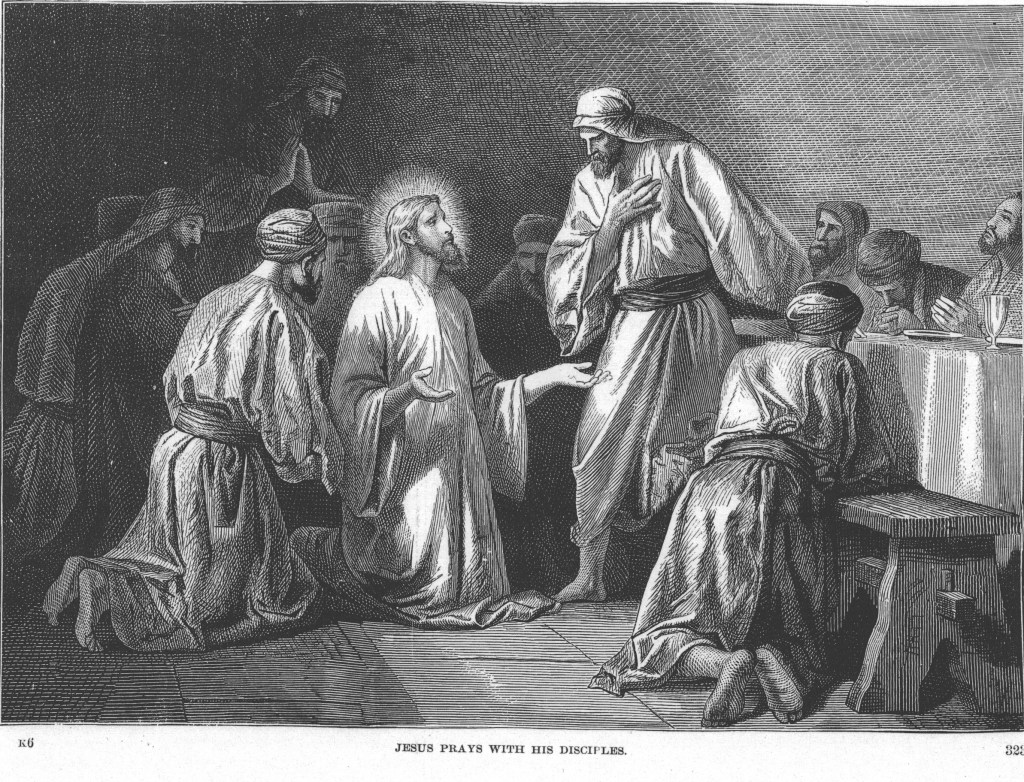
My suggestion is that you do whatever it takes to be able to picture this.  Perhaps in your vision Jesus is still sitting at table.  Or maybe He is sitting in a circle with eyes riveted on Him.  Or maybe He is standing with arms outstretched.  However you see it, make sure you see it.  The picture above, by French artist Alexandre Bida, might be helpful.

Then read the chapter with this vision in your mind’s eye.  Understand that Jesus is praying specifically for you as an individual.  At the beginning of verse nine, when He says, “I pray for them,” understand that them is you.  He is praying for you expressly as one of those given to Him out of the world by God.  This is confirmed at the beginning of verse twenty when He says “My prayer is not for them alone.  I pray also for those who will believe in me through their message.”  That’s you.  You are one of those who believe in Jesus through the message of the gospels and the balance of the New Testament.

Everything that Jesus prays for in this passage applies directly to you.  Narrow your vision so that it is just you and Him.  Move in as close as you dare.  Tune out whatever else might be a distraction in your vision, and focus on the significance of Jesus praying directly for you to God the Father.    

In verse eleven, Jesus asks the Father to protect you by the Power of His Name.  Then He asks that you may be one as He and the Father are one.  In verse fifteen, He asks the Father to protect you from the evil one.  In verse twenty-four, He asks that you be with Him in His glory.  In the last verse, verse 25, He asks that the love the Father has for Him be given to you, and that He be allowed to be in you always.

Are the immensity and intensity of what Jesus is doing here sinking in yet?

If you are like me, there are times during prayer when you just don’t know what to pray for.  There is an uncertainty that only Jesus can fill.  In these times, I often ask Jesus to simply pray for me.  He knew that I would make this request and this chapter is His answer. 

To envision Him, eyes upturned to heaven, arms spread wide, saying these words on my behalf, is the very definition of humbling.  How could I ever respond adequately to this scene?

—————————-

John Chapter 17, verses 2 and 3:

“For you granted Him authority over all people that He might give eternal life to all those you have given Him.  Now this is eternal life:  that they may know you, the only true God, and Jesus Christ, whom you have sent.”

I would be remiss if I did not start by directly linking this verse to our overall theme of immersion in the gospel of John.  Again, we go back to paragraph four of the OFS Rule:

Secular Franciscans should devote themselves especially to careful reading of the gospel, going from gospel to life and life to the gospel.

The gospel of John has 21 chapters.  We have been reading and reflecting on one chapter a month.  By the time we are finished, we will have spent over two years working our way through just this one gospel.  Why have we done that?  What makes the gospels so important, so central to the life of a Franciscan, that this expenditure of time and effort is justified?

The answer is here.  Jesus declares in these two verses that He was born into our world so that each one of us might have the chance to obtain eternal life, to obtain salvation.  And then He declares that the key to gaining that eternal life is knowing God and knowing Jesus Christ, whom God sent.

How do we gain that knowing? 

We gain it by immersing ourselves in the gospels! 

They are our primary source for obtaining the knowing that leads to eternal life! 

—————————-

Here is a description by Thomas of Celano of Francis’ understanding about the link between knowledge of God and salvation.  This is the entirety of Chapter 68 from The Remembrance of the Desire of a Soul.

Although this blessed man was not educated in scholarly disciplines,
still he learned from God wisdom from above and,
enlightened by the splendors of eternal light,
he understood scripture deeply.
His genius, pure and unstained, penetrated hidden mysteries.

Where the knowledge of teachers is outside,
the passion of the lover entered.
He sometimes read the Sacred Books, and whatever he once put in his mind,
he wrote indelibly in his heart.
His memory took the place of books, because, if he heard something once,
 it was not wasted, as his heart would mull it over with constant devotion.
He said this was the fruitful way to read and learn,
 rather than to wander through a thousand treatises.

He considered a true philosopher the person who never set anything ahead of the desire for eternal life.
 He affirmed that it was easy to move from self-knowledge to knowledge of God for someone who searches scripture intently with humility and not with presumption. 
He often untangled the ambiguities of questions. 

 Unskilled in words, he spoke splendidly with understanding and power.

In chapter seventeen, Jesus once again brings separation from the world into the conversation.  The deeper we get into the gospel of John, the higher the profile of this message becomes.  In verse 14, Jesus says “I have given them your word and the world has hated them, for they are not of the world any more than I am of the world.”  Other verses in the chapter have similar overtones. 

Francis incorporates this part of Jesus’ message into his ideas about knowledge.  When Francis speaks about worldly knowledge, it is often with negative connotations.  In Chapters 68 and 69 of A Mirror of Perfection, Francis addresses the subject directly.  Some of the brothers, in collusion with the Cardinal of Ostia, tried to persuade Francis to adopt a Rule more favorable to scholarly pursuits.  Francis responded with this:

“My brothers!  My brothers!  God has called me by the way of simplicity and humility, and has truly shown me this way for me and for those who want to trust and imitate me.  Therefore I do not want you to mention to me any Rule…….or any other way or form of life except the one that the Lord in His mercy has shown and given to me…….God did not wish to lead us by any way other than this knowledge, but God will confound you by your knowledge and wisdom.  But I trust in the Lord’s police that through them God will punish you, and you will return to your status, with your blame, like it or not.”

The cardinal was greatly shocked, and said nothing, and all the brothers were greatly afraid.

It grieved blessed Francis when brothers sought learning which inflates while neglecting virtue, especially if they did not remain in the calling in which they were first called.  He said, “Those brothers of mine who are led by curiosity for knowledge will find themselves empty handed on the day of reckoning.” ……….. He did not say these things out of a dislike for the reading of Holy Scripture, but rather to draw all of them back from excessive concern for learning.

It’s a stern message.  Francis believes what the brothers are asking for will corrupt his religion and jeopardize their chance for eternal life.  There is something about worldly knowledge that Francis sees as particularly dangerous to the way of life he is cultivating at the behest of God.   

Francis casts worldly knowledge as being in direct conflict with simplicity and humility, which would also place it in direct conflict with the core value of Franciscan Poverty.  Recall that Franciscan Poverty is very much a spiritual concept.  At its core, it is about removing anything that constitutes worldly distraction from our list of priorities.  When we do this, we provide space for heavenly considerations (for the knowledge of God that leads to eternal life) to enter in.

Knowledge “that inflates,” which I think we can read to mean knowledge that is worldly, is just such a distraction from Francis’ point of view, and thus it is to be avoided.  Knowledge “that inflates” must never be “set ahead of the desire for eternal life.” 

The passage from Celano is not overt, but still the stance against worldly concern is there.  Read again the line about “wandering through a thousand treatises.”  There is a bit of sarcasm there.  Juxtapose it against the instruction to “search scripture intently with humility and not with presumption” and decide for yourself which course you ought to take. 

Think of it this way.  What good would it do to perfectly understand those thousand treatises if we did not know God at all?  What good if we spent all our time studying those treatises and none of it studying scripture?  During our earthly sojourn, we might be widely respected for our knowledge.  Our knowledge might make us wealthy.  It might give us great earthly power.  But when our short sojourn on earth is over, and it is time to face judgment, and we do not achieve eternal life because we do not know God, would we not trade all that knowledge, respect, wealth and power for just one chance at salvation?

This is a lesson in Franciscan Poverty.  From our modern perspective, we tend to think of knowledge as a supreme good, something to be pursued incessantly for its own sake.  But Francis is saying something different.  The pursuit of knowledge is not itself the highest good, but instead a distraction unless it is specifically directed toward knowing God for the purpose of achieving salvation.  The desire for eternal life supersedes the pursuit of worldly knowledge “that inflates.” 

We need Poverty to fight against the tendency toward worldly distraction, even when that distraction comes in the seemingly benign guise of the general pursuit of knowledge.

We need Poverty to help us stay focused on the pursuit of knowing God for the purpose of gaining eternal life.

—————————-

Would you believe me if I told you Lady Poverty herself agrees with Francis? 

In The Sacred Exchange between Saint Francis and Lady Poverty there is a paragraph with the title Poverty Warns False Religion.  Lady Poverty is addressing “the False Poor.”  These are “men who took up the habit of holy religion but did not put on the new man and only covered the old.”  They claim Poverty should be set aside so that wealth can be accumulated in order to better serve the needy.  But their motivations are corrupted, and the wealth they seek, even if they do use a portion of it to serve the poor, has worldly incentives and ramifications that will inevitably taint their activities. 

I said to them: “I am not contradicting the good that you have said, brothers, but I beg you:  look at your calling.  Do not look back.  Do not come down from the housetop to take something from the house.  Do not turn back from the field to put on clothing.  Do not become involved in the business world.  Do not become entangled in the world’s initiatives and the corruption you have fled through knowledge of the Savior.  For it is inevitable that those who are again entangled in these affairs will be overcome and their last state will become worse than their first, for under the appearance of piety, they withdraw from that which was given them by holy commandment.”

Francis is arguing that the pursuit of worldly knowledge will have a similar effect on his brothers.   

In A Mirror of Perfection, Francis is grieved by those who “did not remain in the calling in which they were first called.”  Here, Lady Poverty similarly begs the brothers to “look at their calling.”  She wants them to remember first things first.  Poverty is the essence of who they are.  To reject it would be to reject “knowledge of the Savior” and to “withdraw from that which was given them by holy commandment.”  As a result, their “last state will become worse than their first.”  They potentially have given up eternal life.

If they forego Poverty, even if they do so for another seeming good, then they are no longer who they claim they wanted to be.  They have forfeited their core status and as a result they have rejected knowledge of God and Jesus.  That loss of knowledge places their salvation in jeopardy.

The danger lies in not understanding the hierarchy of good.  In the Franciscan charism, Poverty is not something that can be traded off against another good.  It is foundational.  It is sacrosanct.  It cannot be compromised. 

Poverty gained this status because, as article eleven of the SFO rule says,

“Trusting in the Father, Christ chose for Himself and His mother a poor and humble life.” 

Jesus accomplished everything He accomplished from a position of Poverty.  As Franciscans, we believe we must do the same.  Poverty is not an idea to be embraced or set aside based on human evaluation, but it is instead a grace that Jesus taught us by the very example of His life.  Once we understand and accept this, there is no turning back from that truth.  We must follow the example of Jesus and live as He lived. 

Franciscans who would forsake Poverty on the premise of pursuing another good they deem as equal do not understand the true nature of Franciscan Poverty.  Serving the needy and/or gaining knowledge are goods to be carried out, but they do not have equal standing with Poverty.  Poverty comes first, and only from a position of Poverty can these other goods be properly pursued, at least if you are a Franciscan.   

 —————————-

It’s not possible to discuss chapter seventeen of John without talking about the prologue to the SFO Rule, otherwise known as The Exhortation of St. Francis to the Brothers and Sisters of Penance.  In that prologue, at the end of the first chapter Francis quotes this chapter of John by paraphrasing the words of Jesus:

O holy Father, protect them with your name whom you gave me out of the world.  I entrusted to them the message you entrusted to me and they received it.  They have known that in truth I came from you, they have believed it was you who sent me.  For these I pray, not for the world.  Bless and consecrate them, and I consecrate myself for their sakes.  I do not pray for them alone; I also pray for those who will believe in me through their word that they may be holy by being one as we are.  And I desire, Father, to have them in my company where I am to see this glory of mine in your kingdom. 

Please be aware that an extended version of this language occurs in the Early Rule that Francis wrote for his Brothers.  It also occurs in the Fragments, hinting that this was also part of a Rule or Way of Life that has not survived to be passed down to us.

All have been given to Jesus that He might guide them to eternal life.  A fortunate few (myself included) have also been given to Francis.  Francis feels responsible for those that God has inspired to seek him out as an example and an advocate in their own search for salvation.  Francis therefore prioritizes this teaching by Jesus about the path to eternal life by referencing the words of Jesus from this chapter of John in multiple prominent locations. 

He wants to ensure that his followers know and understand that the only way to eternal life is “knowing the only true God, and Jesus Christ, the one whom He sent.”

In the process, he specifically references Jesus’ teaching about the distracting nature of the world.  He is reinforcing for his followers that the world is an impediment to gaining the knowledge of God and Jesus required for eternal life.  By this reference, he brings the entire role of Poverty in the Franciscan charism to the fore of the conversation.

I can’t help but feel that while Francis has quoted the words of Jesus here, it is Francis who is making the prayer on behalf of his followers.  His desire that his “Brothers and Sisters of Penance” achieve eternal life and join him in “the company of Jesus in the Kingdom” is so strong that he is forcefully compelled to instruct them on how to do so, but he simply can’t find any words better than this prayer by Jesus.  Recognizing that he cannot improve on these words, Francis chooses to repeat them.

In some sense, I feel as if both Francis and Jesus are praying directly for me as an individual.  I could enter a scene and see Francis praying for me just the same way I do with Jesus.  Francis knows that he is not the source of eternal life, but he so desperately wants his brothers and sisters to join him there that he cannot help but align his prayers for this outcome with those of Jesus.  Francis wants to pray for us, but he cannot find any words better than these to use, so he gives them to us as his prayer as well.

—————————-

We are about to move into the final phase of the gospel of John, the Passion of Jesus.

Check this chapter one last time before you move forward.  Look at the last three verses.  Jesus says “I want those you have given me to be with me……..they know you have sent me.  I have made you known to them……..in order that the love you have for me may be in them and that I myself may be in them.”

In John’s gospel, these are the last words Jesus will speak to the disciples before His Passion begins.  It’s no accident that they are deeply profound and that they deal with eternal life.  The verses from the beginning of the chapter that I have been focusing on have been restated and amplified.  When I see Jesus in this scene, the most striking thing is the intensity of His prayer.  His desire for my salvation is palpable.  I can see Him, as He finishes His prayer and moves to the door to embrace His destiny, looking over his shoulder to make sure I was paying attention and that I got the message.

He wants me with Him for all of eternity!

Francis wants that eternal life for us just as intensely as Jesus does.  This is why he quotes these words from Jesus in multiple places as his personal prayer for us as well.  Look at his distillation again.  He finishes with “And I desire, Father, to have them in my company …….”  When I enter the scene with Jesus, it is easy to imagine that Francis enters with me.  I can see him looking directly at me to make sure I got it.  He also is praying vehemently for my salvation.

Francis wants me with Him for all of eternity!

This makes Francis uncompromising in showing us his way.  As the passage from Celano suggests, he “untangles the ambiguities.  He speaks splendidly with understanding and power.”  The intensity of the desire of Francis for our salvation is demonstrated by the severity of the reaction he had when the brothers suggested a path that probably made perfect sense to them but that he knew to be compromised.  He felt the need to make sure they understood his position beyond a shadow of a doubt in order that they would stay the course toward that ultimate prize of salvation.        

Immersion in the gospels, combined with and as a result of staying true to the ideal of Franciscan Poverty, is the answer to my greatest hope, that I might achieve salvation when my time on this earth is done.  It is a sure path to the knowledge of God that Jesus lays in front of us as the key to eternal life in the chapter.

Living Poverty is not easy.  It is often tempting to turn away from it to fulfill this or that earthly desire that seems in the moment to be perfectly reasonable, even pious.

Heeding the words of our Father Francis and staying the course is the key to being a faithful Franciscan, knowing God and Jesus, and achieving the eternal life I so desperately desire.

Journey thru John, Chapter 16: On Tribulation and Joy

As with the last two chapters, Jesus is once again in full teaching mode.  We remain in the time between the last supper and the Passion as Jesus continues to give final instructions to his disciples.

In chapter fifteen, Jesus gave me an image of a grape vine to focus on during my contemplation.  In chapter sixteen, He gives another powerful image that allows me to do the same.  In our modern world, many of us, both female and male, have personal experience with the birth of a child.  If that includes you, take some time to go back and relive that moment from your personal history.  Then take your memories and use them to help you contemplate this chapter, focusing on the juxtaposition between tribulation and joy not just in the image that Jesus presents, but in the overall context of this chapter and the previous one.   

I have three children and I was present for the birth of each one.  Each experience was unique, but the effort required of my wife is a constant theme for all three.  I can’t claim to have experienced the pain she did, nor did I have to endure her anguish (to use the same word as Jesus), but I am grateful to have been at her side throughout.  Even though I was spared the physical hardship and exhaustion, I can at least recall that experience and empathize to some extent with the wonder and joy that a mother feels when “a child is born into the world.”

I know even as the bystanding dad that no other experience in my life quite equates to that one.

Jesus’ reference to the “world” in this little vignette is fascinating.  The reflection from chapter seven focused entirely on the definition of the word “world.”  The “world” as understood there is generally antagonistic to Jesus.  If you were to go back and review all the chapters from seven until now, you would find that this definition holds steady.  When the word “world” is used in the text, it generally signals something opposed to the message of Jesus.

If you don’t believe me, just go back to verses 18 and 19 from the last chapter.

“If the world hates you, keep in mind that it hated me first.  If you belonged to the world, it would love you as its own.  As it is, you do not belong to the world, but I have chosen you out of the world.  That is why the world hates you.”

Yet, in the vignette, Jesus uses the image of a “child being born into the world” as an entirely positive teaching tool.  A mother’s pain and anguish is changed to joy despite the hardship of childbirth.  In the same way, the disciple’s pain and anguish at the coming events will also be changed to joy despite the hostility of the world. 

Every child is meant to become a disciple of Jesus.  Those who succeed will do so in the context of a world that does everything it can to prevent their success.  When they reject the world in favor of Jesus, they will unavoidably be subject to the same forms of pain and anguish that the disciples are about to experience. 

One might think this would temper the joy a mother experiences at the birth of her child.  But when I think back on my own experience, there was only hope and joy in the delivery room.  As parents, we were not thinking about the hardships that would inevitably come into the life of this new creation.  Despite those inevitabilities, the birth of our child into this world was not a cause for concern and fear, but instead, unmitigated joy.

It is clear that Jesus understands that joy to be pure.  (In Franciscan terms, this joy is true and perfect.)  Otherwise, it would not be suitable as the basis of His reassurances to His disciples.  The fact that the child will have to face the trials, tribulations and temptations of the world does not dilute or inhibit this unadulterated joy.  The mother’s joy, despite the inevitable hardships of her child’s life, is justified and honest and good.  If the disciples can live into this teaching of Jesus, the joy they will experience will likewise be true and perfect despite the hardships they are about to endure.

What does this teach me about the nature, necessity and value of tribulation?  

—————————-

John Chapter 16, verse 33:

“I have said these things to you, that in me you may have peace. In this world you will have tribulation. But take heart! I have overcome the world.”

This is the last verse of the chapter.  The opposition of the world to Jesus is once again reinforced.  The world brings tribulation.  In verse two of the chapter, Jesus goes so far as to say that the world will kill us while believing it is offering a service to God via our deaths.  Some of the disciples will soon experience this first hand.

As is referenced above, the theme Jesus summarizes using the metaphor of the birth of a child actually goes back to the middle of the last chapter.  If you have not done so already, go back and read from verse 18 of chapter fifteen through to the end of chapter sixteen as a single unit in order to understand the continuity.  Starting at verse 18, Jesus begins to directly anticipate the Passion.  His teaching about the world, about tribulation and about joy is meant to help the disciples cope with coming events.  This includes not just the Passion, but also the tribulations, difficulties and persecutions that will come after His Resurrection and Ascension.

In fact, those persecutions are a constant throughout post Ascension history.  They never stop, forming one unbroken line from the Romans feeding Christians to the lions straight through to the present day, where ISIS fulfills the words of Jesus from verse two by martyring Christians for their faith.  Even in the US, the reward for being a Christian is often a label of intolerance, as we are expected to embrace and approve alternate lifestyles even if we believe them to be based in sin.

The same thing was true in the time of Francis.  The order was regularly subject to persecutions.  In chapter five of The Anonymous of Perugia, the treatment of the brothers is described like this:

Although the brothers wore the poorest and cheapest clothes, for amusement many people still took these away from them…………People threw mud at the heads of some of the brothers; to others, they shoved dice in their hands, inviting them to play.  One brother was carried by the capuche across someone’s back, for as long as he pleased.  These things, as well as many others, were inflicted on them.  But we will not go on about these things, for it would unduly prolong our words.  In a word, people considered them despicable; that is why they nonchalantly and brazenly persecuted them as if they were criminals.  In addition, they endured a great deal of hardship and suffering from hunger and thirst, from cold and nakedness.

Clearly, the Franciscan movement was not immune to the tribulations of the world.

The unique thing about the Franciscan charism, and for me, one of the hardest things to grasp and embrace, is the view that these tribulations are not a negative experience.  In fact, they are to be welcomed and even hoped for.  There is nothing in our modern culture that prepares me to accept that point of view.  Tribulation, for me, is always something to be avoided.     

The above passage from chapter five of the Anonymous of Perugia goes on like this:

They suffered all these things with constancy and patience, as blessed Francis had counseled them.  They did not become dejected or distressed, but exalted and rejoiced at their misfortune like men placed at great advantage.  They fervently prayed for their persecutors.  When people saw them rejoicing in their tribulations and enduring them patiently for the Lord, unceasing in very devout prayer, ……….many of them, by the kindness of the Lord, experienced a change of heart.  They came to them, begging forgiveness for their offenses against them.

The phrase that I struggle with is explicit here.  How, exactly, does one “rejoice in his tribulations?”  It’s something that I have never been taught to do.  At best, I learned something in the vein of “anything that does not kill me makes me stronger.”  But that is not the same as what is being suggested here.  In that, the tribulation is still to be avoided if possible.  It is to be endured, not embraced.

Of course, in true Francis style, his counsel is backed up by his own personal example.  In chapter seven of the first book of The Life of St. Francis by Thomas Celano, we get this short story:

He who once enjoyed wearing scarlet robes now traveled about half clothed.  Once while he was singing the praises to the Lord in French in a certain forest, thieves suddenly attacked him.  When they savagely demanded who he was, the man of God answered confidently and forcefully, “I am the herald of the Great King!  What is it to you?”  They beat him and threw him in a ditch filled with deep snow, saying:  “Lie there, you stupid herald of God!”  After they left, he rolled about to and fro, shook the snow off himself and jumped out of the ditch.  Exhilarated with great joy, he began in a loud voice to make the woods resound with the praises to the Creator of all.

My tribulations almost always have the opposite effect on me.  They drag me down.  They make me sorrowful.  They even make me depressed at times, draining energy from me and making me lethargic and unresponsive to the call of God.  I simply do not know how to live out this example from St. Francis.

And honestly, who can claim that they would respond to the same situation in the same way?  If you were beaten by thieves and thrown in a snow filled ditch, would you react by making snow angels in the snow, which is what we might as well assume Francis is doing as he rolls about to and fro?  Would you be “exhilarated with great joy,” and then would you begin to sing the praises of Creation to the woods around you?

I don’t do such things when I am in a good mood.  I can’t imagine doing them after being beaten by thieves.

Yet, as a Franciscan, this is what I am called to.  How will I ever achieve this?

—————————-

A list of the persecutions and tribulations of Francis and his followers could quickly get unwieldy.  We would have to talk about the pain inflicted upon him by his father, about rejection at the hands of the people of Assisi, etc., etc.  As the first passage suggests, there is not room to “go on about these things” in a short reflection such as this. 

And to focus on them would be to miss the point. It is already clear that Francis’ attitude towards these tribulations is different than what would be expected.  The clear question is, why does Francis react differently?  What did Francis know that places him so far from the norm for the rest of us? 

In the gospel passage, Jesus tells us to take heart because He has overcome the world.  Somehow, He personally embodies a negation of the tribulations of the world.  Is that the starting point for understanding the perspective of Francis?  Did Francis perhaps take this passage, or another one similar to it, and apply it to his life in a way that led to his extraordinary reaction to the persecutions he experienced in the world?

The SFO Rule, in paragraph 10, says this:

Let them also follow the poor and crucified Christ, witness to him even in difficulties and persecutions.

The commentary from Hidden Power III: From Gospel to Life on this sentence reads like this:

Simple living begins with the choice to unite with Christ so intensely that one is willing to share even His Passion:  ………

Both passages make a clear connection between our own hardships and the Passion of Jesus.  His persecution, which culminates in His embrace of the Cross, must inform how we accept and deal with our own adversity.  The rule is suggesting that the answers to the above questions are yes, Francis did have a unique understanding.  By linking the crucified Christ to our difficulties and persecutions in the same sentence, the Rule locates that unique understanding in the mystery of the victory of the Cross. 

Understand that Jesus is timeless.  When He says in the gospel passage that He has overcome the world, He is actually talking about His Resurrection, which for Him is an assured future, which allows Him to speak about it as if it has already happened. 

Jesus suffers His own tribulation on the way to the Cross.  His arrest.  Being abused by the Pharisee’s guards.  Being flogged.  The crown of thorns.  The burden of carrying the cross.  And ultimately being nailed to the cross.  These tribulations are an essential part of the story.  They were horrific, but necessary to His ability to declare victory over the world in this gospel passage.  If the world did not culminate its opposition to Him by inflicting these tribulations on Him, then His declaration of overcoming the world would lose meaning.

Why then, in our own lives, would we expect to go from now until the day of our deaths without tribulations of our own?  If Jesus had to suffer, then why not us?  And if Jesus’ tribulations were essential to His story, then perhaps our tribulations will also be essential to ours?

We know that Francis sought above all else to emulate the example of Jesus as found in the gospels.  That’s relatively easy when the cost is low.  But when the cost involves embracing are own difficulties and persecutions, it becomes less attractive.  But even so, a life without the opportunity to emulate the tribulations of Jesus would have to be an incomplete life.  Without our own versions of the Cross, our ability to follow Jesus completely would necessarily be compromised. 

The conclusion has to be that we need tribulation in our life.  It is an essential part of who we are and how we are to become what we are supposed to become.  Without it, Jesus in His most important details, the details of His triumph on the Cross, the details of His overcoming the world, would be unknowable to us.

 —————————-

There are many things that are exceptional about Francis, but perhaps the most exceptional is that he was not afraid of this conclusion.  His devotion to emulating Jesus was so strong that he not only decided to accept difficulty, he actually longed for it.  He wanted to follow Jesus as exactly and as precisely as he could, and he knew that his own personal tribulations were integral and necessary to his success.

This understanding and desire culminates in Francis’ definition of “what true joy is.” I have already used the words from the Little Flowers of St. Francis in regard to this a couple times, but that is not the only place this definition occurs.  It is also present in the Undated Writings directly attributed to Francis under the title “True and Perfect Joy.”  Brother Leo asks, “Then what is true joy?”  Francis responds as follows:

I return from Perugia and arrive here in the dead of night.  Its winter time, muddy, and so cold that icicles have formed on the edges of my habit and keep striking my legs and blood flows from such wounds.  Freezing, covered with mud and ice, I come to the gate and, after I’ve knocked and called for some time, a brother comes and asks:  ‘Who are you?’  ‘Brother Francis,’ I answer.  ‘Go away!’ he says.  ‘This is not a decent hour to be wandering about!  You may not come in!’  When I insist, he replies: ‘Go away!  You are simple and stupid!  Don’t come back to us again!  There are many of us here like you – we don’t need you!’  I stand again at the door and say:  ‘For the love of God, take me in tonight!’  And he replies:  ‘I will not!  Go to the Crosiers place and ask there!’ 

I tell you this:  If I had patience and did not become upset, true joy, as well as true virtue and the salvation of my soul, would consist in this.”

Again, the reaction of Francis makes no sense on the surface.  If it were me or most any other man, I would be furious with the brother for not helping me in my time of need.  And yet Francis is ignoring the actions of the brother, not judging them one way or the other.  They are irrelevant to Francis because his focus is elsewhere. 

What, then, is Francis focused on?  What understanding of his own is he using to evaluate this situation?

The answer is that he is evaluating his situation within the context of the Cross.  Francis recognizes that he is undergoing some difficulty and perhaps even some persecution.  But instead of being angry with his antagonist, his focus on Jesus and the Cross gives him an entirely unanticipated perspective.  He sees the tribulation not so much as a hardship but as an opportunity.

He is being given the opportunity to share in the tribulations of Jesus during His Passion.  His tribulation is not as extreme as that of Jesus.  Nothing we experience ever quite matches the experiences of Jesus.  But nonetheless it is an opportunity to embrace kinship with the sufferings of Jesus on the Cross.

In past chapters we have reflected on “Living in Jesus,” on “Laying Down One’s Life,” and on “Loving as He Loved.”  Instead of tribulation being an inconvenience or a disaster, tribulation embraced as an opportunity to share in Jesus’ experience of the Passion becomes in some sense the culmination of all of these teachings.  The ultimate experience of the life of Christ is His Passion.  If you truly want to imitate Christ, if you want to identify with Him as closely as possible, then a chance to share in the tribulations of the Passion is the ultimate experience you can hope for. 

This is the genius of Francis the Saint.  He has found a perspective that perhaps was never found by anyone else who ever lived.  It’s a perspective that allows him to draw closer to Christ than anyone else.  He wants so much to share in the suffering of Christ that it ultimately leads to him receiving the stigmata, which in turn allows him to draw closer yet. 

Chapter thirteen of the Major Legend of Saint Francis, by Bonaventure, describes this symbiosis like this:

The man filled with God (Francis) understood that, just as he had imitated Christ in the actions of his life, so he should be conformed to him in the affliction and sorrow of his passion, before he would pass out of this world.

Is that something I wish for?  I’d like to say yes, but I am not sure it would be the truth. 

—————————-

Francis, in the end, knows that his reaction to tribulation is out of the ordinary.  He knows that most every other man he encounters will think his position foolhardy.  He knows that his position is in contradiction to the world.  At some level, he experiences the same reaction that the rest of us do.  But at some other level, he is working against that typical reaction.  It is a contest with himself.  If he can master himself and not succumb to the worldly desires of his flesh, if he can remain patient and not become upset, if he can stay focused on Jesus and opportunity instead of taking the typical path, then for at least one moment in time, he will have escaped his human frailty.

This escape, this mastery of his human frailty, is what justifies the claim to true and perfect joy.  In that moment, in that acceptance of tribulation, in that decision to drink the cup that God has placed in front of him, he has truly succeeded in his desire to emulate the decision Christ made in the Garden of Gethsemane that leads to the entire Passion that follows.

This is the reason that he can label his position one of True and Perfect Joy.  It is true and perfect precisely because it is a genuine and authentic rejection of worldly position in favor of a true and perfect orientation to Jesus.  If I could accomplish that at some point in my life, I could also claim the same kind of joy.

In other words, it is the fulfillment of this gospel passage.  To embrace True and Perfect Joy is to find peace.   And, as the gospel passage indicates, peace is found in Jesus. 

It becomes a completed circle.  To share in the tribulations of Jesus is to be in Jesus in the most perfect way possible, which is to be in peace, which is to experience True and Perfect Joy, which is to overcome the tribulations of the world.

Its why, in the end, there is not a conflict between the world being opposed to Jesus and the joy that a mother feels when a child is born into the world.  The tribulation that comes from a world in opposition is the tribulation that allows a child to fully experience the Cross of Jesus and thus to experience true and perfect joy, which is the basis and the hope of the mother’s perfect joy at the moment of the child’s birth in the first place.   

Journey thru John, Chapter 15: The Fruits of Penance

In the last reflection, I noted that 28 of 31 verses in chapter 14 in my bible were in red, indicating Jesus was speaking and teaching the entire chapter.  This made it hard to enter the scene because there was little description of the setting where this teaching was taking place.

In chapter fifteen, every word of the chapter is in red.  Jesus is teaching the entire time.  This pattern continues for the two chapters that follow as well.  As John moves from the Last Supper to the Passion, he locates four full chapters of Jesus teaching in the interim.  Jesus is giving last instructions to his disciples because He knows what is coming even if they do not.

Oddly enough, despite the fact that all the words are red, Jesus does give us an image that we can focus on and visualize in this chapter.  At the beginning, as an introduction to His subject matter, He starts by talking about vines and branches and pruning and bearing fruit. 

If you were to open up your internet search engine and enter the words “grape vine images,” you would literally get hundreds of pictures of what grape vines look like.  Many of those images will show you vines sagging under the burden of gorgeous green or purple fruit.  Search “grape vine pruning” and you will get hundreds more illustrations telling you how grape vines are trained and pruned. 

Twenty years ago, before I knew anything about St. Francis, I planted a quarter acre vineyard behind my house.  It has not been cared for lately, but there are still vines growing in it.  Someday I hope to have a life simple enough that I will have time to care for that vineyard.  In the meantime, if I want to see well cared for grape vines, I can drive thirty minutes from my house into southern Michigan and go on a winery tour.  Chances are you can do the same just about no matter where you are. 

If you instead walk at the fringes of an open space in the countryside near you and know what to look for, you can probably find grapes growing wild near where you live.  If you found those wild vines in the spring and monitored them over the summer and fall, you would find that they barely set any fruit at all, and that the fruit they do set is small and sickly compared to what you get at the grocery store.  Those vines are never pruned and they spend all their effort creating and sustaining new wood from year to year.  They direct none of their energy toward the production of fruit.     

As Franciscans, we understand that the Creation we dwell in has much to teach us about the God who loved us into being.  As Jesus talks about vines at the beginning of this chapter, He is capitalizing on this truth.  The difference between a pruned, productive vine and the unproductive vines growing wild in the countryside informs the message that Jesus is conveying. 

Read the chapter a couple times.  Then take a little time to ponder and investigate the nature and process of growing grapes.  Take what you learn about grape vine culture and reread the chapter, looking to see how your new knowledge of Creation enhances the spiritual message of Jesus. 

See if you gain any extra insight as you pray over the verse that has captured your attention.

—————————-

John Chapter 15, verses 1, 2 and 5:

“I am the true vine, and my Father is the gardener.  He cuts off every branch in me that bears no fruit, while every branch that does bear fruit he prunes so that it will be even more fruitful.  I am the vine: you are the branches.  If a man remains in me and I in him, he will bear much fruit: apart from me you can do nothing.”

I have already emphasized repetition in several previous chapters.  When the same words are repeated over and over again in a short space, it’s a sure sign of the importance of the message Jesus is conveying.  At the beginning of this chapter, Jesus uses the word “remain” eight times in four verses.   He also uses a version of the phrase “bear fruit” seven times in the first eight verses. 

The instruction from Jesus to us to “remain in Him” is one that we should easily assimilate as Franciscans.  Paragraph four of our rule, which is the introduction to the Way of Life we have promised to live, is clearly full of this idea.

The rule of life of the Secular Franciscans is this:  to observe the gospel of our Lord Jesus Christ by following the example of Saint Francis of Assisi, who made Christ the inspiration and the center of his life with God and people.  

If we emulate Francis and make Christ the inspiration and center of our lives, then we are living out the instruction of Jesus given here.  We are “remaining in Him.”  In the reflection on chapter thirteen, we talked about how “remaining in Him” helps us to “love as He loved.”  Here, by the same commitment to using Jesus as our inspiration, perhaps we can learn something about how to make our lives “bear fruit.”

At first, I was feeling a little apprehensive about going back to this paragraph of the rule so quickly.  I just used it two chapters ago.  I thought, “Isn’t there somewhere else to pull from that will also make the same point?”  Of course there is.  But then I thought that perhaps this paragraph is important enough that it’s a good idea to emphasize it again.  As it says itself, “the rule is this.”  This one sentence is the summary of all that will come after it. 

As always, as Franciscans, it’s still all about our original purpose for embarking on this journey through the gospel of John.  It still comes down to going from gospel to life and life to gospel in a prayerful manner so that we can take the inspiration that comes from “remaining in Christ” and use it as the means by which we can “be fruitful” in our lives with God and His people.

That will remain the basis of what we do and who we are no matter what sources I cite and no matter what quotations I pull from those sources.

I think, perhaps, that it is a good idea to emphasize the versatility of this paragraph again even though I used it such a short time ago.  If Jesus uses repetition in the gospels to underscore His most important messages, I should not feel bad about doing the same.    

—————————-

That said, one of those other sources that emphasizes the importance of “remaining in Jesus” is the Prologue to the Rule.  Paragraph four, as the introduction and summary of the Way of Life of a Secular Franciscan, is itself an echo of the Prologue, which is in turn an overall introduction to the entire Rule.  (As a reminder, the Prologue contains the direct words of Francis as expressed in the Exhortation to the Brothers and Sisters of Penance.)

Chapter one, entitled Concerning Those Who Do Penance, starts like this:

All who love the Lord with their whole heart, with their whole soul and mind, with all their strength and love their neighbors as themselves and hate their bodies with their vices and sins, and receive the Body and Blood of our Lord Jesus Christ, and produce worthy fruits of penance:

Begin by recalling that Penance in the Franciscan charism is not primarily about restitution.  As Franciscans, we understand that restitution without conversion is meaningless, so we choose to emphasize conversion first.  Penance becomes for us a forward looking, positive and optimistic experience.  It will ultimately lead us to joy.  For Francis, a brother or sister of Penance is a person pursuing the conversion that turns one away from the world and toward God. 

In this passage, Francis is describing the characteristics of this person of Penance.  The reason a penitent hates his body with it vices and sins is because the body tends to worldly concern, which tends to turn our faces away from God.  In other words, the body indulged will inhibit our ability to “remain in Jesus.” 

The other phrases are neatly echoed in paragraph four of the Rule.  Those “who love the Lord with their whole heart” are those who “make Christ the inspiration of their lives” and thus are also those who “remain in Jesus.”  Those who “love their neighbors as themselves” are those who “make Christ the center of their lives with God and His people,” another manifestation of “remaining in Jesus.”  Those who “receive the Body and Blood” are those who invite Christ to dwell within, which is an expression of the other side of the word “remain” from the gospel passage, the side where Jesus “remains in us.”

All of this remaining then leads to “bearing fruit” as Jesus describes in the gospel.  The penitent, as a natural result of his conversion, can’t help but express that conversion and his burgeoning closeness with Christ as he moves through the world.  “Producing worthy fruits of penance” are the words Francis uses to describe the manifestation of the presence of Christ in our lives that comes from a life properly oriented and well lived. 

The penitent, by turning toward God, invites God to apply his pruning shears.  God responds by lovingly caring for the branch that is me.  Christ is the Vine.  As a person of Penance residing in Christ, I am a branch firmly attached to that Vine.  When I allow it, God prunes away the vices and sins of my body so that my attachment to the Vine remains healthy and robust.  The Vine nourishes me and enables me to bear fruit.

If I were to be separated from the vine, I would wither and be able to do nothing, just as the gospel quote says.

—————————-

The next step for the Franciscan is then to embrace the link between Penance and minority.  We look to occupy that position of minority because we understand that a position of minority is a position oriented toward God.  If we look for worldly gain, if we embrace worldly power, if we seek superiority, then we are rejecting our status as penitents in so much as our face will inevitably be turned away from God by those ambitions.  When we reject that status, we are in fact rejecting our ability to “reside in Jesus” and therefore our ability to “bear fruit.”

In the sources, there is a story about St. Francis and St. Dominic being the guests of Cardinal Hugolino.  This story appears in at least four different places (another manifestation of repetition reinforcing importance).  I am taking my quotes from chapter 49 of The Assisi Compilation.

During their discussions, the Cardinal makes this proposal to the two saints:

“In the early Church, the Church’s shepherds were poor, and men of charity, not on fire with greed.  Why don’t we make bishops and prelates of your brothers who excel in teaching and example.”

The text is humorous in the way it describes the attempts of Francis and Dominic to defer to each other.  In the end, in response to the deference of Francis, Dominic answers first.  Francis then gives his answer:

My lord, my brothers are called lesser precisely so they will not presume to become greater.  They have been called this to teach them to stay down to earth, and to follow the footprints of Christ’s humility, which in the end will exalt them above others in the sight of saints.  If you want them to bear fruit in the Church of God, keep them in the status in which they were called and hold them to it.  Bring them back down to ground level even against their will.  Never allow them to rise to become prelates.”

The embrace of minority is rooted in the example of Christ.  Jesus did not come to us as a secular ruler.  Nor did He come to us as High Priest.  He came to us as a common man born in a manger, the son of a carpenter, hailing from Galilee, a backwater held in low regard by the people of worldly power in His time.  In His life, He never had a roof over His head or a bed to sleep on that He could rightfully call His own.  These are the footprints of Christ’s humility that Francis is referencing.

Francis understood that the power of the example would be lost if the minority embraced by Jesus was set aside.  Jesus triumphed from His position of humility and minority.  Francis intends for his brothers to triumph the same way.  Those in power will have his brothers as an example to follow, but the example will not be compromised, lest it be lost.  Those in power will have to find the righteous way by reference to this example if they can, just as Francis himself did by rejecting his earthly station in order to follow the example of Jesus, who chose to die on a Cross rather than to fight to gain worldly power as His followers might have wished and expected.

As always, Francis chooses to follow literally his understanding of the poverty of Christ.

What is the result of this choice by Francis?

As the passage indicates, the result is the ability to “bear fruit.”  His followers, by locating themselves in minority and thereby in Penance, maintain their ability to “remain in Jesus.”  They remain branches firmly connected to the Vine.  As they imitate the humility of Christ, they abandon the need to shape themselves and thus allow God to prune them into the shape He wishes them to wear.

The pruning of God then brings forth the “worthy fruits of penance” that Francis speaks of in the Exhortation/Prologue to the Rule.

 —————————-

The link between being minor and the ability to “reside” in Christ is reinforced dramatically in the introduction to a work called “Of the Tribulations of the Order of Lesser Brothers.”  Understand that while this work is included in the source materials, it is not without controversy.  The author, Angelo Clareno, often found himself on the outskirts of the Franciscan mainstream, mostly because he felt that mainstream did not adhere to Francis’ instructions on minority and poverty closely enough.  (The discussion on the controversies can be found in the introduction to this work in the source materials if you wish to investigate it more thoroughly.)

Clareno presents the following in the context of Jesus instructing Francis:

Therefore the congregation of your brotherhood will be called the religion of lesser ones, so that from the name they might understand that above all they are to be truly humble of heart; since humility is the cloak of My honor and praise, and anyone passing from this life with this habit will find the gates of My kingdom open.

I asked My Father to grant me in this last hour a little poor people, humble, and meek, and mild, who would be like Me in all things, in poverty and humility, and who would be content to have only me; I would come to rest and remain in this people, just as My Father rests and remains in Me:  and this people would rest and remain in Me just as I remain in the Father and rest in His Spirit.  My father gave you to Me, along with those who with their whole heart and with unfeigned faith and perfect charity cling to Me through you; and I will guide and nourish them, and they shall be sons to Me, and I shall be a father to them.

I don’t know how controversial this passage is.  It does not seem so to me.  The link between being minor (“lesser ones”) and “remaining in Christ” rings true to me.  The position of minority and humility that is repeated here again seems to gain importance by the repetition. 

Clareno uses the word nourishment here, which we have used above in the context of the Vine nourishing the healthy branches connected to it so that they might “bear fruit.”

He also provides an echo to the Exhortation/Prologue to the Rule with the words “with their whole heart.”  That echo infers the tie-in to the Franciscan concept of Penance as part of the logic that links all of this together.

I came upon this passage because the text of John chapter 15 is quoted directly here and included in the Index to the source materials.  I pondered whether or not to include it because of the controversy associated with the author.

In the end, I chose to share it because there is something about the boldness of it that spoke to me.  I don’t understand Clareno to be suggesting that he somehow has firsthand knowledge of a conversation between Jesus and Francis.  I am not aware of this being lifted from something earlier in the source material. 

On one hand, I do not think that I would be comfortable placing words in the mouth of Jesus as Clareno has here.  The words Jesus has spoken in the gospel are enough for me.  I often feel inadequate in my attempts to contemplate them, let alone to move beyond that and somehow add to them.

On the other hand, they do feel authentic.  I can see Jesus saying these things to Francis.  They all seem to fit precisely and neatly within my overall understanding of the Franciscan charism.

The text is supportive of the discussion on the verses of John that I am reflecting on.  But in the end, I just wanted you to be exposed to it so that you knew it was there and could react to it on your own terms.  

—————————-

There is one portion of the verses that I have mostly ignored so far.  There has been lots of discussion about “residing in Jesus,” vines and branches, “bearing fruit” and pruning.  But there has been little about the clause at the end that says: “apart from me you can do nothing.”

In the introduction, I talked about the wild and unpruned grape vines that might be growing near you.  These vines, I think, speak to this clause.  They represent those who do not embrace Penance.  They are the people who do not “remain in Jesus” and are therefore unable to bear any fruit. 

I bought a house on a lake a couple years ago that was not well cared for.  In the back of the house there was a large tree.  At the base of the tree there was a grape vine that must have been growing in that spot for decades.  The trunk of the vine was bigger around than my thigh.  Its branches extended in every direction, including up into the tree thirty or forty feet.  The vine used the tree as a trellis and had grown so far out of control that it was hard to tell where the vine and the tree started and ended.

It took so much energy for the vine to support all that wood that it had not flowered at all.  There was no fruit of any kind growing on it.

Before my face was turned toward God in penance and conversion and minority, before I set about trying to “remain in Jesus” as this gospel chapter and the Rule call me to, this is what my life was like.  I had so many worldly things going on that I could not provide proper energy to any of them.  All of these different directions drained me, and I did nothing well.  In short, I produced lots of wood going in a myriad of directions and little if any “worthy fruits of penance.”

Apart from God, I was able to do nothing.

Even today, nearly ten years after beginning my Franciscan formation and seven years after my profession, I am still fighting to contain that overgrown and wild vine.  There are still tendrils from that time that I am supporting.  There is still temptation to grow new shoots in new directions that has to be resisted.  My life is nowhere near as simple as I would have it be.  My face is not turned unceasingly toward God.  I am still in need of that ongoing conversion that will allow God access to do the true pruning that needs to be done in my life, the pruning I cannot accomplish on my own.    

Francis, I think, would understand exactly what I am talking about here.  I think it’s the reason why he told Cardinal Hugolino “no” when he wanted to make his brothers prelates.  He knew that if they were allowed this worldly honor, they would soon be like branches of a vine that had grown wildly out of control and become unfruitful.

Here is one more repetition.  This one comes from the conclusion of Chapter 8 of the Little Flowers of St Francis.  It has already been cited at least twice in these reflections.  Francis confirms here the idea that everything we have comes from God, which is a necessary corollary of the idea that “apart from me you can do nothing.”      

And now, brother, listen to the conclusion. Above all the graces and all the gifts of the Holy Spirit which Christ grants to his friends, is the grace of overcoming oneself, and accepting willingly, out of love for Christ, all suffering, injury, discomfort and contempt; for in all other gifts of God we cannot glory, seeing they proceed not from ourselves but from God, according to the words of the Apostle, `What hast thou that thou hast not received from God? And if thou hast received it, why dost thou glory as if thou hadst not received it?’ But in the cross of tribulation and affliction we may glory, because, as the Apostle says again, `I will not glory save in the cross of our Lord Jesus Christ.’ Amen.”

If and when we do “bear fruit,” we do it not because of our own efforts, but because the goodness and grace and gifts of God have been worked through us.    

That is only possible when we embrace Penance and turn our faces to God.  It is only possible when we embrace minority and set aside worldly concerns in favor of the inspiration that comes from going from life to gospel and gospel to life.   It’s only possible when we “remain in Jesus” and allow God the Gardener to prune us as branches attached to the Vine that nourishes us through His gospel teaching.

In the end, I cut that grape vine out of the tree in the backyard of that house I bought.  I took all that extra wood and made of pile of it.  And then I burned that pile just like Jesus says in verse six of this chapter.  I then had the tree itself pruned, and it looks great today.  It frames nicely the view from the rear of the house out to the lake and the woods beyond.

I had not thought of that task recently, not until I started reflecting on these gospel verses.  But I am glad to have recalled it, because it is an example of how attentiveness to and caring for Creation can lead us to insights into the teachings that Jesus presents to us throughout the gospels.

But for the recollection to bear fruit, I had to be in a position of minority, humility and Penance with my face turned toward God. When I was cutting that overgrown vine out of that tree, I did not connect it to the gospels in the moment. It was only during this contemplation, when I was firmly oriented on Christ, that the full lesson of my action within Creation came clear.

Only when my inner eye was firmly focused on Jesus could I make the connection and learn the lesson that Jesus intended for me from the moment I started to prune.

Chapter 10: Conclusion

The Acts of the Apostles, 14: 8-10:

In Lystra there sat a man who was lame. He had been that way from birth and had never walked. He listened to Paul as he was speaking. Paul looked directly at him, saw that he had faith to be healed and called out; “Stand up on your feet!” At that, the man jumped up and began to walk.

The Acts of the Apostles, 14: 21-22:

They preached the gospel in that city and won a large number of disciples. Then they returned to Lystra, Iconium and Antioch, strengthening the disciples and encouraging them to remain true to the faith. “We must go through many hardships to enter the kingdom of God,” they said. 

The Letter of Paul to the Romans, 1: 18-20:

The wrath of God is being revealed from heaven against all the godlessness and wickedness of people, who suppress the truth by their wickedness, since what may be known about God is plain to them, because God has made it plain to them. For since the creation of the world God’s invisible qualities—his eternal power and divine nature—have been clearly seen, being understood from what has been made, so that people are without excuse.

I have been reading the Acts of the Apostles for the last several weeks.  I read chapter fifteen this morning.  Then, for no pressing reason, I skipped ahead to the first chapter of the Letter of St. Paul to the Romans.  I found the last couple chapters of Acts a little dry, more historical than instructive, so I wanted to see if the next book of the New Testament would get back to teaching mode.

If you reference the quotes above, you can see that the synergy between what I discovered on my journey and what I have been encountering in Scripture has not ceased.  Even when the material feels dry, it seems that every chapter has one or two nuggets that match perfectly with conclusions I have already drawn. 

The first quote speaks directly to the gospel passage from chapter five of Mark that I referenced at the end of chapter two.  The woman with internal bleeding believed that “if I just touch his clothes, I will be healed.”  Here, Paul looks at a cripple sitting in a synagogue, sees the same measure of belief in his soul, and is able to use that belief to cure the man of his affliction.  The importance of faith and belief as a primary component of my journey is thus reinforced.  

The second quote speaks directly to the entire discussion on adversity that took place in chapter seven.  If the Father allowed the Son to suffer the adversity of the Cross, if the Father turned that greatest of evils into the greatest of Goods, then I should welcome every adversity in my life as an opportunity to draw closer to Christ and understand Him better.  Paul is giving his gentile disciples the exact same message.  The idea that adversity is central to the plan of God is highlighted once again.

The third quote speaks against the worldliness that I must deny myself if I am going to progress from Penance and Metanoia to Spiritual Poverty.  It also speaks to the ongoing presence of God in His Creation.  Two of the main themes from my journey are emphasized in these three short verses of Scripture.  When I am present to the words I read in both Acts and the Epistles of Paul, it is astonishing how consistent Scriptural messaging is revealed to be. 

Each of these sets of verses are reinforcements of the great blessings that grew out of my trip.  I can contemplate them in my morning Lectio Divina and take them into my day, repeating and remembering them so they build in me and become part of the core devotion to God that helps me maintain my gratitude, Spiritual Poverty, and desire to adhere to the Will of God.  If I absorb them and add them to the internal guideposts I have already erected on the road to eternal encounter, they will contribute greatly to the overall conversion I am seeking.

_________________

As I think about bringing this work to its conclusion, I have two last thoughts I wish to express.

The first has to do with practical application. 

In the last reflection, I asserted that the first factor in discernment is a sincere desire to do the Will of God.  Because I found no short and succinct checklist I could reference as I decide which concrete task to tackle next, the importance of a genuine longing to adhere to His Will is magnified.  Making sure my commitment is earnest sounds trite, but it is exceedingly difficult to accomplish.  I have to work at developing this good habit continuously. 

If I live this habit, then I can safely choose between all the good possibilities in front of me, assured by the words of Fr. Jeremias that “I will not easily offend against the Divine Will.”  If I am “such a son as this, the Almighty will not desert me, nor will He suffer me to wander far from His Will.”

I want to invite you to walk alongside me as I actually attempt to live out this premise.  In order to transform the theoretical to the practical, I want to find one concrete thing I can change in my life right now in order to help establish and mature this habit I am hoping to instill in myself. 

As a first step, I have begun pondering the following prayer.  If prior patterns repeat, it will evolve over time and become not something I compose, but something that God gives me, just like other prayers I have shared in previous reflections.  It is written in the first person, as if it applies to me, because it does.  But it also applies to you.  When you read I, think not about me, but about yourself, and apply the thoughts and questions to your life and, in your own desire to develop the habit of wanting to do God’s Will persistently, commit yourself to finding and living out the answer you come up with.  Allow the prayer to evolve for you in whatever direction God suggests, so that this prayer will become something uniquely yours, given to you by the Holy Spirit: 

Jesus,

Right now, I am holding on to many things in my life that are completely and solely of my will and my will alone.  I know change needs to happen, but I have resisted that change because of the sinful habits I have accepted over the long years of my life.  Help me identify the one thing You would have me change in my life right now.  Instill in me the faith, belief, hope and joy that is required to overcome the worldly comfort and security my sinfulness falsely brings me.

What can I do right now to draw closer to you so that I will know God’s Will for my individual life?  What can I do right now to demonstrate my gratitude for the Love and Mercy bestowed on me by God via Your ongoing and saving Presence? 

Please, teach me to turn toward God unceasingly, in an attitude of complete Spiritual Poverty, with all my being, today and for all days going forward, by rectifying myself from this sin that is mine and mine alone. 

Holy Spirit, pray with me.  Perfect my prayer.  Help me to desire only that which you know I should rightly desire and to identify this one thing I need to change right now.  Sustain me as I seek to return God’s Love to Him properly and perfectly, for I cannot do so on my own.  Only with your assistance can I pray as deeply and fully as I need and wish to pray. 

Not my will, Lord, but yours be done!

The goal is not to completely overhaul and reform my life overnight.  St. Augustine could not do this, nor could St. Francis.  God knows this is impossible and, so long as my desire to perform His Will is maintained, He will accept my human frailty and my need to work at conversion over time.

To provide context to my efforts, here again is Article Seven from the OFS Rule to act as one final reminder about the nature of my human frailty and my need to approach Jesus from a position of humility daily:

United by their vocation as “brothers and sisters of penance,” and motivated by the dynamic power of the gospel, let them conform their thoughts and deeds to those of Christ by means of that radical interior change which the gospel itself calls “conversion”. Human frailty makes it necessary that this conversion be carried out daily.

I can be confident that God’s Will at this moment is that I change one thing, probably one relatively small thing, as a first step.  The answer to the question in the prayer might be so small that it seems meaningless at first, and it might be a positive change (do this) instead of a negative change (don’t do that).  It might be as easy as filling or emptying the dishwasher every day instead of leaving it for my wife to do.  Or it might mean adding fifteen minutes of spiritual reading to my daily routine ahead of turning on the TV at night. 

I should remind myself often that nothing done in pursuit of the Will of God is meaningless.  No matter how easy this first shift might seem, if I do it faithfully, it will provide a beginning toward more substantial conversion.  I just need to make sure that it is not the last adjustment to occur.  If I begin to experience some success, I need to go back to the prayer and discern what the next step of conversion will be. 

When that next step is complete, I can do it again.  There are plenty of indications in these reflections about the circular nature of God’s Creation.  This is another one.   It is meant to be repeated over and over again, from this day forward until the day when God decides to transition me from this life to whatever is waiting next.  

This is the work of self-denial from chapter five.  This is the work that has the potential to create treasure in heaven.  As my commitment to transformation increases, I can already begin to see how God might lead me to include references to Love within this prayer.  Perhaps the Spirit will lead me to add something like this:

Jesus,

How can I enact God’s Will today by perfectly fulfilling my role in His Plan for Creation?

What can I do today that is certain to increase the amount of Love present in the Cosmos?

As my seeking progresses, the scope of my conversion will evolve accordingly.  My developing sense of Spiritual Poverty will move my focus from the internal to the external.  There will still be things about myself that need work, but the focus will begin to tend towards charity and the betterment of the world around me.  Inner conversion will be linked to good works.  Interior evolution will continue, but my efforts will display the new me and I will hopefully become a mirror that reflects Jesus into the world.  I will learn to actively participate in the acts of Love that are catalogued in the various quotes of the Rule listed in the reflection on Spiritual Poverty in chapter six.

As I evolve, I must be on guard to not become one of those who Jesus never knew despite the miraculous deeds they did in His Name (the opening quote from chapter eight.)  The conversion I undergo, the blessings associated with it, and the good that comes forth remains a gift from God.  I should not take pride in the transformation, but humbly acknowledge that I will still inevitably stray towards sinfulness.  I must seek to maintain the meekness of St. Francis at all times while welcoming adversity when it inevitably comes as correction, all the while joyful for the proximity to Jesus enabled by that adversity.

I should always be praying for interior conversion and always seeking the next step away from sin as I embrace a more complete turn toward God.  I should always seek the next cycle of practical improvement and always do so from a position of minority, gratitude and thanksgiving for the Love that God continually sends me in the form of His Son and the Holy Spirit.

To hearken back to chapter three and the Exhortation of St. Francis to Thanksgiving: 

Wherever we are, in every place, at every hour, at every time of day, every day and continually, let all of us truly and humbly believe, hold in our heart and love, honor, adore, serve, praise and bless, glorify and exalt, magnify and give thanks to the Most High and Supreme Eternal God, Trinity and Unity, Father, Son and Holy Spirit, Creator of all, Savior of all Who believe and hope in Him, and love Him, Who without beginning and end, is unchangeable, invisible, indescribable, ineffable, incomprehensible, unfathomable, blessed, praiseworthy, glorious, exalted, sublime, most high, gentle, lovable, delightful, and totally desirable above all else, forever.

_________________

In has been three weeks since I finished the draft of the section before this one.  Life intervened (my nephew and two nieces were placed in my home by the Department of Child Services), and I found myself distracted from the ability to finish this chapter.  I was able to continue my morning prayer routine during this time, I just did not have the luxury to write these last few words. 

This morning, I was reading from the Letter of St. Paul to the Philippians. 

In chapter five, I presented verses five through eight from chapter two of this letter.  The context was Jesus’ own self-denial.  He left all the glory and trappings of heaven behind in order to become a servant, obedient to His Father’s Will, obedient even to death on a cross. 

Just before the quote from chapter five were these words, verses one to four:

Therefore if you have any encouragement from being united with Christ, if any comfort from his love, if any common sharing in the Spirit, if any tenderness and compassion, then make my joy complete by being like-minded, having the same love, being one in spirit and of one mind. Do nothing out of selfish ambition or vain conceit. Rather, in humility value others above yourselves, not looking to your own interests but each of you to the interests of the others.

The word “Love” could be emphasized here.  Or I could talk one last time about “being united with Christ,” or denying “selfish ambition,” or embracing “humility,” or valuing “others above myself.”  All of these themes are consistent with what I have written in the preceding reflections.  

But when I read these words, I immediately found one last synergy between Scripture and the final thought I wish to express.  That thought revolves around the idea of joy, and these words called me instantaneously to the task of finishing my writing. 

The last assertion I wish to make is this:

Unity with Christ ought to lead me toward the “complete joy” that Paul speaks of here. 

When I define the goal of my journey to be eternal encounter with God, it is an immense desire for this unity that I am expressing.  I expect that eternal unity with God in Heaven will leave me in a state of perpetual bliss.  To the extent that I can approximate this encounter during my earthly stay by uniting myself to Jesus, I should be filled with a joy that borders on indescribability.

Paul is asking the Philippians to be united, one to another, within an effort to have the same Love as Christ, to be one in Spirit with Him, and to be of one mind with Him.  Paul understands the joy that such a state of being brings because he is experiencing it in his own life.  He has found companions to share his devotion to Christ with, and he knows the joy that placing others above himself in this context of mutual love brings.  As such an attitude becomes pervasive throughout the entire nascent church, Paul’s level of joy is concurrently raised.  In order for Paul’s joy to be complete, this state of mutual love in Christ would need to be complete as well.  His greatest desire is therefore to share this state of being, this joy he possesses in community with all those that he considers his brothers and sisters in Christ.

This idea that unity with Christ and God should result in joy is found regularly in Scripture.  I have already touched upon it in the song of Mary from the first chapter of Luke.  When Mary uses the word “magnifies,” she is placing herself in close proximity to God.  This proximity results in rejoicing!

“My soul magnifies the Lord
and my spirit rejoices in God my Savior,
for he has been mindful
    of the humble state of his servant.”

Peter, in his first address at Pentecost, draws upon Psalm 16 to describe the link between joy and closeness to or eternal encounter with God:

I say to the Lord, “You are my Lord;
    apart from you I have no good thing.”
I keep my eyes always on the Lord. 
With him at my right hand, I will not be shaken.
Therefore my heart is glad and my tongue rejoices;
my body also will live in hope,
    because you will not abandon me to the
grave, nor will you let your faithful one see decay.
You make known to me the path of life;
you will fill me with joy in your presence,
with eternal pleasures at your right hand.

John the Baptist, in chapter three of the gospel of John, talks to his own disciples about how his joy has become complete due to the presence of Jesus.  John is content to be diminished, to simply move on to the state of complete joy that proximity to Jesus engenders.

They came to John and said to him, “Rabbi, that man who was with you on the other side of the Jordan—the one you testified about—look, he is baptizing, and everyone is going to him.”

To this John replied, “A person can receive only what is given them from heaven. You yourselves can testify that I said, ‘I am not the Messiah but am sent ahead of him.’ The bride belongs to the bridegroom. The friend who attends the bridegroom waits and listens for him, and is full of joy when he hears the bridegroom’s voice. That joy is mine, and it is now complete. He must become greater; I must become less.”

In Mark chapter two, Jesus speaks about himself as the bridegroom.  He does not specifically mention joy, but the context makes it clear that while Jesus is present, His disciples should not be in a state of fasting or mourning.  Instead, they should be joyfully celebrating, as if at a wedding:

Now John’s disciples and the Pharisees were fasting. Some people came and asked Jesus, “How is it that John’s disciples and the disciples of the Pharisees are fasting, but yours are not?”

Jesus answered, “How can the guests of the bridegroom fast while he is with them? They cannot, so long as they have him with them. But the time will come when the bridegroom will be taken from them, and on that day they will fast.

In chapter fifteen of John, Jesus speaks to His disciples about Love, the Will of God, and about how the joy of Jesus can be theirs if they remain steadfast to His commands.  If the disciples “remain in His love,” if they remain united to Jesus, they can assure that their own joy will be complete.

“As the Father has loved me, so have I loved you. Now remain in my love. If you keep my commands, you will remain in my love, just as I have kept my Father’s commands and remain in his love. I have told you this so that my joy may be in you and that your joy may be complete. My command is this: Love each other as I have loved you. Greater love has no one than this: to lay down one’s life for one’s friends. 

And finally, there is the witness of the good thief in chapter twenty-three of Luke.

But the other criminal rebuked him. “Don’t you fear God,” he said, “since you are under the same sentence? We are punished justly, for we are getting what our deeds deserve. But this man has done nothing wrong.”

Then he said, “Jesus, remember me when you come into your kingdom.”

Jesus answered him, “Truly I tell you, today you will be with me in paradise.”

Dismas confesses his belief in Jesus and confesses his sins.  He places himself entirely in Jesus’ hands.  He places himself entirely at the Mercy of God.  The reward for his repentance is to join Jesus in paradise. 

This is the entire point of this entire work.  This is what I am seeking.  This is what I want.  I want to embrace Penance and Poverty completely and believe in the Mercy of Jesus and God with the confidence and sincerity that Dismas demonstrates here.  I want the example of Dismas to define the rest of my life and I want my desire to fulfill the Will of God to be the harbinger that makes my gratitude undeniably present to Christ my Savior despite my sinfulness.

I want to look at Christ and say, “Jesus, remember me as I hope to be fully united with you for as long as God Wills that I remain in this world, and then forever.”

And I want to hear Jesus respond, despite my unworthiness, “Truly, today you will be with me as you travel through the world, and then forever in paradise.”

Try and imagine the joy that Dismas experienced at the response he received from Jesus.

How joyful would I be to hear Jesus speak similar words to me, guaranteeing me an eternal encounter with Him in heaven? 

How joyful would you be to hear the same?

_________________

I am sure I could continue with other examples.  An entire book could be written on the relationship between joy and proximity to Jesus alone.  But hopefully, the point is made. 

To the extent you are successful in living the themes I have discussed in these reflections, you will inevitably draw closer to Jesus and God. 

The intimacy that results should fill you with joy!

In closing, my final request is this:

  • Be grateful to God for the Love that He shows you moment by moment through the blessings He bestows on you in the ongoing presence and sacrifice of His Son, Our Lord, Jesus Christ. 
  • Tend toward God with all your being, continuously, in an attitude of renewal, Penance, and Metanoia. 
  • Deny your worldly ambitions and embrace a posture of Spiritual Poverty that will help you remain focused on God completely, unconditionally, without reservation or distraction. 
  • Seek to know Jesus in Scripture and prayer so that you can fulfill your own desire to know and accomplish God’s Will for your life as wholeheartedly and resolutely as possible. 

In so doing, we can be united, one to another, within an effort to have the same Love as Christ, to be one in Spirit with Him, and to be of one mind with Him.   

Perhaps then we can help each other experience the “complete joy” that Paul speaks about in his Letter to the Philippians.

Back to Chapter Nine: Discerning the Will of God

Chapter Nine: Discerning the Will of God

The Grand Canyon at Dawn, circa 2007

The Gospel of John 6:29:

Jesus answered,“The work of God is this; to believe in the one he has sent.”

The Gospel of John 6:38-40:

For I have come down from heaven not to do my will but to do the will of him who sent me.  And this is the will of him who sent me, that I shall lose none of all those he has given me, but raise them up at the last day. For my Father’s will is that everyone who looks to the Son and believes in him shall have eternal life, and I will raise them up at the last day.”

The Gospel of John 14:6-7:

Jesus answered, “I am the way and the truth and the life.  No one comes to the Father except through me.   If you really know me, you will know my Father as well. From now on, you do know him and have seen him.”

Matthew 7:13-14, John 10:9:

“Enter through the narrow gate. For wide is the gate and broad is the road that leads to destruction, and many enter through it.  But small is the gate and narrow the road that leads to life, and only a few find it.  I am the gate; whoever enters through me will be saved.

The last reflection ended with these words: “To succeed, I must have some idea about how to discern God’s Will in specific circumstances.”

When reading Heliotropium and other works on the Will of God, it is both fascinating and annoying to see how much time is devoted to the subject of “adversity.”  At times, these books seem unable to help themselves.  Every subject seems to find its way back to emphasizing that all difficulty happens in accord with the Will of God.  I could find it easy to believe that hardship is the only place where the Will of God is revealed.

In the last few years, I have experienced my share of adversity.  I have lost a son and a sister much too young, along with a mother-in-law whose Love was a consistent presence in my life.  God saw fit to send laryngeal cancer to me, using the stress of an overactive and unfocused life to manifest it.  Mercifully, He also made sure the cancer was completely treatable.  He garnered my attention, calling me to focus on His Will and to organize my life accordingly.  With the help of the Spirit, my wife, my family, and an outstanding group of friends, old and new, I have maintained my commitment to my faith through everything.  I think it is even clear that my faith life has prospered through the hardship.  I hope that God is happy with how I have responded to the challenges He sent me.

That said, if I thought adversity was all there is to God’s Will, I think I would have a hard time committing long term to His plan.  I would have trouble wholeheartedly embracing a life philosophy where endurance in adversity was the most significant quality required for a holy life.  I feel summoned to engage in acts of charity.  Kindness and Love toward others must be part of how I respond to the many blessings in my life.  If I am to help increase the amount of Love in Creation, then persevering through tribulation cannot be my only task. 

At the same time, however, I recall the gospel quote from the last reflection where Jesus dismissed those who boasted of doing miracles in His name because those miracles were not founded in the Will of God but in their own desire for glory or worldly greatness.  To follow His Will properly, I need to understand how to discern His Will in the specific choices I make in my life.  I need some way to be confident that it is His Will I am following, and not my own desire for worldly praise or recognition that is motivating my decisions.

Right now, I have this set of definite, positive opportunities in front of me:

  • I am a husband and a father.  I am a son to an eighty-one-year-old father who no longer drives and is shut-in due to Covid.  I am an uncle to three children who find themselves in difficult circumstances because my sister passed away from cancer at age forty-three.  I am a brother-in-law to their father.
  • I am the cofounder with my wife of a not-for-profit (aidansmasterpiece.com) named for my seventeen-year-old son who was lost in a car accident.  This organization sponsors a home (google The Catherine Griffin House) for three men who previously lived in transitional housing.  This not-for-profit also sponsors a ministry club at the high school my son attended.  The only limits on the possibilities for this organization are time and our imagination.
  • I am the Regional Formation Director for my Secular Franciscan Fraternity.  My vocation to the OFS also calls me to be an active member of the local fraternity, which includes volunteering at Our Lady of the Road (olrsb.org), one of our main apostolates.
  • I have a website (ofsongoing.com) where I blog related to religious formation. 
  • I feel called to more substantial religious writing, thus the attempt at this work.
  • I am the lay leader of the evangelization committee at my parish.
  • I just met a Sister from Africa who hopes to start a home to treat addiction in our community.  She has asked my help in realizing her dream.
  • I have already mentioned my friend who suffers from Parkinson’s disease.  I hope to travel to see him again to offer my support.
  • I am also a cofounder of a not-for-profit (mycrosscommunity.org) geared toward developing affordable housing in the poor neighborhood where my parish is located.  This housing is targeted at owners who might not otherwise have access to the wealth building benefits of home ownership.
  • For my own spiritual well-being, I am obligated to my prayer routine and Lectio Divina.  I should also maintain a reasonable hiking/walking regimen to maintain my physical well-being.  If my spiritual and physical life are not healthy, none of the rest is possible.    

This list is too long and much of it was active before I retired.    Now that I have typed it out, I wonder how I ever managed to eat or sleep when I was still working.

Everything on the list suffers at the expense of each other.  I have already let go of the housing not-for-profit.  Just as I was considering that move, God brought someone else to the project who could fill my role, which was surely an instance of divine providence.  The work is proceeding and after several years of consternation caused by the strings attached to government funding, the first house is currently being framed.  I am mainly a cheerleader on that front now.

But there is still more on the list than I can handle.  I need to discern the Will of God for the positive prospects in my life.  I cannot maintain the entire list and meet each obligation with the attention and the high degree of excellence that the fulfillment of God’s Will requires.

How am I to decide which items to focus on, and which to set aside?

_________________

Chapter three of book two of the Heliotropium provides some insight into this question.  Fr. Jeremias writes:

Let us say with strong faith, —– “Thy Will, O my God, is my will; Thy Heart is my heart; I am entirely devoted to Thy Will, O my God.”

Let each person diligently cultivate this union of his will with the Divine in everything —– in affairs of business, in duties, in labor of all kinds, in sickness, and in death itself, ever acquiescing most completely to the Divine decree, and having nothing more constantly in his mouth or heart than “Thy Will be done.”

For as all virtues shone forth most brilliantly during the agony of Christ, so especially His fervor in prayer.  In the hour of His sorest need He exclaimed, —– “Father, if thou wilt, remove this chalice from Me; but yet not My Will, but Thine, be done.”

There is not a better, nor a shorter, nor a more perfect form of prayer, nor one more pleasing to God and useful to man, than this: —– “Not my will, but Thine, be done.”

The first step in discerning God’s Will for the positive possibilities in my life is to be truly and consistently desirous of His Will and His Will alone.  That sounds trite, pedestrian, or cliché, but it is of paramount importance, and it is not an easy state to achieve.  I must not overlook the fundamental need to train my will to be submissive to His until my submissiveness becomes habit.  And then, remembering that my eternal encounter with God depends on this habit, I must safeguard it jealously. 

This, like I saw in the reflection on gratitude, is not a state I simply will myself to through my own strength or fortitude.  If I rely on myself, I will certainly flounder and finally fail.  To develop gratitude, I had to dwell within the saving Love of God and let it shape me to the point that gratitude was the only proper response I could make.  My desire for His Will should be similarly shaped.  I need to return to His saving Love again and again until submission of my Will to His is once more the only plausible choice I can make.

As was discussed in reference to Penance and Metanoia, the conversion of my will to His “implies a change of mind, the complete and unceasing renewal of a man who tends to God with all his being.”  A state of mind where I am truly and consistently desirous of His Will is never safely achieved and put behind me.  My bad habits have a way of enduring while my good ones have a way of fading.  This means this task is subject to my human frailty, so it must be renewed and pursued daily just as Penance must be. 

It is easy for the world to become overwhelming even when I desire to do the right thing.  When I develop a firm disposition toward good, toward virtue, the enemy, in his craftiness, shifts to more subtle schemes.  One of those tactics is to disguise worldliness in ways that make it hard to recognize.  He gives me a list like the one above with so much good possibility that I become confused and distracted. If I take it all on, the one thing I can be sure of is that I will be spread so thin that, in my longing to please God on so many fronts, I will fail at everything because nothing gets the attention required to make it prosper.   

Some of what is on the list above must be my idea, not His.  Some of it is there for my glory, not His.  The enemy, in his wickedness, has used my enthusiasm and fervor against me.  He has taken my desire for good and corrupted it by overloading it to the extent that failure is the only possible outcome. 

I must continuously pray for God’s help in discerning which items are sourced in Him, and which are sourced in my vanity or desire for worldly accolades.  The only way to do this is to regularly pray the type of prayers that Fr. Jeremias suggests above.  Prayers committing myself to the Will of God and asking His help in discerning that Will must be embedded in my regular routine.  When I practice my daily Lectio Divina, such supplications must be present.

On the first page of the first reflection, I spoke about how I thought this entire effort was “given to me by the Lord.”  Since becoming a Franciscan, one of the other things the Lord has given me is a string of prayers that is central in my morning prayer routine.  I cited one of those earlier, in the reflection on Penance, when I invited you to pray the combined words of Mary from the first two chapters of Luke that I first started praying during my trip.

The Lord also “gave me” another prayer on the trip in conjunction with this need to beseech Him often for assistance related to discerning and following His Will.  It is a short prayer, easily repeatable during the day.  It begins with a reference to the calling of Isaiah that I cited in the reflection on self-denial, but it winds up repeating the prayer of Jesus in the Garden of Gethsemane just as Fr. Jeremias suggests above.

If you find this prayer compelling, I invite you to make it your own.  Use it often, not just once a day, but multiple times.  If you are familiar with how the Orthodox practice the Jesus Prayer, you could use this similarly.  Recite it often until it becomes embedded in your subconscious and begins to arise of its own accord.  Allow it to help you consistently remember that, if you are to fulfill your role in God’s plan for the expansion of Love in Creation, you can only do so if you habitually conform and unify your will with His.

Here I am, Lord.
Heart, soul, and mind, completely for you, Lord.
What would you have me do?
Possess me.  Uphold me as I struggle and strive 
to embrace Your Example in the Garden.
Not my will, Lord, but yours be done!

_________________

If I succeed in establishing and maintaining the habit of truly and consistently desiring His Will, I now, to repeat an earlier quote from Francis, “have nothing else to do but to follow the Will of the Lord and to please Him.” 

Again, “Oh, is that all?”

I am down to the nuts and bolts of the issue.  At some point, I must decide between this or that.  I have multiple options that might encompass the good work I desperately want to do.  But which option do I choose?  I could wait until a “a light from heaven flashes around me” and Jesus sends someone like Ananias to instruct me like he did for Paul.  But I have already concluded that an unquestionable experience of divine revelation is probably not happening in my immediate future.   

Where, then, do I find the Will of God?  Spiritual mentors can play a role, but the final decision on which specific task to pursue still finally falls to me.  

Early in the second book of Heliotropium, Fr. Jeremias provides the following quote, which he attributes to St. Cyprian, Bishop of Carthage: (Cyprian was martyred in the year 258 by the local Roman proconsul.  His words about constancy in confession, confidence in torture, and patience in death need to be read in reference to the times he lived in. His Wikipedia article is worth reading.)

“The Will of God is what Christ has done and taught.  It is humility in conduct, steadfastness in faith, scrupulousness in our words, rectitude in our deeds, mercy in our works, governance in our habits; it is innocence of injuriousness, and patience under it, preserving peace with the brethren, loving God with all our heart, loving Him as our Father, and fearing Him as our God; it is accounting Christ before all things, because He accounted nothing before us, clinging inseparably to His love, being stationed with fortitude at His Cross, and when the battle comes for His name and honor, maintaining in words that constancy which makes confession, in torture that confidence which joins battle, and in death that patience which receives the crown.  This it is to endeavor to be co-heir with Christ; this it is to perform the commandment of God, and to fulfill the will of the Father.”

Chapter one of Love’s Reply says this:

“Whoever wishes to do penance; to achieve true Metanoia, is bidden by the Lord to renounce all self-love, all self-will, all self-seeking, and walk his way, the way of him whose whole will and desire was naught else than to do the will of the Father.”

The Franciscan accordingly must immerse himself ever more deeply in all that God has bestowed on mankind and live in keeping with such graces. 

Article four of the OFS Rule is the first article in chapter two, which is headed by the phrase “The Way of Life.”  It sets the tone for the next fifteen articles, which prescribe the demands of the life of a Secular Franciscan in detail.  I have quoted it already, but it fits nicely here again.

The rule and life of the Secular Franciscans is this: to observe the gospel of our Lord Jesus Christ by following the example of Saint Francis of Assisi, who made Christ the inspiration and the center of his life with God and people.

Christ, the gift of the Father’s love, is the way to him, the truth into which the Holy Spirit leads us, and the life which he has come to give abundantly.

Secular Franciscans should devote themselves especially to careful reading of the gospel, going from gospel to life and life to the gospel.

Now comes the great reveal of the six point plan I can follow that will unerringly lead me to knowledge of the Will of God!

I wish.  I wish I could tell you that I had a neat and concise formula for discerning the Will of God in specific applications.  I wish I knew a precise mechanism for taking a concrete circumstance and evaluating it within a set of proscribed guidelines that guarantee an outcome consistent with the Will of God.

Unfortunately, God does not work like that.  I know of no such directives.  They were not put forth in Heliotropium or any other work I read.  I argued at the opening of the second reflection that “one mystery of the Word is that it speaks to the needs of each of us eloquently despite the differences in our circumstances.”  That mystery extends to this discussion on identifying the Will of God.  Because our circumstances vary widely there is no one path of discernment.  I must find the way that works for me within the individuality of my Creation. 

The best I can tell you is what I find in the gospel passages cited at the opening of this reflection and the quotes above:

  • From John 14, Jesus is “the way and the truth and the life.  No one comes to the Father except through” Him. 
  • From John 6, “The work of God is this; to believe in the one he has sent.  My Father’s will is that everyone who looks to the Son and believes in him shall have eternal life.”
  • From John 10, “I am the gate; whoever enters through me will be saved.”
  • From Cyprian, “the Will of God is what Christ has done and taught.”
  • From Love’s Reply, I “must walk His way, the way of him whose whole will and desire was naught else than to do the will of the Father, immersing myself ever more deeply in all that God has bestowed on mankind and live in keeping with such graces.”
  • From the OFS Rule, I must “observe the gospel of our Lord Jesus Christ, making Him the inspiration and center of my life,” accepting that Christ “is the way to Him, the truth into which the Holy Spirit leads me, and the life which He has come to give so abundantly.”

The sum of these quotes and hundreds more that could be added is this:

The Will of God is contained in the life of Christ! 

I may not have specific answers, but I know where to start.  If I am to find the Will of God, I first need to know and love Christ better.  I need to expand my relationship with Him.  I can start by using Lectio Divina to pray the gospels and other Scriptures with the specific intent of increasing my intimacy with Jesus.  Nothing could be more important than to set aside time each day to draw closer to God as I seek to return His Love and discern His Will.

I will immerse myself in the gospels every day, “going from gospel to life and life to the gospel,” not so much seeking answers, but simply seeking to know Jesus better, and through Him, my Father.  I will pray to the Holy Spirit for help because I do not possess the strength, discipline, will, or wherewithal to investigate and Love God adequately on my own.  It is the work of a lifetime to identify His Will for my individual situation.  I will never finish the task, and I will fail often in my human frailty, but I must stay diligent in the search.

I know one thing for sure: His Will includes His desire that I, “with all my heart, and all my soul, and all my mind,” seek to know and Love Him.  If I pursue this, then I can expect He will reveal the balance of His Will to me in His good time.   

Fr. Jeremias resolves the dilemma of choosing like this:

No one discovers the Divine Will with greater certainty than he who sincerely desires to conform himself to it in all things.  This desire is, in truth, the thread for unravelling the mazes of all labyrinths.  All uncertainty about the Divine Will is removed, if, when one is ignorant as to what God wills, or which of two lawful things He would rather have done, he is yet so disposed in mind as to say, with perfect sincerity of intention —— “If I knew, O Lord, what thou willed to be done by me in this matter, I would immediately do it.”

After this protestation has been made, let him unhesitatingly do what he will, and cease to disturb himself, for he will not easily offend against the Divine Will.  Such a son as this the All-loving Father will not desert, nor will He suffer him to wander far from His will.

_________________

Before I started working on this reflection, I spent several weeks reviewing and finalizing the previous eight.  Enough time has passed that yesterday was the first Sunday in Lent.  The gospel for this weekend came from the beginning of the fourth chapter of Luke.  Jesus is tested in the wilderness by the enemy.  The third test went like this:

The devil led him to Jerusalem and had him stand on the highest point of the temple. “If you are the Son of God,” he said, “throw yourself down from here.  For it is written:

“‘He will command his angels concerning you
                              to guard you carefully;
                    they will lift you up in their hands,
                              so that you will not strike your foot against a stone.”

Jesus answered, “It is said: Do not put the Lord your God to the test.”

Jesus’ quote came from chapter six of the Book of Deuteronomy.  Here it is in context:

Fear the Lord your God, serve him only and take your oaths in his name. Do not follow other gods, the gods of the peoples around you; for the Lord your God, who is among you, is a jealous God and his anger will burn against you, and he will destroy you from the face of the land. Do not put the Lord your God to the test as you did at Massah.  Be sure to keep the commands of the Lord your God and the stipulations and decrees he has given you.  Do what is right and good in the Lord’s sight,…………………..

This passage directly links “not putting God to the test” to “serving Him only.”  I am not to follow the will of other Gods, and this does not reference only the deities from the time of Moses, but also the competing deities of my time.  I am not to make myself my own god, or follow others who have done so, and I am not to allow worldliness or the considerations of the current culture to become a god whose will I follow slavishly.

The time that has passed has also brought me to the last couple chapters of the gospel of Mark.  In chapter fifteen, amid Jesus’ crucifixion, we hear this from the religious leaders of Israel. 

In the same way the chief priests and the teachers of the law mocked him among themselves. “He saved others,” they said, “but he can’t save himself! Let this Messiah, this king of Israel, come down now from the cross, that we may see and believe.” 

The book of Deuteronomy is part of the Torah (teachings), the five books in the Old Testament traditionally attributed to Moses that form the core of the Jewish religion.  The chief priests and teachers of the law would have been intimately familiar with it, able to quote it just as readily as Jesus.

It is striking, then, to hear them speaking in the gospel in direct conflict to this prohibition on testing God.  Jesus, in his response to the propositions of the enemy, followed the law put forth in the Torah precisely.  These religious leaders, on the other hand, seem to believe they have the power to put the Messiah to the test.  They acknowledge the signs that Jesus did (“He saved others”) but they do not accept what they reveal. The Messiah must prove Himself to them and not vice versa.  They reveal themselves as their own gods with this stance.

The motivation for their arrogance is revealed in verses nine and ten of the same chapter of Mark; “’Do you want me to release to you the king of the Jews?’ asked Pilate, knowing it was out of envy that the chief priests had handed Jesus over to him.”  When a lack of Spiritual Poverty manifests itself in negative emotions like envy, putting God to the test happens without a second thought.  The critical habit of desiring to know God’s Will is jettisoned in favor of the immediate, worldly calculations needed to preserve earthly status and power.  Following God’s Will becomes an impossibility. 

A couple verses later, Pilate’s own motivations are revealed.  “Wanting to satisfy the crowd, Pilate released Barabbas to them. He had Jesus flogged and handed him over to be crucified.”  Pilate knew the situation.  He knew crucifying Jesus was wrong.  But he chose to “satisfy the crowd,” to appease the religious leadership instead of displaying the courage it would take to change the course of events.  In the end, this was also a worldly calculation for him.  A tempestuous reply by the Jews to a show of courage on his part would have severely jeopardized His worldly power within the Roman hierarchy.

In all of this, we see the consequences of not being focused on God in an attitude of gratitude, Penance, Metanoia, self-denial, and Spiritual Poverty.  Without that foundation, I am incapable of submitting my will to His, and incapable of recognizing His Will even when He is directly present as Jesus was to the Pharisees and Pilate.  Where worldliness prevails, those who have embraced it are blinded, and the Will of God as revealed by the life of Christ is therefore unattainable.   

The outcome is predictably sinful and tragic, not just for those (like Jesus) oppressed by worldly power, but even more so for the eternal prospects of those doing the oppressing.          

_________________

Scriptures contains these negative examples to warn us.  But it also contains the positive.  In some instances, we even find Jesus giving very specific indications of His Will.  In chapter sixteen, Mark closes with this (verses 15-19):

He said to them, “Go into all the world and preach the gospel to all creation. Whoever believes and is baptized will be saved, but whoever does not believe will be condemned.  And these signs will accompany those who believe: In my name they will drive out demons; they will speak in new tongues; they will pick up snakes with their hands; and when they drink deadly poison, it will not hurt them at all; they will place their hands on sick people, and they will get well.”

After the Lord Jesus had spoken to them, he was taken up into heaven and he sat at the right hand of God. Then the disciples went out and preached everywhere, and the Lord worked with them and confirmed his word by the signs that accompanied it.

When the apostles receive the Holy Spirit at Pentecost, they immediately begin to “preach the gospel” in obedience to this instruction from Jesus.  Peter addresses the crowd summoned by the violent wind that accompanied the bestowing of the Spirit; “Therefore let all Israel be assured of this; God has made this Jesus, whom you crucified, both Lord and Christ.”  When the crowd, “cut to the heart,” asks what they should do, Peter replies (Acts 2:38-41):

“Repent and be baptized, every one of you, in the name of Jesus Christ for the forgiveness of your sins. And you will receive the gift of the Holy Spirit. The promise is for you and your children and for all who are far off—for all whom the Lord our God will call.”

With many other words he warned them; and he pleaded with them, “Save yourselves from this corrupt generation.” Those who accepted his message were baptized, and about three thousand were added to their number that day.

Jesus began his public ministry on earth with this call: “Repent and believe the good news.”  Peter, fully aware through the Holy Spirit that God has taken the adversity of the Crucifix and turned it to the greatest possible good, also starts his public ministry with a call to Penance.  His conversion, fed by Penance brought about by the bitterness of his denial of Christ during the Passion (now also turned to good), is complete and he has come fully into his own.  His next act in Scripture is to heal a crippled beggar, a sign that Jesus uses to “confirm His Word” just as He promised at the end of Mark.  

Acts 2:42-45 states this:

They devoted themselves to the apostles’ teaching and to fellowship, to the breaking of bread and to prayer.  Everyone was filled with awe at the many wonders and signs performed by the apostles. All the believers were together and had everything in common. They sold property and possessions to give to anyone who had need.

Peter’s speech on Pentecost is just the beginning.  The apostles succeed in doing the exact opposite of the chief priests, the teachers of the law, and Pilate.  The apostles obediently embrace the Will of Jesus as expressed through the gospels, and the “many wonders and signs” they perform overcome the tragic consequences brought about by their adversaries.

The Church comes into being.  The Will of the Father is achieved through the Son and the Holy Spirit in such mysterious and glorious ways that my feeble human imagination and intellect can never comprehend the full significance of what God has wrought.  

In his first words, Peter promises the gift of the Holy Spirit to me in my baptism.  His promise, made in the Spirit, holds true and comes to fruition.  The same gift that he received on Pentecost is also bestowed on me.  I can call on the Spirit and, if I have enough faith, belief, joy, and hope, He will answer. 

The task of “preaching the gospel to all creation” is also my task.

Unfortunately, I cannot perform the same signs and miracles as the apostles.  My “corrupt generation” does not embrace the Spirit of Love that allowed the apostles to create the first community of believers and I cannot escape its influence.  The words above do not describe my culture and my outlook is infected by the worldliness that surrounds me. I am unable to deny and empty myself sufficiently that Jesus might fill me and perform miracles through me.

The overarching Will of Jesus as expressed by the instruction preach the gospel to all creation” becomes another example of a very simple statement that is too profound for me to implement.  Again, I say, “Oh, is that all?”  And I have no idea how to proceed.

Or, I should say, I used to have no idea how to proceed, because the seed planted by the Holy Spirit on my journey has now revealed its fruit.  Gratitude, Penance, Metanoia, self-denial, and Spiritual Poverty are the tools which I must deploy to fulfill this command from Jesus.  There are many ways to be a “witness” for Jesus (Acts 1:8).  I need to use these tools to find my individual way according to the mystery and Love of my Creation.  If I am unsure what to do, I can return to these ideas, but they will only aid me if my habit of desire to do the Will of God is secure and I am fully engaged in an intimate relationship with Jesus via Scripture, spiritual reading, prayer, and contemplation.

If I meet these conditions, then I can choose with confidence between all the positive opportunities in front of me and trust that God, to quote Fr. Jeremias from above, will not “suffer me to wander far from His will.”

_________________

I said in the opening reflection that I did not experience some deep and profound encounter with God on my trip.  Instead, I was making unspectacular, slow, steady, and methodical progress.  I will likely never be so fortunate as to have the experience of Paul.  Instead, like Peter, it is my fate to learn the Will of God over extended periods of time in what might often feel like painstaking fashion.  Fortunately, I now understand that anything “painstaking” can be attributed to the Will of God.  I know to respond to such burdens with faith, belief, joy, and hope.   He is in control of the outcome, and He will turn all to good if I just have the patience and wisdom to embrace the minor hardship of this slow progress.

He has chosen this for me, so it is certainly in my best interest.  He is in control, He is all-Good and all-Knowing, He Loves me, He wants relationship with me, and He wants me to wind up in eternal encounter with Him in Heaven.

In the last two sentences of that opening reflection, I said this: “All I can do is align myself with God so that His Word and Will might be done to me and be fully fulfilled through me.  Understanding how to do this, then, is the goal of what follows.”

In the end, it is the entire work described here that will lead me to the Will of God.  The work of Penance and Metanoia will especially help me understand His will more and more as time goes by. Turning to Him unceasingly, with all my being, is best accomplished by the work of immersing myself in the gospels and Scripture as I seek a relationship with Jesus that will reveal God’s Will to me.  But gratitude, self-denial, and Spiritual Poverty all have roles to play.  They are all connected, and each needs the other for worldliness to be abandoned and a full discovery of His Will to be forthcoming. 

Encompassing it all is the Love He employed when He first Created me, and that he deploys again and again as He continuously makes His only Son present to me in the hope that I will believe in Him and be redeemed and saved.

“The brilliance of God’s design in the arena of Love cannot be understated.  It is inevitably underappreciated.”  The same can be said about His Will.  The brilliance of how He deploys and makes known His Will cannot be understated.  It is inevitably not only underappreciated, but also misunderstood.  The misunderstanding happens when I seek to become my own god and no longer see my freedom as His gift, but as my own possession to do with as I will.

Instead, I must turn to God and Love Him completely, unconditionally, and unreservedly.  I must be united to the perfect gospel example of Jesus.  I must request the help of the Advocate, the Holy Spirit, as I seek to draw ever closer to Jesus in my pursuit of the Will of God.

The way to know if I am succeeding is to test the outcome of my actions against my primary duty in God’s plan.  Am I helping to increase the overall amount of Love present in Creation?

If so, and if I can maintain my fidelity to that duty, then I can have hope of achieving the eternal encounter with God that is principal goal of my journey.

Proceed to Chapter Ten: Conclusion

Back to Chapter Eight A: The Will of God and Political Freedom

Chapter Eight A: The Will of God and Political Freedom

(This short reflection was originally included in the main body of chapter eight.  In review, I decided it did not fit well, so I excised it.  But, given the references to current culture in other places, I thought it was still relevant.  So here it is on its own.  If it is objectionable, hopefully it will not distract from the worthiness of the other reflections.)

The Gospel of Mark, 12:1-12:

Jesus then began to speak to them in parables: “A man planted a vineyard. He put a wall around it, dug a pit for the winepress and built a watchtower. Then he rented the vineyard to some farmers and moved to another place.  At harvest time he sent a servant to the tenants to collect from them some of the fruit of the vineyard. But they seized him, beat him, and sent him away empty-handed. Then he sent another servant to them; they struck this man on the head and treated him shamefully. He sent still another, and that one they killed. He sent many others; some of them they beat, others they killed.

“He had one left to send, a son, whom he loved. He sent him last of all, saying, ‘They will respect my son.’  “But the tenants said to one another, ‘This is the heir. Come, let’s kill him, and the inheritance will be ours.’ So they took him and killed him, and threw him out of the vineyard.

“What then will the owner of the vineyard do? He will come and kill those tenants and give the vineyard to others. Haven’t you read this passage of Scripture:

“‘The stone the builders rejected
               has become the cornerstone;
    the Lord has done this,
               and it is marvelous in our eyes’?”

Then the chief priests, the teachers of the law and the elders looked for a way to arrest him because they knew he had spoken the parable against them. But they were afraid of the crowd; so they left him and went away.

I am fortunate to live in America, the “land of the free.”  This country, more than any other, is focused on what it means to fully exercise the blessings of liberty.  The understanding and importance of the connection between religious freedom and political freedom was instrumental in the motives of the founding fathers.  Their deepest held beliefs about the primacy of free will speak to the idea of conforming the human will to the Divine.  Women and men must be free to embrace the Will of God wholeheartedly if they are to live honorable, principled, ethical, moral, honest, decent, just, and satisfying lives.

Thomas Jefferson spoke for all the founding fathers in the Declaration of Independence when he wrote:

We hold these truths to be self-evident, that all men are created equal, that they are endowed by their Creator with certain unalienable Rights, that among these are Life, Liberty, and the pursuit of Happiness.

Liberty is not a right of man distributed according to the will of men.  It is not transitory, something that can be taken away if men decide that it is no longer of paramount importance and that some other value or right should be asserted in its place.  Freedom is eternal.  It is a basic and necessary truth of Creation.  It was endowed on me and all other women and men in equal measure by our Creator.  Women and men do not have the right or capacity to tamper with it.  They only have the obligation to secure it.

No matter how poorly the times might have embraced this reality, this was true at the time of Jesus, at the time of St. Francis, and at the time of the founding of this country.  It remains true today and nothing can undo it.  As the current culture moves away from this and many other self-evident truths, the moral principles of western religion become further and further eroded.  But no matter how much they are de-emphasized; they can never be made false.  That these truths cannot be unmade is at the root of the disunity that is currently plaguing our country.

As the passage from Love’s Reply at the beginning of chapter eight asserts, and as the Declaration of Independence confirms, my free will, my ability to choose, is a gift from God.  This gift comes with immense responsibility.  Human will cannot be used to redefine that which is ordained and established by God.  To do so is the essence of sin.  Instead, I must seek to unify my will with His unconditionally.  

We can argue about what the Will of God is asking.  We can agree that the Will of God may be asking something different of you than it is of me.  I can adapt my understanding of the Will of God if revelation, science, the fruit of my seeking, the advancement of my understanding, or the Will of God itself makes it prudent to do so.

But I cannot flaunt the Will or the corresponding plan of God without expecting to incur severe consequences.  You can ask me to do so as many times as you wish, but my answer will always be the same.  My first obligation is to the Will of God, and the will of one woman or man, or millions of women and men, cannot void this primary obligation.  The effect on my eternal well-being is too critical.      

My first and only obligation is to my Creator.  My obligation to anything earthly is only enforceable to the extent that it corresponds to this initial obligation.  There is nothing more fundamental than the belief that I was created in a Spirit of Love, with the obligation to return that Love.  As has been repeated here numerous times in many different combinations of words, my most fundamental duty in response to the Loving action of My Creator is to participate willingly and devotedly in His plan to increase the amount of Love present in His Creation.

This duty is the basis of my existence.  God was not just present, but actively at work when soul and flesh were Lovingly combined in my mother’s womb to create me.  He Willed me and every other woman and man that has ever been conceived into being.  His careful attention is the moving force at the root of the inexplicable miracle that made me possible.  Nature may be participatory, but He is also Nature.  Just as He brought me into being, He brought Nature into being.  All that He brings into being is governed by Him and must operate according to His Will.  All of Creation is meant to cooperate in His plan and to fulfill the duty that has been assigned to it.

The gift of freedom to men is as fundamental to His plan as everything else is.  Liberty is what enables a woman or man’s ability to Love.  It is what allows me to participate in His plan for the expansion of Love.  Without freedom of will, I would be bereft of the consciousness that separates me from the rest of non-human creation.  Without freedom and the consequent ability to Love, my humanity would disappear.

My liberty is therefore the most basic tool I have for contributing to the fulfillment of the plan of God.  As His creation, my duty to participate in His plan binds my will to His Will.  It must dictate the choices I make with my freedom.  My choices must conform to and be unified with this most simple but most profound truth as spoken by Paul:

               “If I do not have Love, I am nothing.”

_________________

I look at the culture around me and I wonder how it has come to this, and can it ever be salvaged?  The women and men who lead me construct elaborate schemes and try to convince me that their sole motivation is my well-being.  But they fail again and again, the situation gets worse, and the morass deepens.  The country I love begins to look more and more fragile, and I wonder not how it will be healed, but how many pieces it will break into, and how will the pieces that contain me and my loved ones be put back together.

When these leaders fail, they never look in the mirror and assess their role in their failures from a perspective of humility and Spiritual Poverty.  Their worldly political concern makes this impossible.  It forces them to seek to blame their opponents at all costs.  In the process, the basic goal of Creation is foregone.  No longer do they seek to expand Love.  They seek only to expand the amount of power and control they possess and wield over others.  In the process, since they do not have Love, they become nothing, and their ineffectiveness compounds. 

As their ineptitude escalates, they seek more and more power in an effort to preserve themselves.  As additional power and control is accumulated and exercised, the freedom that lies at the foundation of God’s plan and our political structure is compromised and the pain and division grow faster and faster.  It is a downward spiral, and the downward momentum appears more and more unstoppable by the moment.

I read the Parable of the Tenants (above) in chapter twelve of the gospel of Mark this morning.  A wealthy landowner develops a vineyard and rents it to local farmers.  At harvest time, He seeks to collect His portion of the grapes and the farmers beat or kill every representative He sends to them.  When He finally sends his Son, they kill Him as well, thinking they can take His inheritance as their own.

This gospel passage closes by speaking about the leaders of Jesus’ time, saying “they looked for a way to arrest him because they knew he had spoken the parable against them.”  Those leaders were not open to a message meant to save them because they were blinded by worldly ambition and power.  Instead, their response was to figure out how to silence the Messenger.  They thought His inheritance could be their own, but it is impossible for man to be God.

This is the state the world often finds itself in.  It is the state it is in now.  In a talk I heard yesterday, the presenter was discussing the division in the country, and he told of seeing a sign that read, “If Jesus comes back, we will kill him again.”  It is as if the “chief priests, the teachers of the law and the elders” are reincarnate and walking amongst us.  They are just waiting for the right opportunity to nail God to the Cross once again in the hope that this time, He will not rise.

Our leaders should be unable to dismiss the way the founding fathers cherished the gift of eternal freedom, but they are.  Our original leaders were flawed and lived out their ideals imperfectly.  Today’s leaders, despite the validity of the principles of the founders, seek to silence and supplant their principles based on their imperfections. 

Those in power, and I speak not of one side or the other, but of the lack of humility on both sides, seek to usurp what they have no right to.  They seek to manipulate the situation in the hope that they will emerge victorious and consolidate power for themselves.  Each in their own way seeks to eliminate the true God and become gods themselves.  Neither understands that both sides hold losing hands, and that all of us will lose with them if our course is not altered.

In the process, they also seek to silence the perfect Messenger, the one who came with overwhelming Love to save those who sought to silence Him then, and those who seek to silence Him now.  But He will not be silenced because, unlike those who exhibited imperfection at the time of the founding, He embodies perfection.  His entire life was a perfect endorsement of Spiritual Poverty and a perfect example of Obedience to the Will of the Father.  Therefore, His teachings cannot be disputed or overturned.  They can only be ignored to the disadvantage of all.

He continues to live that perfect life as He comes each day in Love in the Word, the Eucharist, in His ongoing sustenance of Creation, and in those hearts that seek to follow His Will.  Even when in minority as they are now, those willing to embrace the example of a perfect life lived by a perfect man will remain those who have access to true power through the forsaking of earthly power.  It is in humble submission to His True, Excellent and Holy Will that we have hope of overcoming the decrepitude that surrounds us.  His Power, employed through those not afraid to forsake the world so that He may work His Will through them, will lead to an inevitable revival of His plan for Love to be ever-increasing in His Creation.

No human hubris can forestall Him.  Human hubris only leads to correction.  It leads to the adversity that I detoured to understand in chapter seven.  All the evil and all the adversity that is happening in our culture now is happening according to His Will.  He will turn it all to good in the end. 

If this adversity grows well beyond anything we are currently experiencing, including the pandemic, we should not be surprised.  A deviation as great as the one we are currently engaged in will likely require a correction of equal magnitude.  The sin of slavery could only be answered by the adversity of the Civil War.  Our current hubris is sinful in ways that well exceed the dreadfulness of slavery.  Over fifty million innocents conceived in His Love have been lost before seeing His Light in this world.  We all have culpability, so we will suffer together and our suffering, if we do not change course immediately, is likely to be far-reaching. 

But when the suffering comes, it will be the suffering that will rejuvenate us.  The suffering will lead us to an inexorable conclusion.  The only way to journey beyond the hardship is to allow the Will of God to lead us back to Love according to the example of the perfect man, our Lord Jesus Christ.  We will find that we cannot prosper separate from His Teaching and that His Will is Love and nothing else.  We will, in large numbers, find ourselves relentlessly drawn to Him.

No other solution will allow us to rise from the pile of ashes we are currently burying ourselves in.

And when Love rebounds, as it inevitably will, then perhaps another altered/combined quote from Paul will finally be remembered by those who seek to kill God. 

            Love never fails. 
            These three remain: faith, hope and love.
            But the greatest of these is love.  

Proceed to Chapter Nine: Discerning the Will of God

Back to Chapter Eight: The Will of God and the Example of Jesus

Chapter Eight: The Will of God and the Example of Jesus

The Colorado River, River Island State Park, Parker, AZ

The Gospel of Matthew, 7:21-27:

“Not everyone who says to me, ‘Lord, Lord,’ will enter the kingdom of heaven, but only the one who does the will of my Father who is in heaven. Many will say to me on that day, ‘Lord, Lord, did we not prophesy in your name and in your name drive out demons and in your name perform many miracles?’ Then I will tell them plainly, ‘I never knew you. Away from me, you evildoers!’

“Therefore, everyone who hears these words of mine and puts them into practice is like a wise man who built his house on the rock. The rain came down, the streams rose, and the winds blew and beat against that house; yet it did not fall, because it had its foundation on the rock. But everyone who hears these words of mine and does not put them into practice is like a foolish man who built his house on sand. The rain came down, the streams rose, and the winds blew and beat against that house, and it fell with a great crash.”

Up through chapter six, I had been consistently drawing connections from one chapter to the next, from one subject to another.  In chapter seven, I took a short detour from this pattern because I felt the need to investigate the notion that all the hardship in my life was due to either the Ordaining or Permitting Will of God. The idea that adversity is sourced in God’s Will was not immediately obvious to or swiftly accepted by my intellect, so I had to spend time getting comfortable with it. 

Now that this is accomplished, I want to get back to making connections.  In this chapter, I want to begin by establishing the link between Spiritual Poverty and conformity of my will to the Will of God.  To get started, here is one last quote from chapter nine of Love’s Reply to refresh my memory about where I left off:

Again, he who wishes to be absolutely poor must be ready to renounce his own will, even though this is the most difficult form of such poverty.  Time and again Francis warned his friars against the danger of considering their will as a possession they could use or abuse according to their own whims.  The power of choice is itself a gift given us by God, which ultimately belongs to him and must be used in accordance with his will.  True obedience is thus an essential element of absolute poverty.

I can immediately see how elegantly this passage dovetails with the end of the quote on Perfect Joy by Francis in chapter seven.  There, Francis said about all the Goodness in my life, “in all other gifts of God we cannot glory, seeing they proceed not from ourselves but from God.”  In this quote, Esser and Grau extend this concept to the gift of free will itself.  My very “power of choice is itself a gift given me by God.”

In chapter six, as I described Spiritual Poverty, I made this statement: “I no longer live according to my own desire.  Instead, I live according to the desire of God.”  As this chapter begins, I think it is fitting to alter this quote slightly, exchanging the word “will” for the word “desire.”  As the road I am traveling moves from Spiritual Poverty toward conformity with the Will of God, I now want to assert that the best way to express what I am seeking is this:

“I no longer live according to my own will.  Instead, I live according to the Will of God.” 

If I do not return the gift of my will to God but instead seek to possess it as my own, I defeat this statement straight away and my will becomes firmly located in the realm of worldly desire.  In opposition to article eleven of the Rule, it becomes the tool I use to acquire the excess “temporal goods” I am meant to be detached from.  Even worse, my will, in its worldly state, inevitably “yearns for the possession and power” that drags me into a state of nearly uncontrollable sinfulness.

To avoid this, I must think of my will in terms of what has gone before.  If I am going to enact self-denial, the main target of my discipline is my will itself.  Likewise, I must think in terms of my will when I seek to embrace Spiritual Poverty.  It is my will, above all else, that must be suppressed when I seek to integrate gratitude, Penance, Metanoia and self-denial into an embrace of Spiritual Poverty that imitates the example that Jesus set for me by His gospel life.   

Only when I link my will to Spiritual Poverty and return it to God along with all my other worldly desires can I fully open my ability to return God’s Love to Him.  Once I eliminate the willful desires that distract me from God, I can consider what comes next.  Will I simply sit gazing at Him for eternity in an act of perpetual prayer?  Or is it more likely, now that He has my complete attention, that He has work for me to do?  Work related to advancing His plan for the expansion of Love within Creation, perhaps?

If I believe that my individual life has purpose beyond prayer, then it is clear God and I are not meant to just stare at each other.  As glorious as it is to dwell in His Presence, this is not the sum of all that I was created for.  My responsibility becomes to identify and cooperate in His plans in the unique way that my distinctive set of talents allows.  To do that, I need to align my will with His as a fulfillment of the position of Spiritual Poverty that I have adopted in my relationship with Him. 

It is in discerning the specifics of His Will that I travel the final leg of the course I have been charting, the leg that takes me from Spiritual Poverty through the Will of God to an eternal encounter with the One who so Lovingly Created me.  The decision to forego my will in favor of fulfilling His is the culmination of all that I have been considering.

_________________

This story from the beginning of Book Two of Heliotropium speaks elegantly to the idea that conforming my will to His is the last step in securing an eternal encounter with Him:

A learned and religious man desires more than anything else to meet someone who can teach him the most direct route to Heaven.  One day, he hears a voice that says, “Go to the front porch of the church and you will find the man you seek.”

When he arrives, he finds a beggar covered in sores sheltering on the porch.  He wishes the beggar a good day, and the beggar replies “I do not remember ever having a bad one.”  The man amends the greeting and wishes the beggar good fortune, to which the beggar replies, “I never had any bad fortune.”  The man tries again, wishing the beggar happiness.  The beggar responds in similar fashion; “I never was unhappy.”  Finally, the man, thinking the beggar is just playing word games with him, says to the beggar, “I desire that whatever you wish may happen to you.”  The beggar answers with unnerving consistency; “All things turn out according to my wishes, but I do not attribute my success to fortune.”

The learned man is intrigued by this last response because the beggar has dismissed fate as a player in his condition.  He congratulates the beggar and asks him how he has managed to escape misfortune.   The beggar replies with this statement about completely accepting the will of God:

“I am perfectly contented with the lot God has assigned me in the world.  Not to want happiness is my happiness.  Fortune hurts him only who wills, or at least fears, to be hurt by it.  I offer my prayers to my Heavenly Father who disposes all things.  I say I never was unhappy since all things turn out according to my wishes.  If I suffer hunger, I praise my most provident Father for it.  If cold pinches me, if rain pours down upon me, or if the sky inflicts upon me any other injury, I praise God just the same.  When I am a laughingstock to others, I no less praise God.  For sure I am that God is the author of all these things, and that whatever God does must be best.  Therefore, whatever God either gives, or allows to happen, whether it be pleasant or disagreeable, sweet or bitter, I esteem alike, for all such things I joyfully receive as from the hand of a most loving Father; and this one thing I will —- what God wills. And so all things happen as I will.  This is true happiness in this life, to cleave as closely as possible to the Divine Will.” 

The religious man is now further intrigued.  He seeks to test the beggar, so he asks him, “What if God decreed that you be cast down into hell?”  The beggar replies by doubling down on his devotion:

“I have two arms of wondrous strength, and with these I should hold God tightly in an embrace that nothing could sever.  One arm is the lowliest humility shown by the oblation of self, the other, purest charity shown by the love of God.  With these arms I would so entwine myself round God, that wherever He might banish me, thither would I draw Him with me.  It is far more desirable to be out of Heaven with God than to be in Heaven without Him.”

This answer astonishes the learned man.  When the voice told him to go to the porch of the church, he expected to find a fellow sophisticate.  He is beginning to realize that it is this beggar that holds the answers to his desire.  

Needing to understand more, he asks the beggar, “Where did you come from?”  The beggar replies, “From God.”  And then, “Where did you find God?”  To which the beggar responds, “Where I forsook all created things.”  And finally, “Who has taught you these things?”  The beggar answers: 

“For whole days I do not speak, and then I give myself up entirely to prayer or holy thoughts, and this is my only anxiety, to be as closely united as possible to God.  Union and familiar acquaintance with God and the Divine will teach all this.”   

The man is now completely convinced that the beggar is describing for him the fastest way to heaven.  He recalls this quote from Scripture; “Thou has hidden these things from the wise and prudent, and revealed them unto babes.”  The story closes with this thought from the seeking man:

“Lo! These two arms of unconquerable strength.  Oblation of self and Love of God draw God whithersoever this poor mans wills!  With these two arms God permits Himself to be closely bound; other embraces He refuses.”

This story has all the components of my road.  The beggar is full of gratitude to God even though God continually sends him adversity.  In an embrace of true Penance and Metanoia, the beggar not only turns to God with all his being, but He embraces God so tightly that God is drawn to wherever he is.  Self-oblation, which forms one half of his unyielding hold on God, is just another term for self-denial.  He declares his Spiritual Poverty when he says he found God “where he forsook all created things.”  This clearly means not just material things, but all earthly yearning for power and possession as well.  And his Love for God is the second arm of the unshakeable grip he uses to never allow himself to be separated from God.

This story also hearkens directly to the definition of Perfect Joy given by Francis in the last chapter.  The beggar clearly Loves and obeys God unconditionally despite being besieged by all sorts of earthly adversity and hardship.  He not only professes the joy he finds in accepting the hardship sent to him by the Will of God, but he is also full of the faith, belief, and hope that I spoke of as virtuous assets required for my journey to succeed.

And it is all wrapped up in the statement “I will —- what God wills.  True happiness in this life is to cleave as closely as possible to the Divine Will.” 

_________________

I believe this beggar would agree with the assertion at the end of chapter six that Spiritual Poverty is “the full integration and acceptance of” the demands of gratitude, Penance, Metanoia, and self-denial.  I can thus hope that I have grounded the belief and faith of my journey on the rock that Jesus speaks about in the gospel at the head of this chapter.  This foundation has a chance to withstand the rain, wind, and rising water, but the world and the enemy will continually seek to undermine it and cause the full house that is my relationship with God to come down in a “great crash.”

But the beggar would also consider the construction unfinished.  He places too much emphasis on the Will of God for the job to be complete.  He would assert that if I am to “draw Him” to the meeting place I am constructing, then His Will must play its part.    

Jesus confirms this assumption when he links the two pieces of the gospel passage with the phrase “everyone who hears these words……”  The balance of my construction project, the meat of the house that sits on the foundation, is defined at the start of the passage when Jesus says,

“Not everyone who says to me, ‘Lord, Lord,’ will enter the kingdom of heaven, but only the one who does the will of my Father who is in heaven.”

This is the key that everything else points to.  The secret to a complete relationship and eternal encounter with God is the discernment and implementation of His Will. 

The next verse drives this conclusion home.  Those hypothetically speaking with Jesus argue that they prophesied, drove out demons and performed miracles in His Name, and thus they should be welcome in the Kingdom of Heaven.  Jesus answers, “I never knew you.  Away from me you evildoers!”  They are denied entry despite what seem to be great works that should make them worthy?  How can this be?

The context makes it clear that these works were not performed at the bequest of God.  They were done according not to His Will, but according to the will of those who performed them.  They did these things for their own glory, not God’s.  Thus, even though the works seem to be what God would want, they are flawed.  In the context of the analogy to a house, the works would not withstand the rain or the wind because they were not reinforced by the Will of God.  Despite the appearance of their goodness from a worldly perspective, they were not pleasing to God, and thus they failed to meet the definition of sound practice where the construction of a relationship with God is concerned. 

For me, this is eye opening.  It tells me that I am incapable of judging what is good and what is not.  I would assume that if I could prophesy, drive out demons, and perform miracles, that I was automatically doing the Will of God.  But this passage says this is not so. 

The reason I was reading about the Will of God on my trip was a story I read about St. Anthony of Padua, who set out for Moorish Africa determined to become a martyr.  As he crossed the Straights of Gibraltar, he became ill and was forced to recuperate after his landing.  During his recuperation, it became clear to him that martyrdom was his idea, not God’s.  He sought to become a martyr because of the earthly adulation and glory he would receive when his body was returned to Portugal, not because he was following the Will of God.  He set out thinking that God automatically willed the martyrdom of anyone inclined to seek it.  But he was forced to accept that such a desire can come from the hearts of men and can in fact be sinful despite the great service to God it would appear to represent.  

As was discussed in the last reflection, I am unqualified to see the big picture.  What I judge as desirable may in fact be sinful.  I cannot rely on my own capacity when deciding what form the structure of my relationship with God will take and what actions are needed for the construction to progress.

Instead, my ability to complete the structure of my relationship with God depends entirely on my ability to conform myself to His Will.

The quote from Love’s Reply ends with the assertion, “true obedience is thus an essential element of absolute poverty.” 

This obedience articulates the full link between Spiritual Poverty and the Will of God that I am trying to express.  It is integral to the road I am taking.  If I want to make it to the end, if I want to make it to salvation and eternal encounter with God, then I must deny my own will.  No matter how much confidence I have in my own judgment, I must resolutely obey the Will of God to the exclusion of my all too human machinations.

_________________

In the discussion on Spiritual Poverty in chapter six, I made some intellectual arguments regarding the importance of embracing Spiritual Poverty when seeking to live a proper Christian life.  But then I went on to suggest that these arguments could be trumped by the example of Jesus in the gospels.  The gospels, in their entirety, are a call by Jesus to leave the world behind and to, in an attitude of perfect Penance and self-denial, adopt Spiritual Poverty completely.  If this was the example that Jesus set, then, regardless of whatever intellectual reasons I contrive in support of Spiritual Poverty, His example by itself should be enough to convince me.   

There is a similar argument to be made regarding conformity to the Will of God.  In the end, despite the arguments I made above, it is the example of Jesus that is instrumental in the final tipping of the scales.  (This was hinted at in chapter seven when I was discussing adversity.  If you recall, Fr. Jeremias was almost apologetic about using any story other than the Passion as justification for the adversity sent to us through the Will of God.)  

This next gospel passage is my favorite above all others.  If I had my way, every church would have some version of the Garden of Gethsemane on its grounds, and every Holy Thursday procession would end there, regardless of the weather.  As Francis argued in his discussion of Perfect Joy, cold and rain can only enhance our understanding of the suffering that Jesus endured during His Passion.

The Gospel of Matthew, 26:36-44:

Then Jesus went with his disciples to a place called Gethsemane, and he said to them, “Sit here while I go over there and pray.” He took Peter and the two sons of Zebedee along with him, and he began to be sorrowful and troubled. Then he said to them, “My soul is overwhelmed with sorrow to the point of death. Stay here and keep watch with me.”

Going a little farther, he fell with his face to the ground and prayed, “My Father, if it is possible, may this cup be taken from me. Yet not as I will, but as you will.”

Then he returned to his disciples and found them sleeping. “Couldn’t you men keep watch with me for one hour?” he asked Peter. “Watch and pray so that you will not fall into temptation. The spirit is willing, but the flesh is weak.”

He went away a second time and prayed, “My Father, if it is not possible for this cup to be taken away unless I drink it, may your will be done.”

When he came back, he again found them sleeping, because their eyes were heavy. So he left them and went away once more and prayed the third time, saying the same thing.

Let me begin by noting that when I look at this passage, I find all the justification God needs to send me adversity.  I am represented here by “Peter and the two sons of Zebedee.”  Peter has already boasted that He will suffer whatever Christ suffers, even unto death.  Not only will Peter fail to stay loyal to Jesus in what is to come, but he is also unable to fulfill the relatively easy task of “keeping watch” with his friend and professed Lord in His tribulation.  And I even see John, who is never depicted as failing Christ, failing here.  He falls asleep just like the other two.

I am specifically guilty of this every year on Holy Thursday.  I firmly believe that Jesus can act out of time, and that His request to keep watch is a request to me.  I am invited, after Holy Thursday services, to spend “one hour” supporting Jesus in the Garden of Gethsemane, and He can make me truly there in that moment in history.  Despite that belief, I have never succeeded in this.  Even in the couple times that I have stayed for an hour after the services, I was never able to “keep watch” for that entire hour.  I was lucky if I made it five minutes before distraction overwhelmed me and my thoughts began to wander aimlessly. 

When I do stay for one hour, I am inevitably the last one there.  No one else stays for that hour despite the specific request by Jesus in the Scripture.  We do not seem to hear Him, or to believe that He can transport us with Him to that moment in time.  All of us are guilty of “falling asleep” just as his closest disciples did that night.  All of us deserve correction for this before we even begin to consider the rest of our sinful lives. 

(If you asked me for just one act of Penance and Metanoia to fulfill, this is the task I would give you.  After Holy Thursday services, stay with Jesus for at least one hour, but preferably much longer.  Turn toward Him for that time with your full being.  For the entire time, pray to Him repeatedly for the wherewithal to deny yourself completely so that you may begin to understand the Spiritual Poverty and Obedience that was at the core of His life on earth.  Then resolve to repeat that act in some regular fashion going forward.  If we all did this, the world would be a much different place.

If you try this, and you are honest with yourself in how you evaluate your effort, you will conclude that “your spirit is willing, but your flesh is weak.”  You will begin to understand just how far you must go if you wish to emulate the saints.)

I am not used to seeing Jesus in such a troubled state.  The closest I might recall is Him going through the temple overturning tables or Him weeping at the death of Lazarus.  But those are not the same.  Here He is troubled on His own account.  Usually, He is in such complete control that he transcends normal human concern.  But in this scene, He shows his humanity more than in any other place in the gospels.

He does not want to go through the pain and anguish that He knows is coming.

And because of who He is, He could choose to avoid it.  If you watch the movie The Passion of the Christ, this is the opening scene.  The enemy is depicted speaking with Jesus, and this is the argument he/she makes.  “No one can take on the burden of all of humanity’s sins.  It is too costly.”  Jesus responds with the prayers to His Father in the Scripture above.  It is almost as if the presence of the enemy is just what Jesus needed to get over the hump.  He might have wavered, but the enemy’s plan backfired.  By talking to Jesus, he/she only solidified His resolve.

But the most telling thing for me is that Jesus, despite being the Son of God, is asking for His Father’s help and assistance, even for His Father to change the plan. 

When I discussed Spiritual Poverty, I made note of how Jesus often went off by Himself to pray.  This is counterintuitive.  Jesus, as a member of the Trinity, has direct access to the thoughts of God.  He should not need to go off separately to seek union with the Father.  By his nature, He is already one with God and thus they are always together, always aware of what the other is thinking or desiring.  He even asserts in Scripture that He is One with God.

It should be built into the nature of Jesus to know everything He needs in reference to God.  Yet He still prays to God regularly.  He does this for my benefit, to give me an example that encourages me to turn to God often in an attitude of Penance and Spiritual Poverty.  If Jesus feels the need to pray often to strengthen His relationship with God, how much more should I feel that same need?

The same is true regarding the Will of God.  Jesus would not seem to need to ask God what His Will is, or for help in seeing it through.  Their Wills are already joined.  As the Son of God, he should be able to “just do it.”  It shouldn’t be any harder for Him than putting on a pair of shoes is for us.

But here He is, in anguish, living out the moment like a normal human being.  He is full of sorrow and trouble just as I would be if facing such a trial.  He is seeking the comfort of His closest friends, just as I would in the circumstances.  He is hoping that it will not come to the worst, that somehow this trial will pass Him by, just as I would.

The difference between us is that He is fully committed to carrying out the Will of the Father regardless of the hardship.  Where I would be likely to cut and run, He tells the Father, “Yet not as I will, but as you will,” and then, “may your will be done.”

He did not have to do these things in my sight.  He could have just showed up at the right spot at the right time and been arrested and done without all the angst in the Garden.  But it was imperative to His Mission that I see Him acquiesce to the Father’s Will because it is essential that I do so in turn.  He is not willing to ask me to do what He is unwilling to do, so He goes through the entire experience to demonstrate His unfailing solidarity with me. 

He knows that I need His example.  I need to know that it is possible to suffer through adversity and do the right thing in its midst.  I need to know that He can empathize with my hardship because He suffered His own hardship.  His difficulty did not start with His arrest, or His scourging.  It started with His anxiety in the Garden and the first hurdle He faced (and possibly the hardest) was staying obedient to the Will of His Father.  He succeeded in conforming to the Father’s Will despite the hardship, therefore I can as well. 

He wanted me to know how to say yes to the Father’s Will in the most difficult circumstances, and therefore He demonstrated for me how to do so.  He will not ask more of me than I can handle, and His example is there to see me through.  It is no different than His example of living a perfect life in reference to Spiritual Poverty.  Whatever He asks me to do, He firsts instructs me by the impeccable and Holy pattern of His earthly life. 

_________________

I have already quoted Article eleven of the OFS Rule in reference to Spiritual Poverty:

Christ chose for himself and his mother a poor and humble life.

Article ten says this about the Will of God and the example of Jesus:

Uniting themselves to the redemptive obedience of Jesus, who placed his will into the Father’s hands, let them faithfully fulfill the duties proper to their various circumstances of life. 

I have defined the overarching duty that is incumbent on me.  I am, without question, called to employ Spiritual Poverty as I endeavor to discern, embrace, and carry out the Will of God.  First and foremost, the Will of God calls me to participate in the primary plan of God, which is to expand the total amount of Love present in Creation.

As I reflect on that duty, I cannot help but think that these two articles of the Rule are instances of colossal understatement.  Just as it is easy to overlook the profundity of the Nativity, or of Jesus’ request that I keep watch with Him in the Garden, it is easy to overlook the words in these two articles of the Rule.

I need to stop and consider long and often the statement “Jesus chose for himself and his mother a poor and humble life.”  The same holds true when I observe that “Jesus placed His Will into the Father’s hands.”

Either of those statements could be the subject of multiple books or an entire lifetime of contemplation.  It would take work that I am incapable of completing to fully explore and analyze the meaning of these exhortations.  That such few words can be so profound is unsettling, in a good way.

Francis, in his wisdom and simplicity, follows closely behind in chapter twenty-two of the Earlier Rule:

Now that we have left the world, however, we have nothing else to do but to follow the will of the Lord and to please him.

Oh!  Is that all?  Another example of grand understatement.  A very simple statement that represents an effort that is most surely beyond my ability to complete.

But Jesus knows this.  He does not expect that I will fulfill His entire Will in the next few moments.  What He desires is a commitment to begin the work of building that house, that structure of relationship, that we both know will take a lifetime to complete.

The house will not be perfect on the first try.  The foundation will need reinforcing.  The principles that form it will have to be revisited regularly so they can be bolstered as needed.  And the balance of the house, the parts that are constructed by my efforts to follow the Will of God, will surely remain a work in progress until the day my stay on this earth is completed. 

But I do not need the whole house to encounter Him.  He is willing, as I have seen, to meet me in the Garden for just an hour in ordered to get started.  My first step is to honor this request and join Him there.

That Garden is the beginning place.  It is the place where He demonstrates to me that no matter how much adversity I encounter, the house is possible.  God desires relationship with me.  Jesus desires relationship with me.  He came to show me how to align my will with His so I might participate in the building of that which He has already designed.  I just need to believe in Him and adhere to His obedient example.

The building blocks, in the end, consist of the Love that “never fails” as spoken of by Paul.  It is the Love that created me and the Love that sustains me moment by moment that provides the raw materials I need to succeed.  When I internalize that Love, and then return it to God by adhering to His Will, the engine of Creation that has Love as both input and output generates the materials I need to construct the house that is my relationship with God. 

Whether I have been fully aware of it or not, this Love has guided me along my journey in search of eternal encounter with God the entire time.  What I have been searching for has accompanied me on the way.  He guides me to the place where my house of relationship with God can withstand all assaults and safely reside.

His Love reveals to me that: 

  • “a frank recognition and acceptance of what it means to bear the human condition through the life God has given me to live on this Earth” is the launching point of my seeking.
  • I am His creature, and it is through Love that He Created and continually sustains me.
  • I am a sinner and that I must acknowledge my sinfulness before my journey back to Him can progress.
  • He knows I am a sinner, but He wants me to join Him in Heaven for all of eternity anyway.  To make this possible, He makes His Son present as my Savior continuously.  I need to believe in His Son, and to follow His example, if I wish to be redeemed.
  • faith, belief, joy, and hope are all invaluable assets as I make the journey.
  • when I accept His Saving Love in the core of my being, and make that Love the driving force behind how I interact with the world, then I cannot help but develop the overwhelming sense of gratitude that is required for my journey to succeed.
  • gratitude leads to Penance and Metanoia, which consist of “a change of mind, the complete and unceasing renewal of a man who tends to God with all his being.”
  • Penance and Metanoia lead me to let go of all concerns related to material and spiritual worldly entanglement in an attitude of complete self-denial.  My “yearning for power and possession” dissipate as my turn to Him matures. 
  • gratitude, Penance, and self-denial culminate in an embrace of Spiritual Poverty.  “What I desire no longer drives me.  Instead, I begin to want what God desires.”  The example of Spiritual Poverty that He set during His earthly life becomes the pattern I seek to imitate.
  • Spiritual Poverty leads to a state where my self-denial is most completely expressed by denial of my own will.  “What I will no longer drives me.  Instead, I begin to want what God Wills.”  When I conform myself to His Will, I become fully capable of realizing my role in His Plan for Creation.  I become fully capable of Loving as He desires and Wills for me to Love.
  • Even when I commit to following His Will, I remain capable of sin, and I still require correction at times.  To keep me moving in the right direction, He sends me adversity, which I am meant to accept gratefully, peacefully, and even joyfully, according to Jesus’ example.
  • I am to return His Love always, in times of prosperity, but more crucially in response to the adversity He sends me. I accept difficulty in the Spirit of Love that it is offered, knowing that it is in hardship that my adherence to His Will is most clearly displayed.  To the degree that I succeed, my house, the structure of my relationship with God, becomes stronger.  But the work is never complete.  I always must be searching and looking for the best way to discern God’s Will and how to fulfill it. 
  • Success in all of the above gives me hope for the eternal encounter with God that is the goal of the journey.

Even though the above is a summary of the full road that I laid out for myself to travel in chapter two, there is still a little more to consider. I must have some idea how to avoid the pitfall that St. Anthony encountered when he initially sought martyrdom.

To succeed, I must have some idea about how to truly set my will aside and discern God’s Will in specific circumstances.

Proceed to Chapter Eight A: The Will of God and Political Freedom

Back to Chapter Seven: God’s Will in Adversity

Chapter Seven: God’s Will in Adversity

The Gospel of Mark, Chapter 10: 29-31:

“Truly I tell you,” Jesus replied, “no one who has left home or brothers or sisters or mother or father or children or fields for me and the gospel will fail to receive a hundred times as much in this present age: homes, brothers, sisters, mothers, children and fields—along with persecutions—and in the age to come eternal life.  But many who are first will be last, and the last first.”

Hopefully, the last reflection gives me an adequate working understanding of the definition of Spiritual Poverty within the Franciscan charism.  In the reflection on Penance, I asserted that the true definition of Penance, even though developed from a Franciscan perspective, applied universally across the Church.  I think the same came be said about Spiritual Poverty.  I do not think there would be large discrepancies from Order to Order in the Church on this topic.  The Franciscan perspective just emphasizes Poverty to a much higher degree than other Orders do.

It is now time to shift my attention to the last major stop on my journey toward the final goal of eternal encounter with God.  The last reflections in this work will be focused on defining and discerning the Will of God.  This means moving on from Love’s Reply, except for one or two last quotes, and considering the other major book of spiritual reading that defined my trip last fall.

This book is titled Heliotropium, which refers to a sunflower that rotates continuously during the day to always face the sun.  You might recall from chapter two that it was published in Latin by the German priest Fr. Jeremias Drexelius, S.J., in 1627.  The English translation that is the basis for the edition I read first appeared in 1862.  Please also recall that the subtitle of the book is Conformity of the Human Will to the Divine.

In the next chapter, I will concentrate on making the connection between Spiritual Poverty and conformity with the Will of God.  But in this chapter, I wish to make a couple points about the nature of God’s Will. 

To begin, I want to tell a story from the beginning of my trip.

My first stop was originally scheduled to be at Grand Isle State Park in Louisiana.  I had visited there previously, and I wanted to go back to do some fishing.  However, in August of 2021, Hurricane Ida made landfall at Grand Isle and destroyed much of the town.  The state park also took considerable damage, and it was a few days later that I got an email saying my stay had been cancelled.

I began looking for alternative places and finally settled on White Oak Lake State Park in southern Arkansas.  This park was close to the route that would take me to my second reservation in Texas.  It was also a reasonable one-day drive from my home in Indiana, so I made a new reservation and was all set.

As my trip drew closer and I was making final preparations, I began to have doubts about one piece of my plan.  Proximity to fishing was a major consideration in my itinerary and I intended to pack my fishing gear and strap my one-person canoe to the top of my van.  But now I was having second thoughts.  The primary purpose of the trip was solitude.  I intended to minimize touristy side trips and to fill my time with prayer, contemplation, and spiritual reading.  I can be intense about fishing, and that had the potential to be a distraction. 

In the end, I decided to delay the decision.  I took everything with me and thought “I can choose not to fish if it doesn’t feel right.”  But when I got to the ranger station in Arkansas, the wall was covered with pictures of ten-pound bass, so I knew I was going fishing.  I arrived on a Thursday and the park was full.  But by Sunday, it had cleared out.  I asked to move to a campsite on the water so I did not have to handle my boat on and off my van every day.  They gave me my pick and I went fishing that evening and the next morning.

As I fixed lunch on Monday, I noticed yellow jackets buzzing around my food.  They had not been present at the first site.  After I ate, I walked away for a bit to give them some room, then returned to clean up.  I noticed a wasp half hidden on a kitchen towel laid over the arm of my folding chair and thought, “I could have easily picked that up and got stung.”  I had another towel over my shoulder, which I swung at the wasp, and it stung me on the wrist.  (I know, not a very Franciscan thing to do, but I succumbed to temptation in the moment.)

A couple weeks before I had been stung at home.  The tip of my finger swelled up, but that was it.  I found out later that the effects of the stings are cumulative, which meant this time I had a severe allergic reaction.  I immediately felt a severe fever come on and I was semi-delirious for about fifteen minutes.  When I came out of the fever, I went back to cleaning up, but I still did not feel right, so I called 911 and went to the hospital. 

In the first couple days of my trip, I had already read the first chapters of Heliotropium.  Its teaching was front and center in my thoughts, so I quickly recognized that the sting happened as a direct result of the Will of God. 

He wanted to remind me of the purpose of the trip.  The distraction of fishing was incongruous.  I acquiesced and I hauled my gear from Arkansas to California and back and never went fishing again.    

_________________

It is easy to believe that the Will of God is present when things are going well.  I can thank God when a blessing appears and think nothing of it.  It is much more difficult to accept that the Will of God is active when negative things are happening. 

But this is the main message of the opening chapters of Heliotropium.  The book asks that I accept not just the positive, but everything that happens in my life as happening according to the Will of God.

The gospel quote at the opening of this chapter is from the same section of Mark as the quotes in the addendum to chapter six.  It occurs at the end of the story of the Rich Man.  It could easily have been included there as another reading related to Spiritual Poverty.  The reason it is located here is because of the word “persecutions.”

As Jesus tells His disciples that they will be rewarded one hundred times over for their embrace of Spiritual Poverty, He also tells them to expect persecutions.  That seems strange.  If we do exactly as Jesus asks, we would anticipate recompense, but we likely would not expect hardship to remain.  But here Jesus has both outcomes present in the same verse and He makes no apologies.  Hard times are to be expected.  The incentive for embracing them, which is also found in the same verse, is eternal life.

This passage from Heliotropium speaks to this reality:

Nothing whatever is done in the world (sin only excepted) without the Will of God.  No power belongs to Fortune, whether she smile or frown.  These are but dreams of heathen, who used to feign that the changes of human life were disposed by some goddess or other.

Christian wisdom treats all idea of Fortune with contempt.

“Good things and evil, life and death, poverty and riches, are from God.”  (Ecclus 11:14)

The use of the word “evil” in the bible quote is striking.  I would not normally think of evil as something God is capable of.  If I look at a modern translation from the King James Bible, I find the quote rendered as “Prosperity and adversity, life and death, poverty and riches, come of the Lord.”  This meets my perceptions more readily.  I would not think of God as sending evil my way, but I can envision Him exposing me to adversity.

The chapter goes on to give several important clarifications.  God’s Will can be thought of as having two aspects.  There is His Ordaining Will, and His Permitting Will.  Acts of nature, like the hurricane that hit Grand Isle, would fall under His Ordaining Will.  Acts of sin performed by individual human beings fall under His Permitting Will.  He is not the author of sin, but He does permit it as part of His overall design.  This is understandable when you consider that He can control outcomes, including the outcomes of sin.  He routinely and always turns sin, which He did not author but did permit, to His purposes, and therefore to good.

This leads then to two different aspects of sin, the guilt, and the punishment.  The guilt remains completely with the person who committed the sin.  The punishment is the outcome of the sin that God has allowed because it is useful to Him to allow it.  Here is an example from Heliotropium:

A man covets his neighbor’s possessions, so He sets fire to his neighbor’s house.  When the community arrives to put out the fire, he joins in the efforts, but instead of helping to extinguish the blaze, he uses the opportunity to steal his neighbor’s possessions.  The guilt of the sin lies squarely on the thief who set the fire.  But the punishment that the neighbor suffered was allowed by God, because God saw fit to chastise the neighbor for reasons that only God might understand.  God used the sin for His own purposes and the good of the neighbor.

I do not wish to delve any deeper than this into the more esoteric arguments related to the nature of God’s Permissive Will.  The point to make is God is the author of everything that happens in my life, not just the prosperity, but the adversity as well.

Fr. Jeremias draws this conclusion:

Since whatever is done in the world happens through the Permission or Command of God, it is our duty to receive everything as from the Hand of God, so conforming our will to His most holy Will, through all things, and in all things, as to ascribe nothing to accident, chance, or fortune.

And it is not only to fortune or chance that nothing is to be ascribed, but neither to the negligence or persevering care of man, as prime causes.  Vain and idle are such complaints as “this or that happened to me because this or that man hated me, or managed my affairs badly, or did my business carelessly.”

This kind of philosophy is vain and foolish.  But true, wise, and holy is this, “The Lord has done it all.”  For, as I have already said, good and evil things are from God.   

Again, think adverse instead of evil if that makes the passage more accessible.  This outlook aligns perfectly with the opening gospel quote from Jesus, especially if we substitute the word “adversity” for the word “persecutions.”  Yes, we will receive good things from God when we obey the teachings of Jesus.  But, because we are human, we will sin, and we will accumulate guilt accordingly.  God is justified in sending us punishment, whether it be from His Ordaining Will or from His Permitting Will.  The direction which the punishment comes from is His choice.  Our only choice is not to question the punishment, but to accept and to seek to use it for our own improvement.

When I got stung by that yellow jacket, I already knew that I should not allow fishing to distract me on my trip.  I felt this enough as I was preparing to leave that I should have taken it to heart.  But, in my human weakness, I ignored what I was feeling and made the decision to do what I wanted to do, not what God wanted me to do. 

Can you see Him watching me as I walk in the door of the ranger office and ask to move my site? Can you see Him nudging me toward the site that had the yellow jackets?  Can you picture Him shaking His head as He watches me launch the boat?  It might have been worse.  He might have let the hurricane miss Grand Isle and I could have been attacked by an alligator while fishing from the bank of the lagoon there.

I had that sting coming.  He was right to send it to me.  In retrospect, I am even grateful He sent it to me.  I might not be writing this if He had not.

He surely controlled it all.  From the first sting at home to the storm to the second sting to pulling me out of my delirium.  He also made sure I read the first few chapters of Heliotopium before the sting occurred, so I was ready to benefit from His chastisement when it arrived.  I’m not saying that storm was arranged just for me.  He likely had millions of reasons for bringing that storm to bear.  But I was one of the myriad reasons, and He was able to keep that piece of His plan progressing even as He managed the rest of it. 

And the plan extended beyond the sting.  The hospital was twenty-three miles from the state park.  The first EMT on site told me someone from the park would get me when I was done in the emergency room, but when I called, no one was available.  They suggested I call the county sheriff’s office.  It was shift change and maybe an officer who lived that way was getting off.  At first when I called, I was told no, but then they called back and said someone was coming to get me.  It was a good thing, because no one in this rural Arkansas town had ever heard of Uber.  I would have been stranded.

I had a nice conversation with the officer who gave me the ride home.  When I told him about my sting, he told me all about the poisonous snakes and spiders in Arkansas.  That turned out to be a blessing because the next day, when I went to take a shower, there were wolf spiders in each of the shower stalls.

By that time, I knew better than to try and smack one with my sandal.

_________________

These hardships do not happen because God does not Love me.  Quite the opposite.  As the Scriptural passage indicates, these hardships are part of the plan.  They are meant for my correction and improvement.  God uses them to get my attention.  In response, I am supposed to embrace Penance and turn to Him with all my being.  I am supposed to appreciate self-denial and not go fishing when His Will says otherwise.  I am supposed to adopt Spiritual Poverty and forego my own selfish, worldly desires.

In short, I am supposed to participate fully in His plan for the expansion of Love as discussed in chapter two.  When I get distracted, He uses whatever means He deems best to remind me of my primary responsibility within His Creation.  When He sends me adversity, it is an act of Love pointed at ensuring my redemption and salvation.  He turns my sin to Love through adversity, and I must willingly accept His correction in whatever form it takes.

Fr. Jeremias puts it like this:

Never certainly would such infinite Goodness permit so great wickedness in the world, unless it could thence produce greater good, and turn to salvation things which were devised for destruction.

Father then uses several stories from the Old Testament as examples.  Joseph was thrown into a well by his brothers, but he was rescued and went on to high station in Egypt and was ultimately instrumental in saving his family from starvation.  Saul sought the death of David, but David did not kill Saul when he had the chance.  King David was a sinner in his own right, but in the end, his demonstration of mercy and repentance allowed him to become a great leader.  Daniel was unjustly thrown into the lion’s den.  When he survived, King Darius issued a proclamation telling his subjects to worship the God of Daniel.

All illustrations of God turning the sin of men to the larger benefit of mankind. 

Father then seems to chastise himself for bothering with such insignificant tales when the greatest example has yet to be cited:

But why do I mention such as these?  God permitted His Own Son to be crucified by murderers, but His Permission was for the ineffable good of the whole human race.  And so from every Divine Permission there flows the greatest increase to Divine Glory, and the richest blessings to the human race.  Hence the Goodness of God and His Mercy, hence His Bounty and Power, hence His Providence, hence His Wisdom and Justice shine forth in a way which is altogether wonderful. 

If God is willing to permit His own Son to be crucified by desperate, sinful men seeking to affirm their own station in the world, why should I expect to be excluded from similar trials?  Not only should I anticipate hardship in my life, but I should welcome it as a great gift because in this I can truly share in the human experience of Jesus.

In chapter eight of The Little Flowers of St. Francis, Francis speaks to Brother Leo about the definition of Perfect Joy.  It does not consist in the brothers being perfect examples of holiness, in them being able to perform miraculous healings, in them having superior or complete knowledge, or in them being perfect preachers that convert everyone who hears them. 

Thinking that all these things would be wondrous goods, Brother Leo is perplexed, so he asks Francis to define perfect joy.  This is how Francis responds: 

Now when this manner of discourse had lasted for the space of two miles, Brother Leo wondered much within himself; and, questioning the saint, he said: “Father, I pray thee teach me wherein is perfect joy.” Saint Francis answered: “If, when we shall arrive at Saint Mary of the Angels, all drenched with rain and trembling with cold, all covered with mud and exhausted from hunger; if, when we knock at the convent-gate, the porter should come angrily and ask us who we are; if, after we have told him, `We are two of the brethren’, he should answer angrily, `What ye say is not the truth; ye are but two impostors going about to deceive the world, and take away the alms of the poor; begone I say’; if then he refuse to open to us, and leave us outside, exposed to the snow and rain, suffering from cold and hunger till nightfall – then, if we accept such injustice, such cruelty and such contempt with patience, without being ruffled and without murmuring, believing with humility and charity that the porter really knows us, and that it is God who maketh him to speak thus against us, write down, O Brother Leo, that this is perfect joy.

And if we knock again, and the porter come out in anger to drive us away with oaths and blows, as if we were vile impostors, saying, `Begone, miserable robbers! to the hospital, for here you shall neither eat nor sleep!’ – and if we accept all this with patience, with joy, and with charity, O Brother Leo, write that this indeed is perfect joy.

And if, urged by cold and hunger, we knock again, calling to the porter and entreating him with many tears to open to us and give us shelter, for the love of God, and if he come out more angry than before, exclaiming, `These are but importunate rascals, I will deal with them as they deserve’; and taking a knotted stick, he seize us by the hood, throwing us on the ground, rolling us in the snow, and shall beat and wound us with the knots in the stick – if we bear all these injuries with patience and joy, thinking of the sufferings of our Blessed Lord, which we would share out of love for him, write, O Brother Leo, that here, finally, is perfect joy.

And now, brother, listen to the conclusion. Above all the graces and all the gifts of the Holy Spirit which Christ grants to his friends, is the grace of overcoming oneself, and accepting willingly, out of love for Christ, all suffering, injury, discomfort and contempt; for in all other gifts of God we cannot glory, seeing they proceed not from ourselves but from God, according to the words of the Apostle, `What hast thou that thou hast not received from God? And if thou hast received it, why dost thou glory as if thou hadst not received it?’ But in the cross of tribulation and affliction we may glory, because, as the Apostle says again, `I will not glory save in the cross of our Lord Jesus Christ.’ Amen.”

This definition is completely counterintuitive.  If asked to define perfect joy, I would immediately start talking about all the virtues a man could have, and I would assert that perfect joy lies in these qualities being well lived.  But from the perspective of Francis, all Goodness is the gift of God.  I cannot develop, possess, or perfect these good qualities.  I cannot call them my own and thus I have no basis in which to exult in them.

Love’s Reply puts it like this in chapter nine:

He who is poor in spirit must recognize that every good is the gift of God, and so render to God what belongs to God.  To claim as one’s own what belongs to God would be the greatest obstacle to true inner poverty.

Francis argues that the grace to “overcome myself” in the face of adversity is the greatest gift that God can bestow.  This gift is manifested when I willingly accept “out of love for Christ, all suffering, injury, discomfort and contempt.”  My sinful disposition urges me to defy the difficulty God sends me.  Penance, self-denial, and Spiritual Poverty are pointed at overcoming this inclination.  With the help of the Holy Spirit, they encourage me, in all situations, to turn toward God, deny my desire for defiance, and, to harken back to the quote from article ten of the OFS Rule, “follow the poor and crucified Christ even in difficulties and persecutions,” in a purposeful embrace of Spiritual Poverty.

Jesus accepted the Will of God completely, including the adversity of the Cross.  To “glory in the cross of my Lord Jesus Christ” is to do the same.  When I accept hardship out of Love for Jesus, then I accept the Will of God in imitation of Him.  His acceptance was motivated first by His Love of the Father, and then by the subsequent obligation to fulfill His role in the Father’s plan for salvation.  I can, despite my human desire to rebel, also choose to Love the Father despite the difficulties He sends me.  I can then also seek to fulfill His plan for my life.  I am not called to save mankind but returning God’s Love amid adversity is the epitome of successfully participating in His plan for the expansion of Love within Creation.

It is this gift’s association with the Passion of Jesus that makes it superior to all others.  The other gifts cannot engender joy because they lack the adversity that makes this gift special.  To celebrate a gift without hardship is to deny the ease of accepting the gift in the first place.  But to successfully overcome myself and Love God within hardship in imitation of Jesus begets a joy that would be inappropriate in relation to pleasant gifts that I do not create but enjoy solely at the discretion of God.

_________________

To review:

  • Everything that happens in my life happens according to the Will of God, both the prosperity and the adversity. 
  • Beyond that, everything that God Wills for me is done according to His Love.  As the good Father, He chastises only those He Loves.  The time to be concerned would be the time when hardship disappears completely.  He instructs, corrects and Loves me all at once in the hope that I will embrace the road to salvation and sincerely return the Love He so generously bestows on me despite my unworthiness.
  • Finally, He has the ability and the desire to turn everything to good.  Nothing happens unless He expressly Ordains it, or expressly Permits it.  He only allows adversity to occur with the foreknowledge that He will turn that adversity to even greater good.

My role is to unquestionably accept everything that happens to me, even when I may not understand the big picture.  If I question God or get angry with Him, all I can accomplish is a delay in my comprehension.  Instead, I must set aside my inclination toward defiance and concentrate on accepting and fulfilling God’s Will within the adversity He sends me.  I must focus on Him, pray for understanding, and discover my place in the plan He is unfolding.

Romans 5:3-5 speaks of this in these terms:

Not only so, but we also glory in our sufferings, because we know that suffering produces perseverance; perseverance, character; and character, hope.  And hope does not put us to shame, because God’s love has been poured out into our hearts through the Holy Spirit, who has been given to us.

Adversity is the result of “God’s Love being poured out into my heart.”  If the purpose of adversity is to build perseverance, then character, then hope, it follows that He will not ask me to endure more than I am incapable of enduring.  But He will ask me to endure that which will increase my capacity for Love.  That capacity is not expressed as strength, but rather as the wisdom to recognize the good outcome and the patience to await the next good outcome.  As my experience grows, my faith grows with it, and soon I can face adversity with the certainty that God will turn every outcome to Love.

To fulfill my role, I must return to the lessons from earlier in this discussion.  I must unceasingly attend to God with all my being.  I must deny my own desire and outlook and embrace His.  I must give away all the conclusions that I draw on my own and all the negative emotions surrounding my hardship, and instead create room for Him to communicate with me so that He can help me see the good that will come from each situation.

Here are a couple quotes from Fr. Jeremias that speak to this:

Without question the holiest men have ever held it as the most certain truth that all things happened to them as if God were the Doer of them; because turning away the eyes of their mind from the thought of another’s sin, they constantly viewed the Permission of God as the actual and efficient cause of whatever happened.  For God is so Good that on no account would He ever permit evil, unless He knew that from it, He could produce greater good.  St. Augustine speaks most admirably to the point: “God has judged it better to work good out of evil than to allow no evil.”

Excellently, too, does Theophilus Bernardinus speak: “God winds Himself in among our errors and sins in a most penetrating way, not indeed as approving and participating in them, but as turning us away from them and correcting them, since out of evil things He brings forth the more good, just as if it was fire out of water.”

This then is the shortest way to attain tranquility,  —-  not to regard the man who inflicts an injury, but God Who permits it.  It was the custom of the Saints to think, not of him who for any reason might do them wrong, but of Him who did not hinder the wrongdoer.  And so, with eyes ever fixed upon God, they rested on the Divine Will in everything, and waited to receive all things from God.

_________________

When I was in California at the end of my trip last fall, I was visiting a guy I have been friends with since high school.  He had been contacted a few weeks earlier by another friend who was planning a trip near the same time.  The first friend told the second, “If you come a week later, Tim will be here.”  So, the second friend adjusted his schedule.

I had not seen the second friend in thirty years.  The first kept the visit a secret.  It was a complete shock when the second walked in.  It was a wonderfully glad reunion, but, unfortunately, the reunion was tainted by some melancholy news.

The second friend has been diagnosed with Parkinson’s disease.  It is in its early stages, so he is still in good shape.  He is a physician, so he was able to understand the diagnosis and put the recommendations to delay the disease into action.  But in the end, there is only one possible outcome.  His condition will slowly decline until he loses track of just about everything.

My recent trip to Florida was initially inspired by that visit.  The first friend was already planning a trip and the second friend was on the agenda.  I said, “I’ll come too.”  I planned a short vacation with my wife and then moved on to see these two friends again.

When we were at dinner a couple nights ago, the conversation took a turn away from remembering our past antics to the current situation.  Then the second friend told a story that goes something like this:

There is a list of about ten things that can be done proactively to slow the progress of the disease.  These include medicines and exercise, but also meditation.  So, he is meditating as part of his regular routine to combat the illness.

He is a cradle Catholic who went to Catholic schools, but the practice of his faith has slipped.  His wife describes herself as more “spiritual” than “religious,” so she is not a reinforcing factor.  My friend said that at first, he was angry with God, which is easy to sympathize with.  “Why, God, are you doing to this to me?”

But then he related an experience he had one day while lying still in bed. 

A profound feeling of Love settled over him and he felt as if he was experiencing the Trinity. All three were present to Him in Unity, and yet he could recognize each individually.  He felt as if the Trinity was asserting its own reality to him and testing him, asking him to confirm his belief in them. It is difficult for him to explain, but he has no doubt that he experienced something extraordinary.  It was an out of body experience that he thinks only took a few seconds, but that felt like it went on for twenty minutes.

Once he confirmed his belief and understanding, the vision was accompanied by an overwhelming feeling of contentedness and, more importantly to him, connectedness.  He knew intrinsically that He was part of a whole that included all people everywhere, and that this whole was governed and sustained by the Love fed to it continually by the Trinity.  This vision was an experience of heavenly eternity and the Trinity wanted him to be aware that it was waiting for him. 

And then He was offered a choice.  His illness could be removed from him, but the enjoyment of this vision for all of eternity would not be guaranteed to him.  Or he could persist and endure his illness, and the vision would be secured as a result.

The vision was so profound that He chose to keep his illness.

There are many in the modern world that would speak about this as something concocted by my friend’s subconscious to help him explain or accept his diagnosis.  I suppose that is possible.

But I think the version that my friend believes is equally plausible.

It sounds harsh, but perhaps God has given my friend this disease for the express purpose of making him open to this encounter with the Trinity.  My friend, in his life before the disease, had never meditated.  He felt no need to seek God in this manner.  If his life had continued in the status quo, he likely never would have opened himself to new possibilities through the art of meditation.  He had not been seeking God specifically in his meditation, but the door was opened enough for my friend to be receptive to an encounter with the Trinity.  He was living a life that took him away from regular interaction with God and the world around him was consuming him.  Perhaps his eternal soul was in danger. 

Now he sees his life differently.

God had many options to deal with this scenario, but He chose this one.  He wants my friend saved and God saw this as the most likely path to succeed.  No other path would have included my friend telling the story of his vision to me so that I, as a believer, could affirm it for him. No other path included a scenario where that same believer, because he was writing a book on the subject, would talk to him about discovering and accepting the Will of God in adversity as part of his coping mechanism.  Perhaps no other person would have suggested that he include Scripture reading as part of his meditation practice or invited him to attend Mass. 

My friend accepted that invitation and it has him thinking.  There is a long way to go, and I cannot say whether my friend will continue going to Mass, but I hope he does, and I know God hopes he does as well.   

We cannot see the outcome of events like God can.  In our hubris, we might look at the plan of God and condemn it as too harsh or unloving, but we would be mistaken.  We cannot predict results like He can, so the only proper response is to trust His Judgement.  We can have confidence that His motives are pure and that, if we cooperate, the best possible end will ensue. 

When we recognize and accept that everything, both the positive and negative, happens according to His Perfect and Holy Will, then we cannot help but be filled with the immense hope that the above passage from Romans speaks of.

He is Love.  He is All Good, the Supreme Good, everything that is Good. 

His primary Will is for our redemption and salvation.  Regardless of our sinfulness, He can and will turn all things, even something like the disease that my friend has been asked to endure, to good.  If my friend achieves Heaven and an eternal encounter with God, the fleeting hardship of his illness will become nothing.

My responsibility is to actively participate in seeing His Will fulfilled, even when that Will includes a heavy dose of adversity.  I hope I do not have to endure what my friend is enduring.  But I hope even more that if it comes to that, I will have the wherewithal to accept it with the grace that Francis spoke of in his definition of perfect joy.

I hope that I would have the courage to accept God’s Will with the same faith, belief, dignity, joy, and hope as my friend.  (Yes, joy!  He is still as funny as he ever was!) 

Proceed to Chapter Eight: The Will of God and the Example of Jesus

Back to Chapter Six A: Examples of the Teaching of Jesus on Spiritual Poverty